Voluntary Simplicity and Intentional Communities in India

Introduction
India's development narrative is largely defined by urbanisation, technological integration, and economic growth. Yet a countermovement is quietly emerging — intentional communities that voluntarily withdraw from modernity in pursuit of spiritual and ecological living. Kurma Gramam, a 60-acre Vedic hamlet in Andhra Pradesh's Srikakulam district, is one such community. With 85 residents across 17 families — some of them engineering graduates — it represents a conscious rejection of consumerist values, offering a lens through which to examine India's social fabric, sustainability challenges, and ethical questions about the good life.
"The good life is one inspired by love and guided by knowledge." — Bertrand Russell
Background & Context
Established in 2018 under the spiritual guidance of Bhakta Vikas Swami, Kurma Gramam draws its name from the Sri Kurmam temple — the world's only shrine dedicated to Vishnu's Kurma (tortoise) avatar. What began with two families has grown to 85 residents from Andhra Pradesh, Telangana, Odisha, and Maharashtra.
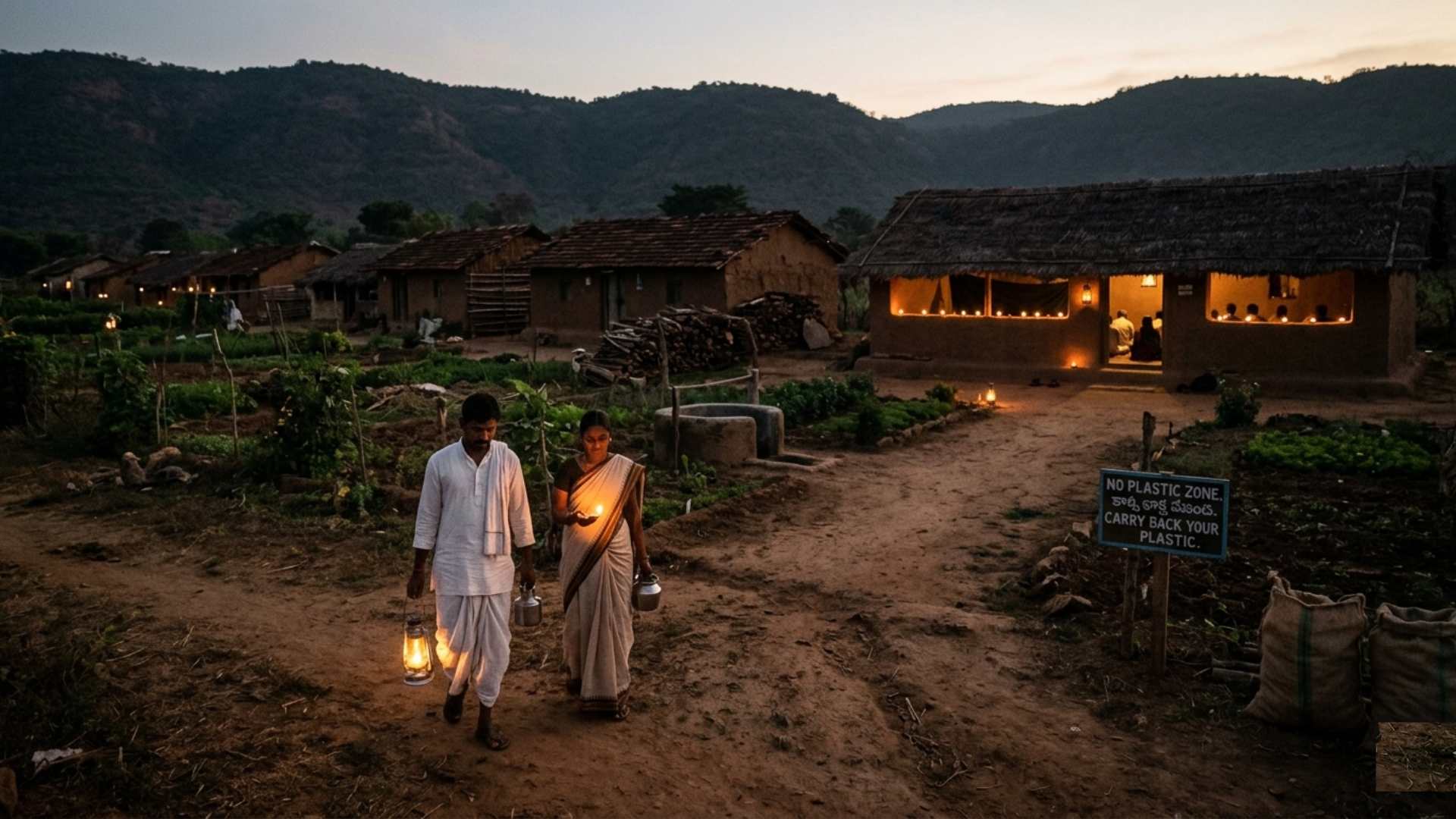
The village operates entirely without electricity, LPG, mobile internet, and tap water. Houses are mud-and-wood structures with earthen floors. Clothing is handwoven within the village. The daily schedule — 3:30 AM to 8:30 PM — is anchored by twice-daily Bhagavad Gita discourses.
Key Concepts
| Concept | Relevance to Kurma Gramam |
|---|---|
| Intentional Community | Voluntary, value-based co-habitation outside mainstream society |
| Voluntary Simplicity | Deliberate reduction of consumption for spiritual/ecological reasons |
| Subsistence Living | Self-sufficiency through agriculture, handloom, and local crafts |
| Alternative Education | Gurukul model — Vedic knowledge, Sanskrit, skill-based learning over formal curriculum |
| Ecological Sanitation | Compost-based waste management; no septic tanks; zero plastic |
Sociological Significance
Kurma Gramam is a case study in what sociologist Durkheim called mechanical solidarity — community cohesion based on shared beliefs and homogeneous roles, as opposed to the organic solidarity of modern, differentiated societies. Its residents — including B.Tech graduates who walked away from IT careers — represent a growing disillusionment with the alienation of urban-industrial life.
The village also reflects the Gandhian ideal of gram swaraj: self-reliant village republics as the true unit of Indian civilisation. Gandhi wrote in Hind Swaraj that "real home rule is self-rule or self-control."
Education Model — A Critical Assessment
The village runs a Gurukul where children study until ages 13–14, after which they are guided toward vocational skills — agriculture, cooking, handloom, or carpentry — based on observed aptitude.
Strengths: Holistic development; low stress; skill-aligned learning; cultural preservation.
Limitations: No formal certification; children may face barriers to re-entering mainstream education or economy; potential restriction of individual choice in career paths; limited exposure to constitutional rights and civic awareness.
This raises a tension central to GS4 ethics — the conflict between community values and individual autonomy, and the State's obligation to ensure the Right to Education (Article 21A) is not inadvertently compromised.
Sustainability Practices
- Earthen architecture (low embodied energy, passive cooling)
- Firewood stoves (no LPG dependency, but raises indoor air quality concerns)
- Composting lavatories (circular waste management)
- Rainwater/well-based water sourcing
- Plastic ban with visible signage and community enforcement
- Subsistence farming with kitchen gardens
This aligns with several SDG targets: SDG 11 (Sustainable Cities & Communities), SDG 12 (Responsible Consumption), SDG 15 (Life on Land).
Challenges & Concerns
- Healthcare access: No modern medical facility within the village; dependence on traditional remedies raises concerns especially for children and elderly.
- Child rights: Alternative schooling, while culturally rich, may limit children's future agency and constitutional entitlements.
- Gender equity: Gendered spatial segregation (prayer hall divided by cloth; traditional dress codes for women) warrants scrutiny from an equality lens.
- Scalability: This model cannot address mass poverty or development deficits — it is a niche lifestyle choice accessible mainly to those with prior socioeconomic security.
- Information isolation: Complete unawareness of national and global events (West Asia crisis, elections, etc.) raises questions about civic participation and informed democratic citizenship.
Comparison: Intentional Communities in India
| Community | Location | Core Ideology | Key Feature |
|---|---|---|---|
| Kurma Gramam | Andhra Pradesh | Vaishnavite Vedic | No electricity, Gurukul, handloom |
| Auroville | Tamil Nadu | Integral Yoga (Sri Aurobindo) | Experimental township, 3,000+ residents |
| Sadhana Forest | Tamil Nadu | Ecological restoration | Vegan, reforestation-focused |
| Ralegan Siddhi | Maharashtra | Gandhian development | Watershed management, total liquor ban |
Governance & Policy Dimensions
The existence of Kurma Gramam poses nuanced questions for the State:
- Should the government ensure minimum service delivery (electricity, healthcare, education) even to communities that voluntarily opt out?
- Does non-enrolment in formal schooling violate the RTE Act, 2009?
- How should panchayati raj institutions engage with such self-governing communities?
- Can such models inform low-carbon rural development policy?
The village attracts ~200 daily visitors and ~500 on weekends — indicating growing urban interest in alternative living, which itself has sociological and economic implications for heritage tourism and rural revitalisation.
Conclusion
Kurma Gramam is neither a utopia to be romanticised nor an anomaly to be dismissed. It is a mirror held up to mainstream Indian society — reflecting anxieties about consumerism, ecological cost, and the meaning of progress. While its scalability is limited and certain practices raise rights-based concerns, the community's emphasis on ecological sanitation, skill-based education, and spiritual discipline carries lessons for sustainable rural development. The challenge for policymakers lies in respecting such voluntary choices while ensuring that the rights of every individual — especially women and children — within such communities are preserved and not foreclosed by collective norms.
Attribution
Original content sources and authors

Syllabus classification
How this article maps to GS papers
Main syllabus
GS1Indian SocietyQuick Q&A
What are the defining features of Kurma Gramam’s socio-cultural and economic model?
Key features include:
- Minimalist living: Houses made of mud and wood, use of earthen lamps, and absence of modern gadgets.
- Spiritual discipline: Daily routines centered around prayers, scriptures like Bhagavad Gita, and community gatherings.
- Self-reliance: Agriculture, handloom weaving, and skill-based occupations sustain livelihoods.
The village also follows unique practices such as early rising, structured meal timings, and natural waste recycling into manure. Education is imparted through a Gurukulam system, focusing on scriptures and practical skills rather than formal curricula.
Thus, Kurma Gramam exemplifies a community that prioritizes spiritual well-being, ecological harmony, and sustainable living over material progress, offering an alternative development paradigm.
Why are some individuals, including educated professionals, choosing to adopt a lifestyle like that of Kurma Gramam?
Key reasons include:
- Stress and competition: Urban life is marked by high stress, job insecurity, and constant competition.
- Search for purpose: Many seek spiritual fulfillment rather than material success.
- Work-life balance: Simpler lifestyles allow more time for family and community.
For instance, Srikanth, a B.Tech graduate and former IT employee, left his corporate career to embrace a simpler life focused on teaching and spirituality. Similarly, families report improved mental well-being and stronger social bonds.
This trend highlights a broader societal shift where individuals question the sustainability of consumerist lifestyles. It also raises important questions about redefining development beyond GDP growth to include happiness, well-being, and environmental sustainability.
How does Kurma Gramam achieve sustainability and ecological balance in its daily practices?
Key sustainable practices:
- Energy use: Dependence on natural lighting (earthen lamps) instead of electricity.
- Waste management: Human waste is repurposed as manure, eliminating the need for septic systems.
- Local production: Food, clothing, and basic needs are produced within the village.
Additionally, the ban on plastic and the use of jute bags for waste collection demonstrate a conscious effort to reduce pollution. Agricultural practices are small-scale and organic, ensuring soil fertility and biodiversity conservation.
Impact: These measures reduce carbon footprint, promote circular resource use, and ensure long-term ecological sustainability. The village serves as a micro-model of sustainable living, aligning with global goals such as climate action and sustainable consumption.
Critically analyze the advantages and limitations of adopting a lifestyle like that of Kurma Gramam.
Advantages:
- Mental well-being: Reduced stress and enhanced community bonding.
- Environmental sustainability: Minimal resource consumption and eco-friendly practices.
- Cultural preservation: संरक्षण of traditional knowledge and values.
Limitations:
- Lack of access to modern amenities: Absence of healthcare, technology, and infrastructure can pose risks.
- Educational constraints: Limited exposure to formal education may restrict opportunities.
- Isolation: Disconnect from broader socio-economic developments.
For example, while residents report peace and happiness, their lack of awareness about global events and limited healthcare access could be problematic in emergencies.
Critical perspective: While the model is ideal for a niche group seeking spiritual fulfillment, it may not be scalable for larger populations. A balanced approach integrating modern development with traditional wisdom may be more practical.
How does Kurma Gramam serve as an example of alternative education and livelihood systems?
Education model:
- Children are taught through a Gurukulam system, focusing on Vedic knowledge, Sanskrit, and moral values.
- Learning is interest-based, with no pressure to pursue formal degrees.
- Skill development is prioritized over academic competition.
Livelihood approach:
- Residents engage in agriculture, handloom weaving, carpentry, and cooking.
- Work is viewed as a means of sustenance rather than wealth accumulation.
- Community sharing reduces economic inequalities.
For instance, children are guided based on their natural inclinations, whether in farming or crafts, ensuring meaningful engagement. This contrasts with mainstream systems where standardized education often overlooks individual talents.
This model demonstrates that alternative pathways can exist, emphasizing holistic development and self-reliance rather than purely economic outcomes.
What are the underlying philosophical principles guiding life in Kurma Gramam?
Core principles include:
- Simple living, high thinking: Prioritizing spiritual growth over material wealth.
- Self-sufficiency: Meeting basic needs through local resources and skills.
- Detachment from consumerism: Rejecting excessive consumption and modern distractions.
Residents believe that many modern societal issues—such as stress, crime, and inequality—stem from materialistic lifestyles. By limiting desires and focusing on spiritual practices, they aim to achieve inner peace and social harmony.
For example, the disciplined daily routine, early meals, and absence of digital devices reflect a conscious effort to align life with natural rhythms.
Thus, the village embodies a philosophical critique of modern development, advocating for a value-based approach centered on well-being and sustainability.
As a policymaker, how would you integrate lessons from Kurma Gramam into mainstream rural development without compromising modern progress?
Policy measures:
- Promote sustainable practices: Encourage organic farming, waste recycling, and plastic bans.
- Community-based living: Strengthen local governance and social cohesion through cooperative models.
- Skill-based education: Integrate vocational training with formal education systems.
Modern integration:
- Ensure access to healthcare, digital connectivity, and quality education.
- Use renewable energy solutions like solar power instead of complete electricity absence.
- Promote eco-tourism to generate income while preserving culture.
For instance, rural clusters can adopt Kurma Gramam’s waste management and community living practices while maintaining access to essential services.
Outcome: Such an approach would create resilient and sustainable rural communities without isolating them from national development. The goal should be to harmonize tradition and modernity for inclusive growth.
Practice questions
2 questions for mains preparation