
GS1 Geography

Delayed Monsoon and El Niño Raise Concerns for India

Delayed Monsoon, El Niño and India's Rainfall Challenge in 2026

Central India struggles with a significant 63% deficit as the monsoon slows; government initiates contingency plans for affected districts.
Gopi Gopi
4 mins read

“June rainfall and the pace of onset are governed largely by local and regional factors.” — D.S. Pai, IMD

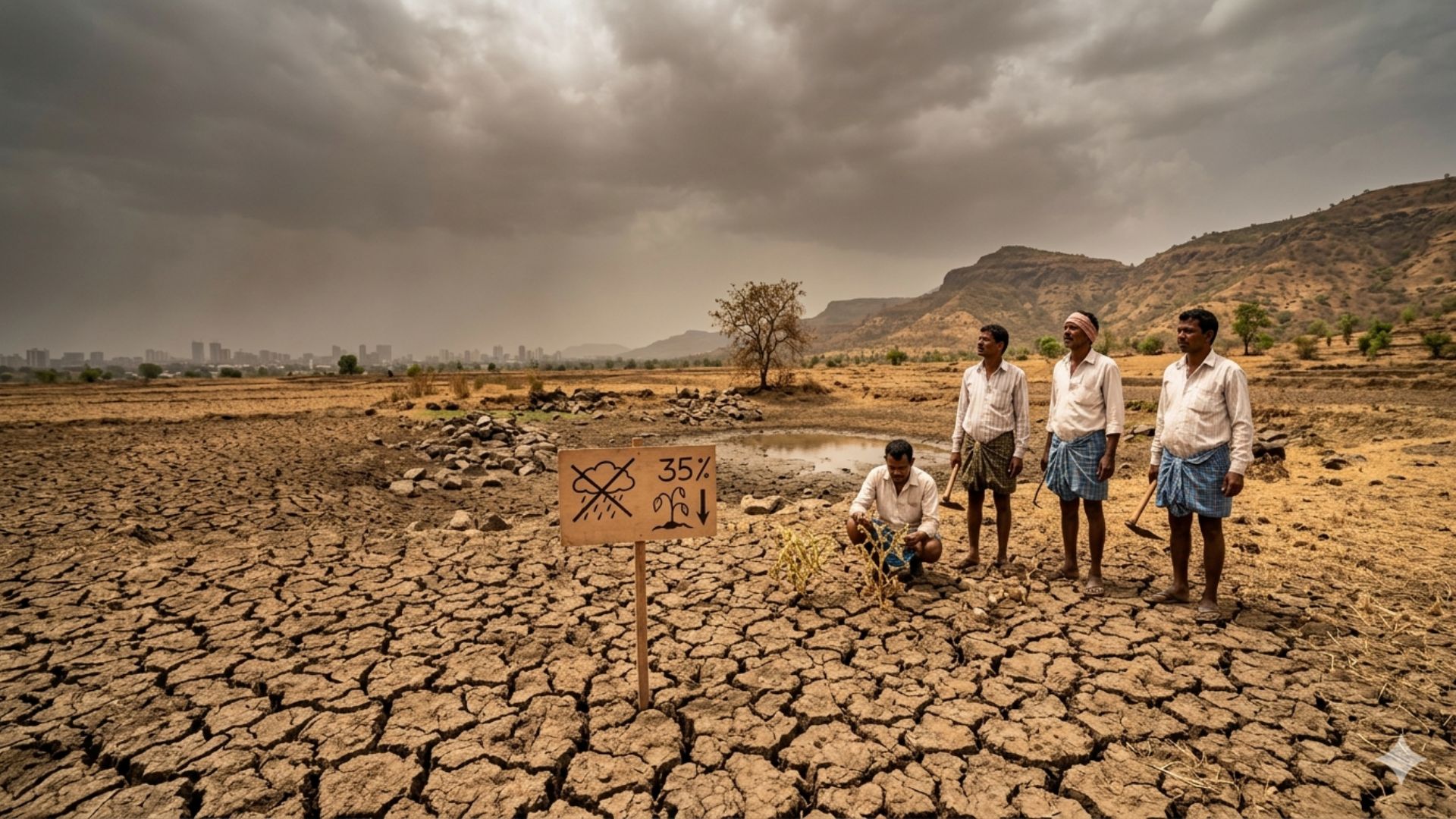
India's southwest monsoon, the lifeline of agriculture and water security, has witnessed a sluggish advance this year. More than a week after its normal arrival date in Mumbai, the monsoon remains stalled, resulting in a nationwide rainfall deficit of 35% as of June 16.

Current Rainfall Situation

The deficit is concentrated in regions where the monsoon has not yet advanced fully.

RegionRainfall Departure
Northwest India+5%
East & Northeast India-43%
Central India-63%
Southern Peninsula-14%
All-India-35%

The delay is particularly evident across:

  • Maharashtra
  • Konkan Coast
  • Central India

• Mumbai and Konkan coast
• Maharashtra interior
• Parts of Central India
• Delayed monsoon coverage zones

Why Is This Year Important?

The delayed monsoon has attracted attention because 2026 is expected to be a "Super El Niño" year, raising concerns about rainfall deficiency and agricultural stress.

What is El Niño?

El Niño refers to:

  • Periodic warming of the central and eastern Pacific Ocean
  • Weakening of monsoon circulation over India
  • Reduced rainfall tendency during the monsoon season

However, historical evidence suggests that June rainfall alone is not a reliable indicator of seasonal performance.

Lessons from Previous El Niño Years

YearJune Rainfall Status
2002+2% (near normal)
2004+1% (near normal)
2009-47%
2014-44%
2015+14%
2023-8%

Key observation:

  • Drought years do not always begin with poor June rainfall.
  • Deficits often emerge during July and later months.

Why Has the Monsoon Stalled?

The monsoon reached Kerala on June 4, only three days behind schedule, but subsequently lost momentum.

Immediate Causes

FactorEffect
Anticyclonic circulation north of MumbaiBlocks monsoon advance
Mid-latitude westerly systemsPush monsoon southward
Weak first monsoon pulseFailed to sustain progress
Unfavourable Madden-Julian Oscillation (MJO)Suppressed convection

Weak Monsoon Pulse
         +
Anticyclonic Circulation
         +
Unfavourable MJO
         +
Strong Westerlies
         ↓
Delayed Onset over Mumbai

Meteorologists expect the next monsoon pulse, possibly aided by a Bay of Bengal low-pressure system, to revive the advance.

Growing El Niño Warnings

Several international agencies have issued alerts.

InstitutionAssessment
NOAA (USA)El Niño confirmed
NOAA63% chance of very strong event
WMO80% probability of emergence
IMDOcean-atmosphere coupling established

Additional concern:

  • No positive Indian Ocean Dipole (IOD) is expected to offset El Niño impacts.

IMD Forecast Trend

Forecast StageSeasonal Rainfall Projection
April Forecast92% of Long Period Average
May Update90% of Long Period Average
Probability of Deficient Year60%

This is IMD's most pessimistic pre-season outlook since 2015.

Implications for Agriculture

The kharif season remains highly dependent on monsoon performance.

Government Measures

  • Identification of low-rainfall districts
  • Crop-wise contingency plans
  • Weekly El Niño monitoring
  • Promotion of cotton and pulses
  • Assurance of seed and fertiliser availability

150–200 districts under close watch

Focus:
• Rainfall deficiency
• Crop advisories
• Alternative sowing options

Reservoir Situation

IndicatorStatus
Current Storage30.4% capacity
Previous El Niño Average25.1% capacity

This provides a relatively better starting position compared to past deficient monsoon years.

Economic Concerns

Analysts remain cautious.

Potential Risks

  • Reduced agricultural output
  • Higher food inflation
  • Fertiliser supply constraints
  • Increased production costs

ICRA estimates that severe agricultural disruption could add approximately 0.4 percentage points to retail food inflation.

Additional pressures include:

  • China's restrictions on DAP exports
  • Elevated natural gas prices affecting urea production

Monsoon vs Westerlies: The Atmospheric Tug-of-War

A key factor this year is the interaction between the monsoon and mid-latitude weather systems.

How It Works

  • Strong monsoon normally pushes westerlies northward.
  • Weak monsoon allows westerlies to intrude southward.
  • June represents a transition phase between these systems.

Strong Monsoon
→ Pushes Westerlies North

Weak Monsoon
→ Westerlies Push Monsoon Back

Result:
→ Delayed advance and rainfall deficit

Way Forward

  • Strengthen district-level climate contingency planning.
  • Promote climate-resilient crop varieties.
  • Improve reservoir and irrigation management.
  • Diversify fertiliser supply chains.
  • Enhance seasonal forecasting and early warning systems.
  • Expand micro-irrigation and water conservation measures.

Conclusion

The delayed monsoon of 2026 reflects the combined influence of El Niño, unfavourable atmospheric conditions, and competition from mid-latitude weather systems. While early-season deficits do not necessarily determine the entire monsoon outcome, the evolving El Niño conditions warrant close monitoring. India's preparedness in agriculture, water management, and climate adaptation will be crucial in reducing the economic and social risks associated with a potentially deficient monsoon season.

Attribution

Original content sources and authors

Jacob Koshy Author Jacob Koshy The Hindu Source The Hindu

Syllabus classification

How this article maps to GS papers

Main syllabus

GS1Geography

Quick Q&A

What are El Niño conditions and how do they influence the Indian summer monsoon and agricultural economy?
El Niño is a periodic climatic phenomenon characterized by abnormal warming of sea surface temperatures in the central and eastern equatorial Pacific Ocean. It is a phase of the El Niño-Southern Oscillation (ENSO) cycle and has far-reaching consequences for global weather systems. In India, El Niño generally weakens the southwest monsoon by disrupting atmospheric circulation and reducing moisture transport from the Indian Ocean. Historically, several drought years such as 2002, 2009, 2014, and 2015 have been associated with El Niño conditions. The U.S. National Oceanic and Atmospheric Administration (NOAA) issued an El Niño advisory on June 11 and estimated a 63% probability of the event becoming very strong by winter. Similarly, the World Meteorological Organization (WMO) had earlier assigned an 80% probability of El Niño formation during June-August. The India Meteorological Department (IMD) has lowered its seasonal rainfall forecast from 92% to 90% of the Long Period Average (LPA), assigning a 60% probability to a deficient monsoon year, the most pessimistic forecast since 2015. Such deficiencies have significant implications for India's agriculture, food security, inflation, and rural economy. Nearly half of India's net sown area remains rain-fed, making monsoon performance crucial for kharif crops. Weak rainfall can affect sowing patterns, fertilizer demand, reservoir levels, and food prices. For UPSC aspirants, the topic is highly relevant to GS Paper I (Geography), GS Paper III (Agriculture, Environment, and Economy), disaster management, climate change, and current affairs. It illustrates the interconnectedness of atmospheric sciences, food security, and economic stability.
How do atmospheric phenomena such as Madden-Julian Oscillation and western disturbances affect monsoon progression in India?
The Indian summer monsoon is influenced not only by large-scale climatic phenomena like El Niño but also by regional atmospheric systems such as the Madden-Julian Oscillation (MJO), western disturbances, and anticyclonic circulations. The Madden-Julian Oscillation is a moving zone of enhanced and suppressed tropical rainfall that travels eastward around the globe every 30-60 days. Depending on its phase, it can either strengthen or weaken monsoon activity. According to IMD forecaster D.S. Pai, the MJO is presently in an unfavorable phase, contributing to the delay in monsoon advancement over Mumbai. Additionally, an anticyclonic circulation north of Mumbai and a strong push from mid-latitude westerlies have stalled the first pulse of the monsoon. Western disturbances, embedded in eastward-flowing westerly winds originating from the Mediterranean and West Asia, generally affect northwest India during winter. However, during transitional months like June, these systems can interact with the monsoon. If the monsoon is strong, both systems may reinforce each other and produce heavier rainfall. Conversely, a weak monsoon is pushed southward, delaying its advance. This dynamic interaction highlights the complexity of Indian weather systems. Modern forecasting increasingly relies on satellite observations, numerical weather prediction models, and ocean-atmosphere coupling studies. For UPSC preparation, this topic is relevant to GS Paper I (Physical Geography), disaster management, and climate science. It demonstrates how atmospheric processes operate across multiple scales and influence agriculture, water resources, and socio-economic planning in India.
What are the major reasons behind the delayed advance of the southwest monsoon and rainfall deficit in India?
The delay in the advance of the southwest monsoon during the current season is the result of multiple interacting meteorological factors rather than a single cause. Although the monsoon arrived over Kerala on June 4, only three days later than normal, its subsequent northward movement slowed considerably. One major factor is the emergence of El Niño conditions. While El Niño exerts stronger influence during the latter half of the monsoon season, it weakens the overall monsoon circulation, making it less capable of advancing steadily. NOAA and WMO have issued warnings regarding the development of a potentially strong El Niño event. Second, according to IMD scientist D.S. Pai, monsoon progress occurs in pulses. The first pulse that reached the outskirts of Mumbai lost momentum. An anticyclonic circulation north of Mumbai blocked further advancement. Simultaneously, mid-latitude westerlies exerted a counteracting influence. Third, the Madden-Julian Oscillation is currently in an unfavorable phase, reducing convective activity and rainfall generation over the Indian region. The absence of a positive Indian Ocean Dipole, which often offsets El Niño effects, further aggravates the situation. As of June 16, central India recorded a rainfall deficit of 63%, east and northeast India 43%, and the southern peninsula 14%. Maharashtra and the Konkan region have been particularly affected. For UPSC aspirants, this issue is relevant to climatology, agriculture, disaster management, and environmental geography. It also highlights the importance of understanding interactions among global climate systems, regional atmospheric circulation, and oceanic conditions in determining India's monsoon performance.
Why is a deficient monsoon considered a major economic and food security challenge for India?
A deficient monsoon poses significant risks to India's economy because agriculture remains heavily dependent on rainfall. Nearly half of the country's cultivated area lacks assured irrigation facilities, making kharif crop production vulnerable to monsoon variability. Consequently, weak rainfall affects food production, rural incomes, inflation, and overall economic growth. The India Meteorological Department has projected seasonal rainfall at 90% of the Long Period Average and assigned a 60% probability to a deficient year. Such forecasts have prompted the government to place 150-200 districts under priority monitoring. Union Agriculture Minister Shivraj Singh Chouhan has directed states to prepare crop-specific contingency plans and promote alternative crops like cotton and pulses. The economic implications are substantial. Rating agency ICRA estimates that severe farm disruption could increase retail food inflation by about 0.4 percentage points. The Reserve Bank of India has also highlighted inflationary risks arising from weather shocks. Rising food prices can affect monetary policy and consumer welfare. Another concern is fertilizer availability. China's restrictions on di-ammonium phosphate exports and elevated natural gas prices have increased the cost of urea production, potentially affecting agricultural input supplies. However, India enters this season with relatively favorable reservoir storage at 30.4% of capacity compared to the average of 25.1% during previous El Niño years. This provides some resilience. For UPSC, the topic connects GS Paper III themes including agriculture, food security, inflation, fiscal management, and disaster preparedness. It demonstrates how climate variability influences macroeconomic stability and why integrated policy responses are essential for sustainable development.
What policy measures and contingency strategies are being adopted by India to address the risks associated with El Niño-induced monsoon deficiency?
India's response to the threat of El Niño-induced monsoon deficiency provides an important case study in climate adaptation and disaster preparedness. Recognizing the risks associated with rainfall variability, the central government and various institutions have initiated several precautionary measures. On June 16, Union Agriculture Minister Shivraj Singh Chouhan reviewed kharif preparedness and directed states to identify districts experiencing low or uneven rainfall. State governments have been asked to formulate crop-wise contingency plans to provide farmers with alternatives, advisory services, and financial assistance. Approximately 150 to 200 districts have been placed under priority monitoring. Weekly reviews of El Niño developments have been institutionalized to facilitate timely policy responses. Authorities are encouraging farmers to diversify toward relatively drought-tolerant crops such as cotton and pulses. The government has also assured adequate stocks of seeds and fertilizers. Reservoir storage levels, standing at 30.4% of capacity in May compared with an average of 25.1% during previous El Niño years, provide a buffer against water shortages. These measures reflect a shift from reactive crisis management to proactive risk mitigation. Similar approaches are promoted under frameworks such as the National Disaster Management Plan and climate-resilient agriculture programs. Nevertheless, challenges persist. Input costs are rising due to global fertilizer market disruptions, and weather uncertainties remain high. Effective implementation at the district level is essential. For UPSC aspirants, this case study is relevant to GS Paper III, governance, agriculture, disaster management, and climate adaptation. It illustrates the importance of institutional preparedness, cooperative federalism, and evidence-based policymaking in addressing climate-induced vulnerabilities.
What is the critical analysis of the relationship between El Niño events and rainfall deficiency in India?
The relationship between El Niño and Indian monsoon rainfall is significant but not deterministic. Traditionally, El Niño has been associated with weak monsoons and drought conditions. However, historical evidence reveals that this relationship is more complex than commonly perceived. An examination of El Niño years since 2000 shows considerable variability. During the strong El Niño year of 2015, June rainfall was actually 14% above normal. Similarly, in 2002 and 2004, June rainfall remained near normal, with deficiencies emerging only later in the season. By contrast, June rainfall deficits were severe in 2009 and 2014, reaching 47% and 44%, respectively. In 2023, June rainfall was only 8% below normal, which still fell within IMD's normal range. These examples indicate that El Niño alone cannot explain monsoon performance. Regional factors such as sea surface temperatures in the Indian Ocean, the Madden-Julian Oscillation, western disturbances, and atmospheric circulation patterns also play important roles. Scientists like D.S. Pai emphasize that June rainfall and monsoon onset are governed primarily by local and regional influences rather than by El Niño itself. Therefore, deterministic predictions based solely on ENSO phases may be misleading. This nuanced understanding has implications for climate science and policymaking. It highlights the importance of multi-factor forecasting and adaptive governance. For UPSC candidates, this debate is relevant to scientific temper, evidence-based policy, and environmental governance. It also demonstrates the need to critically analyze simplistic assumptions and appreciate the complexity of atmospheric systems while answering questions in interviews and Mains examinations.

Practice questions

2 questions for mains preparation

Discuss the implications of a Super El Niño year on India's weather patterns and monsoon performance. What strategies should be adopted to adapt to these changes?

10 marks · 150 words · 8 mins

Examine the influence of El Niño and associated atmospheric processes on the variability of the Indian monsoon. Discuss its implications for agricultural production and economic stability in India.

15 marks · 250 words · 8 mins