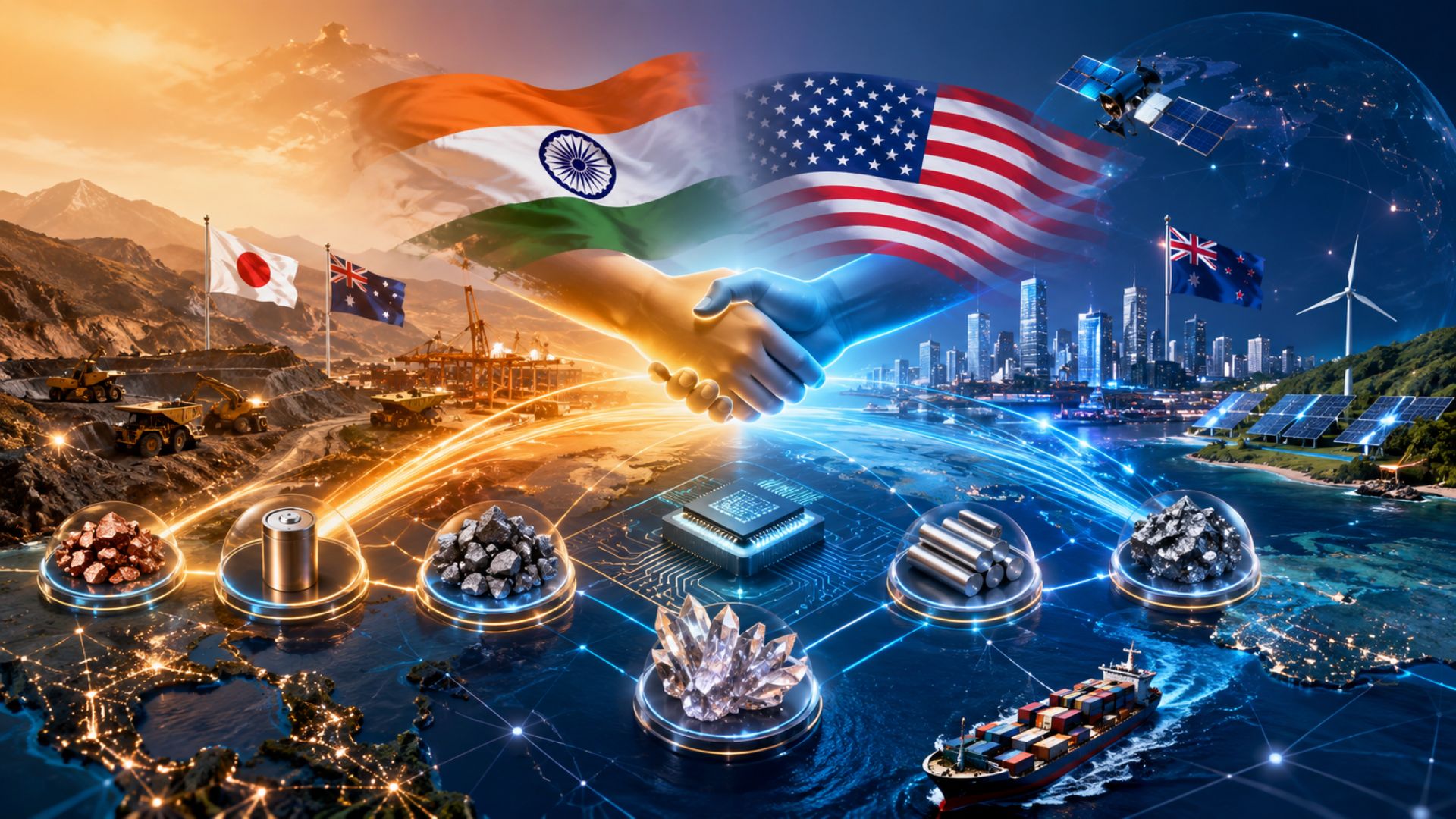
The 11th Quad Foreign Ministers' Meeting — chaired by External Affairs Minister S. Jaishankar and attended by US Secretary of State Marco Rubio, Australian Foreign Minister Penny Wong, and Japanese counterpart Toshimitsu Motegi — produced two significant framework agreements on critical minerals. One between India and the United States bilaterally, and another among all four Quad partners. Together, they mark a decisive step toward building an alternative global supply chain architecture for critical minerals and rare earth elements, explicitly designed to reduce dependence on China.
Why Critical Minerals, Why Now
The immediate trigger is unambiguous: China imposed export controls on Rare Earth Elements (REEs) in 2025, following the United States' imposition of tariffs on a large number of partner countries. The Quad foreign ministers collectively voiced "grave concerns" over what they described as "economic coercion" — a direct reference to China's export-control regime.
China's control over REE mining and processing has long been a structural asymmetry in global trade. The 2025 export controls converted a latent risk into an active crisis, accelerating what was already a strategic priority among like-minded democracies into concrete institutional action.
The India-U.S. Bilateral Framework
The bilateral framework — titled "Securing of Supply in the Mining and Processing of Critical Minerals and Rare Earths" — covers the entire supply chain:
- Mining and processing of critical minerals and rare earths
- Recycling and management of rare earth scrap
- Financing and investment cooperation
- Building resilient and diversified supply chains
Rubio described the framework as "a tangible example" of the US-India strategic partnership. It builds upon:
- PM Modi's Washington D.C. visit (February 2025), where secure and resilient critical mineral supply routes were identified as a "shared strategic priority"
- India signing the U.S.-led Pax Silica initiative on February 20, 2026
The U.S. has committed significant financial firepower:
"The United States is mobilising unprecedented resources to secure critical supply chains, supporting projects with more than $30 billion in letters of interest, investments, loans and other support in partnership with the private sector." — U.S. Embassy statement
The Quad Critical Minerals Initiative Framework
At the multilateral level, the four Quad partners launched the Critical Minerals Initiative to:
- Mobilise approximately $20 billion in government and private-sector support
- Prioritise projects located in Quad partner countries and operated by companies headquartered in Quad partner countries — a deliberate design to keep supply chains within trusted geographies
- Collaborate on e-waste recovery and recycling of critical minerals
"Quad partners intend to work together to improve the recovery and use of critical minerals from e-waste and other scrap materials to enhance the supply chain and promote recycling of contained critical minerals within Quad partner and like-minded countries."
Alongside critical minerals, the Quad also launched the Initiative on Indo-Pacific Energy Security — aimed at ensuring open and stable energy markets and resilient supply chains amid disruptions in energy and fertiliser supplies. A Quad Fuel Security Forum will be convened for high-level coordination, leveraging existing programmes like Japan's $2 billion Southeast Asia Investment Financing Facility.
The Broader Quad Agenda: Maritime and Infrastructure Security
Critical minerals sit within a wider strategic canvas the Quad is actively shaping:
- Stressed navigational freedom through the Strait of Hormuz and the Red Sea
- Condemned attacks on commercial shipping and opposed imposition of tolls
- Expressed serious concern over militarisation of disputes in the East China Sea and South China Sea
- Plans to augment maritime surveillance technology in the Indo-Pacific
- Commitment to ensuring safety of undersea cables
- Advancing port infrastructure for key Indo-Pacific corridors, beginning with construction of a port in Fiji
As Rubio noted, 60% of global maritime trade passes through the Indo-Pacific — making these commitments inseparable from the critical minerals agenda.
Regulatory Harmonisation: The Hidden Strategic Lever
Both frameworks are expected to drive harmonisation of domestic laws and regulations across partner countries — making it easier to access supply chains across borders, tighten controls on national security grounds, and align export control regimes to prevent critical minerals from leaking to adversarial actors through third-country routing.
India's MEA clarified that the Quad's lack of a formal secretariat is a feature, not a weakness — making it a "nimble and flexible organisation" capable of adding new layers of cooperation without bureaucratic friction.
Way Forward
- India's domestic processing capacity must be developed urgently — the frameworks create market access, but India needs refining and processing infrastructure to capture higher value-chain positions, not just raw material extraction
- Geological Survey of India must accelerate critical mineral mapping, particularly lithium, cobalt, and REE deposits in Rajasthan, Andhra Pradesh, and Jharkhand
- E-waste recycling infrastructure must be scaled — India generates enormous e-waste volumes but recovers a fraction of contained critical minerals
- Private sector mobilisation is essential — government frameworks create architecture, but industry must drive project execution
- Supply chain transparency — common traceability standards must be established to prevent adversarial infiltration through shell companies or indirect ownership
- Quad Summit continuity — uncertainty over India hosting the Quad Summit must be resolved; leadership-level signalling is critical to sustaining momentum on these frameworks
Conclusion
The Quad critical minerals frameworks are not merely trade agreements — they are geopolitical architecture. China's REE export controls revealed that technological sovereignty and economic security are inseparable in the 21st century. By anchoring supply chains within trusted democracies, pooling $20 billion in Quad-level support, advancing maritime security, and building regulatory interoperability, these agreements represent a structural response to a structural vulnerability. For India, the opportunity is historic: to position itself not just as a consumer of critical minerals, but as a processing, recycling, and supply chain hub within the emerging democratic minerals order — while simultaneously reinforcing its role as the anchor of Quad's strategic credibility in the Indo-Pacific.
Attribution
Original content sources and authors
Syllabus classification
How this article maps to GS papers
Main syllabus
GS1GeographyQuick Q&A
What are critical minerals, and why have they become strategically important in contemporary geopolitics?
The strategic significance of critical minerals arises from the concentration of supply chains in a few countries, especially China, which dominates mining, refining, and processing capacities for several rare earth minerals. China’s export controls on rare earth elements in 2025 highlighted the vulnerability of global supply chains and pushed countries such as India, the United States, Japan, and Australia to diversify sourcing arrangements. In this context, the India-U.S. Critical Minerals Framework and the Quad Critical Minerals Initiative aim to reduce excessive dependence on a single supplier and establish resilient supply networks.
The strategic importance of critical minerals can be understood through the following dimensions:
- Economic security: Essential for manufacturing and industrial competitiveness
- Energy transition: Necessary for batteries, solar panels, and wind turbines
- National security: Crucial for missile systems, radar technology, and defense electronics
- Technological sovereignty: Supports semiconductor and AI-related industries
For example, lithium-ion batteries used in electric vehicles require lithium, cobalt, and nickel, while rare earth magnets are critical for wind turbines and fighter aircraft. Countries lacking secure access to these minerals may face disruptions in industrial production and defense preparedness.
India’s approach therefore focuses not only on acquiring mineral resources abroad but also on developing domestic refining, recycling, and strategic partnerships. This reflects a broader shift in global geopolitics where control over supply chains has become as important as military or economic power.
Why is the India-U.S. Critical Minerals Framework considered a major strategic development for India?
India’s clean energy transition and manufacturing ambitions under initiatives such as Make in India, the Production Linked Incentive (PLI) scheme, and electric vehicle expansion require stable access to critical minerals. However, India currently depends heavily on imports for many strategic minerals. Through cooperation with the United States, India can gain access to advanced technologies, investments, and diversified supply networks. The framework also aligns with broader Indo-Pacific strategic cooperation and strengthens India’s integration into trusted global value chains.
The agreement is strategically important for several reasons:
- Reduces excessive dependence on Chinese supply chains
- Supports India’s renewable energy and EV ecosystem
- Enhances defense and semiconductor manufacturing capabilities
- Encourages technology transfer and private investment
- Improves supply chain resilience during geopolitical disruptions
For example, India’s growing electric mobility sector requires large quantities of lithium and cobalt. Through partnerships with countries like Australia and the United States, India can secure long-term supply contracts and participate in overseas mining projects.
From a geopolitical perspective, the framework also reflects the evolution of India-U.S. relations beyond traditional defense cooperation into technology and economic security collaboration. However, challenges remain, including environmental concerns related to mining, the need for domestic refining capacity, and balancing strategic autonomy while deepening Western partnerships.
Overall, the agreement positions India as an important stakeholder in emerging global supply chain architectures and supports its aspiration to become a manufacturing and technology hub.
How can the Quad Critical Minerals Initiative reshape global supply chains and reduce strategic vulnerabilities?
At present, global supply chains for rare earth elements and other critical minerals are highly concentrated. China dominates a significant share of refining and processing operations, creating vulnerabilities for countries dependent on these materials. The Quad initiative attempts to address this by promoting alternative production networks among trusted partners. Australia contributes mineral reserves, Japan offers technological expertise, the United States provides investment and strategic coordination, while India offers manufacturing potential and a growing market.
The initiative can reshape global supply chains through:
- Diversification: Expanding sourcing beyond a single dominant country
- Supply chain integration: Linking mining, refining, and manufacturing ecosystems
- Regulatory harmonization: Aligning standards and policies among partner countries
- Recycling initiatives: Recovering minerals from e-waste and industrial scrap
- Strategic financing: Supporting long-term infrastructure and extraction projects
For example, Australia possesses significant lithium reserves, while Japan has expertise in rare earth recycling technologies. India can emerge as a manufacturing and assembly center for batteries and electronics if integrated effectively into Quad supply chains.
However, challenges remain. Mining projects often face environmental opposition, local community resistance, and long gestation periods. Additionally, processing technology for rare earth minerals remains concentrated in a few countries. Building alternative supply chains will therefore require sustained investment, policy coordination, and technological collaboration.
Despite these constraints, the initiative represents an important attempt to create a rules-based economic architecture in the Indo-Pacific. It reflects the growing realization that economic security and national security are increasingly interconnected in the 21st century.
Critically analyze the challenges India may face in becoming a reliable player in the critical minerals supply chain.
One major challenge is limited domestic reserves and processing capacity. India has relatively modest reserves of several key minerals such as lithium and cobalt compared to countries like Australia, Chile, or Congo. Even where resources exist, refining and processing technologies remain underdeveloped. China currently dominates global refining operations, making it difficult for new entrants to compete immediately.
Other major challenges include:
- Environmental concerns: Mining activities can damage ecosystems and displace local communities
- Technological dependence: Advanced refining technologies are concentrated in a few countries
- Infrastructure gaps: Logistics, energy supply, and industrial clusters require modernization
- Investment risks: Mining projects involve high capital costs and long gestation periods
- Global competition: Developed countries are aggressively securing overseas mineral assets
For example, lithium extraction projects in ecologically sensitive areas may trigger environmental debates similar to those surrounding mining activities in tribal and forest regions. Balancing industrial growth with sustainability and local rights will therefore become essential.
Another concern relates to strategic autonomy. While deeper cooperation with Quad countries benefits India economically and strategically, excessive alignment with one bloc could complicate relations with other partners. India must therefore maintain a balanced and diversified foreign policy approach.
To overcome these challenges, India should:
- Invest in domestic exploration and geological surveys
- Develop refining and recycling ecosystems
- Encourage public-private partnerships
- Strengthen research in battery and material sciences
- Promote sustainable and community-sensitive mining practices
Ultimately, India’s success will depend not merely on securing raw materials but on creating an integrated value chain from extraction to advanced manufacturing.
How can recycling and e-waste management contribute to critical mineral security in India?
Modern electronic devices such as smartphones, computers, batteries, and electric vehicles contain valuable materials including lithium, cobalt, nickel, copper, and rare earth elements. Instead of treating discarded electronics as waste, countries are increasingly viewing them as ‘urban mines.’ India, being one of the world’s largest consumers of electronics, generates enormous quantities of e-waste annually. Proper recycling systems can help recover strategic minerals while reducing environmental pollution.
The benefits of recycling include:
- Reducing import dependence on scarce minerals
- Lowering environmental damage from fresh mining
- Creating green jobs and recycling industries
- Improving supply chain resilience during geopolitical disruptions
- Supporting sustainable manufacturing and climate goals
For instance, Japan has successfully developed advanced recycling technologies to recover rare earth elements from used electronics. Similarly, the European Union has promoted circular economy policies to reduce strategic vulnerabilities. India can learn from these models and integrate recycling into industrial policy.
However, India faces several obstacles. A large share of e-waste recycling remains informal and unsafe, exposing workers to toxic chemicals while reducing material recovery efficiency. Lack of awareness, weak enforcement, and insufficient infrastructure also hinder scientific recycling.
To improve critical mineral recovery from e-waste, India should:
- Strengthen implementation of E-Waste Management Rules
- Formalize the informal recycling sector
- Promote research in mineral recovery technologies
- Encourage producer responsibility and collection systems
- Develop specialized recycling parks and industrial clusters
Thus, recycling is not merely an environmental necessity but also a strategic economic and geopolitical imperative for India’s long-term technological and industrial security.
Suppose India faces a sudden disruption in rare earth imports due to geopolitical tensions. What policy measures should the government adopt to ensure supply chain resilience?
The immediate response should focus on crisis management and diversification. India must activate strategic reserves and secure alternative import arrangements through trusted partners such as Australia, the United States, and Japan. Diplomatic engagement through frameworks like the Quad can help coordinate emergency supply mechanisms. Simultaneously, industries dependent on rare earth materials should be prioritized based on national importance, particularly defense and energy sectors.
Medium-term measures should include:
- Accelerating domestic exploration and mining projects
- Providing incentives for private-sector participation
- Expanding refining and processing infrastructure
- Strengthening recycling and e-waste recovery systems
- Encouraging research into substitute materials and technologies
For example, after China restricted rare earth exports to Japan in 2010, Japan diversified its import sources and invested heavily in recycling technologies. India can adopt a similar strategy by reducing overdependence on any single supplier.
Long-term resilience requires institutional reforms. India should establish a dedicated National Critical Minerals Mission integrating ministries related to mining, commerce, external affairs, and technology. Strategic stockpiles similar to petroleum reserves can also be developed for key minerals.
At the same time, sustainability concerns must not be ignored. Mining expansion should follow environmental safeguards and involve local communities through transparent rehabilitation mechanisms. International cooperation should also include technology sharing and capacity building.
Ultimately, supply chain resilience in critical minerals will depend on India’s ability to combine diplomatic partnerships, domestic industrial capacity, recycling ecosystems, and technological innovation into a coherent long-term strategy.
Practice questions
1 question for mains preparation