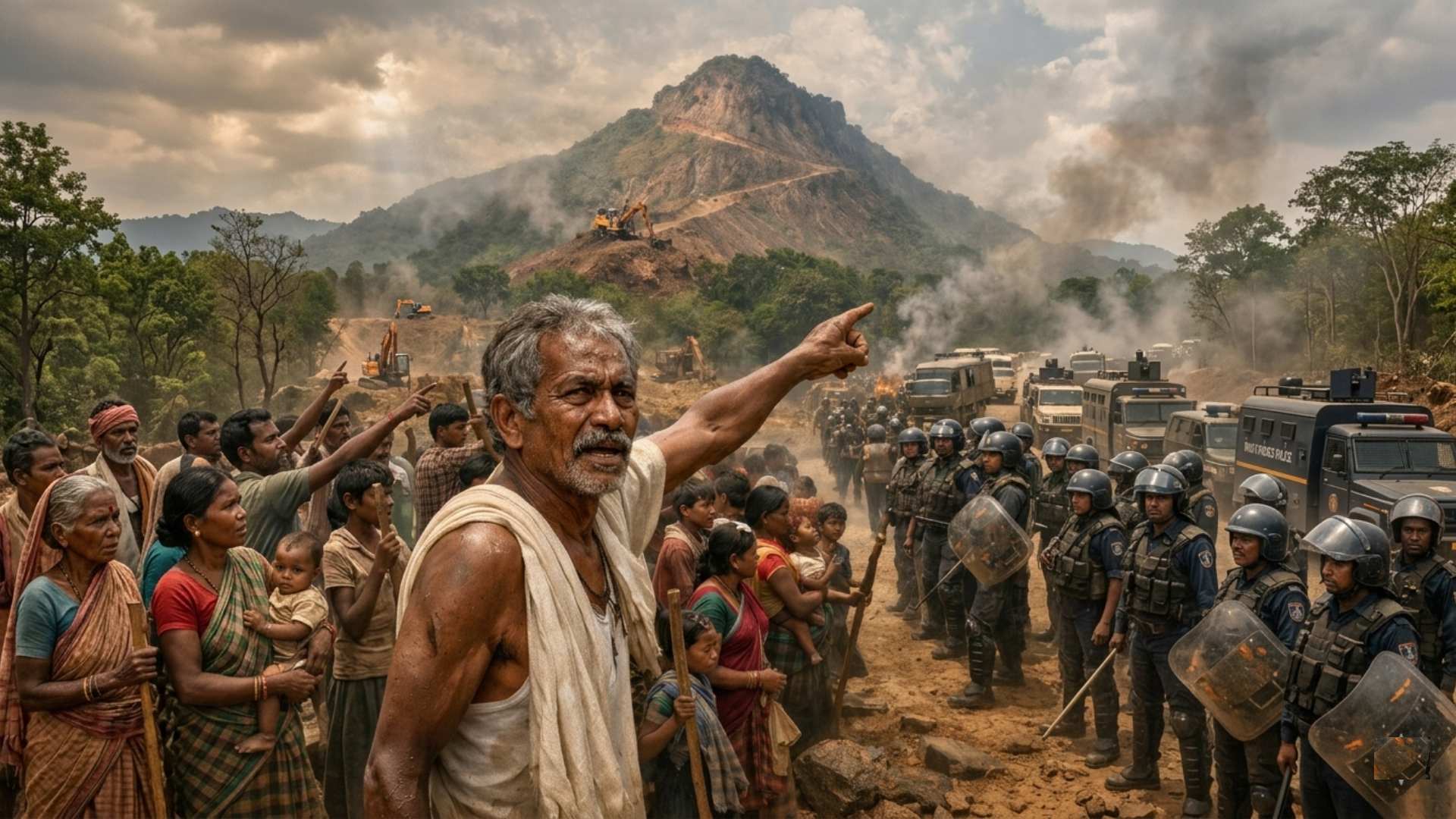
Mining Push Faces Stiff Opposition from Tribal Communities

Tribal Rights, Bauxite Mining & Environmental Governance: The Sijimali Crisis
GS Paper: GS-II (Governance, Rights) | GS-III (Environment, Mining, Internal Security) Tags: Forest Rights Act, PESA, Gram Sabha, Eastern Ghats, Tribal Displacement, Environmental Clearance
Introduction
India holds the 5th largest bauxite reserves globally, with Odisha alone accounting for 51% of national reserves and ~75% of production (Indian Minerals Yearbook 2023). Yet resource extraction in tribal-dominated regions consistently reproduces a familiar conflict: industrial growth imperatives colliding with constitutional rights of forest-dwelling communities. The Sijimali hill crisis in Odisha — echoing the landmark Niyamgiri verdict of 2013 — tests whether India's legal architecture for tribal consent is enforceable or merely aspirational.
"Has anyone studied the environmental cost that bauxite mining would cause? Who will evaluate the value of forest, water, and wildlife resources that undergo degeneration due to mining over the years?" — Prafulla Samantara, Goldman Environmental Prize Winner (2017)
| Indicator | Data |
|---|---|
| Sijimali estimated bauxite reserves | 311 million tonnes |
| Vedanta refinery current capacity | 2 MTPA (target: 6 MTPA) |
| Bauxite required at 6 MTPA | ~18 million tonnes/year |
| Odisha's share of India's bauxite reserves | 51% |
| Projected govt. revenue (Vedanta EIA) | ₹2,511 crore/year |
| Direct jobs projected | ~600 |
| Villages under prohibitory orders (Sec.163 BNS) | Multiple, April 4 onwards |
| Persons arrested (Talaamapadar alone) | 21 (incl. 10 women) |
Background & Context
The Niyamgiri precedent (2013) — where 12 gram sabhas unanimously rejected Vedanta's bauxite mining proposal — stands as India's first effective environmental referendum, legally grounded in the Forest Rights Act (FRA), 2006 and PESA, 1996. The Supreme Court's ruling affirmed that gram sabha consent is a mandatory, non-negotiable precondition for mining in Scheduled Areas.
Sijimali, straddling Rayagada and Kalahandi in the ecologically sensitive Eastern Ghats, represents the next frontier. The bauxite block was allocated to Vedanta in March 2023. Environmental clearances were reportedly granted on December 31, 2025, amid allegations of procedural violations, forged gram sabha records, and absence of free, prior, and informed consent (FPIC). A 2.98-km access road requiring 11.314 hectares has triggered the current standoff, with ~40 villages organising round-the-clock vigils on the hill.
Key Issues — Sijimali Bauxite Mining Crisis
1. Consent Framework: FRA & PESA
- FRA 2006 + PESA 1996 = gram sabha must approve any project on forest/tribal land
- Allegations: forged signatures + deceased persons' names + migrant workers listed = records fabricated
- If proven → entire consent process = void → all clearances = legally invalid
2. Manufactured Consent
- Pattern = forged records + police at gram sabhas + activist intimidation + entry bans
- Mimics legal compliance ≠ actual compliance → "manufactured consent"
- Orissa HC struck down activist ban = judicial pushback ✓ but power asymmetry = still stark
3. Eastern Ghats — Ecological Value
- Bauxite hills = natural water towers → sustain rivers + paddy fields even in peak summer
- Mining → hydrological disruption → affects displaced tribes + downstream farmers
- Multiple corporations (Vedanta + Adani + Aditya Birla + NALCO + OMC) = same belt → cumulative damage ꜛꜛ
4. Criminalisation of Protest
- Sec.163 BNS = assembly of 4+ banned + pre-dawn raids + minors + pregnant women arrested
- Medha Patkar + Prafulla Samantara = detained
- Legitimate protest ≠ being distinguished from unlawful assembly → Art.19 + Art.21 = under threat
5. Displacement & Rehabilitation
- Past projects in same region = fragmented communities + traditional livelihoods lost
- Compensation ≠ long-term stability
- Vedanta EIA = 600 jobs + ₹2,511 cr revenue counted ✓
- Water + forest + medicinal plants + cultural value = not counted ✗ → real cost = invisible in EIA
Relevant Legal & Policy Framework
| Law/Policy | Relevance |
|---|---|
| Forest Rights Act, 2006 | Gram sabha consent for forest land diversion |
| PESA, 1996 | Self-governance rights in Scheduled (V) Areas |
| Environment Protection Act, 1986 | EIA mandate for mining projects |
| Wildlife Protection Act, 1972 | Eastern Ghats biodiversity protection |
| Land Acquisition Act, 2013 | Consent & SIA requirements for tribal land |
| SC Niyamgiri Judgment (2013) | Gram sabha = final authority on sacred/livelihood land |
| BNS Section 163 | Prohibitory orders — misuse risk in protest contexts |
| Article 244 + 5th Schedule | Constitutional protection of Scheduled Areas |
Development vs. Rights: A Balanced View
For mining: India's aluminium industry is strategically critical — for defence, aerospace, EVs, and infrastructure. Odisha's bauxite is central to national industrial self-reliance. Regulated mining with genuine rehabilitation, revenue sharing, and ecological safeguards can coexist with tribal welfare — but this requires institutional integrity, not just legal compliance on paper.
Against current approach: The procedural violations alleged, the scale of arrests, and the pattern of activist suppression suggest the state is prioritising project timelines over legal due process. A repeat of the post-Niyamgiri litigation cycle — years of legal battles, delayed projects, deepened community alienation — is the likely outcome if consent manufacturing replaces genuine consent.
Conclusion
Sijimali is not merely a local land conflict — it is a constitutional stress test. India's tribal rights framework (FRA + PESA + 5th Schedule) is sophisticated on paper; its consistent subversion in resource-rich regions reveals an implementation deficit driven by structural incentives that privilege extraction over rights. The Niyamgiri precedent established that gram sabha consent is not a procedural checkbox but a substantive democratic act. If Sijimali's clearances are grounded in forged records, they will not survive judicial scrutiny — but the damage to community trust, ecological integrity, and rule of law will be lasting. Sustainable industrial growth in tribal regions requires not faster clearances but more legitimate ones.
Attribution
Original content sources and authors


Syllabus classification
How this article maps to GS papers
Main syllabus
GS1GeographyQuick Q&A
What is the Sijimali bauxite mining conflict, and what are its key stakeholders?
Key stakeholders include:
- Local tribal communities: Depend on the hill for livelihood and cultural survival.
- Corporate entities: Such as Vedanta Group seeking raw materials for alumina production.
- Government authorities: Including district administration and police enforcing law and order.
- Activists and civil society: Raising concerns about environmental and legal violations.
The conflict is reminiscent of the earlier Niyamgiri case (2013), where gram sabhas successfully rejected mining proposals, marking a landmark assertion of tribal rights. The Sijimali issue similarly highlights tensions between developmental objectives and indigenous rights.
Thus, the conflict is multi-dimensional, involving economic, environmental, legal, and ethical considerations, making it a critical case study in India's development discourse.
Why is the Sijimali mining project significant for India's economic and industrial policy?
From a policy perspective:
- It supports Make in India and industrial self-reliance.
- Promises revenue generation (₹2,511 crore annually as per estimates).
- Creates employment opportunities (around 600 direct jobs).
However, the significance extends beyond economics. It reflects the state's attempt to balance resource extraction with sustainable development. Policymakers view such projects as critical for maintaining competitiveness in global aluminium markets, especially as demand rises in sectors like renewable energy and infrastructure.
Yet, this significance is contested. Critics argue that economic gains may come at the cost of ecological degradation and social displacement. Past experiences in mining regions show that benefits often do not adequately reach local populations. Therefore, while economically vital, the project raises important questions about inclusive and equitable development.
How do legal frameworks like the Forest Rights Act (2006) and PESA (1996) apply to the Sijimali case?
Application in the Sijimali case:
- Villagers allege that consent was “manufactured” through forged signatures and procedural violations.
- Several gram sabhas have reportedly passed resolutions rejecting mining.
- Activists argue that legal safeguards have been undermined by administrative actions.
The situation echoes the Niyamgiri judgment (2013), where the Supreme Court upheld the authority of gram sabhas in deciding mining projects. That case set a precedent for recognizing community rights over natural resources.
However, implementation challenges persist. Weak enforcement, lack of transparency, and power asymmetries often dilute these protections. In Sijimali, the imposition of prohibitory orders and police action raises concerns about whether legal rights are being effectively upheld. Thus, the case tests the robustness of India's legal framework in balancing development with tribal autonomy.
What are the environmental and socio-economic concerns associated with bauxite mining in the Eastern Ghats?
Key environmental concerns include:
- Deforestation and habitat loss, threatening biodiversity.
- Disruption of water systems, affecting irrigation and drinking water.
- Soil degradation and long-term ecological imbalance.
On the socio-economic front, mining often leads to displacement and livelihood disruption. Studies from similar regions show that affected communities face challenges such as:
- Loss of traditional occupations like agriculture and forest-based livelihoods.
- Increased dependence on migratory labour.
- Fragmentation of social and cultural structures.
For instance, past mining projects in Odisha have shown that compensation packages rarely ensure long-term economic stability. In Sijimali, villagers highlight how their paddy fields remain fertile due to the hill’s ecological role, questioning whether mining can replicate these benefits.
Thus, while mining offers short-term economic gains, it poses irreversible environmental costs and social disruptions, necessitating a careful cost-benefit analysis.
Critically analyze the concept of 'manufactured consent' in the context of development projects like Sijimali.
Critical evaluation:
- Undermines الديمقراطية (democracy): Gram sabhas are meant to be instruments of grassroots democracy; manipulation erodes trust.
- Violates legal safeguards: It contravenes provisions of FRA and PESA requiring free, prior, and informed consent.
- Leads to conflict: Lack of genuine consent fuels resistance, protests, and even violence.
However, from the state’s perspective, delays in obtaining consent can hinder critical infrastructure and economic projects. This creates a tension between efficiency and participatory governance.
The Sijimali case highlights the risks of prioritizing procedural compliance over substantive justice. Genuine consent requires transparency, awareness, and voluntary participation, not mere documentation. Without this, development projects risk losing legitimacy and facing prolonged resistance.
Thus, 'manufactured consent' is not just a procedural flaw but a deeper governance issue that can derail both development and democratic ideals.
What lessons can policymakers learn from the Sijimali conflict for managing development-induced displacement and resistance?
Key lessons include:
- Prioritize genuine consultation: Ensure free, prior, and informed consent through credible gram sabha processes.
- Strengthen rehabilitation frameworks: Go beyond monetary compensation to include livelihood restoration and social integration.
- Adopt a regional approach: Assess cumulative environmental impacts rather than project-specific evaluations.
The conflict also highlights the importance of trust-building measures. Heavy police deployment and criminalization of protests can exacerbate tensions rather than resolve them. Instead, dialogue-based conflict resolution mechanisms should be emphasized.
A comparative example is the Niyamgiri case, where respecting gram sabha decisions helped avoid prolonged conflict and set a positive precedent. Similarly, integrating local knowledge into environmental assessments can lead to more sustainable outcomes.
In conclusion, the Sijimali case demonstrates that sustainable development is not just about economic gains but also about social justice, environmental stewardship, and democratic governance. Policymakers must adopt a holistic approach to ensure long-term success and legitimacy of development initiatives.
Practice questions
2 questions for mains preparation