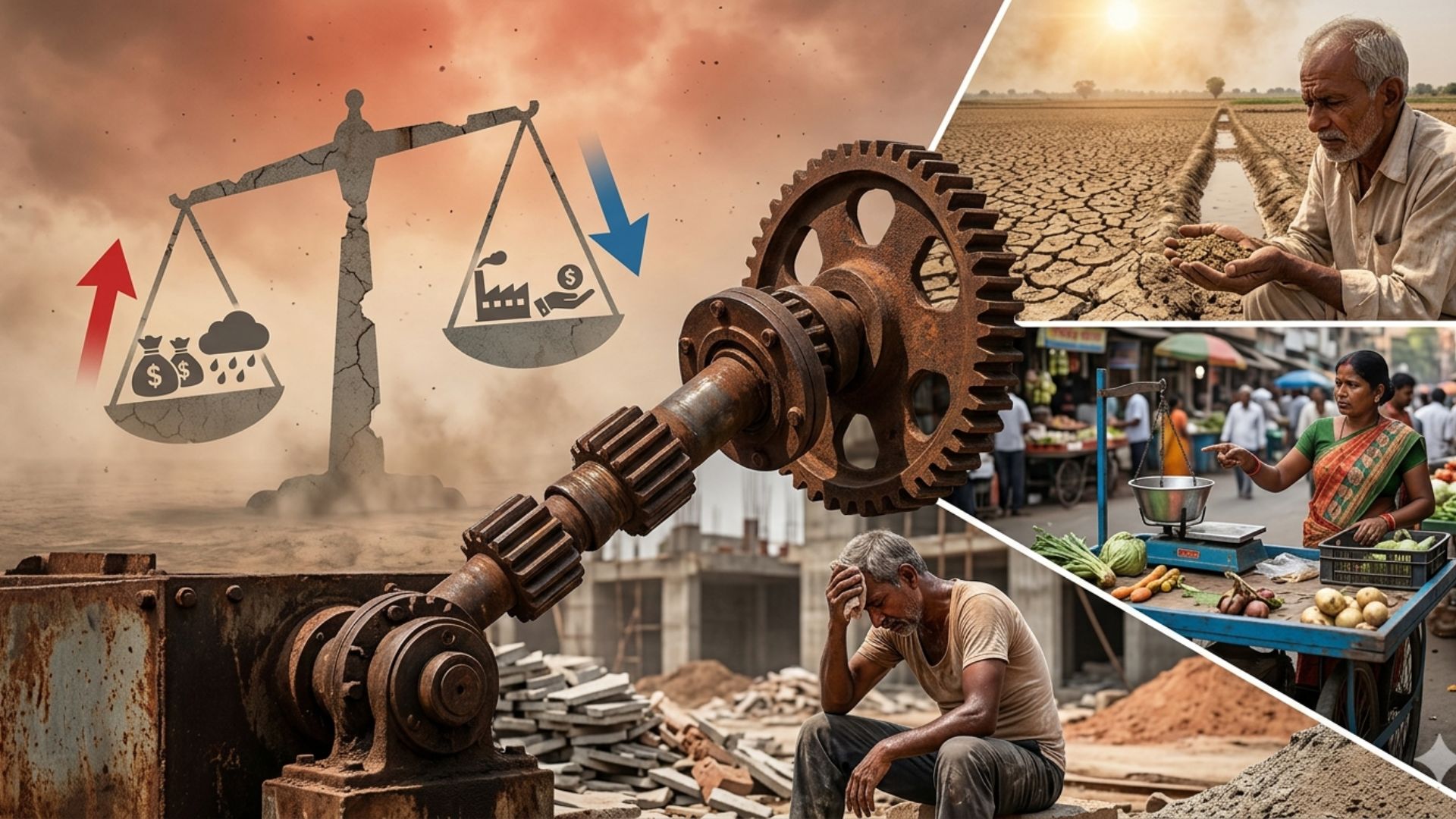

India often views extreme heat and erratic rainfall as recurring seasonal challenges. However, the likely return of El Niño in 2026 highlights a deeper reality: climate shocks increasingly translate into economic and development challenges, affecting livelihoods, agriculture, inflation, and social equity.
Why is El Niño a Concern?
According to NOAA's ENSO Diagnostic Discussion Report (2026):
| Forecast | Probability |
|---|---|
| El Niño emergence (May–July 2026) | 82% |
| Continuation through Winter 2026–27 | 96% |
Simultaneously, the IMD's Long Range Forecast projects monsoon rainfall at 92% of the Long Period Average (LPA), placing it in the "below normal" category.
El Niño
    ↓
Weaker Monsoon
    ↓
Lower Agricultural Output
    ↓
Higher Food Prices
    ↓
Pressure on Household Budgets
This demonstrates that climate events are no longer confined to weather systems; they increasingly influence economic stability.
"Climate shocks do not remain confined to the atmosphere; they move quickly into labour markets, farms, households and cities."
The Economic Transmission Mechanism of El Niño
1. Heat Stress and the Labour Economy
The first and most immediate impact is through rising temperatures.
Workers most exposed include:
- Construction labourers
- Agricultural workers
- Delivery personnel
- Street vendors
- Informal sector workers
Effects of prolonged heat:
- Reduced working hours
- Lower labour productivity
- Increased health risks
- Declining daily earnings
Extreme Heat
      ↓
Reduced Outdoor Work Capacity
      ↓
Lower Daily Income
      ↓
Greater Economic Insecurity
The burden is particularly severe because many workers lack social protection, formal contracts, or income security.
2. Agriculture Under Stress
Agriculture remains highly dependent on monsoon rainfall.
A Reuters report (2026) notes that the southwest monsoon provides nearly 70% of the rainfall required for:
- Crop cultivation
- Reservoir recharge
- Groundwater replenishment
When rainfall becomes uncertain:
- Sowing decisions become riskier
- Irrigation costs rise
- Groundwater extraction increases
- Crop yields become unpredictable
| Agricultural Impact | Consequence |
|---|---|
| Weak rainfall | Reduced crop productivity |
| Higher irrigation demand | Rising cultivation costs |
| Groundwater depletion | Long-term water stress |
| Crop uncertainty | Income instability |
For small and marginal farmers, climatic uncertainty compounds existing challenges of volatile prices and rising input costs.
"El Niño is not merely a climatic event; it is a shock to the production base of the rural economy."
3. Food Inflation and Household Stress
Climate stress eventually reaches consumers through food prices.
According to the Consumer Price Index Press Release (2026):
| Indicator | April 2026 |
|---|---|
| Food Inflation | 4.2% |
If monsoon performance weakens:
- Vegetable prices may rise
- Pulse production may decline
- Essential food items may become costlier
Poor Monsoon
      ↓
Crop Stress
      ↓
Lower Supply
      ↓
Food Inflation
      ↓
Household Budget Pressure
This creates a policy dilemma where the same climate event can:
- Slow economic growth
- Increase inflation simultaneously
Urban India: The Emerging Heat Trap
Cities are becoming increasingly vulnerable due to:
- Rapid concretisation
- Shrinking green spaces
- Urban heat island effects
However, the impact is highly unequal.
| Wealthier Households | Poorer Households |
|---|---|
| Better housing | Congested settlements |
| Access to cooling | Limited cooling options |
| Reliable water supply | Water scarcity |
| Greater adaptive capacity | Higher heat exposure |
As a result, climate change is amplifying existing urban inequalities.
Why El Niño is a Development Challenge
The cumulative effects extend far beyond meteorology.
Key concerns include:
- Declining labour productivity
- Rural income losses
- Agricultural uncertainty
- Rising food inflation
- Water scarcity
- Widening urban inequality
Thus, climate risk increasingly functions as economic risk, especially for vulnerable populations dependent on climate-sensitive livelihoods.
Way Forward
- Develop heat-resilient urban infrastructure and expand green cover.
- Strengthen Heat Action Plans across states and cities.
- Improve worker protection through flexible work schedules and cooling facilities.
- Promote climate-resilient agriculture and drought-tolerant crops.
- Enhance irrigation efficiency and water conservation measures.
- Strengthen weather forecasting and early warning systems.
- Expand social protection mechanisms for climate-vulnerable households.
- Improve groundwater management and reservoir planning.
Conclusion
The anticipated return of El Niño underscores a fundamental shift in India's development landscape. Heatwaves, weak monsoons, and food inflation are no longer isolated environmental concerns but interconnected economic challenges. As climate variability intensifies, India's response must move beyond disaster management towards comprehensive climate adaptation, ensuring that growth, livelihoods, and social welfare remain resilient in an increasingly uncertain future.
Attribution
Original content sources and authors


Syllabus classification
How this article maps to GS papers
Main syllabus
GS1GeographyQuick Q&A
What is El Niño and why is it increasingly viewed as a development challenge rather than merely a weather phenomenon in India?
Why is the impact of El Niño and climate variability particularly significant for India’s informal economy and vulnerable populations?
How does El Niño influence agricultural production, water resources and food inflation in India through multiple economic channels?
What are the major reasons behind the increasing vulnerability of Indian cities and societies to extreme heat events associated with climate change?
Critically analyse the proposition that climate risk has become economic risk in contemporary India.
What policy measures and practical examples can serve as case studies for building climate resilience against El Niño-related disruptions in India?
Practice questions
1 question for mains preparation