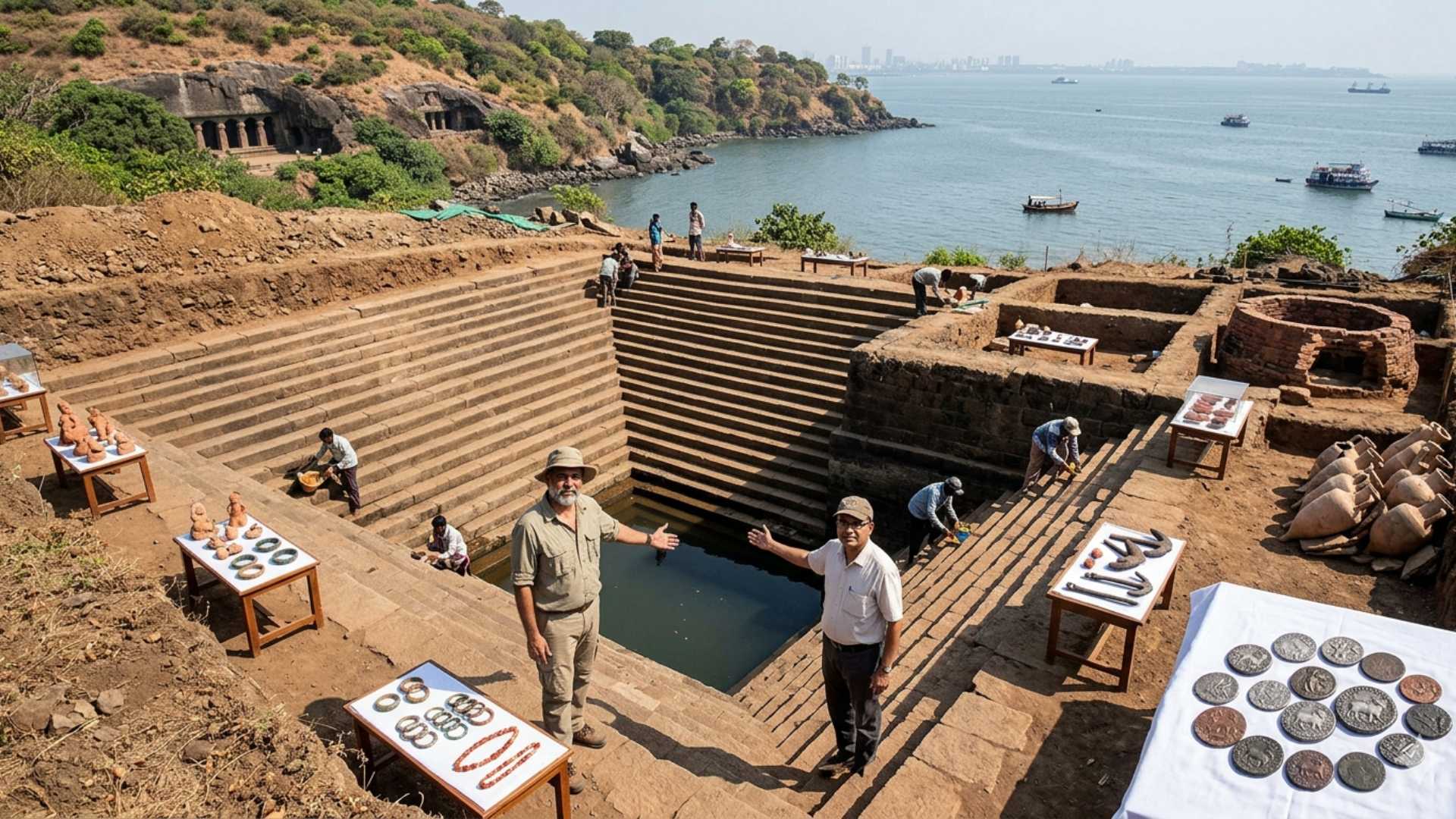
Elephanta Island Excavation: Ancient Maritime Trade & Heritage
Introduction
"Archaeology is the search for fact — not truth. If it's truth you're interested in, philosophy class is right down the hall." — Indiana Jones (fictional, but pedagogically apt)
India's ancient maritime civilisation is being progressively revealed through archaeological discoveries that challenge the notion of pre-colonial India as inward-looking. The March 2026 ASI excavation at Elephanta Island — uncovering a 1,500-year-old stepped reservoir, Mediterranean amphorae, and Kalachuri dynasty coins — adds compelling evidence to India's deep history of long-distance maritime trade, hydraulic engineering, and cultural exchange with Rome and West Asia.
| Parameter | Data |
|---|---|
| Discovery site | Elephanta Island, Mumbai coast |
| Excavating authority | ASI, Mumbai Circle |
| Excavation began | November 2025 |
| Trenches excavated | 19 (each 10m × 10m) |
| Stepped reservoir age | ~1,500 years (5th–6th century CE) |
| Reservoir dimensions | 14.7m long, T-shaped, 5m deep, 20 steps |
| Amphorae sherds found | ~3,000 (Mediterranean + West Asian origin) |
| Coins found | 60 (copper, lead, silver) |
| Dynasty identified | Kalachuri dynasty (6th century CE) |
Background & Context
Elephanta Island (also known as Gharapuri) is located approximately 10 km off the Mumbai coast in the Arabian Sea. It is already a UNESCO World Heritage Site (1987) for its magnificent rock-cut Shaiva cave temples dating to the 5th century CE.
The current ASI excavation reveals that Elephanta was not merely a religious site but a thriving port and trading hub during the Early Historic and early medieval periods.
Three port localities on the island:
- Morabandar
- Rajbandar
- Shethbandar
Key Discoveries & Their Significance
1. Stepped Reservoir (Stepwell-type)
| Feature | Detail |
|---|---|
| Type | Stepped reservoir (T-shaped) |
| Age | ~1,500 years |
| Construction | Stone blocks ferried from mainland |
| Steps exposed | 20 |
| Significance | Planned hydraulic architecture on a rocky island with high water runoff |
- Distinct from previously found rock-cut cisterns — this is a designed water storage system
- Demonstrates advanced civil/hydraulic engineering of early medieval India
- Island's rocky terrain causes monsoon water to run off rapidly — making this reservoir a critical water security infrastructure
2. Mediterranean Amphorae & West Asian Torpedo Jars
- ~3,000 sherds of amphorae (Mediterranean) and torpedo jars (West Asia/Mesopotamia)
- Used historically for storing wine, oil, and fish sauce
- Confirms direct maritime trade links with Rome and Mesopotamia
- Places Elephanta within India's ancient Indian Ocean Trade Network
3. Kalachuri Dynasty Coins
- Copper coins identified as belonging to ruler Krishnaraja of the Kalachuri dynasty (6th century CE)
- Identification basis: seated bull motif (obverse) + temple symbol with legend "Sri Krishnaraja" (reverse)
- Establishes political chronology of the island's occupation
- Kalachuri dynasty ruled parts of western and central India during this period
4. Other Artefacts
- Terracotta figurines, glass and stone bangles
- Beads of carnelian and quartz — carnelian was a key trade commodity in ancient India
- Stone anchors — direct evidence of maritime activity
- Brick structure possibly a dyeing vat — suggests textile production/trade
Historical & Cultural Context
India's Ancient Maritime Trade Networks
| Trade Partner | Evidence | Period |
|---|---|---|
| Rome/Mediterranean | Amphorae sherds, coins | Early Historic (1st–4th century CE) |
| West Asia/Mesopotamia | Torpedo jar sherds | 2nd century CE onwards |
| Local mainland | Stone blocks for reservoir construction | 5th–6th century CE |
Kalachuri Dynasty — Brief Note
- Ruled parts of western Deccan and central India (6th century CE)
- Their coins at Elephanta suggest political control or strong commercial presence over western coastal trade routes
- Contemporaneous with the rock-cut Shaiva cave sculptures at Elephanta
UPSC Relevance — Connecting Themes
GS1 — Indian Heritage & Culture:
- Ancient Indian maritime history
- Hydraulic engineering traditions (stepwells, reservoirs)
- Rock-cut architecture (Elephanta caves, UNESCO heritage)
- Trade contacts with Rome and West Asia
GS1 — History:
- Kalachuri dynasty
- Early Historic period trade
- Indian Ocean as a zone of civilisational exchange
Broader Connections:
- India's stepwell tradition (Rani ki Vav — UNESCO, Gujarat) — Elephanta reservoir adds a new maritime dimension
- Periplus of the Erythraean Sea — ancient Greek text documenting India's western coast trade ports
- Silk Road and Spice Route — Elephanta fits into the larger Indian Ocean commerce narrative
Significance of the Discovery
Archaeological:
- First stepped reservoir of this scale found on Elephanta
- Expands understanding of early medieval water management on island settlements
- Mediterranean amphorae quantity (~3,000 sherds) is unusually high — suggests Elephanta was a major entrepôt, not a minor port
Historical:
- Confirms western India's integration into Roman-era global trade networks
- Adds numismatic evidence for Kalachuri political presence on the western coast
Heritage & Tourism:
- Strengthens Elephanta's significance beyond its cave temples
- May support case for expanded UNESCO heritage zone coverage
Challenges in Archaeological Conservation
- Island's rocky, humid, coastal environment accelerates weathering of exposed structures
- Tourist footfall (Elephanta caves attract ~500,000 visitors annually) poses conservation pressure
- Underwater archaeology potential around the three port localities remains largely unexplored
- Need for community archaeology frameworks involving local island communities
Conclusion
The Elephanta excavation is a reminder that India's civilisational story is still being written — one trench at a time. The stepped reservoir speaks to sophisticated hydraulic planning; the Mediterranean amphorae to India's confident participation in global commerce; the Kalachuri coins to the political economy of early medieval western India. Together, these discoveries reinforce a central historical argument: that India was never an isolated civilisation but a dynamic node in ancient Eurasian and Indian Ocean networks. For UPSC, this topic sits at the rich intersection of heritage, history, maritime trade, and archaeological methodology.
Attribution
Original content sources and authors
Syllabus classification
How this article maps to GS papers
Main syllabus
GS1Indian CultureQuick Q&A
What is the significance of the recently discovered stepped reservoir on Elephanta Island in terms of ancient Indian engineering and water management?
Engineering and architectural significance:
- Use of imported stone blocks indicates logistical planning and maritime transport capabilities
- Design ensures gradual access to water even during dry periods
- Excavation depth and step alignment suggest precision in measurement and execution
This discovery aligns with other ancient Indian water systems like stepwells (baolis) in Gujarat and Rajasthan, showcasing a long tradition of sustainable water architecture. Overall, it reinforces the idea that ancient Indian societies were not only environmentally aware but also technologically adept in addressing ecological challenges.
Why is the Elephanta Island excavation important for understanding India's maritime trade and cultural interactions?
Key implications:
- Evidence of long-distance maritime trade routes during the Early Historic and later periods
- Integration of Indian ports into global trade networks
- Exchange of goods, ideas, and cultural practices
Additionally, the presence of multiple port settlements—Morabandar, Rajbandar, and Shethbandar—suggests that Elephanta was a vibrant commercial hub. This reinforces India's role as an active participant in ancient globalization, contributing to both economic prosperity and cultural pluralism.
How do archaeological findings such as coins, pottery, and structures help in reconstructing the socio-economic history of a region?
Analytical value of different artifacts:
- Coins: Indicate political authority, economic systems, and trade transactions
- Pottery and amphorae: Reveal trade connections and consumption patterns
- Structures (e.g., reservoirs, vats): Reflect technological capabilities and occupational activities
The presence of a possible dyeing vat suggests textile-related activities, pointing to local industries. Thus, such multi-dimensional evidence enables historians to construct a holistic picture of economic specialization, trade integration, and cultural practices.
What factors might have led to the development of advanced water conservation structures like the stepped reservoir on Elephanta Island?
Key driving factors:
- Geographical constraints: Rocky substratum limiting water absorption
- Climatic variability: Seasonal monsoon dependence requiring storage systems
- Population and trade activity: Demand for water by inhabitants and traders
Additionally, the island’s role as a trade hub would have increased water demand for ships, traders, and local industries. This necessity-driven innovation reflects the adaptive capacity of ancient societies and their emphasis on sustainability and resource optimization.
Critically analyze the role of archaeological excavations in shaping our understanding of ancient Indian history. What are their limitations?
Contributions:
- Provide empirical evidence for reconstructing history
- Reveal everyday life aspects often absent in texts
- Help establish timelines through scientific dating methods
However, limitations exist:
- Excavations are often partial and site-specific, limiting generalization
- Interpretation of artifacts can be subjective
- Preservation bias may lead to incomplete historical records
For instance, while Elephanta’s findings indicate trade links, they may not fully represent the broader regional dynamics. Thus, archaeology must be integrated with literary, epigraphic, and scientific evidence for a more comprehensive understanding.
Can the Elephanta Island findings be used as an example to illustrate ancient India's integration into global trade networks?
Broader context:
- Similar evidence has been found at sites like Arikamedu (Tamil Nadu) and Berenike (Egypt)
- Indian spices, textiles, and beads were in high demand globally
- Ports acted as nodes of economic and cultural exchange
The existence of multiple port settlements on Elephanta further strengthens its role as a trade hub. This example underscores the interconnectedness of ancient civilizations and challenges the notion of isolated regional histories, emphasizing early globalization processes.
Using Elephanta Island as a case study, how can heritage conservation and tourism be balanced with archaeological research?
Strategies for balance:
- Zoning: Separate tourist areas from active excavation sites
- Controlled access: Limit visitor numbers in sensitive zones
- Awareness programs: Educate tourists about the importance of preservation
At the same time, ongoing research must be supported through funding and infrastructure. Learning from global examples like Pompeii in Italy, India can adopt sustainable tourism models that protect heritage while leveraging its economic potential. This approach ensures that cultural assets are preserved for future generations without compromising present-day benefits.
Practice questions
2 questions for mains preparation