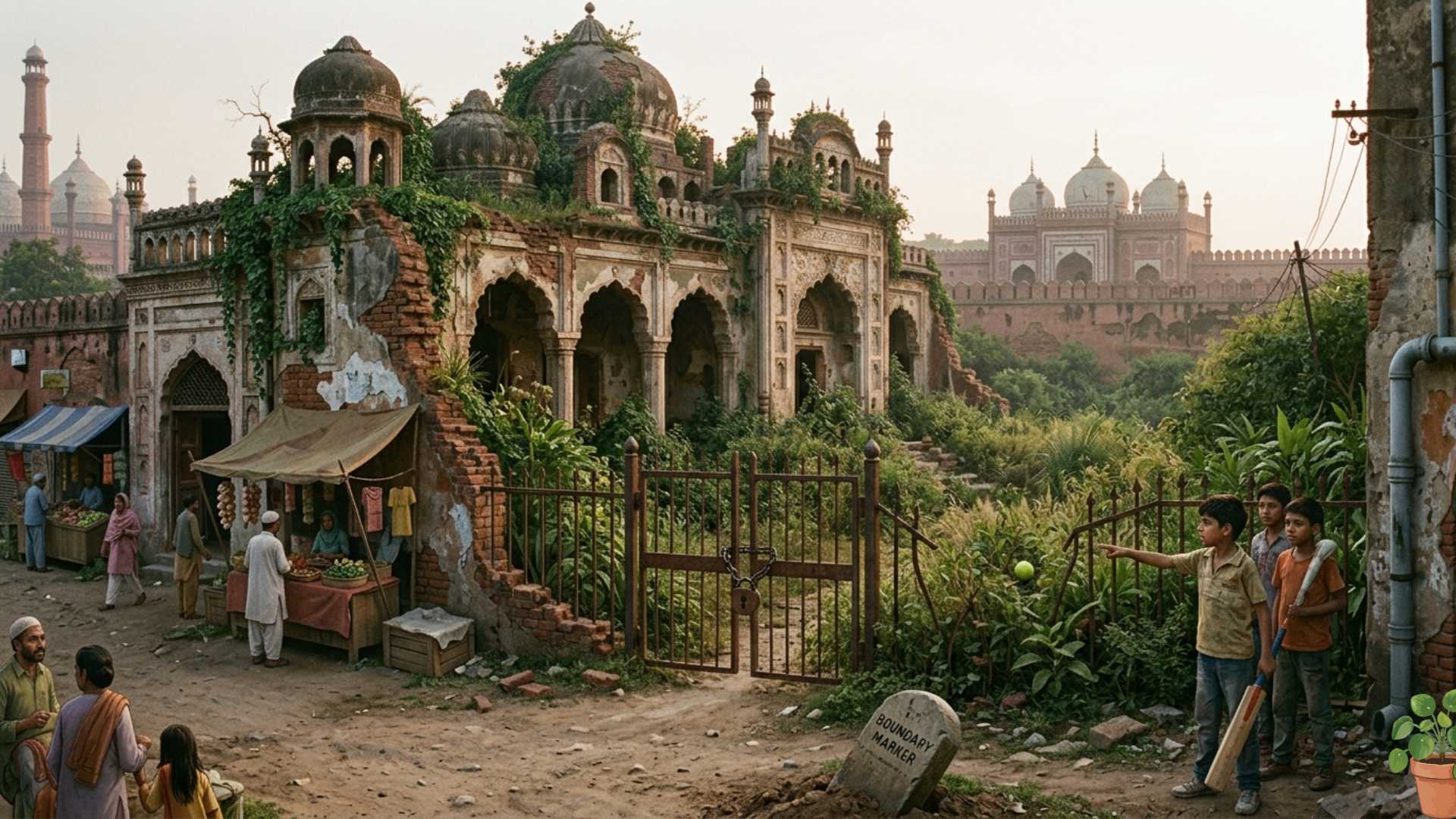
India's Crumbling Heritage: The Crisis of Monument Protection in Uttar Pradesh

"It's almost like we are waiting to see monuments disappear in front of us." — Umakant Mishra, heritage preservationist
The Ground Reality: A Snapshot
Shahid Alam, a 15-year-old cricketer in Lucknow, calls the area around the historic Qadam Rasool monument a "jungle" — wild undergrowth, locked gates, collapsing walls. This is not a remote ruin. It stands beside the Imambara Shah Najaf, on the banks of the Gomti river, built in the 19th century under the Nawabs of Awadh. Its condition is emblematic of a systemic rot.
What the CAG Report (March 2026) Found
A Comptroller and Auditor General report on UP's Centrally Protected Monuments (CPMs) — those under the Archaeological Survey of India (ASI) — revealed alarming numbers:
Total CPMs in Uttar Pradesh        →  487
Untraceable monuments              →  31
Monuments with ownership docs      →  31 (only 6.4%)
Encroached monuments               →  96
Mid/long-term conservation plans   →  0 (none prepared)
Site Management Plans (SMPs)       →  0 (none prepared)
Institutional Failure: Key Manifestations
-
Monuments gone missing: 31 CPMs are simply untraceable — yet ASI continues listing them. As lawyer-heritage activist Syed Mohammad Haider Rizvi puts it, "the government agency entrusted with our heritage cannot even locate what it claims to protect."
-
No ownership documentation for 93.6% of monuments — a custodian with no deed to the property it guards.
-
Encroachment by government bodies themselves: The old Rohilla Fort in Saharanpur is under a district jail. The Hussainabad Baradari in Lucknow has been encroached upon by the electricity department and Jal Nigam due to absence of a boundary wall.
-
ASI violating its own norms: At Rani Mahal, Jhansi, ASI's own circle office was located inside the protected monument — fitting ACs, laying ceramic tiles on floors, running water pipes — all inconsistent with conservation norms.
-
Events over safety: Despite the Agra Circle's Superintendent Archaeologist warning about structural vulnerability of the Diwan-e-Aam at Agra Fort in February 2023, a large public event was permitted just days later. The monument remains on the events-approved list.
Delisting: Erasing Failures on Paper
A particularly insidious practice is the delisting of monuments — removing them from the protected list on grounds of "ceasing to be of national importance." Monuments recently delisted include:
- Qadam Rasul, Lucknow
- Begum Kothi, Lucknow
- Imambada Ghulam Husain Khan
- Chota Chhatar Manzil, Lucknow
All are considered markers of Awadhi civilisation. Critics call delisting a tool to "paper over failures of protection when negligence goes too far."
What Is at Stake: Awadhi Culture
The Nawabs of Awadh — Shia Muslims from Naishapur, Iran — came to prominence after the Mughal decline in the late 18th century. Under Nawab Asaf ud Daula, Lucknow became a cultural capital. The architectural legacy they left reflects a distinct Persian-Lucknavi fusion:
- Bara and Chota Imambara — arcaded iwans, stucco work, geometric tile patterns, calligraphic inscriptions
- Chota Imambara (Palace of Lights) — Persian mausoleum design fused with Lucknavi glasswork, illuminated on Moharram
- Rumi Darwaza — modelled on Istanbul's Sublime Porte, reflecting Ottoman-Persianate court connections
Beyond buildings, Awadhi culture is a composite of tehzeeb (refined manners), pahle aap (social grace), Kathak, Chikankari embroidery, Urdu poetry, and the culinary arts. Losing the built form risks losing the living culture anchored to it.
Legal Framework: Existing but Unenforced
- Ancient Monuments and Archaeological Sites and Remains Act, 1958 — prohibits construction or activity that damages protected heritage within notified areas
- ASI Guidelines (January 2005) — cultural events in protected areas require ASI circle clearance
- National Conservation Policy, 2014 — mandates short-term (0–2 yr), mid-term (2–5 yr), and long-term (5+ yr) plans; full documentation before, during, and after conservation; Site Management Plans by multidisciplinary teams
The CAG found none of these planning requirements were complied with by UP ASI circles.
What Activists Demand
- A State-level heritage law with clear boundary demarcations
- Mandatory digitisation of all monuments and records
- Anti-encroachment provisions with legal teeth
- Citizen grievance mechanisms
- PILs have been filed in Allahabad High Court demanding encroachment removal; mass awareness campaigns are being planned
Way Forward
- State heritage legislation with legally enforceable boundary demarcations, anti-encroachment clauses, and citizen grievance redressal — the central AMASR Act alone is proving inadequate.
- Mandatory digitisation of all 487 CPMs — geo-tagged surveys, satellite mapping, and digital title documentation to prevent monuments from becoming "untraceable."
- Compliance with the 2014 Conservation Policy in letter and spirit — short, mid, and long-term plans along with Site Management Plans must be prepared without further delay.
- Independent audit mechanism for ASI circles, so that violations like Rani Mahal (where ASI itself was the encroacher) do not go unchecked.
- Regularisation audit of commercial occupants in heritage complexes — cases like Wahid Ahmed's three-generation eatery inside Chota Imambara need transparent documentation and legal clarity, not blanket eviction or continued informality.
- Community ownership — local heritage committees, tourism linkages, and school outreach can build a constituency that politically resists neglect.
Conclusion
-
The CAG report is not merely an audit finding — it is a civilisational warning. When 31 monuments vanish from official records, when ASI itself installs air conditioners inside a protected Jhansi palace, when children playing cricket outside an Imambara mistake a historic garden for jungle, the failure is institutional and moral in equal measure.
-
Awadhi culture — its poetry, its manners, its light-soaked Imambaras — was built over centuries. It can be lost within a generation of administrative indifference.
-
The question is not whether India has the laws to protect its heritage. It does. The question is whether it has the will to enforce them.
Attribution
Original content sources and authors


Syllabus classification
How this article maps to GS papers
Main syllabus
GS1Indian CultureQuick Q&A
What does the recent CAG report reveal about the condition of centrally protected monuments in Uttar Pradesh, and why is it significant?
The significance of the report lies in the fact that it exposes weaknesses in India’s heritage governance framework. Heritage conservation is not merely about preserving old buildings; it is about protecting civilisational memory, cultural identity, and historical continuity. When monuments disappear or deteriorate, society loses valuable evidence of its architectural, social, and political history. The issue becomes even more serious because the ASI itself, the statutory authority responsible for conservation, was found violating preservation norms in places like Rani Mahal in Jhansi by making modern alterations inconsistent with the monument’s original character.
The report also has broader governance implications. It demonstrates failures in documentation, planning, accountability, and interdepartmental coordination. Encroachments by government institutions such as police stations, municipal offices, and utility departments indicate that even state agencies often disregard heritage laws. This undermines public confidence in conservation institutions.
The findings are particularly important in the context of Uttar Pradesh because the State possesses a rich legacy of Mughal, Awadhi, Persianate, and colonial architecture. Structures like Bara Imambara, Chota Imambara, Rumi Darwaza, and Shah Najaf are not isolated monuments but symbols of India’s composite culture. Therefore, the CAG report acts as a warning that without systematic intervention, India risks losing irreplaceable cultural assets.
Why is the preservation of Awadhi architectural heritage important for India’s cultural identity and social fabric?
The preservation of this heritage is important because cultural monuments act as repositories of collective memory. They help societies understand their historical evolution and foster a sense of continuity between past and present generations. In a diverse country like India, Awadhi architecture demonstrates how multiple cultural streams can coexist harmoniously. The Persianate and Ottoman influences seen in Lucknow’s structures illustrate India’s historical openness to global cultural interactions.
The decline of these monuments therefore represents not only an architectural loss but also the erosion of intangible cultural practices associated with them. For example, Moharram traditions linked to Chota Imambara or literary gatherings connected with Lucknow’s Urdu culture derive meaning from these physical spaces. If such sites deteriorate, cultural practices gradually lose relevance and continuity.
From an economic perspective, heritage conservation also contributes to tourism, employment, and urban identity. Cities like Jaipur, Rome, and Istanbul have successfully leveraged heritage conservation for sustainable tourism development. Lucknow possesses similar potential but risks losing it because of neglect and encroachment. Therefore, preserving Awadhi heritage is essential not only for cultural reasons but also for social harmony, historical education, and economic development.
How do encroachments and administrative failures threaten the protection of heritage monuments in India?
Administrative failures aggravate the situation because enforcement mechanisms remain weak. The ASI often lacks updated ownership records, clear boundary demarcations, and effective monitoring systems. The CAG report showed that only 6.4% of monuments had proper ownership documentation. Without legal clarity over land and boundaries, encroachments become difficult to challenge in courts or remove through administrative action. Furthermore, inadequate staffing, limited funding, and poor coordination between central and state agencies worsen implementation gaps.
Another major issue is the contradiction between conservation objectives and commercial or political pressures. For example, despite structural concerns regarding the Diwan-e-Aam at Agra Fort, permission was granted for large public events. Such decisions prioritise short-term visibility over long-term preservation. Similarly, heritage activists fear that monuments are being quietly “delisted” from protected status when authorities fail to conserve them adequately.
The consequences are severe and often irreversible. Encroachments alter the original architectural character of monuments, weaken foundations, and create environmental stress through pollution and overcrowding. Administrative negligence also reduces public trust in conservation institutions. Therefore, effective heritage protection requires digitised records, strict anti-encroachment enforcement, community participation, and transparent accountability mechanisms. Without these measures, heritage laws remain ineffective on the ground.
Critically analyse the effectiveness of the Archaeological Survey of India (ASI) in fulfilling its mandate of heritage conservation.
However, the article and the CAG report reveal serious shortcomings in the ASI’s functioning. One major criticism is weak implementation capacity. The inability to trace 31 monuments in Uttar Pradesh reflects administrative inefficiency and poor documentation practices. The absence of mid-term and long-term conservation plans, as well as Site Management Plans (SMPs), indicates inadequate institutional planning. Furthermore, even ASI offices were found violating conservation norms by altering structures inside protected monuments such as Rani Mahal in Jhansi.
Another challenge is the lack of coordination and enforcement. Encroachments by government departments themselves suggest that ASI lacks authority or political backing to enforce regulations effectively. In many cases, conservation work is reactive rather than preventive. Budgetary constraints, shortage of skilled personnel, and increasing urbanisation also place additional pressure on the institution.
At the same time, criticism of the ASI must be balanced with recognition of structural constraints. India has thousands of heritage sites but limited financial and human resources. Conservation often requires coordination between local governments, police, municipal bodies, historians, engineers, and communities. Therefore, the burden cannot rest solely on the ASI.
A comprehensive reform agenda is needed. This should include digitisation of records, use of GIS mapping, stricter anti-encroachment laws, increased public funding, and community participation. Professional training and independent audits can improve accountability. Thus, while the ASI remains indispensable for heritage protection, institutional reforms are essential to make it more effective and responsive.
As a district administrator, how would you address the issue of heritage encroachment and monument deterioration in a historically important city like Lucknow?
The second step would involve strict yet humane anti-encroachment measures. Illegal occupations by commercial establishments or government departments must be addressed through legal notices, rehabilitation plans where necessary, and phased removal drives. In sensitive cases like long-standing family-run shops near Chota Imambara, rehabilitation and stakeholder dialogue should accompany enforcement to avoid social conflict. Simultaneously, heritage bylaws should regulate construction activities near protected zones.
Public awareness would form another major pillar of the strategy. Citizens often perceive monuments as abandoned spaces rather than living cultural assets. Awareness campaigns in schools, colleges, and local communities could promote civic responsibility toward heritage conservation. Partnerships with historians, NGOs, and religious trusts would help create local stewardship models.
Technology and tourism management should also be integrated into conservation efforts. QR-code-based information systems, digital archives, surveillance cameras, and crowd management plans can improve monitoring. Responsible heritage tourism can generate revenue for maintenance while creating employment opportunities for local artisans and guides.
Finally, I would ensure preparation of short-term, medium-term, and long-term conservation plans in accordance with the National Policy for Conservation of Ancient Monuments, 2014. Regular audits, public grievance mechanisms, and transparent reporting would improve accountability. Such a balanced approach would preserve both the physical structures and the cultural spirit of Lucknow’s Awadhi heritage.
What are the major reasons behind the deterioration and disappearance of heritage monuments in India?
Encroachment is another major factor. Rapid urbanisation and rising land values increase pressure on heritage spaces. In many cities, monuments become surrounded by commercial establishments, informal settlements, or government infrastructure projects. Examples from Uttar Pradesh include shops around Chota Imambara and government offices operating inside protected monuments. Encroachments not only alter the visual integrity of monuments but also damage foundations and drainage systems.
Financial and technical limitations also contribute significantly. Conservation requires specialised expertise in archaeology, architecture, engineering, and material science. However, many ASI circles face shortages of skilled personnel and inadequate budgets. As a result, restoration efforts are often delayed or poorly executed, leading to inappropriate interventions that damage the monument’s original character.
Another reason is the lack of public awareness and community ownership. Many citizens do not view heritage conservation as a shared social responsibility. Monuments are often treated as abandoned spaces suitable for dumping waste, organising large events, or unauthorised commercial use. Political priorities also tend to favour infrastructure development over conservation.
Environmental degradation further accelerates deterioration. Pollution, water seepage, climate change, vegetation growth, and uncontrolled tourism weaken old structures over time. For example, heavy footfall and public events in sensitive areas like Agra Fort increase structural stress.
Therefore, the crisis is multidimensional and requires integrated solutions. Stronger laws, digitised records, increased funding, scientific restoration methods, public participation, and sustainable tourism policies are essential to prevent further loss of India’s cultural heritage.
Practice questions
2 questions for mains preparation