GS1 Population

Census 2027: Counting Every Citizen for Inclusive Development and Better Governance

Census 2027: Counting People, Strengthening Democracy

Census 2027 is more than just a count; it’s essential for equitable development, resource allocation, and democratic representation in India.
Gopi Gopi
4 mins read

“Not everything that counts can be counted, and not everything that can be counted counts.” — Albert Einstein

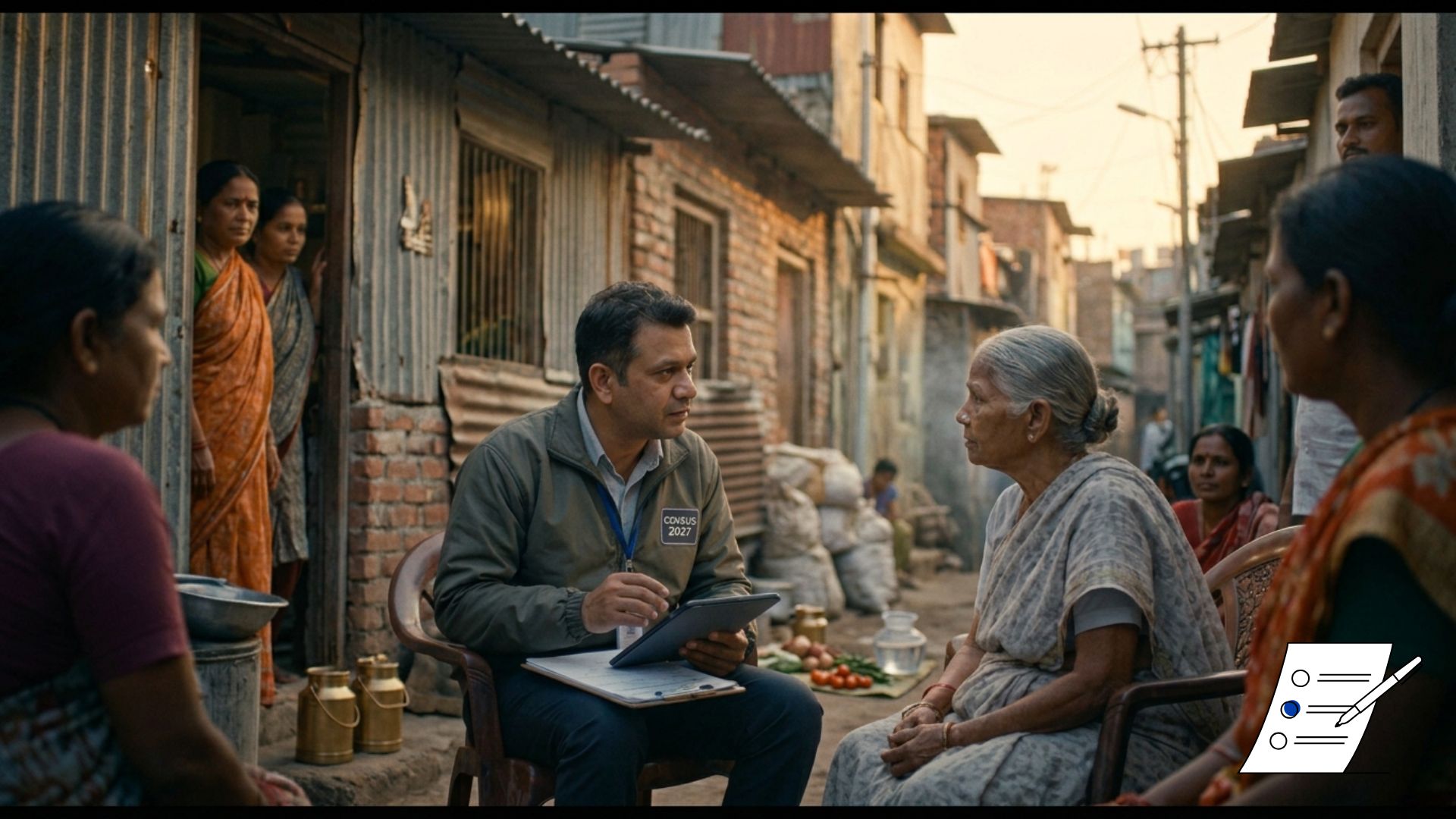
India has begun the world's largest enumeration exercise with Census 2027, a crucial exercise that goes beyond population counting to shape governance, welfare delivery, representation, and development. In a democracy where every vote matters, every individual count matters equally.

Why Census 2027 Matters

AspectDetails
ScaleLargest population count in the world
Phase 1Housing Census: assets, amenities, and household conditions
Phase 2Demographic details: education, migration, fertility, caste, etc.
SignificanceBasis for governance, planning, welfare and representation

A Long-Delayed Census

  • Census 2027 comes after a 15-year gap, instead of the usual 10 years.

  • Delays occurred due to:

    • COVID-19 pandemic
    • Lok Sabha elections
  • Policymaking has largely depended on:

    • Census 2011 data
    • Estimates from surveys such as NFHS
    • UN and World Bank projections
Population Snapshot

Census 2011      : 121 crore
Estimated 2025   : 146+ crore
Expected increase: 25–30 crore people

An updated demographic database is therefore essential for evidence-based decision-making.

Census and India's Development Journey

The purpose of Census has evolved significantly.

Colonial EraIndependent India
Administrative controlInclusive development
Efficient governance for rulersWelfare-oriented governance
Revenue and regulationPlanning and social justice

The 1951 Census highlighted:

  • Low literacy
  • High poverty
  • Low life expectancy

The 2027 Census will measure India's transformation in:

  • Education
  • Healthcare
  • Infrastructure
  • Mobility
  • Connectivity
  • Living standards

Census and Representative Democracy

The Census has major political implications.

Delimitation and Women's Reservation

  • Future constituency boundaries will rely on Census data.
  • Implementation of 33% reservation for women in legislatures is linked to delimitation.
  • Accurate population figures are therefore essential for fair representation.

Electoral Roll Revision

The ongoing Special Intensive Revision (SIR) has reinforced awareness about:

  • Inclusion in voter rolls
  • Importance of being officially counted

The Significance of Caste Enumeration

One of the most debated features of Census 2027 is the inclusion of caste data.

Potential implications include:

  • Better understanding of social composition
  • Evidence-based policymaking
  • Informed public debate
  • Assessment of social inequalities
Why Caste Data Matters?

→ Reservation policies
→ Social justice measures
→ Welfare targeting
→ Representation of marginalized groups

Existing provisions for:

  • Scheduled Castes (SCs)
  • Scheduled Tribes (STs)

will also draw upon updated Census findings.

Census and Everyday Welfare

The Census directly influences citizens' lives.

  • Employment
  • Food security
  • Housing
  • LPG access
  • Drinking water
  • Sanitation
  • Education
  • Healthcare

Accurate data enables:

  • Better targeting of welfare schemes
  • Efficient allocation of resources
  • Reduced exclusion errors

Economic Importance

Census data guides:

InstitutionUse of Census Data
Finance CommissionFiscal devolution
State GovernmentsDevelopment planning
Local BodiesService delivery
Private SectorInvestment decisions

Digital Census and Data Protection

For the first time, Census 2027 incorporates extensive digital data collection.

Key Features

  • Online self-enumeration available
  • More than one crore households have already participated
  • Multiple language options
  • Physical enumeration retained to ensure universal inclusion

“An enumerator will definitely visit your home.”

The Census Act, 1948 provides safeguards for confidentiality and protection of individual data.

Challenges Ahead

More than three million census personnel will have to:

  • Reach remote habitations
  • Cover dense urban settlements
  • Overcome geographical barriers
  • Address social and logistical challenges

The success of the Census ultimately depends on public cooperation and accurate disclosure of information.

Way Forward

  • Ensure universal coverage without exclusion.
  • Strengthen public awareness regarding the benefits of enumeration.
  • Maintain transparency in data collection and processing.
  • Protect privacy through robust digital safeguards.
  • Use Census findings for evidence-based governance rather than political polarization.
  • Integrate Census data with welfare and development planning at all levels.

Conclusion

Census 2027 is not merely a statistical exercise; it is the foundation of democratic representation, social justice, welfare delivery, and developmental planning. Just as citizens recognise the value of every vote, they must also recognise the value of every count. A successful Census ensures that no individual, community, or region remains invisible in the nation's developmental journey. In that sense, the slogan extends naturally from “Our Census, Our Development” to “My Census, My Right.”

Attribution

Original content sources and authors
Akshay Rout Author Akshay Rout The Hindu Source The Hindu

Syllabus classification

How this article maps to GS papers

Main syllabus

GS1Population

Quick Q&A

What is Census 2027 and why is it considered a crucial instrument for inclusive governance and development in India?
Census 2027 is the eighth Census conducted after Independence and the first digital Census in India. It is a comprehensive exercise aimed at collecting information regarding households, demographic characteristics, education, migration, fertility, socio-economic conditions and caste composition. Although the Census is generally conducted every ten years, the 2027 exercise comes after a 15-year gap due to the COVID-19 pandemic and subsequent electoral priorities. The last Census was held in 2011, when India's population stood at about 121 crore. According to UNFPA estimates, India's population in 2025 exceeds 146 crore, highlighting the urgency of updated demographic information. Historically, the colonial Census primarily served administrative control, whereas post-Independence censuses have focused on improving governance and promoting inclusive development. Census data forms the backbone of planning for housing, education, healthcare, sanitation, food security and infrastructure. It also guides Finance Commission transfers and private-sector investments. Census 2027 introduces digital data collection and online self-enumeration, improving efficiency and accuracy. It also includes caste enumeration, making it politically and socially significant. For UPSC aspirants, the topic connects with GS-I (Population and Society), GS-II (Governance and Welfare Schemes), GS-III (Economic Development) and Essay. Census 2027 represents the principle that evidence-based policymaking and social justice depend upon accurate demographic information. Therefore, it is not merely a statistical exercise but a foundation for democratic governance and multidimensional development.
Why is an accurate and comprehensive population census indispensable for policy formulation and welfare delivery in India?
An accurate population census is indispensable because it provides the most reliable database for evidence-based policymaking and targeted welfare delivery. In a country with immense regional, social and economic diversity, demographic information helps governments identify deprivations and allocate resources efficiently. Public services relating to food security, housing, employment, drinking water, sanitation, education and healthcare depend heavily upon accurate population estimates. India has relied on the 2011 Census for nearly fifteen years. Although surveys such as the National Family Health Survey (NFHS) provide valuable information on health and nutrition, they do not replace the comprehensive nature of a Census. Outdated population figures can lead to errors in planning, inadequate infrastructure and exclusion of deserving beneficiaries. Census data is also essential for the Finance Commission in determining fiscal transfers to States and local bodies. Furthermore, private investors and businesses rely on demographic profiles to identify markets and investment opportunities. From a constitutional perspective, welfare schemes and affirmative action policies derive legitimacy from accurate socio-economic information. Programmes such as PM Awas Yojana, Jal Jeevan Mission and food security initiatives require updated beneficiary databases. For UPSC preparation, the issue is relevant to GS-I, GS-II and GS-III and highlights themes of cooperative federalism, social justice and inclusive development.
How does Census 2027 influence representative democracy, delimitation and social justice mechanisms in India?
Census 2027 has profound implications for representative democracy because electoral representation, delimitation of constituencies and reservation policies are closely linked to population data. The delimitation process seeks to redraw parliamentary and assembly constituencies to ensure equal representation based on demographic changes. The issue gained prominence during debates surrounding women's reservation. The implementation of the 33% reservation for women in legislatures is linked to delimitation based on fresh Census data. Thus, delays in the Census have implications for gender representation and political empowerment. Similarly, reservations for Scheduled Castes and Scheduled Tribes depend on demographic information obtained through the Census. Accurate data enables fair allocation of reserved seats and strengthens constitutional commitments under Articles 330 and 332. Another major feature of Census 2027 is the inclusion of caste enumeration. Supporters argue that caste data is essential for designing targeted welfare programmes and assessing inequalities, whereas critics fear excessive politicisation and identity-based mobilization. Representative democracy depends upon the principle that every individual should count equally. Population data ensures that electoral boundaries remain relevant and that marginalized communities receive constitutional safeguards. For UPSC aspirants, this topic connects with GS-II (Polity and Governance), GS-I (Indian Society) and Essay. Census 2027 is therefore a vital component of India's constitutional architecture and representative institutions.
What are the major debates and challenges associated with caste enumeration and demographic politics in Census 2027?
The inclusion of caste enumeration in Census 2027 has emerged as one of the most debated issues in contemporary Indian politics. Supporters argue that accurate caste information is necessary for ensuring social justice and designing evidence-based affirmative action policies. Several States have already conducted caste surveys, reflecting growing demands for updated socio-economic data. Critics fear that caste enumeration may intensify identity politics and deepen social divisions. They argue that excessive focus on caste categories could undermine national integration and encourage competitive populism. Methodological difficulties and concerns regarding data accuracy further complicate the issue. Another challenge is the politicisation of demographic questions. Debates surrounding delimitation, reservations and resource distribution often become emotionally charged. Balancing social justice with national cohesion remains a delicate task. Privacy concerns in the digital era constitute another challenge. Although the Census Act, 1948, provides safeguards, fears regarding misuse of personal information persist. From a broader perspective, demographic politics must not overshadow developmental priorities. Reliable data should serve as an instrument for reducing inequalities rather than creating new social fault lines. For UPSC aspirants, this issue is relevant to GS-I (Society), GS-II (Governance) and Essay. A balanced approach requires acknowledging both the need for evidence-based affirmative action and the necessity of preserving social harmony and constitutional values.
What are some practical examples demonstrating how census data shapes economic planning and public service delivery in India?
Census data has practical applications across almost every sector of governance and economic planning. One major example is the Public Distribution System, where population estimates help determine food grain allocation under the National Food Security Act. Similarly, PM Awas Yojana relies on demographic information to identify housing shortages and vulnerable populations. The Jal Jeevan Mission and Swachh Bharat Mission use household-level data to assess access to drinking water and sanitation facilities. In the education sector, literacy and school-age population statistics help governments plan schools, recruit teachers and expand digital infrastructure. Healthcare policies also depend heavily on demographic statistics. During the COVID-19 pandemic, population density and migration patterns influenced resource allocation and vaccination campaigns. The Finance Commission uses population data to recommend tax devolution and grants to States. Private enterprises similarly depend on demographic trends to identify markets and investment opportunities. Urban planning, transportation networks and industrial corridors require reliable population projections. For UPSC Mains and interviews, these examples illustrate the interrelationship between GS-I (Population), GS-II (Governance) and GS-III (Economy). They demonstrate that census data translates directly into better public services and more efficient developmental outcomes.
How does Census 2027 represent a significant transformation in data collection methods and citizen participation in India?
Census 2027 represents a landmark transformation in India's administrative history because it introduces digital enumeration and online self-enumeration for the first time. More than one crore households have reportedly participated through self-enumeration, indicating increasing digital literacy and citizen engagement. Nevertheless, manual enumeration has been retained to ensure inclusiveness and prevent the exclusion of digitally disadvantaged groups. This hybrid approach reflects India's broader Digital India initiatives and e-governance reforms. Digital data collection is expected to improve speed, accuracy and granular analysis, facilitating evidence-based interventions. More than three million personnel have been mobilized to reach remote villages, tribal regions and densely populated urban settlements. Another noteworthy feature is the emphasis on privacy and data protection under the Census Act, 1948. Challenges such as the digital divide, cyber-security concerns and logistical difficulties remain. Ensuring accuracy and minimizing exclusion errors will determine the success of the exercise. For UPSC aspirants, this case study is relevant to GS-II (Governance and E-Governance), GS-III (Technology and Development) and GS-I (Population). Census 2027 demonstrates how technological innovation, administrative capacity and citizen participation can collectively strengthen democratic governance and inclusive development.

Practice questions

1 question for mains preparation

Census is not merely a population-counting exercise but a foundational instrument for democratic governance, social justice, and inclusive development. In the context of Census 2027, examine its significance for welfare planning, political representation, and affirmative action in India.

10 marks · 150 words · 8 mins
