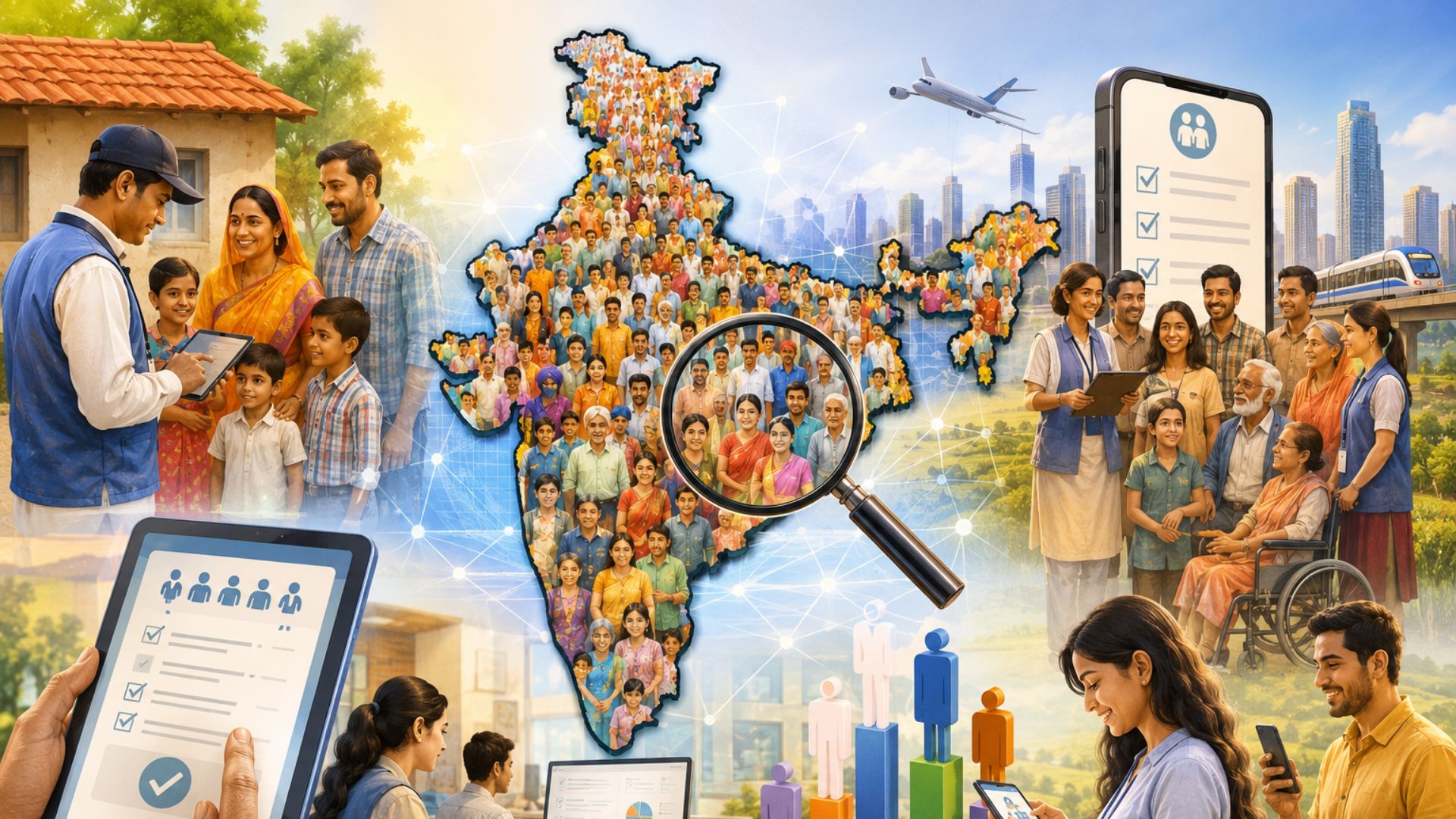
Preparing India for a Credible Digital Census

Where Things Stand
The house listing phase of Census 2027 is already underway in some States, with others to follow soon. However, the inclusion of caste questions has delayed the pre-testing of the questionnaire for the population enumeration phase — the more complex second phase that will count people, not just houses.
Pre-testing is not a formality. It is the only way to ensure that concepts and definitions are understood equally by three million-plus enumerators spread across the country's most remote geographies.
The Caste Question — Uncharted Territory
"The experience of Karnataka and Bihar suggests that, whatever the results, there will be communities that are not ready to accept their numbers."
Caste is being included in the Census for the first time since Independence. The only recent reference points are the Bihar and Karnataka caste surveys — both of which triggered political controversies over their findings. A nationwide caste enumeration will be exponentially more complex, both logistically and politically.
The NRI Problem: Who Gets Counted Where?
One of the least-discussed but most consequential questions in Census 2027 concerns Non-Resident Indians (NRIs). India follows an extended de facto method of enumeration:
Who Gets Counted at a Household?
──────────────────────────────────────────────────────
✔ Members present at usual place of residence
✔ Members absent but stayed at least one night
  during the 20-day enumeration period
✔ Visitors present throughout the entire period
✔ Household help / paying guests sharing the kitchen
✘ NRIs living abroad — NOT counted in Census at all
According to the Ministry of External Affairs, there are approximately 1.58 crore NRIs living abroad — over 1% of India's population. If counted in one State, they would add at least five Lok Sabha seats in the next delimitation.
States with disproportionately large NRI populations — Kerala, Gujarat, Punjab, Telangana and Tamil Nadu — face real demographic undercounting. The Kerala Migration Survey 2023 estimated around 22 lakh Keralites living or working abroad. Excluding them could cost Kerala one Lok Sabha seat in delimitation.
This matters because Census 2027 figures will directly feed into the next delimitation of Lok Sabha and State Assembly constituencies — making accurate enumeration a political and constitutional question, not just a statistical one.
The Complexity Problem: Questions Enumerators Themselves Struggle With
The population enumeration schedule is far more demanding than the house listing phase:
- The disability question in the 2011 Census required six printed pages of explanation
- The question "Have you worked at any time during the last year?" came with more than two pages of instructions defining what constitutes 'work'
- Follow-up questions on industry, occupation and related matters are difficult for most respondents — and many enumerators — to navigate accurately
With the introduction of self-enumeration (online submission), these problems multiply. Respondents are unlikely to read lengthy instructions before selecting from a dropdown menu. Without significant simplification, the self-enumeration facility risks generating systematically inaccurate data.
The Risk of Omission and Fatigue
- Respondent fatigue — too many questions per individual in a household increases the likelihood of incomplete or deliberately incorrect responses
- Higher omission rates — post-enumeration surveys from past censuses show that distant relatives and domestic helpers living with households are most frequently missed; self-enumeration makes this worse
- Fraudulent enumeration — the memory of Census cancellations in certain areas in 2001 remains a cautionary reminder that organised manipulation is a real risk
Way Forward
- Simplify and restructure questions — embed explanations within questions rather than appending lengthy instruction manuals; the goal is enumerator-proof clarity
- Targeted prompts for easy omissions — questions like "Is there any unrelated person such as a servant or nurse who shares meals from the same kitchen?" should be built into the schedule to reduce omission of domestic workers and helpers
- Revisit NRI enumeration methodology — a policy decision on whether and how to count NRIs must be made before delimitation, given the direct seat-allocation consequences for States like Kerala
- Rigorous field testing of caste questions — given the political sensitivity and the absence of any national-level precedent since Independence, the pre-testing phase must be completed without further delay
- Vigilance against fraudulent self-enumeration — field-level checks and area-specific monitoring must be built into the system, particularly in regions with a history of enumeration disputes
Conclusion
Census 2027 is not merely a headcount — it is the data foundation for delimitation, welfare targeting, reservation policy and resource allocation for the next decade. The stakes are high enough that every methodological shortcut will have a long political and administrative tail.
The delay caused by the caste question is understandable given its complexity, but it cannot become an excuse for rushing the pre-testing phase. A census counted quickly but counted wrong is worse than a census delayed — because its errors will be locked into policy for ten years before anyone gets another chance to correct them.
Attribution
Original content sources and authors

Syllabus classification
How this article maps to GS papers
Main syllabus
GS1PopulationQuick Q&A
What are the major methodological and administrative challenges associated with the 2027 Census in India?
One major challenge is the inclusion of caste-related questions. Since caste enumeration has not been conducted comprehensively after Independence, there are concerns regarding classification, self-identification, and social acceptance of final numbers. Experiences from Bihar and Karnataka caste surveys suggest that several communities may contest the findings, leading to political and social disputes. Ensuring uniform understanding of caste categories among enumerators and respondents is therefore crucial.
Another challenge relates to the Census methodology itself. India follows an “extended de facto” method where individuals are counted based on their presence during the enumeration period along with certain absent household members. This creates complexities regarding migrants, hostel residents, domestic workers, and non-resident Indians (NRIs). Since delimitation of constituencies will rely on Census data, inaccuracies in enumeration may directly affect political representation.
Administrative challenges are equally significant. The Census requires the deployment of more than three million enumerators with varying levels of training and comprehension. Questions relating to disability, occupation, and employment involve technical definitions that even trained personnel may struggle to interpret uniformly. In self-enumeration systems, respondents may misunderstand questions, skip details, or intentionally provide incorrect information to avoid follow-up questions.
Respondent fatigue and fraudulent enumeration are also emerging concerns. Lengthy digital questionnaires may reduce data quality, especially in large households. Additionally, vulnerable groups such as domestic helpers, distant relatives, and temporary migrants are more likely to be omitted.
Therefore, the success of the 2027 Census will depend on extensive field testing, simplification of questions, technological safeguards, enumerator training, and public trust. Accurate Census data is essential not only for welfare planning but also for democratic representation and evidence-based policymaking.
Why is the inclusion of caste enumeration in the 2027 Census politically and socially significant?
From a policy perspective, caste data is important for evidence-based governance. Many welfare schemes and reservation policies are designed for socially and educationally backward communities, but the absence of updated caste data has often led to disputes regarding representation and benefits. Governments rely on outdated population estimates for policy formulation. Accurate caste enumeration may therefore help in better targeting of welfare schemes and rationalisation of reservation policies.
Politically, caste data has major implications for power distribution and electoral mobilisation. Different communities may use Census figures to demand greater political representation, reservation quotas, or economic benefits. The article highlights how experiences from Bihar and Karnataka caste surveys revealed that several communities were dissatisfied with the published numbers. This demonstrates that caste enumeration is not merely a statistical exercise but also a politically contested process.
The issue is also linked to future delimitation of constituencies. Since Census figures determine representation in Parliament and State Assemblies, demographic changes may influence political power among regions and communities. States with higher migration or large NRI populations may face concerns regarding underrepresentation if certain populations are excluded from enumeration.
At the same time, critics caution that caste enumeration may deepen identity politics and social fragmentation. There are fears that excessive emphasis on caste identities could strengthen competitive populism and intensify demands for sub-categorisation among backward classes.
However, supporters argue that ignoring caste realities does not eliminate social inequalities. Instead, accurate data is necessary to understand patterns of deprivation and exclusion. The challenge lies in conducting enumeration transparently and scientifically while ensuring social harmony.
Ultimately, caste enumeration in the 2027 Census is significant because it sits at the intersection of democracy, social justice, representation, and public policy. Its outcomes could shape India’s socio-political landscape for decades.
How does the Census methodology influence political representation and delimitation in India?
India currently follows an extended de facto Census method. Under this approach, individuals are generally counted at the place where they are found during the enumeration period, along with certain absent household members who stayed there during the reference period. This differs from a strict de jure approach, where people would be counted only at their permanent place of residence.
The article highlights how this methodology creates complexities regarding migrants, hostel students, domestic workers, and NRIs. For example, NRIs who continue to remain on electoral rolls are not included in Census counts because they reside abroad. Since some States such as Kerala, Punjab, Gujarat, Telangana, and Tamil Nadu have large overseas populations, exclusion of NRIs may reduce their official population figures and potentially affect future seat allocation.
The Kerala Migration Survey 2023 estimated around 22 lakh people from Kerala living abroad. The article suggests that excluding them from the Census may lead to the State losing a Lok Sabha seat during future delimitation. This demonstrates how demographic accounting methods can have real political consequences.
Similarly, temporary migrants living in urban centres may be counted away from their native districts, altering constituency populations. Such shifts can create mismatches between voter populations and Census populations because electoral registration follows separate residence rules.
Therefore, Census methodology is not merely a technical issue but also a constitutional and political matter. Inaccuracies or exclusions may influence representation, fiscal allocation, and regional political influence.
To ensure fairness, India must improve clarity regarding residence definitions, migrant enumeration, and digital verification systems. Transparent methodology, public awareness, and post-enumeration audits are essential to maintain confidence in the delimitation process and democratic representation.
Critically analyse the advantages and limitations of self-enumeration in the Census process.
The advantages of self-enumeration are significant.
- It can reduce operational costs and paperwork.
- It allows respondents to complete forms at their convenience.
- Digital systems enable faster data processing and analysis.
- Technology can improve transparency and reduce manual entry errors.
In a country with a massive population, self-enumeration may help modernise Census administration and reduce delays in data publication.
However, the article points out several limitations. Census questionnaires often contain technically complex concepts related to disability, employment, occupation, and household relationships. Even trained enumerators sometimes struggle to interpret these definitions uniformly. Expecting ordinary citizens to accurately understand and answer such questions without guidance may reduce data quality.
Respondent fatigue is another major concern. Long online forms requiring details for every household member may encourage incomplete responses or deliberate misreporting to avoid follow-up questions. Vulnerable groups such as domestic helpers, unrelated residents, elderly dependents, or hostel children are especially vulnerable to omission.
Digital inequality further complicates self-enumeration. Sections of the population lacking internet access, digital literacy, or language familiarity may face barriers in participation. Rural populations, elderly citizens, and economically weaker sections could be disproportionately affected.
The possibility of fraudulent or manipulated entries also exists. The article warns that memories of Census cancellations in certain areas during 2001 remain relevant. Without robust verification mechanisms, self-enumeration may create opportunities for false reporting or politically motivated manipulation.
A balanced approach would therefore combine technology with human oversight. India should use self-enumeration as a supplementary mechanism rather than a complete replacement for trained field enumerators. Simplified questions, multilingual support, built-in explanations, AI-assisted validation, and strong audit systems can improve reliability.
Ultimately, while self-enumeration can modernise Census operations, its success depends on inclusiveness, simplicity, verification, and public trust.
Why is accurate population enumeration essential for governance, welfare delivery, and democratic planning?
One major importance of the Census lies in welfare planning. Governments use population data to design and implement schemes related to health, education, housing, employment, and social security. Reliable demographic information helps identify vulnerable groups such as children, elderly persons, migrants, persons with disabilities, and economically weaker communities. Inaccurate data may exclude deserving beneficiaries or misdirect public expenditure.
The article highlights the challenge of omissions involving domestic workers, unrelated household members, hostel students, and temporary migrants. Such groups are often socially and economically vulnerable. Their exclusion from Census data may lead to inadequate policy attention and underestimation of their needs.
Accurate Census data is also crucial for democratic governance. Population figures determine delimitation of Lok Sabha and State Assembly constituencies. They influence the distribution of parliamentary seats, fiscal transfers, and representation in public institutions. States with significant migration or overseas populations may face representation issues if enumeration methods fail to capture demographic realities accurately.
In addition, Census data supports economic planning and infrastructure development. Urbanisation trends, labour force participation, literacy rates, and migration patterns guide investments in transportation, healthcare, schools, and employment generation. Businesses and researchers also rely heavily on Census statistics for market analysis and social studies.
Inaccurate enumeration can have long-term consequences. Since Census exercises occur only once in ten years, errors may persist for an entire decade. This is particularly concerning in rapidly changing societies with increasing migration, urbanisation, and digital transformation.
Therefore, improving Census accuracy requires:
- Comprehensive enumerator training
- Public awareness campaigns
- Robust technological verification
- Post-enumeration surveys and audits
Ultimately, the Census is not merely a statistical exercise; it is the backbone of democratic governance and evidence-based policymaking in India.
As a district administrator, what measures would you adopt to ensure accurate and inclusive Census enumeration in your district?
The first priority would be intensive training of enumerators. Enumerators must clearly understand definitions related to household composition, disability, occupation, migration, and caste categories. Mock exercises and field simulations should be conducted to minimise interpretational errors. Special emphasis must be placed on identifying vulnerable and easily omitted groups such as domestic workers, elderly persons living alone, hostel students, and migrant labourers.
Second, I would focus on public awareness campaigns. Many Census-related errors arise because respondents misunderstand questions or fear misuse of data. Awareness programmes through local bodies, schools, social media, and community organisations can improve participation and trust. Instructions should be made available in local languages with simplified explanations.
Third, technology should be used carefully and inclusively. While promoting self-enumeration, support centres and helplines should be established for citizens lacking digital literacy. Data validation systems must flag suspicious or incomplete entries for verification. GIS mapping and real-time dashboards can help identify areas with unusually low response rates.
Special attention should also be given to migrant and mobile populations. Temporary shelters, hostels, labour colonies, and urban slums should be mapped in advance. Coordination with employers, educational institutions, and resident associations can improve coverage.
To prevent fraudulent enumeration, random audits and post-enumeration checks would be necessary. Supervisory teams should verify selected entries physically. Community participation can also help detect duplication or omission.
The article rightly points out that respondent fatigue may reduce data quality. Therefore, questionnaires should be simplified wherever possible, and enumerators should be trained to ask sensitive questions tactfully.
Ultimately, accurate Census enumeration requires both administrative efficiency and public confidence. A successful Census depends not only on technology but also on human sensitivity, institutional coordination, and sustained field-level vigilance.
Practice questions
1 question for mains preparation