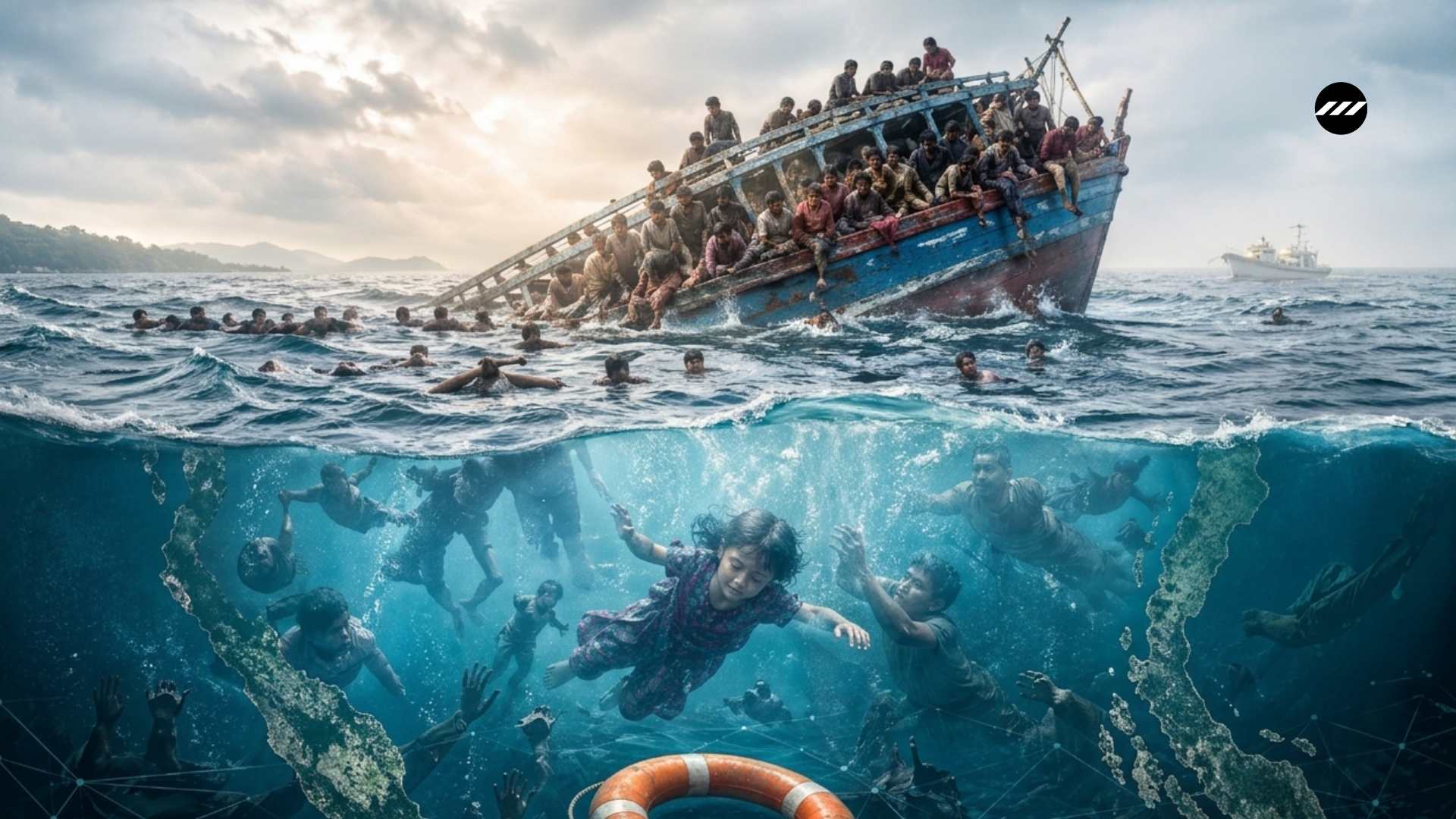
Rohingya Maritime Crisis in Andaman Sea: Governance, Humanitarian and Geopolitical Dimensions

Introduction
-
Forced migration remains a major global challenge, with over 110 million displaced persons worldwide (UN estimates).
-
The recent capsizing of a Rohingya refugee boat in the Andaman Sea, with ~250 deaths or missing persons, highlights the human cost of statelessness and governance gaps in South and Southeast Asia.
“Where there is no justice, there can be no peace.” — Martin Luther King Jr.
Key Data Snapshot
| Indicator | Details |
|---|---|
| Refugee Group | Rohingya (Myanmar) |
| Displacement since 2017 | >7,00,000 fled to Bangladesh |
| Recent Tragedy | ~250 dead/missing |
| Route | Bangladesh → Malaysia (~1500 nautical miles) |
| 2025 Data | ~900 deaths in sea crossings |
1. Background & Context
The Rohingya crisis originates from:
- Denial of citizenship under Myanmar’s 1982 Citizenship Law
- Systematic discrimination and violence in Rakhine State
Consequences:
- Large-scale displacement to Cox’s Bazar (Bangladesh)
- Creation of one of the world’s largest refugee settlements
Current situation:
-
Over 1 million refugees in overcrowded camps
-
Limited access to:
- Education
- Employment
- Basic services
This pushes refugees toward dangerous sea migration routes.
2. Key Concepts
A. Statelessness
-
Lack of legal nationality
-
Results in:
- Absence of rights
- Vulnerability to exploitation
B. Forced Migration
-
Movement driven by:
- Conflict
- Persecution
- Lack of livelihood
C. Human Trafficking Networks
- Exploit refugee desperation
- Charge high fees for unsafe journeys
3. Causes of Maritime Crisis
A. Structural Drivers
- Statelessness of Rohingya
- Prolonged displacement without durable solutions
B. Economic Vulnerability
- Funding cuts → reduced food rations
- Lack of livelihood opportunities
C. Smuggling Networks
- Overcrowded boats
- Poor safety conditions
- Minimal supplies
D. Governance Failures
- Denial of disembarkation
- Pushbacks at sea
4. Comparison: Andaman Sea vs Mediterranean Crisis
| Aspect | Andaman Sea | Mediterranean Sea |
|---|---|---|
| Legal Framework | Weak / absent | Structured (EU system) |
| Rescue Mechanisms | Ad hoc | Organized missions (Mare Nostrum, Sophia) |
| Institutional Role | Limited | Strong (Frontex, EU asylum system) |
| Legal Accountability | Minimal | Court rulings (ECHR) |
Key Insight
- Mediterranean operates within legal-institutional framework
- Andaman region shows governance vacuum
5. Governance Vacuum in South & Southeast Asia
A. Lack of Legal Framework
-
Countries like India, Bangladesh, Thailand, Malaysia:
- Not signatories to 1951 Refugee Convention
-
Leads to:
- Absence of binding obligations
- Ad hoc responses
B. Regional Limitations
-
Association of Southeast Asian Nations:
- Limited by non-interference principle
- Internal divisions weaken response
C. Weak International Coordination
-
Limited burden-sharing
-
Dependence on agencies like:
- UNHCR
- International Organization for Migration
6. Geopolitical Dimensions
A. Myanmar Conflict
- Rise of Arakan Army
- Continued instability in Rakhine State
B. Bangladesh’s Constraints
- “Compassion fatigue”
- Limited leverage for repatriation
C. China’s Strategic Role
-
Influence in Myanmar via:
- Infrastructure projects (e.g., Kyaukphyu Port)
-
Strategic presence in Bay of Bengal
D. India’s Dilemma
-
Balancing:
- Security concerns (insurgency, border issues)
- Humanitarian obligations
7. Humanitarian Implications
-
High mortality rates in sea crossings
-
Exposure to:
- Starvation
- Dehydration
- Violence
Trend:
- Increasing departures despite risks
- Indicates absence of viable alternatives
8. Key Challenges
A. Legal Challenges
- Lack of refugee protection frameworks
B. Political Challenges
- Diverging national interests
- Weak regional cooperation
C. Security Challenges
-
Linkages with:
- Trafficking
- Insurgency
D. Humanitarian Challenges
- Overcrowded camps
- Declining international aid
9. Way Forward
-
Develop regional refugee protection framework
-
Strengthen:
- Maritime rescue coordination
- Legal accountability mechanisms
-
Enhance:
- International burden-sharing
-
Address root causes:
- Safe repatriation
- Citizenship rights in Myanmar
Conclusion
The Rohingya maritime crisis is not merely a migration issue but a systemic failure of governance, legal protection, and geopolitical will. Without coordinated regional action and sustained international engagement, such tragedies will continue, undermining both human security and regional stability.
Attribution
Original content sources and authors


Syllabus classification
How this article maps to GS papers
Main syllabus
GS1PopulationQuick Q&A
What are the structural causes behind the recurring Rohingya maritime tragedies in the Andaman Sea?
Push factors and systemic vulnerabilities: Life in Cox’s Bazar camps is marked by overcrowding, limited access to education and employment, and declining humanitarian aid. Funding cuts since 2023 have worsened food insecurity, pushing refugees toward desperate survival strategies. Human smuggling networks exploit this vulnerability, offering risky sea journeys to Malaysia, where informal labour opportunities exist. These journeys are undertaken in overcrowded and unseaworthy vessels with minimal supplies, increasing the likelihood of disasters.
Governance and institutional gaps: The absence of a regional refugee protection framework in South and Southeast Asia further aggravates the crisis. Countries in the region are not signatories to the 1951 Refugee Convention, leading to ad hoc responses such as pushbacks and denial of disembarkation. This governance vacuum, coupled with geopolitical constraints and lack of coordinated rescue mechanisms, perpetuates a cycle of tragedy in the Andaman Sea.
Why is the Rohingya maritime crisis considered a significant humanitarian and geopolitical concern?
Geopolitical implications: Beyond humanitarian concerns, the crisis has significant geopolitical ramifications. Countries like Bangladesh face ‘compassion fatigue’ as they host over a million refugees with limited resources. India, meanwhile, confronts a strategic dilemma between humanitarian obligations and national security concerns, particularly in sensitive border regions like Mizoram and Manipur. China’s influence in Myanmar, through projects like Kyaukphyu Port, complicates international efforts, as Beijing prioritizes strategic interests over humanitarian intervention.
Regional stability and security: The crisis also affects regional stability by fueling human trafficking networks, irregular migration, and potential security threats. The lack of coordination among ASEAN countries, due to the principle of non-interference, has resulted in policy paralysis. Thus, the Rohingya maritime crisis is not just a humanitarian issue but a complex interplay of politics, security, and international relations.
How does the Andaman Sea crisis compare with the Mediterranean migration crisis in terms of governance and response?
Differences in institutional response: A key distinction lies in the presence of structured governance mechanisms in Europe. Initiatives such as Italy’s Operation Mare Nostrum and EU-led Operation Sophia demonstrate coordinated rescue and anti-smuggling efforts. Additionally, institutions like Frontex and the Common European Asylum System provide regulatory frameworks for migration management. Legal accountability is also enforced, as seen in the Hirsi Jamaa v. Italy judgment, which ruled against pushbacks.
Governance vacuum in Southeast Asia: In contrast, the Andaman Sea lacks binding legal frameworks and coordinated rescue operations. Regional responses remain ad hoc, with instances of delayed disembarkation and pushbacks. ASEAN’s non-interference principle further limits collective action. This absence of institutional mechanisms creates a governance vacuum, making the Andaman crisis more precarious and less regulated compared to the Mediterranean.
What factors have contributed to the rise in dangerous sea journeys by Rohingya refugees in recent years?
Pull factors and migration networks: Malaysia serves as a major destination due to its demand for informal labour and existing Rohingya diaspora networks. Smugglers capitalize on these aspirations, promising safe passage but often delivering dangerous journeys. The absence of legal migration pathways forces refugees to depend on these illicit networks, increasing their vulnerability to exploitation and abuse.
Policy and enforcement gaps: The lack of a cohesive regional policy framework exacerbates the situation. Countries often resort to deterrence measures such as pushbacks, which do not address root causes but instead force migrants into more dangerous routes. Historical precedents, such as the 2015 boat crisis, illustrate how crackdowns on trafficking without alternative solutions can leave thousands stranded at sea. Thus, a combination of push and pull factors, along with policy failures, drives the surge in risky maritime migration.
Critically analyze the role of regional and international actors in addressing the Rohingya crisis.
Influence of global powers: International actors have also exhibited limitations. While agencies like UNHCR and IOM provide critical humanitarian assistance, their efforts are constrained by funding shortages and lack of political backing. China’s strategic interests in Myanmar, particularly through infrastructure investments, have influenced its stance, often prioritizing stability over accountability. Western countries, though vocal, have struggled to exert meaningful pressure on Myanmar’s military regime.
Need for coordinated action: The fragmented response highlights the absence of a unified strategy. Effective resolution requires burden-sharing, stronger international legal frameworks, and sustained diplomatic engagement. Without addressing geopolitical rivalries and aligning interests, efforts to resolve the crisis will remain inadequate and reactive.
Using the April 2026 Andaman Sea tragedy as a case study, what lessons can be drawn for improving refugee protection and maritime governance?
Key lessons: First, there is an urgent need for strengthening maritime search and rescue (SAR) systems in the region. Countries must collaborate to ensure rapid response to distress situations. Second, addressing root causes such as statelessness and lack of livelihood opportunities is crucial to reduce forced migration. Third, dismantling smuggling networks requires coordinated law enforcement and intelligence sharing among countries.
Policy implications and way forward: The tragedy underscores the importance of establishing a regional refugee framework aligned with international norms. Learning from the Mediterranean experience, Southeast Asia can develop institutional mechanisms for rescue, asylum processing, and legal accountability. Additionally, increased international funding and burden-sharing are essential to support host countries like Bangladesh. Without these measures, such tragedies are likely to recur, reflecting a continued failure of governance and humanitarian responsibility.
Practice questions
2 questions for mains preparation