Bengaluru's Drinking Water Crisis: A Growing Challenge
Introduction
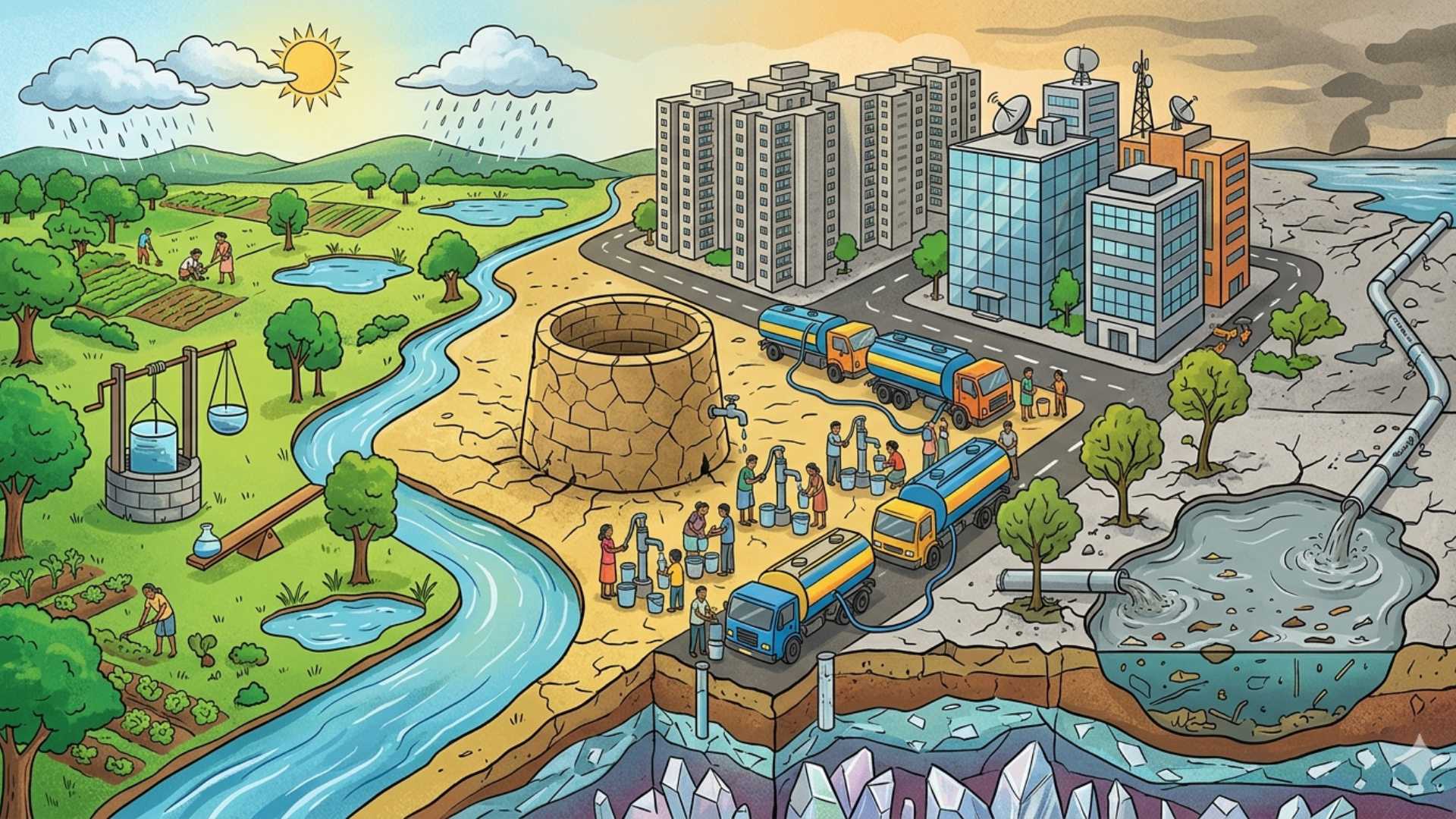
India is home to the world's largest groundwater user, accounting for nearly 25% of global groundwater extraction. Within this national challenge, Bengaluru presents a microcosm of urban water governance failure — a city built on crystalline rock with low water storage capacity, extracting groundwater at 378% of sustainable levels in its eastern taluka even as Karnataka overall draws only 66% of its sustainable limit. The crisis is not purely natural; it is the cumulative outcome of inconsiderate urbanisation, fragmented water governance, and a persistent preference for supply-side solutions over ecological restoration.
"Cities that ignore their hydrological geography eventually pay an existential price — not just an economic one." — broadly reflected in NITI Aayog's Composite Water Management Index findings
Key Concepts
Sustainable Groundwater Extraction — The volume of groundwater that can be withdrawn without permanently depleting the aquifer's recharge capacity. Extraction beyond this threshold causes irreversible aquifer damage over time.
Sponge City — An urban planning model that maximises natural water absorption through permeable surfaces, restored wetlands, and lake-well connectivity, reducing dependence on engineered supply infrastructure.
Grey vs. Green Infrastructure
| Type | Description | Bengaluru's Bias |
|---|---|---|
| Grey | Pipes, borewells, tankers, treatment plants | Over-relied upon |
| Green | Lakes, wetlands, permeable surfaces, urban forests | Systematically neglected |
Crystalline Rock Aquifers — Hard rock formations with low porosity and slow recharge rates. Bengaluru sits on such geology, making groundwater replenishment inherently slow and extraction-sensitive.
Root Causes: A Layered Analysis
Natural Basis
- Bengaluru's crystalline rock geology stores minimal water and recharges slowly — structural vulnerability precedes urbanisation.
- Cauvery River supply is the primary alternative but carries high expansion costs and interstate treaty constraints.
Urbanisation-Induced Stress
- Impermeable built-up surfaces (tech parks, apartment complexes, roads) suppress rainwater percolation — the city literally seals itself against replenishment.
- Population density concentrates demand in areas with the lowest natural recharge capacity.
- 2024 weak monsoon left nearly half of Bengaluru's 14,000 borewells dry — exposing the fragility of the extraction-dependent model.
Governance Failure
- Pipeline supply, groundwater, and wastewater are managed in silos — no integrated urban water management framework.
- Consumers default to tankers when institutional supply fails — an unregulated, costly, and ecologically damaging fallback.
- The 775 MLD supply project for 110 villages has achieved only midway coverage as of 2026.
- A 2026 study confirms the crisis has spread to Koramangala and Hebbal — geographic expansion of the stress zone.
The Governance Gap: Supply vs. Demand Thinking
Bengaluru's water policy operates on a supply expansion logic — more borewells, more Cauvery water, more tankers — treating supply as infinitely expandable. This approach:
- Liquidates ecological capital faster than it can regenerate
- Passes monetary and existential costs to ordinary residents
- Creates perverse incentives — overextraction remains cheaper than conservation for individual consumers
What is missing is demand management: penalising overextraction, mandating decentralised wastewater recycling for non-potable uses, and minimising distribution losses in the existing pipeline network.
Policy Interventions Needed
| Intervention | Type | Rationale |
|---|---|---|
| Sponge city framework | Long-term structural | Restore lake-well connectivity; align land use with recharge capacity |
| 100% decentralised wastewater recycling | Regulatory mandate | Reduce potable water demand for non-potable uses |
| Penalise overextraction | Economic instrument | Internalise ecological cost into pricing |
| Integrated water management | Institutional reform | Unify pipeline, groundwater, wastewater governance |
| Taluka-level recharge mapping | Planning tool | Match development density to aquifer capacity |
| Minimise distribution losses | Operational fix | Reduce systemic wastage before expanding supply |
Conclusion
Bengaluru's groundwater crisis is ultimately a failure of urban imagination — the inability to see a city as an ecological system rather than an engineering problem. Supply-side fixes have repeatedly deferred the reckoning without resolving it; the 2026 spread to Koramangala and Hebbal confirms that deferral has limits. The transition to a sponge city model — porous, restorative, and ecologically aligned — is not an environmental aspiration but an administrative necessity. India's rapidly urbanising cities must learn from Bengaluru's trajectory before they replicate it.
Attribution
Original content sources and authors
Syllabus classification
How this article maps to GS papers
Main syllabus
GS1UrbanisationQuick Q&A
What is the Women’s Reservation Act (Nari Shakti Vandan Adhiniyam), and what are its key features?
Key features of the Act include:
- Reservation of one-third seats for women in Lok Sabha and State Assemblies
- Sub-reservation for women belonging to SCs and STs within the quota
- Implementation linked to the next delimitation exercise after the Census
- Rotation of reserved constituencies after each delimitation
The Act is designed as a structural reform to ensure gender inclusivity in governance. However, its implementation is contingent upon delimitation, which has raised concerns about delays.
Significance: It represents a shift from welfare-oriented policies for women to empowerment through political representation. By ensuring women’s presence in legislative bodies, the Act is expected to influence policy priorities, governance outcomes, and societal attitudes toward gender roles.
Why is women’s political representation important for a लोकतांत्रिक society like India?
Importance can be understood through the following dimensions:
- Inclusive policymaking: Women legislators tend to prioritise issues such as health, education, gender-based violence, and social welfare.
- Democratic legitimacy: A representative legislature enhances trust in institutions and strengthens democracy.
- Role modelling: Increased participation inspires more women to engage in politics and public life.
Empirical evidence from Panchayati Raj Institutions shows that women leaders have improved governance outcomes in sectors like sanitation, drinking water, and education.
Broader implications: Women’s representation contributes to social transformation by challenging patriarchal norms. It also aligns with global commitments such as the Sustainable Development Goals (SDG 5: Gender Equality). Thus, political empowerment is both a means and an end in achieving gender justice.
How will the implementation of the Women’s Reservation Act impact India’s political and governance landscape?
Key impacts include:
- Policy shifts: Greater focus on social sectors such as healthcare, education, and gender justice.
- Change in political culture: Potential reduction in criminalisation and increased emphasis on consensus-building.
- Strengthening grassroots linkages: Women leaders often maintain closer connections with local communities.
However, the actual impact will depend on factors such as political party support, capacity building, and institutional reforms.
Challenges in implementation:
- Delay due to linkage with delimitation and Census
- Risk of proxy representation (e.g., male family members influencing decisions)
- Lack of political training and resources for women candidates
Overall, while the Act has transformative potential, its success will depend on complementary measures like leadership training, financial support, and institutional safeguards.
Critically analyse the strengths and limitations of the Women’s Reservation Act.
Strengths:
- Corrects historical injustice: Addresses systemic exclusion of women from राजनीति.
- Enhances diversity: Brings varied perspectives into policymaking.
- Proven success at grassroots: Builds on the success of reservations in Panchayati Raj Institutions.
Limitations:
- Implementation delay: Dependent on delimitation, which may postpone benefits.
- No OBC reservation: Criticism for not including a separate quota for OBC women.
- Rotation system: May reduce accountability as constituencies change frequently.
Another concern is that reservation alone may not ensure substantive empowerment unless accompanied by capacity building and political will.
Conclusion: While the Act is a significant step toward gender equality, it should be complemented by broader reforms such as internal party democracy, campaign finance support, and social awareness. A holistic approach is necessary to translate representation into real empowerment.
What examples from India and other countries demonstrate the impact of women’s political reservation?
Indian examples:
- States like Bihar and Rajasthan have increased women’s participation to over 50% in local bodies.
- Studies show improved outcomes in sanitation, water supply, and education in women-led पंचायतों.
- Women leaders have been more responsive to issues like domestic violence and health.
Global examples:
- Rwanda: Over 60% women in Parliament, leading to progressive gender policies.
- Nordic countries: High representation has resulted in strong welfare systems and gender equality.
These examples demonstrate that reservation can act as a catalyst for both descriptive representation (numbers) and substantive representation (policy impact).
Key takeaway: While outcomes vary depending on context, the overall evidence suggests that women’s reservation contributes to better governance, inclusive development, and social transformation.
As a policymaker, how would you ensure effective implementation of the Women’s Reservation Act in India?
Key policy measures:
- Capacity building: Training programs for women representatives in legislative procedures, public policy, and governance.
- Political party reforms: Mandating parties to field women candidates beyond reserved seats.
- Financial support: Providing funding and resources to reduce entry barriers.
Additionally, institutional mechanisms such as mentorship networks and leadership academies can help women नेताओं build confidence and effectiveness.
Addressing challenges:
- Prevent proxy representation through legal safeguards
- Ensure timely Census and delimitation for implementation
- Promote awareness campaigns to change societal attitudes
Case-based approach: Lessons can be drawn from successful PRI models, where continuous training and community engagement improved outcomes.
Conclusion: The Act’s success depends on a holistic ecosystem that supports women leaders. With the right policies, it can transform India’s democratic framework into a more inclusive and equitable system.
Practice questions
1 question for mains preparation