Building Hazards: Ensuring Safety Against Fire Risks

Introduction
"Every major fire accident in an Indian city tells a different story — but the endings are tragically similar."
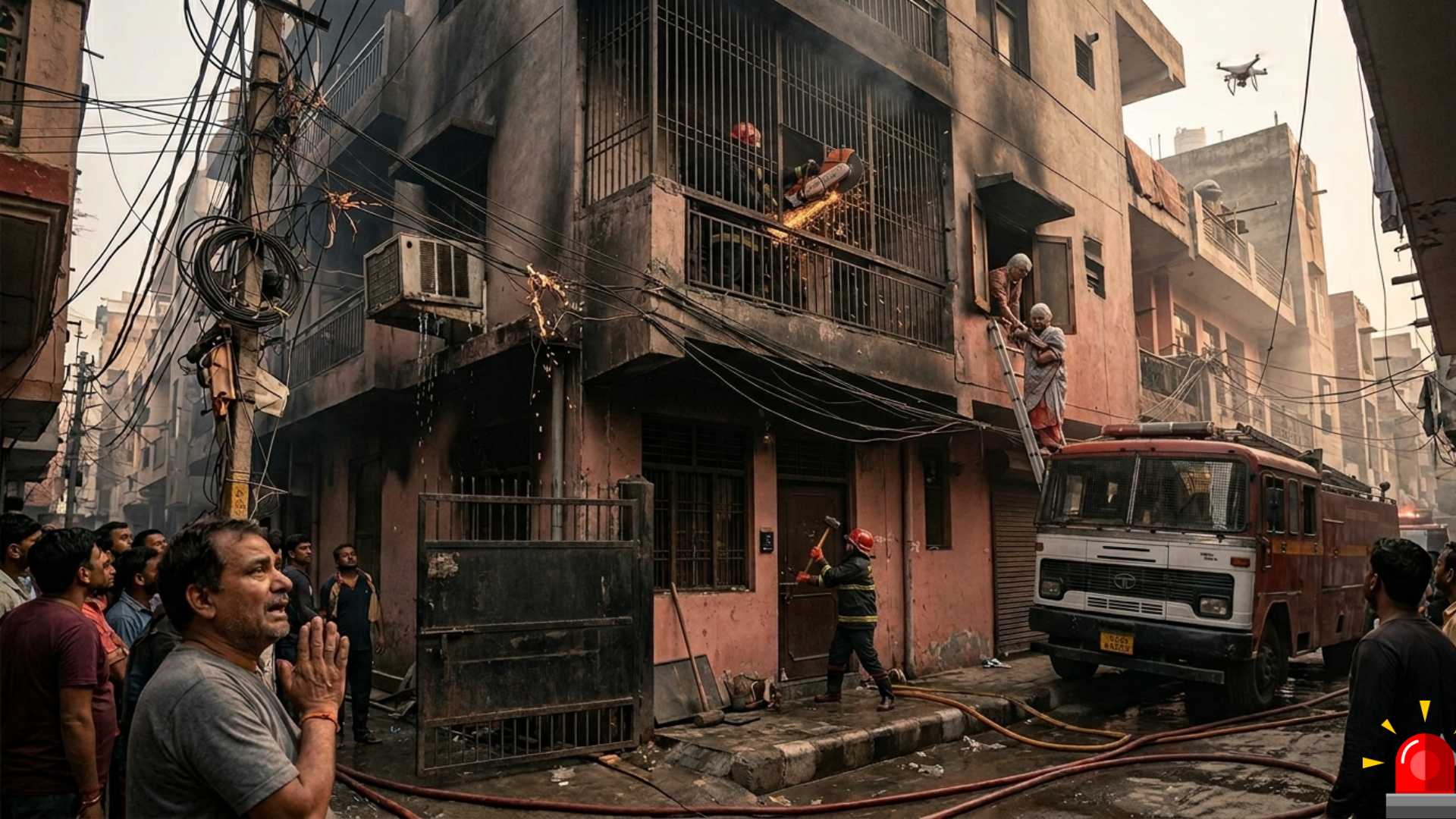
The Shahdara fire in East Delhi (residential building, stilt + four floors, eight houses) killed nine people and left fifteen with grievous injuries. What makes this case particularly instructive for governance is not just what was absent, but what was present and fatal — safety features that turned lethal.
When Security Becomes a Hazard
The Shahdara building had features designed to protect its residents. In an emergency, they did the opposite:
Security features that became death traps:
→ Electronic locks on doors — could not be opened during the fire
→ Terrace — not easily accessible for escape or rescue
→ Metallic grills on balconies and around the building
   — had to be physically cut by fire personnel to reach victims
This is the central paradox of urban fire safety in India: the architecture of security conflicts with the architecture of evacuation. Buildings are planned for intrusion prevention; almost never for emergency exit.
Access Problems: A Recurring Crisis
The Shahdara incident is not isolated. A pattern of access failures runs across Delhi's recent fire tragedies:
- Palam fire, March 2025 — nine members of an extended family died; mixed-use building had few of the recommended firefighting facilities; hydraulic lifts used by fire services to reach upper floors were malfunctioning
- Dwarka fire, 2025 — fire engines could not enter the residential society because the society's name board was physically blocking the gate
Fire services insist they reached Shahdara on time — but response times have been demonstrably longer in Delhi at other times, and arrival means little when access inside is blocked.
The Root Cause Nobody Addresses: Electrical Failures
While fire preparedness and response capabilities dominate the post-accident discourse, the causative factor — electrical overloading — goes consistently unaddressed:
- Summer fires are casually attributed to "AC blasts"
- The actual mechanism is overloading of high-load equipment during peak summer demand
- Overloaded wires heat up and burn
- Circuit breakers that should trip the equipment fail to do so
How electrical fires actually happen:
→ AC and other high-load equipment run continuously in summer
→ Wires not rated for such loads begin to heat
→ Circuit breaker should trip → protect the circuit
→ In most Indian homes: breaker does NOT trip
→ Why? Hierarchy of loads vs. circuit breakers not observed
→ Residences carry equipment load far beyond system capacity
→ Intent: keep equipment running at all costs
→ Reality: tripping IS a safety feature, not a malfunction
This is a systemic design failure — not individual negligence. The norm in Indian urban housing is to maximise equipment without upgrading electrical infrastructure to match.
Planning Gap: Evacuation as an Afterthought
Across all these cases, one theme dominates: buildings are not planned for evacuation.
- No accessible terraces as refuge points
- No fire escape routes independent of electronic systems
- Mixed-use buildings without mandatory firefighting facilities
- No mock drills, no resident awareness of exit protocols
City authorities, meanwhile, speak of drones and robots for firefighting — while basic preventive infrastructure remains absent. This is the governance irony: technological ambition without foundational compliance.
Conclusion
-
India's urban fire tragedies follow a predictable script: an overloaded electrical system ignites, locked grills trap residents, fire engines arrive but cannot enter, and hydraulic equipment malfunctions.
-
The post-mortem blames the fire service. The pre-mortem — which never happens — would blame planning norms that treat security and evacuation as separate problems, electrical codes that are unenforced, and a municipal culture that chases technological solutions before solving basic ones.
Until evacuation planning becomes as mandatory as construction approval, the fires will keep telling the same story.
Attribution
Original content sources and authors


Syllabus classification
How this article maps to GS papers
Main syllabus
GS1UrbanisationQuick Q&A
What is the significance of evidence-based policymaking in modern governance?
The significance of evidence-based policymaking lies in its ability to improve the effectiveness and accountability of governance. Policies grounded in empirical evidence are more likely to achieve intended outcomes, reduce wastage of public resources, and build public trust. For example, during the COVID-19 pandemic, countries that relied on real-time health data and scientific modelling were better able to manage hospital capacity, vaccination strategies, and containment measures.
Key advantages include:
- Improved policy efficiency: Data-driven policies can target beneficiaries more accurately.
- Transparency and accountability: Decisions can be justified using measurable indicators.
- Better resource allocation: Governments can prioritise sectors with the highest social impact.
- Adaptive governance: Policies can be modified based on continuous feedback.
However, evidence-based policymaking also faces challenges such as poor data quality, bureaucratic resistance, and political pressures. Therefore, governments must strengthen statistical systems, institutional research capacity, and collaboration between academia and administration to ensure effective governance.
Why is urban resilience becoming a major governance priority in India?
Indian cities contribute significantly to GDP generation, innovation, and employment, but they also face severe vulnerabilities. Events such as the Chennai floods, Delhi air pollution crisis, and the COVID-19 pandemic exposed weaknesses in urban planning, healthcare systems, and disaster preparedness. As a result, policymakers increasingly recognise that resilient cities are essential for sustainable development and economic stability.
Urban resilience is important because:
- Climate adaptation: Cities must handle rising temperatures, flooding, and water scarcity.
- Public health preparedness: Urban density increases vulnerability to disease outbreaks.
- Economic continuity: Disruptions in cities can affect national supply chains and productivity.
- Social inclusion: Informal settlements require stronger infrastructure and social protection.
Initiatives such as the Smart Cities Mission, AMRUT, and integrated command centres aim to improve urban resilience through technology and infrastructure upgrades. However, experts argue that resilience requires not only physical infrastructure but also institutional coordination, citizen participation, and long-term planning. Therefore, Indian cities must adopt a holistic approach combining sustainability, governance reforms, and disaster preparedness.
How can technology improve public service delivery in India?
One major contribution of technology is the reduction of leakages and corruption in welfare schemes. Through DBT, subsidies and benefits are transferred directly into beneficiaries’ bank accounts, minimising intermediaries. Similarly, digital platforms have enabled online access to services such as tax filing, passport applications, land records, and telemedicine, reducing bureaucratic delays.
Technology improves governance through:
- Greater transparency: Digital records reduce manipulation and improve traceability.
- Faster service delivery: Online systems reduce paperwork and delays.
- Financial inclusion: UPI and Jan Dhan accounts integrate citizens into the formal economy.
- Data-driven administration: Governments can use analytics for policy planning.
However, challenges such as the digital divide, cybersecurity threats, data privacy concerns, and uneven internet access continue to limit the full potential of digital governance. Therefore, India must strengthen digital infrastructure, improve digital literacy, and establish robust data protection mechanisms to ensure inclusive and secure technological transformation.
Why do public health systems often become reactive rather than preventive in developing countries?
In countries like India, rapid population growth, urbanisation, and uneven healthcare access place enormous pressure on public health infrastructure. Preventive measures such as disease surveillance, awareness campaigns, vaccination outreach, and primary healthcare strengthening may not receive sustained investment. During crises like COVID-19, testing and healthcare responses were often intensified only after infections had already spread significantly.
Key reasons include:
- Underfunding of healthcare: Public health expenditure remains relatively low.
- Shortage of healthcare personnel: Rural and underserved areas lack trained staff.
- Weak surveillance systems: Early warning mechanisms are often inadequate.
- Political pressures: Governments may prioritise visible short-term interventions.
The long-term solution lies in strengthening primary healthcare systems, investing in preventive medicine, improving epidemiological surveillance, and promoting community participation. Countries such as Thailand and Cuba demonstrate that strong preventive healthcare can significantly reduce disease burdens and healthcare costs. Therefore, developing nations must shift from crisis-driven governance toward a more resilient and preventive public health framework.
Critically analyse the role of data governance in balancing innovation and privacy in the digital age.
On one hand, effective data governance promotes innovation by enabling research, improving public services, and supporting economic growth. For example, India’s digital public infrastructure, including Aadhaar and UPI, has facilitated financial inclusion and efficient welfare delivery. Similarly, data analytics can improve disaster management, urban planning, and healthcare outcomes.
Advantages of data-driven governance include:
- Better policymaking: Governments can use data for targeted interventions.
- Economic innovation: Start-ups and industries can develop AI-driven solutions.
- Efficient public services: Digital platforms improve accessibility and transparency.
However, major concerns also exist:
- Privacy violations: Personal data may be collected without informed consent.
- Cybersecurity threats: Data breaches can expose sensitive information.
- Mass surveillance risks: Excessive state monitoring may threaten civil liberties.
- Algorithmic bias: AI systems may reinforce discrimination.
Therefore, balancing innovation and privacy requires robust legal safeguards, independent regulatory institutions, and ethical technology frameworks. India’s Digital Personal Data Protection Act represents an important step, but effective implementation and accountability mechanisms remain critical. A balanced approach must ensure that technological progress strengthens democracy and citizen rights rather than undermining them.
How can India use lessons from the COVID-19 pandemic to strengthen future disaster preparedness?
One major lesson is the importance of resilient public health systems. India expanded oxygen production, hospital infrastructure, and vaccination capacity during the pandemic, but these efforts were largely reactive. Future preparedness requires sustained investment in primary healthcare, epidemiological surveillance, and emergency stockpiles even during non-crisis periods.
Key lessons from the pandemic include:
- Strengthening healthcare infrastructure: Increase ICU capacity, medical personnel, and rural healthcare access.
- Improving coordination: Enhance cooperation between the Union, States, and local governments.
- Digital governance: Platforms like CoWIN showed how technology can support large-scale public administration.
- Social protection: Migrant workers and informal labour require stronger welfare safety nets.
- Supply chain resilience: Domestic manufacturing of critical medical equipment should be encouraged.
The pandemic also highlighted the importance of scientific communication and public trust. Countries that maintained transparent communication and community engagement managed crises more effectively. Therefore, India’s future disaster preparedness strategy must integrate healthcare resilience, technological innovation, cooperative federalism, and citizen-centric governance to handle both biological and climate-related emergencies more effectively.
Practice questions
1 question for mains preparation