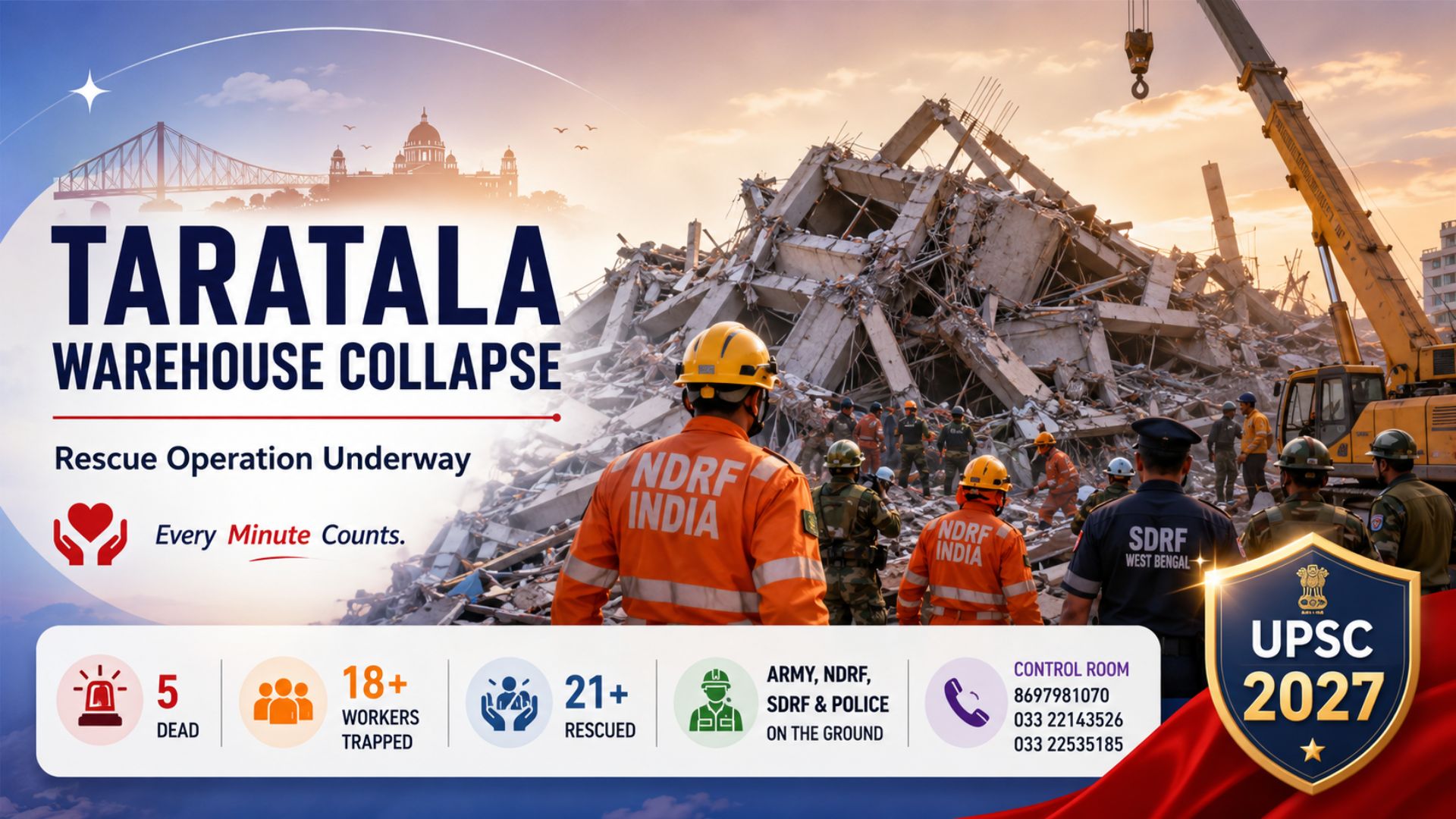
What are the major structural, governance, and regulatory issues highlighted by the Kolkata Taratala warehouse collapse, and why is this incident significant for urban infrastructure governance in India?
The collapse of an under-construction warehouse at Taratala, Kolkata, in June 2026 highlights the multidimensional challenges associated with India's rapidly expanding urban infrastructure. Urban infrastructure refers to the physical facilities and services such as buildings, roads, utilities, transport systems, and industrial structures that support economic and social activities. The incident demonstrates that infrastructure failures often arise not from a single cause but from a combination of faulty design, weak regulatory oversight, inadequate quality control, and poor compliance with construction standards. Preliminary observations by the Kolkata Municipal Corporation reportedly indicated that the sanctioned building plan itself contained flaws, prompting the State Government to suspend commercial construction projects approved under the previous administration until comprehensive audits were completed. The tragedy also underlines the importance of building codes such as the National Building Code (NBC), structural safety norms under the Bureau of Indian Standards (BIS), municipal approval mechanisms, and periodic inspections during construction. It further illustrates the need for coordination among multiple agencies including municipal corporations, NDRF, SDRF, the Indian Army, police, fire services, and medical teams during disaster response. From a UPSC perspective, the incident connects with GS-I topics on Urbanisation, GS-II themes relating to governance and disaster management institutions, GS-III issues concerning infrastructure and disaster resilience, and ethics related to public accountability. It also raises debates regarding political accountability, transparency in urban planning, contractor responsibility, independent structural audits, and enforcement of safety regulations. The case serves as a reminder that sustainable urbanisation requires not merely rapid construction but also institutional capacity, engineering excellence, accountability, and citizen safety.
Why is ensuring structural safety and regulatory compliance in urban construction projects becoming increasingly important for India's urbanisation and disaster resilience agenda?
India is experiencing one of the world's fastest rates of urbanisation, with cities contributing a majority of national economic output while simultaneously facing enormous pressure to expand housing, logistics, industrial facilities, and commercial infrastructure. In this context, structural safety has become a critical public policy concern because infrastructure failures can result in significant loss of life, economic disruption, and erosion of public trust. Incidents such as the Taratala warehouse collapse illustrate how deficiencies in planning, design approval, supervision, and construction quality can transform developmental projects into humanitarian disasters. Regulatory compliance involves adherence to municipal building by-laws, environmental norms, fire safety regulations, structural engineering standards, labour safety provisions, and periodic inspections throughout the construction lifecycle. Compliance is particularly important because urban infrastructure increasingly accommodates larger populations and higher economic activity. The Sendai Framework for Disaster Risk Reduction (2015-2030) emphasises reducing disaster risks through resilient infrastructure and better governance. Similarly, India's National Disaster Management Authority advocates integrating disaster resilience into development planning rather than treating disasters only as emergency events. For UPSC aspirants, the issue demonstrates the intersection of GS-I Urbanisation, GS-II Governance, GS-III Disaster Management, and Economic Development. It also invites discussion on Ease of Doing Business versus regulatory oversight, technological solutions such as Building Information Modelling (BIM), digital approval systems, third-party structural audits, and geo-tagged inspections. While excessive regulation may slow investments, weak enforcement can prove far more costly in terms of human lives and economic losses. Therefore, balanced regulation supported by transparency, professional accountability, and technological monitoring is essential for achieving safe and sustainable urban development.
How should disaster response agencies coordinate during urban infrastructure collapse incidents to maximise rescue efficiency and minimise casualties?
Urban infrastructure collapses require an integrated Incident Response System in which multiple agencies operate under a unified command structure instead of functioning independently. The Taratala warehouse collapse demonstrated this approach through the coordinated involvement of the National Disaster Response Force (NDRF), State Disaster Response Force (SDRF), Kolkata Police, the Indian Army, municipal authorities, medical teams, fire services, and specialised engineering personnel. Effective coordination begins immediately after receiving distress information through rapid assessment, site isolation, establishment of communication channels, and deployment of search-and-rescue resources. Technical teams use heavy machinery, cranes, gas cutters, concrete-cutting equipment, and structural engineers to safely access trapped victims while minimising secondary collapses. Medical personnel establish triage systems for immediate treatment and transportation to hospitals. Simultaneously, administrative authorities set up control rooms, helplines, family assistance centres, and media communication mechanisms to ensure transparency and prevent misinformation. Disaster response must also incorporate occupational safety measures for rescuers and continuous structural assessment to avoid further risks. The Disaster Management Act, 2005 provides the legal framework for coordinated action among central, state, and local agencies. UPSC candidates should recognise that disaster management extends beyond emergency rescue to include preparedness, mitigation, response, recovery, and reconstruction. Lessons from international experiences, such as earthquake rescue operations in Japan and urban search-and-rescue standards developed by INSARAG under the United Nations, highlight the value of specialised training and interoperable systems. The Taratala incident illustrates that rapid coordination among specialised institutions can significantly improve survival rates, but long-term resilience depends equally on preventive governance, regular inspections, and safer construction practices that reduce the likelihood of such disasters occurring in the first place.
Critically analyse whether post-disaster construction audits and temporary suspension of projects are sufficient measures to improve urban infrastructure safety in India.
Post-disaster audits and temporary suspension of construction projects are important immediate administrative responses because they help identify unsafe structures, prevent additional accidents, and restore public confidence. Following the Taratala warehouse collapse, the West Bengal Government ordered comprehensive audits of under-construction commercial projects and temporarily suspended certain construction activities. Such actions enable authorities to review building approvals, engineering designs, construction quality, and regulatory compliance. However, these measures are largely reactive rather than preventive. Sustainable urban safety requires institutional reforms that operate throughout the project lifecycle rather than only after disasters occur. India already possesses several regulatory mechanisms including municipal building by-laws, the National Building Code, BIS standards, environmental clearances, and labour safety laws. The principal challenge often lies in weak enforcement, fragmented accountability, shortage of qualified inspectors, political interference, and inadequate monitoring capacity. Independent third-party structural audits, digital approval platforms, GIS-based monitoring, drone inspections, mandatory insurance, professional licensing of structural engineers, and stronger penalties for negligence could strengthen compliance. Simultaneously, labour welfare, occupational safety training, emergency preparedness, and public disclosure of inspection reports would improve transparency. Critics argue that blanket suspensions may delay economic activity, increase project costs, and affect employment if prolonged without clear criteria. Therefore, governments must balance safety with developmental needs through risk-based regulation rather than indiscriminate restrictions. From a UPSC perspective, this issue links GS-II governance reforms, GS-III infrastructure and disaster management, and ethics concerning public accountability. The broader lesson is that resilient urbanisation depends less on emergency reactions and more on preventive governance, institutional integrity, evidence-based regulation, technological innovation, and continuous oversight.
Using the Kolkata Taratala warehouse collapse as a case study, what key policy lessons can India adopt to strengthen urban infrastructure governance and disaster preparedness?
The Taratala warehouse collapse offers a valuable case study for understanding how infrastructure governance, engineering standards, and disaster management intersect in rapidly urbanising cities. The incident involved the collapse of an under-construction commercial warehouse, resulting in fatalities, injuries, and large-scale rescue operations involving the Indian Army, NDRF, SDRF, municipal authorities, police, and medical services. Preliminary reports reportedly pointed towards deficiencies in the approved building plan, leading the State Government to order construction audits and temporary suspension of selected commercial projects. Several policy lessons emerge from this episode. First, preventive regulation must receive greater emphasis through rigorous scrutiny of structural designs before construction begins. Second, construction projects should undergo periodic third-party quality inspections instead of relying solely on initial approvals. Third, digital governance systems can improve transparency by tracking approvals, inspections, design modifications, and compliance records. Fourth, occupational safety standards for construction workers must be strengthened through mandatory training, protective equipment, emergency evacuation protocols, and strict enforcement of labour laws. Fifth, cities require well-rehearsed disaster response mechanisms integrating municipal bodies, emergency services, hospitals, and specialised rescue agencies under unified command systems. Sixth, accountability should extend across the entire project ecosystem, including developers, contractors, architects, engineers, supervising officials, and regulatory authorities. Finally, public communication through control rooms and helplines demonstrates the importance of citizen-centric governance during emergencies. For UPSC interview preparation, this case illustrates how infrastructure policy, urban planning, governance, ethics, disaster management, and sustainable development converge. It reinforces the principle that economic growth and urban expansion must always be accompanied by robust institutions, engineering excellence, transparent regulation, and a culture of safety to ensure resilient and inclusive urban development.