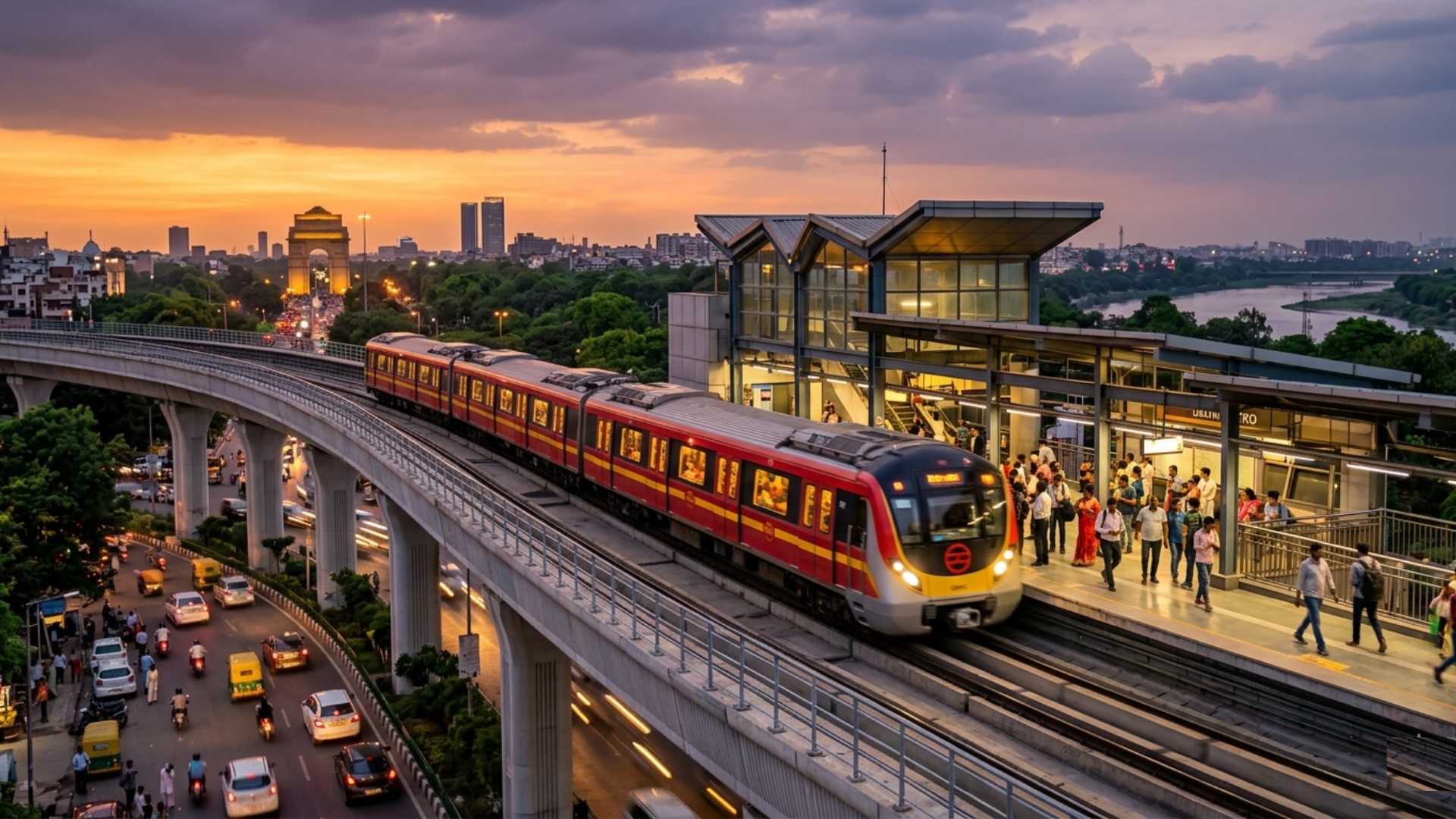
Delhi Metro: The Most Affordable Metro Network Globally
Introduction
Rapid urbanisation and rising traffic congestion have made mass rapid transit systems (MRTS) essential for sustainable urban mobility. Globally, metro rail systems are key to reducing congestion, pollution, and travel time in megacities. India now has the third-largest metro rail network in the world, after China and the United States. The Delhi Metro Rail Corporation network spans 416 km across 12 lines and 303 stations, making it one of the world’s largest urban transit systems.
Background: Evolution of Metro Rail in India
India’s metro rail journey began with the Delhi Metro, which started operations in 2002 under the leadership of E. Sreedharan.
Over two decades, metro systems have expanded rapidly to address:
- Urban congestion
- Increasing population density
- Environmental concerns
- Demand for reliable public transport
Today, metro networks operate in more than 20 Indian cities.
Key Developments in Delhi Metro (2026 Expansion)
In March 2026, Narendra Modi inaugurated new corridors and laid the foundation for further expansion.
Newly Added Corridors
| Corridor | Length | Key Areas Connected |
|---|---|---|
| Pink Line extension | 12.3 km | Burari – Bhajanpura – Yamuna Vihar |
| Magenta Line extension | 9 km | Deepali Chowk – Majlis Park |
Upcoming Phase V-A Corridors
| Corridor | Route |
|---|---|
| Corridor 1 | RK Ashram Marg – Indraprastha |
| Corridor 2 | Aerocity – IGI Airport Terminal 1 |
| Corridor 3 | Tughlakabad – Kalindi Kunj |
These projects will further strengthen the National Capital Region’s integrated transport network.
Delhi Metro as a Global Urban Transit System
Delhi Metro has emerged as one of the largest metro systems globally.
| Indicator | Data |
|---|---|
| Total network length | 416 km |
| Lines | 12 |
| Stations | 303 |
| Global ranking (network length) | 6th |
| Share of India’s metro network | ~44% |
Delhi also became the first Indian metro system to operate a full circular corridor (Pink Line ring route).
Fare Structure: Global Comparison
Despite being the costliest metro within India, Delhi Metro remains among the cheapest globally.
| City | Minimum Fare |
|---|---|
| Delhi | $0.13 |
| London | $4.68 |
| New York | $3.00 |
| Major Chinese cities | ~$0.42 |
Within India:
| City | Minimum Metro Fare |
|---|---|
| Kolkata | ₹5 |
| Ahmedabad | ₹5 |
| Most Indian cities | ₹10 |
| Delhi | ₹11 |
This demonstrates Delhi Metro’s high affordability relative to global transit systems.
Urban Transport Challenges in India
Indian cities face major mobility challenges:
- Traffic congestion
- Rising vehicle ownership
- Air pollution
- Inefficient public transport
For instance, Delhi ranks among the world’s most congested cities, making metro systems a crucial mobility solution.
Significance of Metro Systems for Urban Governance
1. Sustainable Urban Mobility
Metro systems reduce dependence on private vehicles and promote low-carbon transport.
2. Reduced Traffic Congestion
Mass transit significantly reduces road traffic in megacities.
3. Environmental Benefits
Metro rail reduces greenhouse gas emissions and air pollution.
4. Economic Productivity
Efficient urban transport reduces travel time and boosts labour productivity.
Challenges in Metro Expansion
| Challenge | Explanation |
|---|---|
| High capital cost | Metro projects require large investments |
| Last-mile connectivity | Need integration with buses and other transport |
| Financial sustainability | Fare revenues alone cannot sustain operations |
| Urban planning gaps | Coordination between multiple agencies |
Example: Delhi Metro as a Global Model
Delhi Metro is widely recognised for:
- High operational efficiency
- Clean and reliable services
- Successful public transport integration
Many Indian cities have adopted the Delhi Metro model for planning and execution.
Expert Insight
Urban transport expert E. Sreedharan once remarked:
“Efficient public transport systems are the backbone of sustainable urban development.”
Conclusion
The expansion of the Delhi Metro reflects India’s growing emphasis on sustainable urban infrastructure and mass transit systems. As urbanisation accelerates, metro rail networks will play a vital role in reducing congestion, improving air quality, and enhancing urban productivity. However, ensuring financial sustainability, last-mile connectivity, and integrated transport planning will be critical for the long-term success of metro systems across Indian cities.
Attribution
Original content sources and authors
Syllabus classification
How this article maps to GS papers
Main syllabus
GS1UrbanisationQuick Q&A
What is the significance of the Delhi Metro network in India’s urban transport system?
Its significance lies in several key areas:
- Urban mobility: The metro provides a reliable and efficient alternative to road transport in one of the most congested cities in the world.
- Environmental sustainability: By encouraging mass transit, it reduces vehicular emissions and contributes to cleaner urban air.
- Economic productivity: Efficient public transportation improves connectivity between residential areas, business districts, and industrial hubs.
The Delhi Metro also serves as a model for urban transit planning in India. Its success has inspired the development of metro rail systems in more than 20 Indian cities including Mumbai, Bengaluru, Hyderabad, and Chennai. The network has become an example of effective project management, technological innovation, and institutional efficiency.
In a rapidly urbanizing country like India, the Delhi Metro represents a critical component of sustainable urban development by improving mobility, reducing congestion, and supporting economic growth.
Why is the Delhi Metro considered one of the most affordable metro systems among major global networks?
Several factors contribute to this affordability:
- Government support: Capital costs for metro infrastructure are partly financed by central and state governments.
- Subsidised public transport policy: Public transport in India is often priced to ensure accessibility for low- and middle-income populations.
- Operational efficiency: The Delhi Metro Rail Corporation (DMRC) has achieved high operational efficiency through technological innovations and effective management.
However, affordability must also be understood in the domestic context. Although Delhi Metro fares are among the lowest globally, they remain relatively higher compared to some Indian metro systems such as Kolkata and Ahmedabad, where the minimum fare starts at ₹5.
Thus, the Delhi Metro reflects a careful balance between financial sustainability and social accessibility. Maintaining affordable fares ensures that public transport remains inclusive while encouraging greater use of mass transit systems in densely populated urban areas.
How has the expansion of the Delhi Metro contributed to improving urban mobility and reducing traffic congestion in the National Capital Region?
The expansion contributes to urban mobility in several ways:
- Reduced traffic congestion: By shifting commuters from private vehicles to public transit, the metro reduces road traffic pressure.
- Improved connectivity: Metro corridors link major economic centres, educational institutions, and transportation hubs such as airports and railway stations.
- Time efficiency: High-frequency services allow commuters to travel quickly and reliably across long distances.
The creation of the Pink Line as India’s first operational ring metro line further enhances connectivity by linking multiple radial corridors and facilitating smoother passenger transfers. This circular design improves network efficiency and reduces travel time.
In a city ranked among the most congested globally, the metro system has become the backbone of public transportation. By promoting mass transit usage, the Delhi Metro contributes to reducing travel delays, lowering pollution levels, and improving the overall quality of urban life.
What factors have contributed to the rapid expansion of metro rail networks in India over the past two decades?
Several factors have driven the growth of metro systems:
- Urbanization: India’s urban population has grown rapidly, creating pressure on existing transport systems.
- Traffic congestion: Cities such as Delhi, Mumbai, and Bengaluru experience severe traffic congestion, making mass rapid transit systems essential.
- Environmental concerns: Metro rail systems reduce reliance on private vehicles and help lower greenhouse gas emissions.
- Government policy support: Initiatives such as the Metro Rail Policy 2017 encourage the development of metro systems in major cities.
The success of the Delhi Metro has played a catalytic role. Its efficient implementation and operational success demonstrated the feasibility of metro rail as a sustainable urban transport solution. Consequently, cities across India began developing similar systems.
Today, India has the third-largest metro network in the world after China and the United States. This rapid expansion reflects the country’s commitment to building modern, sustainable urban transport infrastructure.
Critically analyse the role of metro rail systems in promoting sustainable urban development in India.
Key benefits of metro systems include:
- Environmental sustainability: Metro rail produces significantly lower emissions compared to private vehicles.
- Improved urban mobility: High-capacity systems can transport large numbers of passengers quickly and efficiently.
- Economic productivity: Efficient transport networks support economic growth by improving access to employment and markets.
However, metro projects also face certain challenges. High construction costs, long implementation timelines, and the need for complex urban planning can limit their feasibility in smaller cities. Additionally, metro systems must be integrated with other public transport modes such as buses and suburban railways to achieve maximum effectiveness.
Despite these challenges, metro rail remains a key component of sustainable urban transport strategies. When combined with integrated planning, transit-oriented development, and multimodal connectivity, metro systems can significantly enhance the livability and economic competitiveness of Indian cities.
Using the Delhi Metro as a case study, explain the importance of institutional leadership and governance in the successful implementation of large infrastructure projects.
Several governance features contributed to the project’s success:
- Professional management: The Delhi Metro Rail Corporation (DMRC) was structured as an autonomous organization with professional leadership.
- Time-bound project execution: Metro phases were completed largely within scheduled timelines and budgets.
- Transparency and accountability: Strict monitoring mechanisms reduced corruption and inefficiency.
The project also benefited from international collaboration. Financial assistance and technical expertise from organizations such as the Japan International Cooperation Agency (JICA) helped ensure high standards in design and construction.
The success of the Delhi Metro demonstrates how strong institutional frameworks, competent leadership, and effective governance can enable the timely delivery of complex infrastructure projects. It provides a valuable model for future infrastructure development initiatives across India.
Practice questions
2 questions for mains preparation