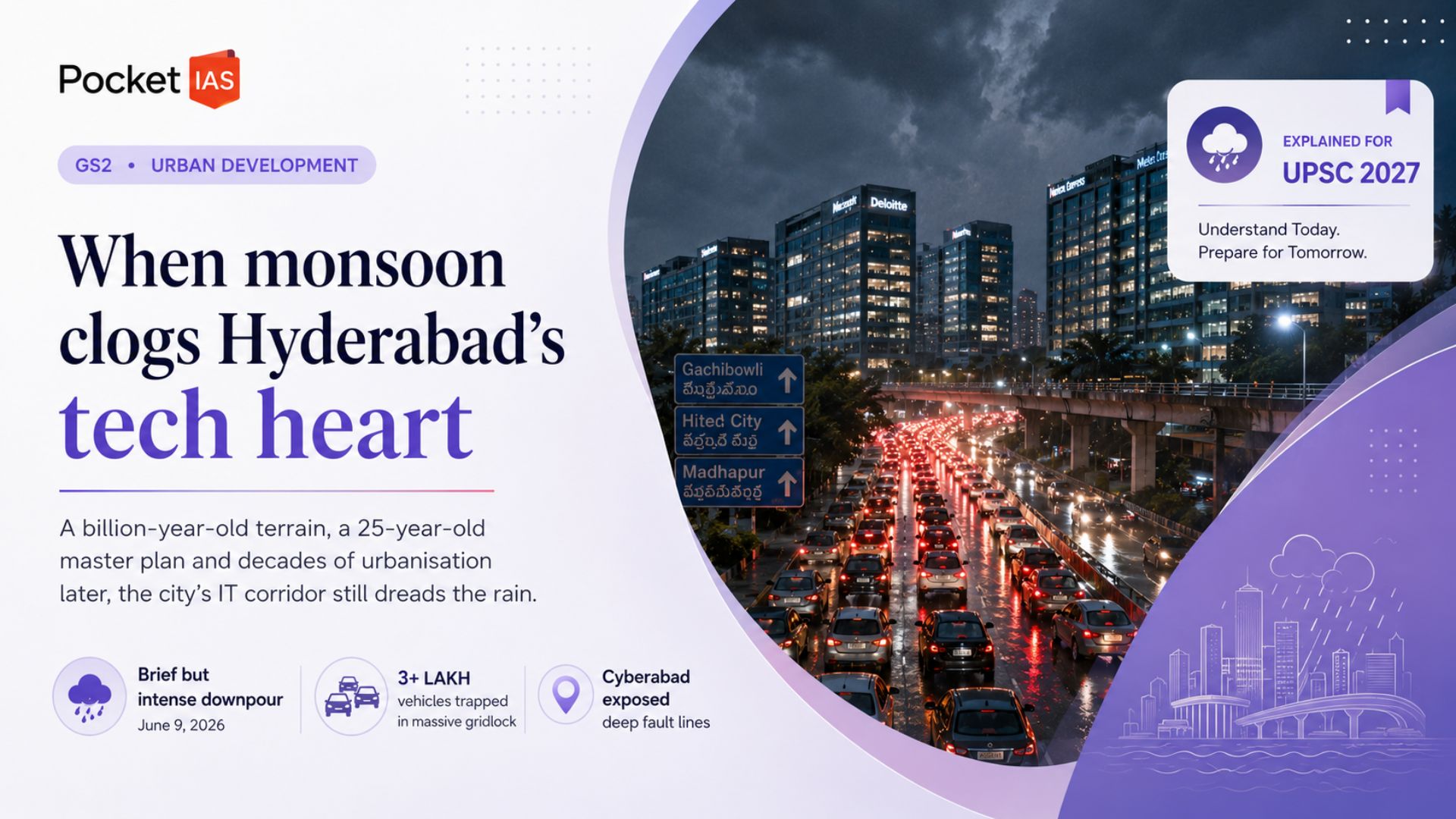
Hyderabad Floods and Traffic Paralysis: When Urban Growth Ignores Geography

The massive traffic gridlock that paralysed Hyderabad's western IT corridor on June 9, 2026, was not merely the result of heavy rainfall. It exposed the interaction between natural geography, rapid urbanisation, inadequate drainage planning, and transportation vulnerabilities.
A Rainfall Event That Brought a City to a Halt
When intense evening thunderstorms struck Hyderabad's IT corridor, lakhs of commuters found themselves trapped in unprecedented congestion.
| Impact | Details |
|---|---|
| Vehicles affected | Over 3 lakh |
| Rainfall intensity | Nearly 57 mm in one hour in some areas |
| Commute delays | Up to 3–4 hours for short distances |
| Area occupied by stranded vehicles | About 824 acres (3.34 sq km) |
"Just a few minutes of rain brought the entire traffic system to its knees." — Commuter account
The disruption occurred precisely during peak office exit hours, amplifying the impact.
Why Did the Rainfall Occur?
According to IMD meteorologists, the rainfall was a typical pre-monsoon thunderstorm event.
Meteorological Factors
-
Prolonged temperatures between 41°C and 46°C heated the land surface.
-
Temperature differences attracted moisture-laden winds from:
- Arabian Sea
- Bay of Bengal
-
Formation of cumulonimbus clouds triggered intense localised rainfall.
Pre-Monsoon vs Monsoon Rainfall
| Pre-Monsoon Thunderstorms | Monsoon Rainfall |
|---|---|
| Localised | Widespread |
| Short duration | Sustained |
| High intensity | Moderate intensity |
| Driven by afternoon heating | Seasonal circulation |
"Such thunderstorms are a common summer phenomenon following prolonged periods of intense heat." — IMD Hyderabad
The Real Issue: Geography Meets Urbanisation
Experts argue that rainfall alone does not explain the flooding.
Western Hyderabad differs significantly from older parts of the city.
| Older Hyderabad | Western Hyderabad |
|---|---|
| Relatively flat terrain | Hills and valleys |
| Natural drainage less steep | Complex slopes and channels |
| Lower runoff velocity | Rapid downhill water flow |
Historically, rainwater flowed through natural drainage paths into water bodies such as Durgam Cheruvu.
However, rapid urban development altered these pathways.
Key Problems
- Construction over natural drainage channels.
- Encroachment of low-lying areas.
- Extensive concretisation reducing water absorption.
- Ignoring geological contours during development.
"Office and residential buildings have come up along the natural pathways, blocking water flow." — Hari Sarvothaman, University of Hyderabad
Cyberabad's Planning Challenge
The roots of the problem trace back to Cyberabad's development model.
1998 → Cyber Towers established
2001 → Cyberabad Development Authority formed
2001 → Master Plan implemented
2013 → Land-use modifications in some areas
2026 → Major flooding and traffic paralysis
Although a master plan existed, critics highlight:
- Limited integration of geological expertise.
- Alteration of planned infrastructure corridors.
- Land-use changes in vulnerable zones.
These decisions increased flood susceptibility over time.
Why Small Rainfall Amounts Create Big Urban Floods
Urban flooding is amplified by impervious surfaces.
IMD's Illustration
5 cm rainfall over 1 sq km
=
50,000 cubic metres of water
=
Nearly 50 million litres
=
Around 10,000 water tankers emptied simultaneously
With limited infiltration:
- Water accumulates rapidly.
- Roads become temporary channels.
- Flood depths can reach 60–100 cm.
- Traffic movement collapses.
Why Traffic Became Unmanageable
The rainfall coincided with office closing hours across the IT corridor.
Sequence of Events
- Rain began around 5 p.m.
- Employees entered road network simultaneously.
- Waterlogging emerged at vulnerable junctions.
- Congestion spread across connected roads.
- Entire corridor entered gridlock.
Major bottlenecks included:
- Biodiversity Junction
- Cyber Gateway
- Hitec City Main Road
- IKEA Flyover
Authorities admitted that once the vehicles had entered the network, large-scale diversions became nearly impossible.
Emerging Urban Governance Lessons
The event revealed:
- New flood-prone zones.
- Inadequate real-time forecasting integration.
- Need for dynamic traffic management.
- Limits of conventional drainage solutions.
Even successful drainage improvements in some locations shifted flooding elsewhere, creating new vulnerabilities.
Way Forward
- Restore and protect natural drainage corridors.
- Integrate geological and hydrological assessments into urban planning.
- Expand permeable surfaces and rainwater infiltration systems.
- Implement real-time weather-linked traffic management.
- Enforce stricter land-use regulations in low-lying zones.
- Develop urban flood modelling and digital monitoring systems.
- Encourage staggered office timings during severe weather alerts.
Conclusion
The Hyderabad floods demonstrate that urban flooding is not solely a climatic issue but also a planning challenge. While intense rainfall acted as the trigger, the underlying causes lie in altered drainage patterns, unchecked concretisation, and development that overlooked natural geography. Building resilient cities requires aligning future urban growth with ecological and geological realities rather than attempting to overcome them through infrastructure alone.
Attribution
Original content sources and authors


Syllabus classification
How this article maps to GS papers
Main syllabus
GS1UrbanisationAlso covers
Quick Q&A
What are the major causes of urban flooding in Hyderabad and what do they reveal about the challenges of contemporary urbanisation in India?
Why is the Hyderabad flooding episode significant for understanding climate resilience, infrastructure planning and governance in Indian cities?
How did Hyderabad's geographical characteristics and historical urban development patterns contribute to the June 2026 flooding crisis?
What were the institutional and governance-related reasons behind the severe traffic gridlock witnessed during the Hyderabad rainfall event of June 2026?
Critically analyse whether climate change alone can explain the increasing frequency of urban flooding events in Indian metropolitan cities.
What lessons and policy measures can Indian cities derive from the Hyderabad flooding episode to promote sustainable and resilient urban development?
Practice questions
1 question for mains preparation