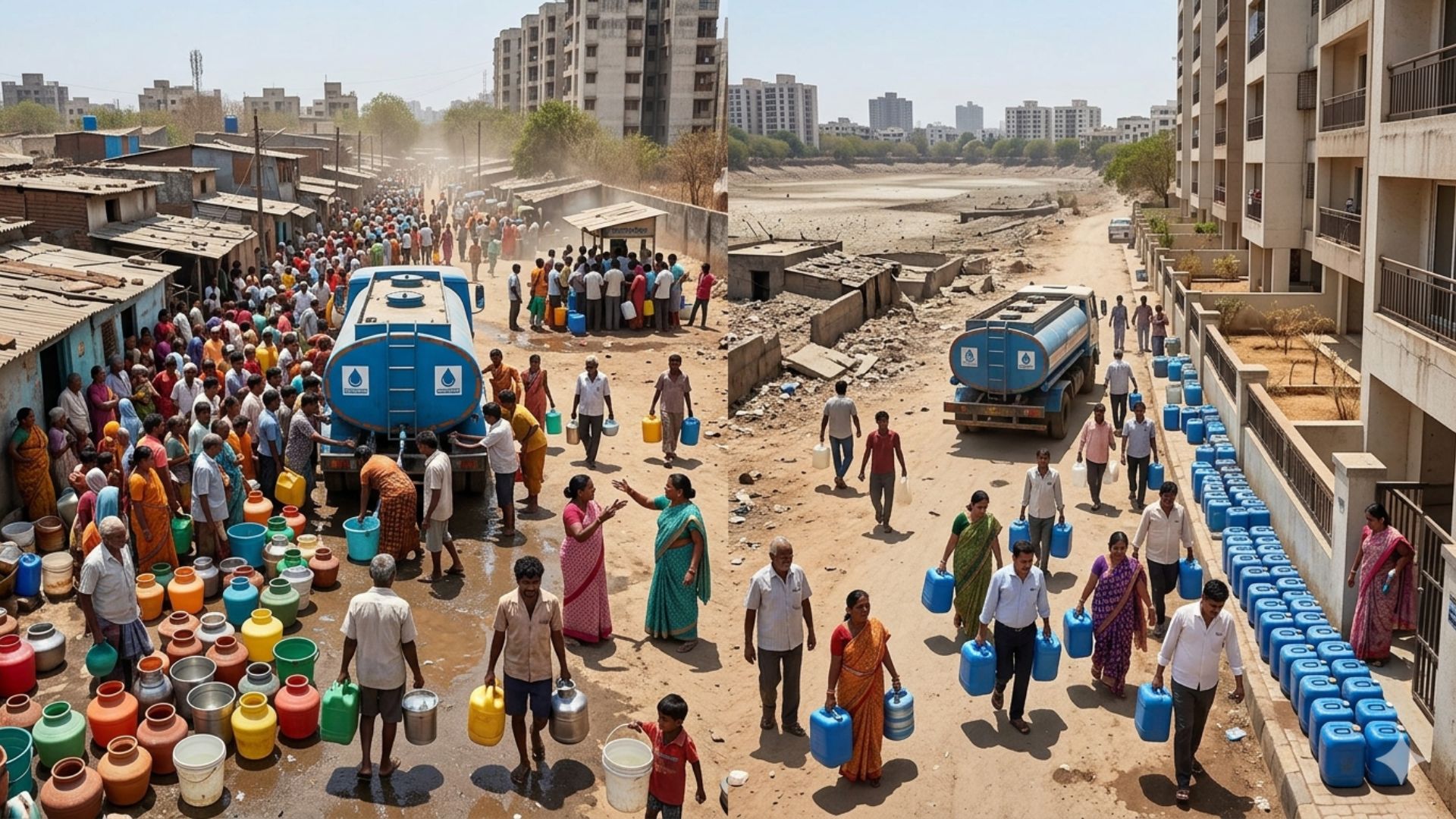
India's Urban Water Emergency: A Crisis of Governance, Not Just Scarcity
Addressing urban water shortages requires strategic planning, infrastructure development, and sustainable practices to ensure long-term water security.

Attribution
Original content sources and authors


Syllabus classification
How this article maps to GS papers
Main syllabus
GS1UrbanisationQuick Q&A
What is the nature of the urban water emergency in India and why has it become a recurring structural challenge?
The urban water emergency in India refers to the persistent and recurring shortage, inequitable distribution, and declining quality of water available to city residents. What was once considered a seasonal problem has increasingly become a structural challenge linked to rapid urbanisation, unsustainable groundwater extraction, degradation of local water bodies, and weak infrastructure management. Major cities such as Delhi, Chennai, Bengaluru, and Hyderabad have experienced severe shortages in recent years. During the summer of 2026, parts of Delhi witnessed interruptions in piped supply, forcing authorities to deploy more than 1,000 water tankers.
Historically, Indian cities depended on local lakes, tanks, ponds, and rivers. However, urban expansion and encroachment have reduced these natural buffers. Simultaneously, groundwater extraction has exceeded recharge rates, while cities have increasingly relied on distant sources requiring expensive pipelines and energy-intensive transport.
Nearly 30% of water in many urban systems is lost due to leakages before reaching consumers. Intermittent supply and contamination further aggravate public health concerns, resulting in illness, lost productivity, and increased household expenditure.
The issue has direct relevance to UPSC General Studies Paper I (Urbanisation), GS II (Governance and Public Policy), GS III (Environment and Resource Management), and Ethics. It demonstrates how development planning, environmental sustainability, and governance intersect. The crisis is not merely about scarcity but about managing unpredictability, waste, inequity, and declining water quality. Therefore, India's urban water emergency represents a governance challenge requiring integrated solutions rather than seasonal firefighting.
Why is the issue of urban water security increasingly important for UPSC aspirants and contemporary public policy debates?
Urban water security has emerged as one of the most significant governance and sustainability challenges facing India. For UPSC aspirants, the issue is important because it cuts across multiple dimensions of the syllabus, including urban development, environmental conservation, public health, disaster management, federalism, and sustainable development.
According to various estimates, India hosts nearly 18% of the world's population but possesses only about 4% of global freshwater resources. Rapid urbanisation and climate variability have intensified stress on already limited resources. Water shortages in Delhi, Chennai, Bengaluru, and Hyderabad have frequently dominated public discourse and highlighted weaknesses in urban planning.
From a policy perspective, water security directly affects economic productivity, industrial growth, public health, and social stability. Poorer sections suffer disproportionately because they depend on public standposts and expensive private tankers. Women and children are often burdened with collecting water, creating social inequities.
The issue is also linked to SDG 6 (Clean Water and Sanitation), climate adaptation, and the goals of the Jal Jeevan Mission and Atal Mission for Rejuvenation and Urban Transformation (AMRUT). Increasingly, policymakers are debating groundwater regulation, wastewater recycling, demand management, and the restoration of urban lakes.
For UPSC interviews and Mains examinations, urban water security offers opportunities to discuss cooperative governance, technological interventions, environmental ethics, and inclusive development. The topic also highlights the need for balancing economic growth with ecological sustainability. Consequently, urban water management represents a classic example of how public policy, resource conservation, and social justice are interconnected.
How do governance failures, urbanisation patterns, and infrastructure deficiencies contribute to recurring water shortages in Indian cities?
Recurring water shortages in Indian cities are largely the result of cumulative governance failures rather than sudden climatic events. Rapid urbanisation has outpaced the capacity of existing water infrastructure, leading to excessive dependence on groundwater and distant river systems.
Historically, traditional water bodies such as lakes, tanks, ponds, and stormwater channels acted as natural reservoirs. Encroachments and unplanned development have reduced their capacity, making cities vulnerable to both floods and droughts. Consequently, a city may experience inundation after heavy rainfall and severe scarcity a few weeks later.
Infrastructure deficiencies worsen the situation. Water distribution systems are often old and poorly maintained, resulting in losses approaching 30% through leakages. Intermittent supply and damaged pipelines increase contamination risks. In many areas, wastewater management systems are inadequate, allowing sewage infiltration and compromising water quality.
Governance fragmentation is another major factor. Multiple agencies share responsibilities for supply, sewage, groundwater regulation, and urban planning, often leading to coordination failures. Regulatory mechanisms for borewells and groundwater extraction remain weak, encouraging overexploitation.
Examples from Chennai's 2019 water crisis and Bengaluru's groundwater depletion illustrate how poor planning can intensify scarcity. Climate change further compounds these problems by increasing the frequency of heatwaves and rainfall variability.
This issue has relevance to GS II (Governance), GS III (Environment and Disaster Management), and Essay papers. It underlines that water scarcity is fundamentally a problem of institutions and management. Effective solutions require integrated urban planning, stronger regulations, infrastructure maintenance, and community participation rather than simply identifying new water sources.
What are the major reasons behind the increasing dependence of Indian cities on tankers and groundwater extraction systems?
The growing dependence of Indian cities on water tankers and groundwater extraction reflects long-term neglect of local water systems and rising urban demand. One of the primary reasons is the mismatch between population growth and infrastructure expansion. Cities have expanded rapidly without corresponding investments in supply networks and storage facilities.
A second factor is the depletion and encroachment of lakes, ponds, and wetlands. Traditional water bodies that historically acted as buffers have been converted into residential and commercial areas. Consequently, natural recharge mechanisms have weakened.
Third, weak groundwater governance has encouraged excessive borewell drilling. Individuals, industries, and commercial establishments often extract groundwater faster than aquifers can replenish. This has been particularly visible in Bengaluru and Chennai, where groundwater levels have fallen sharply.
Another reason is the tendency of governments to prioritise large projects and distant water sources instead of maintaining existing infrastructure. Leakages and non-revenue water account for significant losses, forcing authorities to depend on supplementary tanker supplies during summer.
Climate variability and recurring heatwaves have further intensified demand. Rising temperatures increase domestic and industrial consumption, while erratic rainfall affects recharge patterns.
The tanker economy itself has generated controversies regarding transparency, pricing, and sustainability. Questions are often raised regarding the sources from which private suppliers obtain water and the environmental consequences of excessive extraction.
For UPSC preparation, these factors relate to GS I (Urbanisation), GS III (Environment and Resource Management), and Ethics. They illustrate the importance of sustainable resource governance and demonstrate how short-term solutions can create long-term vulnerabilities when institutional reforms are neglected.
What practical measures and policy interventions can help Indian cities address water scarcity and improve water security?
Addressing urban water scarcity requires a combination of immediate interventions and long-term structural reforms. No single solution is sufficient; rather, a portfolio of measures is necessary.
First, cities should prepare transparent emergency water plans. Public disclosure of reservoir levels, supply schedules, and priority allocation to vulnerable areas can reduce panic and improve trust. Such information-sharing mechanisms strengthen accountability and citizen participation.
Second, reducing water losses through leak detection and infrastructure maintenance offers substantial gains. Since nearly 30% of water in many systems is lost before reaching consumers, even modest improvements can effectively create new sources without major investments.
Third, demand management is essential. Government offices, commercial establishments, and residential societies can conduct water audits, repair leaks, and adopt efficient fixtures. Community-based monitoring can encourage responsible consumption.
Fourth, rainwater harvesting and restoration of urban lakes and wetlands can improve groundwater recharge and enhance resilience against droughts. Chennai's emphasis on rainwater harvesting has often been cited as an important example of policy innovation.
Fifth, wastewater treatment and reuse can augment supplies. Low-cost improvements such as desludging and optimising treatment plants can reduce pollution while increasing the availability of recycled water.
Finally, strengthening groundwater regulations and integrating urban planning with water management are critical. Programmes such as AMRUT, Smart Cities Mission, and Jal Jeevan Mission provide institutional support for these reforms.
These measures are relevant to GS II and GS III and demonstrate how governance, technology, and citizen participation together can create sustainable urban water systems. They also align with the principles of circular economy and sustainable development.
What is a critical analysis of India's traditional approach to urban water management and its limitations?
A critical analysis of India's urban water management reveals that policy responses have often been reactive rather than preventive. Governments frequently treat water shortages as seasonal emergencies and rely on short-term measures such as tanker deployment, emergency borewells, and diversion of supplies from distant reservoirs.
While these interventions provide immediate relief, they do not address underlying causes such as infrastructure leakages, groundwater depletion, and degradation of local ecosystems. Excessive focus on supply augmentation has overshadowed demand management and conservation. Large projects involving long pipelines and inter-basin transfers are expensive and environmentally contentious.
Another limitation is institutional fragmentation. Different agencies manage drinking water, sewage, groundwater, and urban planning, leading to poor coordination. The absence of integrated water governance often results in inefficiencies and duplication of efforts.
Social inequity is another concern. Wealthier communities can purchase tanker water and install private borewells, whereas informal settlements and poorer households face disproportionate hardships. Thus, water scarcity becomes an issue of distributive justice.
Environmentalists argue that restoring urban lakes, wetlands, and aquifers should receive greater priority. Public health experts emphasize water quality and wastewater treatment, while economists advocate pricing reforms and efficiency improvements. Critics, however, caution that excessive commercialization may affect affordability and equity.
The debate highlights the need for integrated urban water management, which combines conservation, recycling, infrastructure upgrades, and community participation. This topic is highly relevant to GS II, GS III, and Ethics. It demonstrates that sustainable governance requires balancing efficiency, equity, and ecological integrity rather than relying solely on engineering solutions.
What lessons can be drawn from recent urban water crises in cities such as Delhi, Chennai, Bengaluru, and Hyderabad for future policymaking?
Recent water crises in Delhi, Chennai, Bengaluru, and Hyderabad provide important case studies for understanding the vulnerabilities of Indian cities and the reforms required for sustainable water governance.
Delhi's recurring summer shortages and deployment of more than 1,000 tankers illustrate the limitations of emergency responses. Dependence on external river sources and uneven distribution networks have created recurring stress despite significant investments.
Chennai's 2019 crisis became a national symbol of urban water vulnerability when major reservoirs nearly dried up. The episode highlighted the dangers of overdependence on monsoon rainfall and groundwater. At the same time, Chennai's rainwater harvesting initiatives demonstrated how policy interventions can partially mitigate scarcity.
Bengaluru's rapid expansion has led to the decline of interconnected lakes and heavy dependence on groundwater and Cauvery River water. Experts have warned that unsustainable extraction and unplanned urbanisation could worsen future shortages.
Hyderabad has also experienced recurring stress due to increasing demand and infrastructure constraints. These examples show that urban water crises are not isolated incidents but manifestations of broader governance and ecological challenges.
Several lessons emerge. First, cities must restore local water bodies and recharge systems. Second, leak reduction and wastewater recycling can significantly augment supplies. Third, transparent communication and emergency preparedness are essential. Fourth, integrated planning involving multiple agencies is indispensable.
These case studies are relevant to GS I, GS II, GS III, and Essay papers. They demonstrate that resilience depends not only on engineering infrastructure but also on institutions, ecological restoration, and citizen participation. Consequently, future policymaking must shift from crisis management to long-term water security strategies.
Practice questions
1 question for mains preparation