Urban Fire Safety in India: The Need for Safer Growth Amid Rapid Urbanisation

"Development without safety is not progress; it merely shifts risks from poverty to preventable disasters."
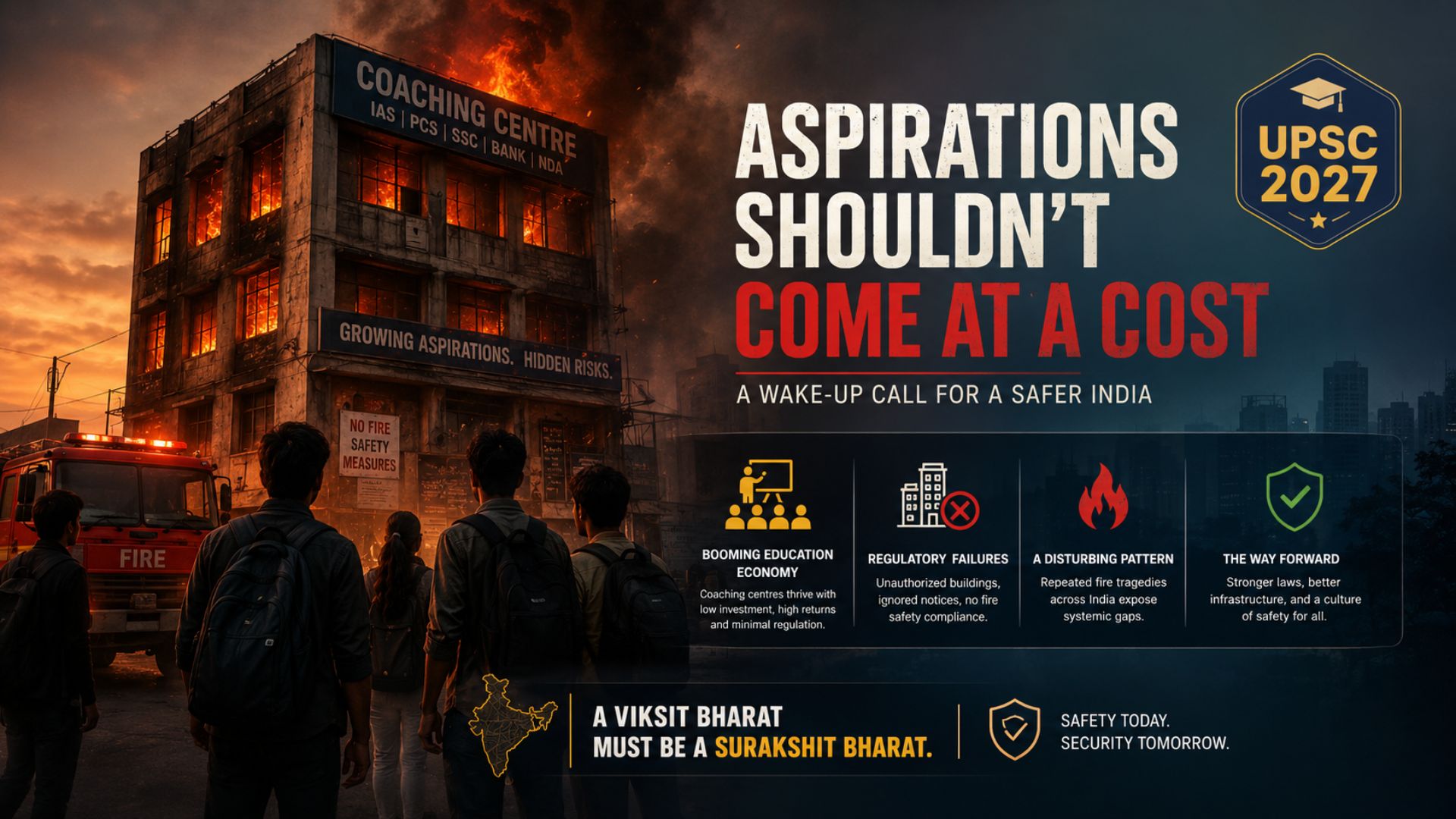
The recent Lucknow coaching centre fire, which claimed 15 lives and injured several others, highlights a growing contradiction in India's development journey. While expanding education and urban services reflect rising aspirations, weak regulatory enforcement and poor fire safety continue to expose citizens to avoidable tragedies.
The Lucknow Fire: More Than an Isolated Incident
The incident reflects two parallel realities:
| Positive Trend | Emerging Challenge |
|---|---|
| Rapid growth of the education and coaching industry | Weak regulation and unsafe commercial infrastructure |
| Rising aspirations among youth | Unplanned urbanisation and poor enforcement |
| Expanding skill ecosystem | Buildings operating without adequate safety compliance |
The three-storey building reportedly:
- Was not authorised for commercial use.
- Continued operating despite repeated civic notices.
- Lacked adequate fire safety measures.
Such violations are common in many commercial and educational establishments across India.
Why Are Coaching Centres Expanding?
Several structural factors are driving their rapid growth:
- Growing youth population seeking employment opportunities.
- Rising demand for competitive examinations and skill development.
- Slow adaptation of formal educational institutions to changing job markets.
- Emerging technologies such as Artificial Intelligence reshaping employment and skill requirements.
- Low capital investment and high profitability encouraging private coaching centres.
As demand for reskilling increases, such institutions are likely to expand further, making regulatory oversight even more critical.
Fire Accidents: A Recurring National Concern
The Lucknow tragedy is part of a broader pattern of major fire accidents witnessed across India.
Common responses often attribute such incidents simply to an "electrical fire."
However, this explanation frequently overlooks deeper technical causes.
| Technical Cause | Impact |
|---|---|
| Overloaded electrical circuits | Excess heat and short circuits |
| Poor-quality wiring | Increased fire risk |
| Harmonic currents from modern equipment | Localised overheating |
| Absence of arc-fault protection devices | Failure to prevent electrical sparks from escalating |
Understanding these root causes is essential for preventing future disasters rather than merely responding to them.
Example:
A coaching centre operating in a residential building
with overloaded electrical wiring,
multiple air-conditioners and inadequate exits
can quickly become a high-risk fire zone.
Gaps in India's Fire Safety Ecosystem
The tragedy exposes several institutional weaknesses.
Major challenges include:
- Poor enforcement of building and fire safety regulations.
- Unauthorized commercial use of residential buildings.
- Inadequate fire detection and suppression systems.
- Shortage of trained firefighting personnel.
- Limited availability of fire-forensics experts.
- Weak scientific investigation into the root causes of fire accidents.
Without detailed forensic analysis, each disaster produces few lessons for improving future safety.
Why Fire Forensics Matter
Effective fire investigations help identify:
- Exact point of fire origin.
- Technical causes of ignition.
- Structural design failures.
- Electrical faults.
- Regulatory lapses.
Such investigations enable evidence-based reforms rather than relying on generic explanations.
Example:
Instead of concluding "electrical fire",
a forensic investigation can identify whether
the cause was overloaded circuits,
faulty wiring or failure of protective devices,
allowing targeted corrective action nationwide.
Towards Safer Urban Development
India's aspiration to become a Viksit Bharat must be accompanied by stronger public safety systems.
Key reforms include:
- Strict enforcement of building occupancy and fire safety norms.
- Mandatory installation of modern fire detection and suppression systems.
- Periodic fire safety audits of educational and commercial buildings.
- Strengthening firefighting infrastructure.
- Expanding training in fire-forensics and disaster investigation.
- Ensuring accountability for repeated regulatory violations.
- Conducting a nationwide scientifically designed assessment of building safety to identify systemic vulnerabilities.
Way Forward
- Integrate fire safety into urban planning and building approvals.
- Strengthen coordination between municipal authorities, fire departments and regulatory agencies.
- Modernise electrical safety standards and inspections.
- Establish specialised fire-forensics laboratories across States.
- Promote regular fire safety drills and public awareness.
- Develop a national database on fire incidents to guide policy reforms.
- Use scientific evidence to improve building regulations and enforcement mechanisms.
Conclusion
The Lucknow fire is not merely an accident but a warning about the costs of unchecked urban growth and weak regulatory enforcement. As India expands its education and service economy, public safety must become an integral part of development planning. A truly Viksit Bharat can only be realised through a Surakshit Bharat, where growth is supported by resilient infrastructure, effective regulation and a culture of prevention rather than post-disaster response.
Attribution
Original content sources and authors


Syllabus classification
How this article maps to GS papers
Main syllabus
GS1UrbanisationAlso covers
Quick Q&A
What does the Lucknow coaching centre fire reveal about the relationship between rapid urbanisation, commercialisation of education, and deficiencies in urban infrastructure governance in India?
Why is strengthening fire safety regulations and enforcement becoming increasingly important in India's rapidly urbanising cities and commercial establishments?
How can India strengthen urban fire prevention systems through better infrastructure planning, technological interventions, and institutional reforms?
Critically analyse whether regulatory failures or technical deficiencies are the primary causes of recurring urban fire disasters in India.
Using the Lucknow coaching centre fire as a case study, explain the key policy lessons for achieving the vision of 'Viksit Bharat' through safer and more resilient urban infrastructure.
Practice questions
2 questions for mains preparation