Wastewater Surveillance Unveils Hidden COVID Surges in Bengaluru

Introduction
"When clinical testing declines and official case counts lose their reliability, where does public health look for the truth?"
Bengaluru's experience with Sewage Epidemiology — tracking COVID-19 through wastewater — offers a compelling answer. A study published in PLOS Global Public Health by researchers from IISc, ICTS-TIFR, and TIGS demonstrates both the promise and the limits of this emerging surveillance tool.
What is Wastewater Surveillance?
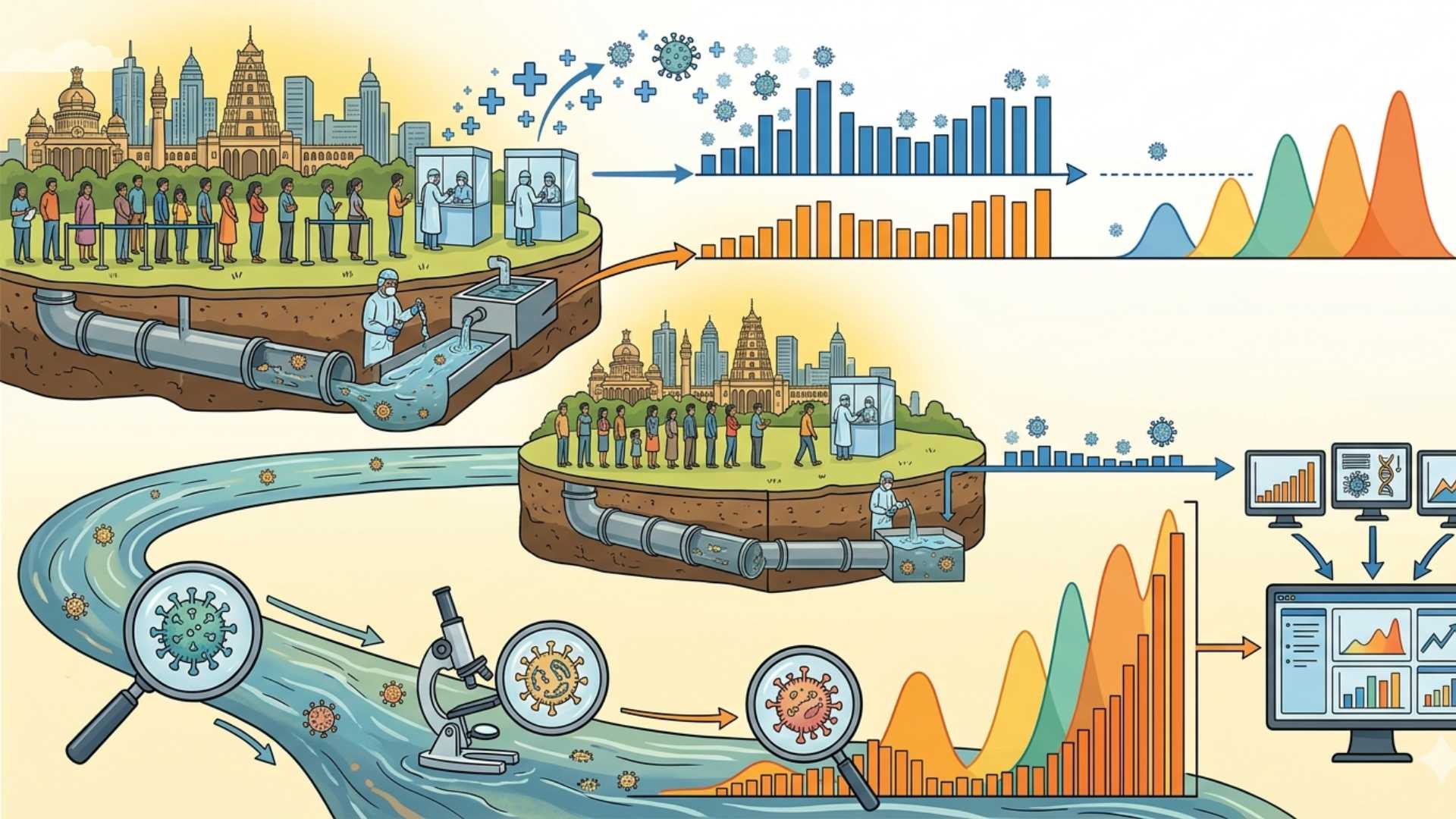
Wastewater-Based Epidemiology (WBE) involves detecting viral genetic material in sewage to estimate infection levels in a community — independent of whether individuals get tested or report symptoms. Bengaluru became one of India's earliest cities to adopt this systematically, launching citywide monitoring in August 2021 across 26 Sewage Treatment Plants (STPs).
Bengaluru Wastewater Surveillance Setup:
→ 26 STPs monitored citywide
→ Catchment areas mapped to 198 BBMP administrative wards
→ Ward-level viral load compared with ward-level case counts
→ Statistical tools: Pearson correlation + change-point analysis
→ Correlation coefficient: often above 0.8 (strong reliability)
Four COVID Surges — What the Sewage Showed
Bengaluru experienced four distinct COVID-19 surges between December 2021 and April 2024:
- BA.2.10 wave
- Mixed BA.2 lineage (BA.4, BA.5, BA.2.75)
- XBB wave — April 2023
- JN.1 surge — from late December 2023
The surveillance story unfolded in two distinct phases:
Phase 1 (December 2021 – June 2022): Alignment
- Wastewater signals and clinical case counts rose and fell simultaneously
- Both systems were functioning effectively — the Omicron wave was visible in sewage and in hospitals equally
"During the early phase, wastewater signals and reported clinical cases were closely aligned. That showed both surveillance systems were functioning effectively and capturing the spread of infection in the community." — Dr. Farah Ishtiaq, TIGS
Phase 2 (July 2022 – November 2023): Divergence
- Routine clinical testing declined substantially
- Testing was stepped up only after infections had already risen — a reactive, not proactive, model
- Wastewater monitoring continued consistently → became the more dependable indicator
XBB Wave — April 2023:
→ Clearly detected in wastewater data
→ NOT proportionately reflected in clinical case reporting
→ NOT captured in genomic surveillance data

JN.1 Wave — December 2023 onwards:
→ Visible in sewage trends
→ Underreported in official clinical counts
The Early Warning Limitation
A critical finding: wastewater surveillance did not provide early warning during the Omicron wave. Viral loads in sewage and reported infections rose almost simultaneously — no significant lead time was observed. Apparent short leads were attributed to interpolation of weekly data, not genuine advance signals.
"By the time a strong signal appears in wastewater, it often means that a substantial number of people in the community are already infected." — Dr. Ishtiaq
This is the key constraint — WBE tells you an outbreak is happening; it does not tell you before it begins.
Complementary, Not a Replacement
The study's central policy message:
- Wastewater surveillance cannot substitute clinical testing
- Sentinel clinical testing at key locations remains essential for early detection
- WBE's real strength: community-level transmission tracking when public testing weakens
The ideal architecture is both systems running in parallel — not one replacing the other.
- Maintain surveillance between waves, not just during peaks
- Enables faster hospital preparedness
- Reduces the impact of future outbreaks by closing the detection gap
Conclusion
-
Bengaluru's wastewater surveillance experiment reveals a larger truth about India's pandemic preparedness: no single system is sufficient.
-
Clinical testing is reactive when public participation falls; wastewater monitoring is consistent but not predictive.
-
The lesson for governance is clear — build redundant, complementary surveillance architectures before the next outbreak, not during it. In public health, the cost of preparation is always lower than the cost of surprise.
Attribution
Original content sources and authors


Syllabus classification
How this article maps to GS papers
Main syllabus
GS1UrbanisationQuick Q&A
What is wastewater surveillance, and how did Bengaluru use it during the COVID-19 pandemic?
The Bengaluru model covered 26 sewage treatment plants, whose catchment areas were mapped to 198 BBMP wards. By comparing viral load data with ward-level clinical case counts, researchers found a strong correlation between wastewater signals and reported infections, especially during the first Omicron wave between November 2021 and January 2022. Statistical methods such as Pearson correlation and change-point analysis showed that wastewater data reliably reflected real-time infection trends.
Key findings included:
- Wastewater viral loads closely mirrored clinical case trends during the Omicron wave.
- The method became especially valuable when routine clinical testing declined after mid-2022.
- Hidden surges linked to XBB and JN.1 variants were detected through sewage data even when official case reporting remained low.
The Bengaluru experience demonstrates that wastewater surveillance can function as a community-level public health monitoring tool, particularly useful in densely populated urban centres where asymptomatic infections and reduced testing can obscure the actual scale of disease transmission.
Why is wastewater surveillance considered important in strengthening public health systems?
The Bengaluru study highlighted how wastewater monitoring became increasingly reliable after routine clinical testing weakened between July 2022 and November 2023. While official case counts underestimated infection levels, sewage samples continued to reveal rising viral transmission linked to variants such as XBB and JN.1. This indicates that wastewater systems can act as a silent epidemiological indicator of community transmission.
The importance of wastewater surveillance can be understood through the following dimensions:
- Early situational awareness: It helps governments understand disease prevalence across entire communities.
- Cost efficiency: One wastewater sample can represent thousands of people.
- Detection of asymptomatic spread: It captures infections missed by hospital-based systems.
- Public health planning: Authorities can prepare hospitals, oxygen supplies, and vaccination campaigns based on rising trends.
- Long-term epidemiological use: The system can also monitor antimicrobial resistance, polio, or future pandemics.
Globally, countries such as the United States and the Netherlands integrated wastewater surveillance into national pandemic response strategies. In India, Bengaluru’s experience demonstrates how urban local bodies can use scientific data to build resilient public health systems. Therefore, wastewater monitoring should be seen not merely as a pandemic tool but as part of a broader framework of preventive and data-driven governance.
How does wastewater surveillance complement clinical testing instead of replacing it?
Researchers observed that during the first Omicron wave, wastewater signals and clinical cases rose almost simultaneously. This meant that wastewater surveillance did not provide a substantial lead time for predicting outbreaks. However, once routine testing declined, sewage monitoring became more dependable in identifying hidden surges. Therefore, the two systems must operate together rather than in isolation.
The complementary relationship can be understood as follows:
- Clinical surveillance: Provides patient-specific diagnosis, treatment, and genomic sequencing.
- Wastewater surveillance: Offers broader population-level indicators and detects underreported spread.
- Sentinel testing: Hospitals and selected clinics can provide targeted testing while wastewater systems monitor overall trends.
- Policy coordination: Combining both methods allows governments to make evidence-based decisions on restrictions, vaccination drives, and healthcare preparedness.
For example, Bengaluru’s wastewater data identified XBB and JN.1 surges that were not proportionately reflected in official case reporting. Yet authorities still required clinical testing to confirm infections and study variant-specific impacts. Thus, wastewater surveillance should be viewed as an additional layer of epidemiological intelligence that strengthens public health systems when integrated with traditional healthcare mechanisms.
Why did wastewater surveillance become more valuable after the decline in routine COVID-19 testing?
According to the Bengaluru study, testing after July 2022 was often intensified only after infections had already started rising. Researchers described this as a reactive surveillance model. In contrast, wastewater monitoring continued consistently regardless of testing behaviour, healthcare access, or public willingness to participate. This continuity allowed researchers to identify infection waves associated with variants such as XBB and JN.1, even when clinical reports remained relatively muted.
Several factors explain this increased importance:
- Pandemic fatigue: Many individuals stopped voluntary testing despite experiencing symptoms.
- Asymptomatic spread: Infected individuals continued shedding the virus into sewage systems.
- Reduced healthcare burden reporting: Mild cases often went undocumented.
- Resource optimisation: Governments reduced testing expenditures as emergency conditions eased.
This shift highlights a broader lesson in public administration: surveillance systems must remain functional even during periods of apparent stability. Wastewater monitoring provided continuity and objectivity when traditional indicators weakened. Therefore, it demonstrated the importance of maintaining diversified public health surveillance mechanisms rather than depending exclusively on hospital-based data.
Critically analyse the strengths and limitations of wastewater surveillance as a pandemic management tool.
Major strengths include:
- Population-wide coverage: It captures infections from both symptomatic and asymptomatic individuals.
- Cost-effectiveness: A single sample represents thousands of residents.
- Continuity of monitoring: It functions even when testing participation declines.
- Urban planning utility: Authorities can identify transmission hotspots and prepare healthcare infrastructure.
- Scalability: The model can be replicated in other cities with sewage infrastructure.
However, important limitations also exist:
- Lack of precise lead time: Bengaluru’s data showed wastewater signals did not significantly precede clinical surges.
- No individual diagnosis: It cannot identify or isolate infected persons.
- Dependence on sewage infrastructure: Informal settlements without proper drainage may remain excluded.
- Data interpretation challenges: Rainfall, dilution, and sampling frequency can affect viral measurements.
- Limited genomic precision: Variant identification still requires clinical sequencing.
From a governance perspective, wastewater surveillance should therefore be treated as a supplementary epidemiological instrument. Its greatest contribution lies in strengthening preparedness and identifying hidden trends rather than serving as a standalone outbreak prediction system. Policymakers must integrate it with hospital surveillance, genomic sequencing, and digital health systems to create a comprehensive pandemic response architecture.
What lessons can Indian cities learn from Bengaluru’s wastewater surveillance model for future pandemic preparedness?
One major lesson is the importance of continuous monitoring. Bengaluru maintained wastewater testing even after the immediate Omicron crisis subsided. As a result, hidden surges linked to XBB and JN.1 variants were successfully identified despite declining clinical testing. This highlights the need for surveillance systems that remain active between pandemic waves rather than becoming reactive only during emergencies.
Key lessons for Indian cities include:
- Institutional coordination: Public health agencies should collaborate with universities and scientific bodies.
- Data-driven governance: Real-time surveillance can improve hospital preparedness and emergency planning.
- Investment in urban infrastructure: Efficient sewage systems are essential for effective monitoring.
- Integrated surveillance frameworks: Wastewater data should complement genomic sequencing and clinical testing.
- Scalability: Similar models can be implemented in metropolitan regions like Mumbai, Chennai, and Hyderabad.
The Bengaluru experience also underscores broader governance themes relevant to UPSC preparation, such as federal cooperation, urban resilience, scientific policymaking, and preventive healthcare. In the long term, India can institutionalise wastewater surveillance not only for pandemics but also for tracking antimicrobial resistance, waterborne diseases, and environmental health risks.
Practice questions
1 question for mains preparation