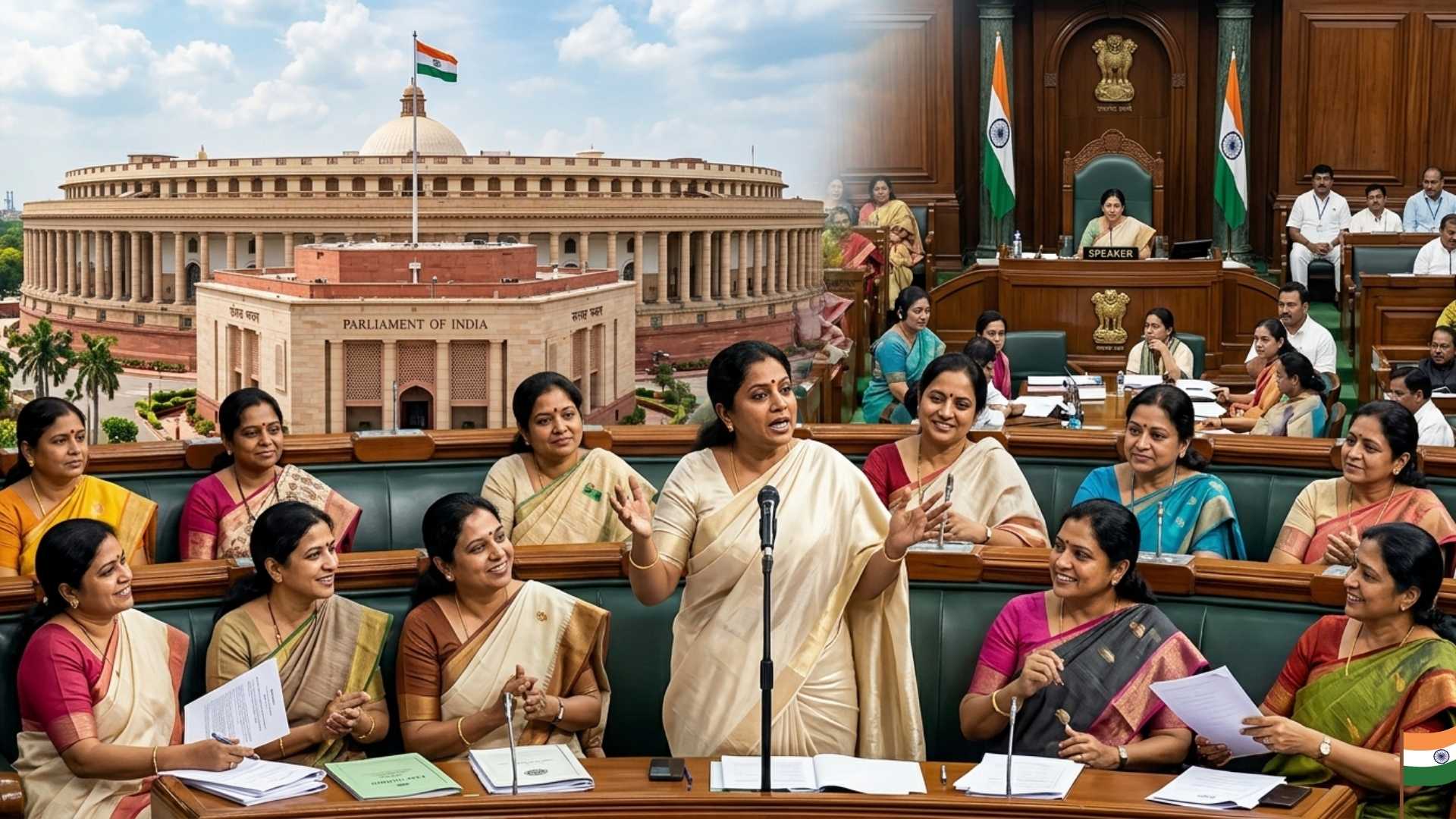
Delimitation and Women’s Reservation: Political Dynamics Ahead

India stands on the cusp of the most significant transformation of its representative system since the early decades of the Republic — one that simultaneously addresses gender justice, demographic rebalancing, and federal equity. The convergence of women's reservation, delimitation, and Lok Sabha expansion is not incremental reform; it is a foundational reordering.
"Women's reservation, seat expansion and delimitation will jointly reshape who is represented, from where, and in what proportions."
| Indicator | Data |
|---|---|
| Constitutional amendment | Constitution (106th Amendment) Act, 2023 — Nari Shakti Vandan Adhiniyam |
| Women's reservation quantum | One-third (33%) of Lok Sabha and Vidhan Sabha seats |
| Current Lok Sabha strength | 543 seats |
| Proposed Lok Sabha strength | 816 seats (+50%) |
| Additional seats proposed | 273 (33% of 816 = seats for women) |
| Census data proposed for delimitation | 2011 Census (not awaiting 2026–27 Census) |
| Constitutional freeze on delimitation | Since early 1970s (based on 1971 population) |
| OBC higher education expansion precedent | 54% seat expansion under UPA-I (2008–09) |
Background & Context
The Long Road to Women's Reservation
The demand for legislative reservation for women in India dates back to the 1990s. Multiple attempts in Parliament failed due to political resistance, primarily over demands for sub-quotas for OBC and Muslim women within the women's quota.
The Nari Shakti Vandan Adhiniyam (2023) broke this deadlock — but with a critical deferral: implementation was tied to a new Census and subsequent delimitation, effectively postponing it by several years.
The Sudden Shift
The government now appears to be decoupling implementation from the next Census, instead proposing:
- Delimitation based on the 2011 Census
- A ~50% expansion of the Lok Sabha (543 → 816 seats)
- 273 new seats reserved exclusively for women (= 33% of 816)
The Arjun Singh Playbook: Expanding the Pie
The current approach has a direct precedent in OBC reservation in higher education (2005–06):
| Dimension | OBC Higher Education (UPA-I) | Women's Reservation (NDA) |
|---|---|---|
| Reform | 27% OBC reservation in central institutions | 33% women's reservation in legislatures |
| Method | 54% expansion of total seats | ~50% expansion of Lok Sabha/Assemblies |
| Logic | General category absolute numbers preserved | Existing MPs' re-election pathways preserved |
| Political architect | Arjun Singh (Education Minister) | BJP-led NDA government |
| Outcome | No net loss for existing category | No net loss for existing male incumbents |
Core political logic: Expand the total before carving out the new accommodation — minimising resistance from groups that would otherwise lose seats.
Key Dimensions of Analysis
1. Women's Reservation: Mechanics and Gaps
- 33% of all Lok Sabha and Vidhan Sabha seats reserved for women
- Reservation includes constituencies already reserved for SC/ST — one-third of SC/ST seats will go to women of those communities
- Critical unresolved issue: Rotation of reserved constituencies — which seats rotate, how frequently, and whether constituency continuity is preserved
- Smaller states/UTs (1–2 Lok Sabha seats) may see less frequent rotation; larger states may see some seats permanently reserved across successive terms
- Rotation design directly affects accountability, constituency development, and electoral continuity
2. The North–South Fault Line
Delimitation based on population creates a structural tension in India's federal architecture:
| Region | Demographic Trend | Implication under Population-Based Delimitation |
|---|---|---|
| Northern states (UP, Bihar) | Higher fertility rates; larger populations | Gain seats significantly |
| Southern states (TN, Kerala, Karnataka, AP, Telangana) | Stabilised population; high economic contribution | Relative influence diluted |
- UP + Bihar combined could approach 180 Lok Sabha seats
- Five southern states combined may reach ~195 seats — a narrow margin
- In a first-past-the-post system, numerical dominance translates directly to political power
- Southern states' concern: They were "rewarded" with slower population growth through better development outcomes, yet face reduced political representation as a result
3. The Data Problem: 2011 vs. 2026 Realities
| Factor | Implication |
|---|---|
| Migration patterns | Significantly altered since 2011 |
| Rapid urbanisation | Urban-rural constituency boundaries outdated |
| COVID-19 demographic impact | Mortality, migration, and fertility shifts not captured |
| Caste Census (expected in 2026–27) | Could sharpen OBC sub-quota demands within women's reservation |
Proceeding with 2011 data for foundational delimitation decisions risks misrepresenting current demographic realities at the most consequential moment for electoral restructuring.
4. Political Timing and Electoral Calculus
The government's shift from its earlier position — that delimitation must await a fresh Census — has clear political drivers:
- Credit capture: Delivering a reform that eluded previous governments for three decades
- Electoral mobilisation: Women voters in upcoming Assembly elections (key states) and 2027 contests
- 2029 positioning: BJP positioned as the party that delivered on gender justice
- Pre-empting caste Census pressure: Moving ahead before OBC caste data triggers sub-quota demands within women's reservation
Implications and Challenges
- Federal compact strain: Population-based delimitation risks deepening north-south political asymmetry, weakening cooperative federalism
- OBC sub-quota pressure: Caste Census data, once available, will intensify demands for OBC women's sub-quotas — the current framework offers no clarity
- Rotation design vacuum: Without a settled rotation mechanism, implementation may create perverse incentives (MPs avoiding long-term constituency investment)
- Legitimacy of 2011 data: Constitutional challenge risk if delimitation based on 14-year-old data is contested
- Representation quality vs. quantity: Mere numerical reservation without addressing skilling, institutional support, and proxy candidacy (the "Pradhan Pati" syndrome) may limit real empowerment
Conclusion
Women's reservation is constitutionally overdue and democratically necessary — evidence from global quota systems confirms quotas work. However, the manner of implementation matters as much as the reform itself. Basing historic delimitation on outdated 2011 data, leaving rotation mechanisms undefined, and restructuring India's electoral map without adequately addressing the north-south federal imbalance risks undermining the legitimacy of the very reform it seeks to advance. India requires not just the courage to implement women's reservation, but the deliberateness to do it right — grounded in current data, federal sensitivity, and transparent institutional design.
Attribution
Original content sources and authors


Syllabus classification
How this article maps to GS papers
Main syllabus
GS1Women EmpowermentQuick Q&A
What is the Nari Shakti Vandan Adhiniyam, 2023, and what are its key constitutional provisions?
However, a crucial feature of the Act is that its implementation is not immediate. It is contingent upon the completion of the next Census and a subsequent delimitation exercise, which will redraw constituency boundaries. Additionally, the Act provides for rotation of reserved constituencies, although the exact mechanism has not yet been clearly defined. This raises concerns about continuity in representation and accountability of elected representatives.
In essence, while the Act establishes a strong constitutional foundation for women's political empowerment, its effectiveness will depend on how these enabling processes—Census, delimitation, and rotation—are designed and implemented. The reform must be seen not just as a symbolic gesture, but as a structural intervention in India's representative democracy.
Why has the implementation of women's reservation been linked to Census and delimitation, and why is this linkage controversial?
However, this linkage has been widely criticised as it effectively delays implementation. Women's groups and opposition parties argue that such a condition is not constitutionally necessary and serves as a political deferral mechanism. Given that the Census itself has been delayed and delimitation is a complex process, the reservation could be postponed by several years, undermining the urgency of gender justice.
The controversy lies in the trade-off between procedural correctness and political urgency. While accurate data is important, critics argue that India's existing electoral framework has functioned with outdated boundaries for decades. Therefore, delaying a transformative reform like women's reservation on these grounds raises questions about political intent and prioritisation.
How does the proposed 50% expansion of seats aim to facilitate women's reservation without reducing opportunities for existing legislators?
This approach is strategically designed to minimise political resistance. Incumbent legislators are less likely to oppose reforms that do not threaten their re-election prospects. The model draws inspiration from the OBC reservation in higher education (2006), where seat capacity was expanded by 54% to accommodate new quotas without reducing general category seats. This ensured a "win-win" situation and facilitated smoother policy implementation.
However, this strategy also raises important questions. While it eases political acceptance, it leads to a significant increase in legislative size, which may affect governance efficiency and parliamentary functioning. Moreover, expansion does not fully address deeper issues of representational balance across regions, particularly when combined with delimitation.
Critically analyse the implications of delimitation and seat expansion on India's federal balance and regional representation.
Even with a uniform expansion of seats, the absolute increase in northern States would be larger, potentially tilting the balance of power in Parliament. For example, Uttar Pradesh and Bihar together could command nearly 180 seats, giving them substantial electoral weight in a first-past-the-post system. This raises concerns about the marginalisation of economically advanced but less populous States, thereby deepening the north–south divide.
From a federal perspective, this could strain cooperative federalism and alter the political economy of resource distribution. While the expansion aims to preserve proportionality, it does not fully mitigate the structural imbalance created by demographic asymmetry. Therefore, delimitation must consider not just population, but also factors like development, fiscal contribution, and regional diversity.
What are the concerns associated with using 2011 Census data for delimitation and women's reservation implementation?
Relying on outdated data risks creating misaligned constituencies, where representation does not accurately reflect present-day population patterns. For instance, urban areas may be underrepresented despite population surges, while rural areas may be overrepresented. This undermines the democratic principle of "one person, one vote".
Additionally, the absence of updated caste data in the 2011 Census complicates the issue further. The upcoming Census is expected to include broader caste enumeration, which could trigger demands for sub-quotas within women's reservation, particularly for OBCs. Proceeding without this data may temporarily avoid political contestation but risks future conflicts and demands for revision.
Can you provide a comparative example of how seat expansion has been used in India to implement reservation policies?
To ensure that this did not reduce the number of seats available for the general category, the government expanded total सीट capacity by 54%. For instance, what was earlier 100 seats increased to 154, ensuring that the absolute number of general category seats remained unchanged. This approach was widely seen as a pragmatic and politically viable solution, as it balanced social justice with stakeholder acceptance.
The current proposal for women's reservation mirrors this strategy. By expanding legislative seats, the government aims to accommodate a new category of representation without triggering resistance from existing groups. This demonstrates how policy design can use institutional expansion as a tool for managing competing interests in a लोकतांत्रिक system.
Consider a scenario where frequent rotation of reserved constituencies is implemented. What could be its impact on governance and accountability?
From the perspective of voters, frequent rotation may weaken the representative-constituency relationship. Elected leaders may lack sustained engagement with local issues, and voters may find it difficult to hold representatives accountable. In contrast, limited or phased rotation could allow representatives to build stronger connections and deliver more consistent governance outcomes.
However, rotation also has benefits. It prevents the monopolisation of political power and ensures broader participation of women across regions. The challenge lies in designing a balanced rotation mechanism that ensures inclusivity without compromising stability. This highlights the importance of institutional design in translating constitutional intent into effective democratic practice.
Practice questions
2 questions for mains preparation