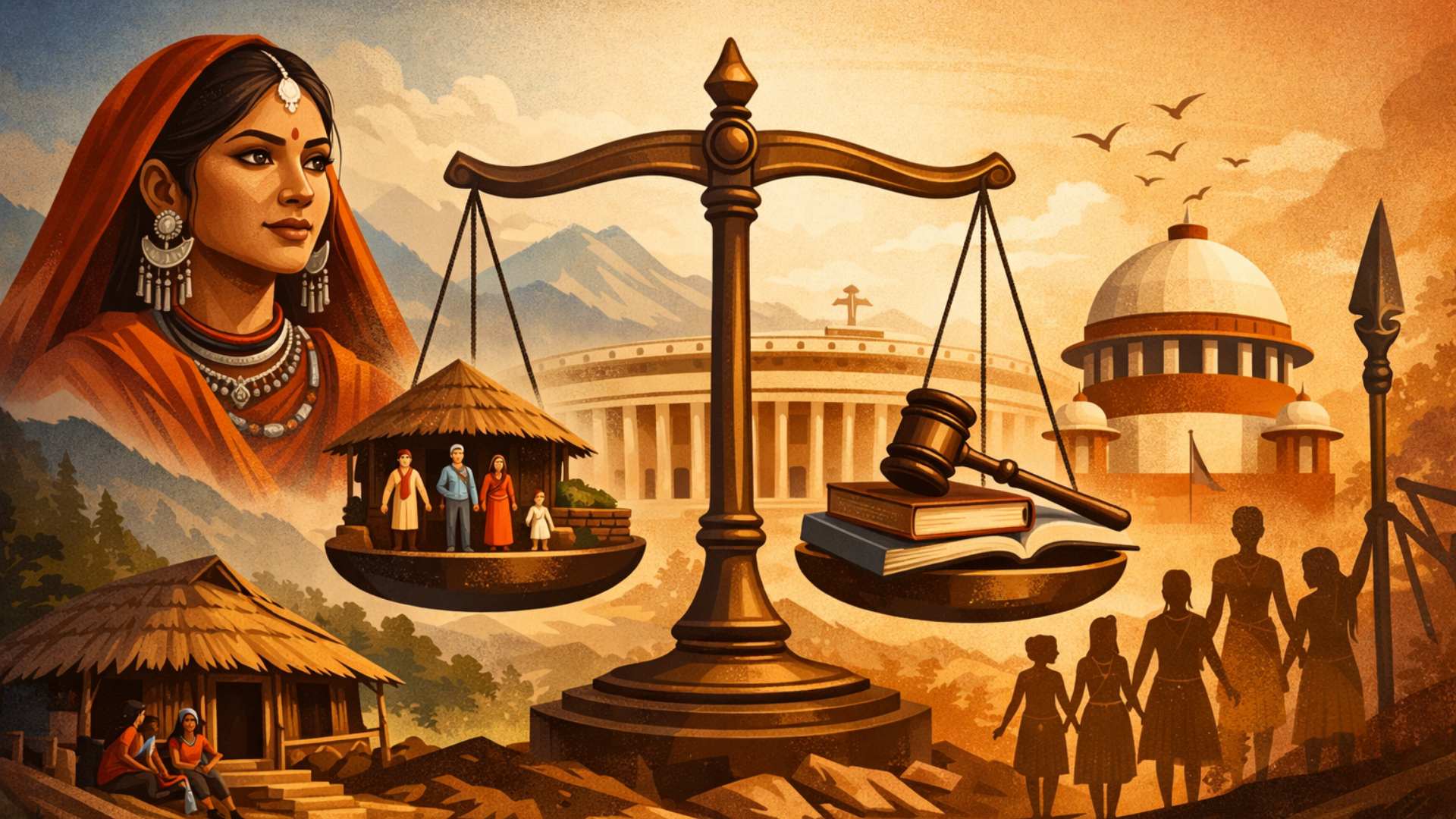
Rethinking Inheritance Rights for Tribal Women in India
Tribal Women’s Inheritance Rights & the Hindu Succession Act: Constitutional and Legal Dimensions
1.Exclusion of Scheduled Tribes from the Hindu Succession Act, 1956
Women’s inheritance rights in tribal communities remain legally complex. Customary laws of many tribal societies do not grant women absolute property rights, especially in ancestral property.
The Hindu Succession Act (HSA), 1956 grants daughters equal inheritance rights in ancestral property. However, Section 2(2) explicitly excludes Scheduled Tribes (STs) from its application unless the Central Government directs otherwise.
This has created a dual legal regime—tribal women are excluded from statutory inheritance protections while also being subject to customary laws that may be patriarchal.
The tension lies between gender justice and protection of tribal autonomy. If unresolved, tribal women may remain structurally disadvantaged under both statutory and customary frameworks.
2. Judicial Inconsistency & the ‘Hinduisation’ Approach
Before 2025, courts sometimes extended inheritance rights to tribal women who had “Hinduised”—i.e., adopted Hindu customs after abandoning tribal practices. In such cases, courts interpreted them as falling within the definition of “Hindu” under Section 2(1) of the Act.
However, this approach conflicted with Section 2(2), which clearly states that the Act does not apply to Scheduled Tribes. It created uncertainty and forced tribal women to choose between asserting tribal identity and accessing statutory inheritance rights.
This practice blurred constitutional commitments under Articles 14 (Equality), 15 (Non-discrimination), and 29 (Cultural rights), while undermining the protective framework for indigenous communities.
Judicial expansion through ‘Hinduisation’ risked eroding tribal identity while attempting to secure gender equality, leading to doctrinal inconsistency.
3. Supreme Court Verdict (October 8, 2025): Nawang v. Bahadur
In Nawang v. Bahadur (2025), a Bench of Justices Sanjay Karol and Prashant Kumar Mishra held that the Hindu Succession Act cannot be applied to Scheduled Tribes under any circumstances unless Parliament so provides.
The Court overturned a Himachal Pradesh High Court order that had extended inheritance rights under the HSA to “Hinduised” tribal daughters. It ruled that only Parliament has the authority to extend the Act to STs, and courts cannot direct legislative changes.
The judgment reaffirmed the constitutional validity of Section 2(2) and upheld the principle of special protection for indigenous communities under the legal system.
The ruling restores legislative supremacy and clarifies that inheritance among Scheduled Tribes remains governed by customary law unless Parliament intervenes.
4. Equality vs. Cultural Protection: Constitutional Dilemma
The verdict came months after the Supreme Court in Ram Charan v. Sukhram (2025) observed that exclusion of daughters from ancestral property violates the fundamental right to equality.
This raises a deeper constitutional question: Can gender justice for tribal women be achieved without diluting tribal identity? Should equality be ensured through general Hindu law or through a separate tailored framework?
The earlier judicial practice of including STs under Section 2(1) contradicted Section 2(2), effectively pressuring tribal communities to assimilate into the Hindu fold to claim rights.
On defining “Hindu,” the Supreme Court in Sastri Yagnapurushadji v. Muldas (1966) observed:
“It may broadly be described as a way of life and nothing more.” — Supreme Court (1966)
This expansive definition had facilitated interpretative inclusion, but the recent verdict restricts such extension when an explicit statutory exclusion exists.
The core dilemma is reconciling Articles 14 and 15 (equality) with Articles 29 and 244 (cultural autonomy and tribal protections). Ignoring either dimension risks constitutional imbalance.
5. Implications for Tribal Women
The judgment clarifies the legal position but leaves substantive concerns unresolved. Tribal women remain dependent on customary inheritance systems, many of which exclude daughters from coparcenary rights.
The exclusion of STs from HSA has been challenged as creating invidious discrimination between tribal and non-tribal women. However, the Court upheld the exclusion as constitutionally valid.
Thus, gender parity within tribal communities now hinges on legislative reform rather than judicial reinterpretation.
Legal certainty has been achieved, but substantive gender justice requires proactive policy intervention.
6. Way Forward: Legislative & Policy Solutions
The Supreme Court’s clarification presents an opportunity for Parliament to address the gap.
One possible approach is the enactment of a special legislation governing inheritance among Scheduled Tribes, ensuring gender parity while preserving cultural identity.
Another approach is codification and reform of customary succession laws, as seen in certain tribal-majority States such as Mizoram.
Possible Reform Pathways
- Enact a separate statute ensuring equal inheritance rights for tribal women.
- Codify customary laws with gender-sensitive amendments.
- Allow community consultation to balance autonomy and equality.
- Ensure reforms align with constitutional guarantees of equality and cultural protection.
Balanced reform must ensure that tribal women do not face discrimination under the guise of tradition, while respecting the constitutional mandate to protect indigenous identity.
Conclusion
The Supreme Court’s 2025 verdict in Nawang v. Bahadur has clarified that the Hindu Succession Act cannot be extended to Scheduled Tribes without parliamentary action. While it reinforces constitutional protection of tribal identity, it leaves unresolved the issue of gender inequality in customary inheritance systems.
The path forward lies in legislative reform that harmonises gender justice with cultural autonomy. Ensuring equal inheritance rights for tribal women within a culturally sensitive framework would strengthen both constitutional morality and social justice.
Attribution
Original content sources and authors
Syllabus classification
How this article maps to GS papers
Main syllabus
GS1Women EmpowermentQuick Q&A
What is the legal position regarding the applicability of the Hindu Succession Act, 1956 to Scheduled Tribes after the Supreme Court’s 2025 verdict?
This judgment ended the earlier inconsistent judicial approach where some courts allowed tribal women inheritance rights if they had adopted Hindu customs. By doing so, the Court reaffirmed constitutional protection for tribal autonomy and customary laws under Articles 244 and 366(25), which recognise the distinct status of Scheduled Tribes.
Thus, tribal inheritance continues to be governed by customary practices, unless a specific statutory intervention is made. The ruling clarifies legal uncertainty but also highlights the continuing gender gap in many tribal succession systems.
Why does the exclusion of Scheduled Tribes from the Hindu Succession Act raise concerns about gender equality?
The Supreme Court in Ram Charan v. Sukhram recognised that exclusion of daughters from ancestral property violates the fundamental right to equality. However, in the tribal context, courts have balanced equality with constitutional commitments to protect indigenous identity. The dilemma arises when customary laws perpetuate patriarchal norms.
The core issue is whether tradition can justify gender discrimination. While preserving tribal culture is constitutionally mandated, equality is also a basic feature of the Constitution. Reconciling these two values remains an unresolved policy challenge.
Critically analyse whether ‘Hinduisation’ was a constitutionally sound method of granting inheritance rights to tribal women.
This approach undermined the constitutional objective of protecting tribal distinctiveness under the Fifth and Sixth Schedules. It also contradicted Section 2(2) of the HSA, which explicitly excludes Scheduled Tribes. By broadening the definition of ‘Hindu’ under Section 2(1), courts risked judicial overreach and blurred the line between interpretation and legislation.
The 2025 verdict restores doctrinal clarity by rejecting Hinduisation as a legal workaround. However, it simultaneously exposes the absence of a comprehensive statutory framework to ensure gender parity within tribal inheritance systems.
How can India reconcile the protection of tribal identity with the constitutional mandate of gender equality in inheritance laws?
Such legislation could:
- Recognise community-specific practices
- Guarantee equal inheritance rights to women
- Provide dispute resolution mechanisms sensitive to tribal governance systems
This approach aligns with constitutional principles by preserving cultural autonomy under Article 29 while upholding equality under Articles 14 and 15. Reform through consultation with tribal councils and women’s groups would ensure legitimacy and acceptance.
Assume a tribal woman challenges her exclusion from ancestral property on equality grounds. How should the judiciary approach such a case post-2025 verdict?
The court may assess whether the custom in question is essential to tribal identity or merely a patriarchal practice lacking cultural centrality. Precedents such as Shayara Bano demonstrate that customs inconsistent with fundamental rights can be struck down.
Ultimately, long-term resolution requires legislative intervention. While courts can provide relief in individual cases, systemic reform must come through Parliament, ensuring both gender justice and preservation of indigenous identity.
Practice questions
1 question for mains preparation