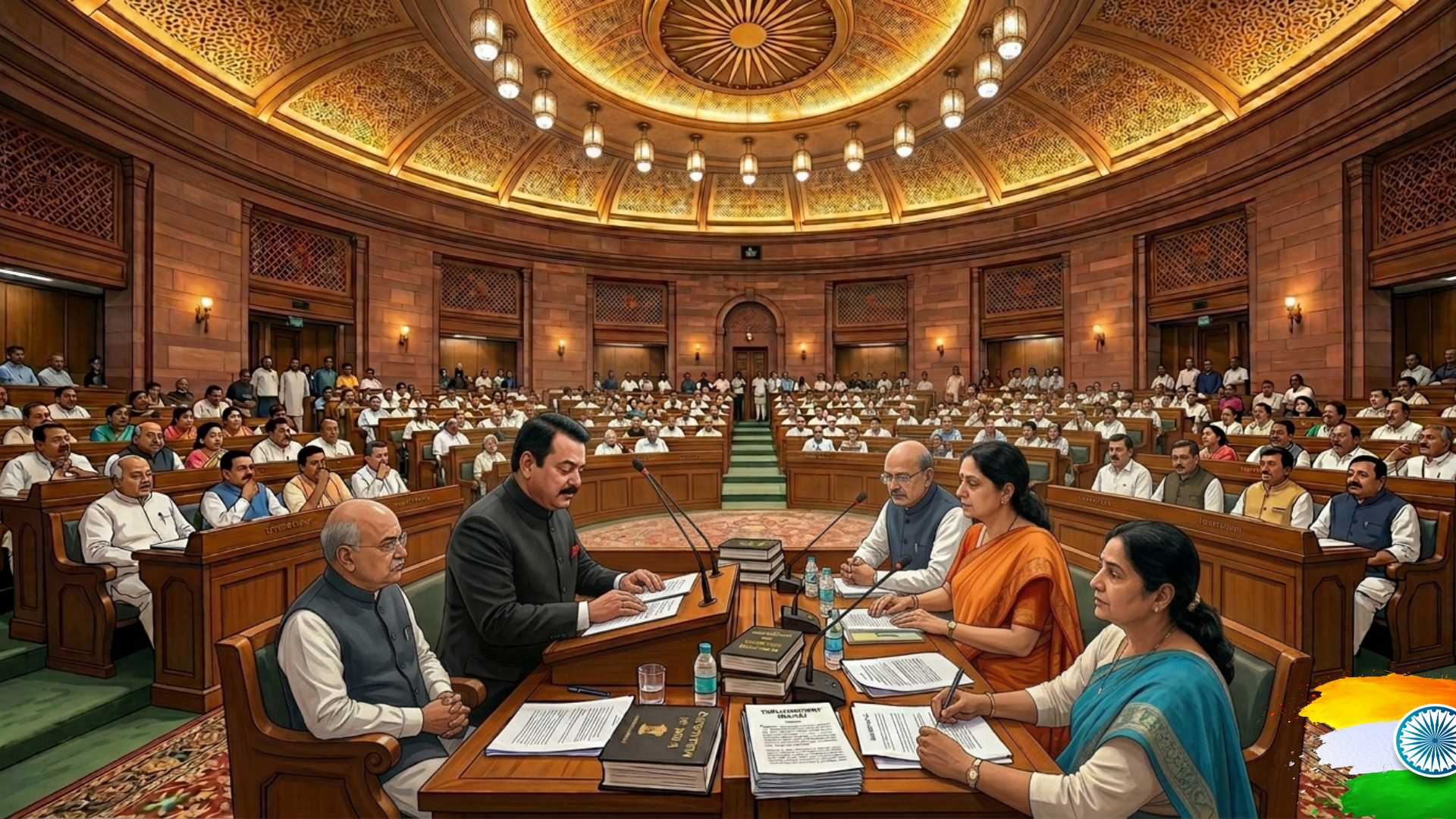
Why Women's Reservation in India Cannot Wait Any Longer
Introduction
India ranks 148th out of 193 countries in women's parliamentary representation (IPU, 2024), despite being the world's largest democracy. Women constitute nearly 50% of the population yet hold only ~14–15% of Lok Sabha seats and a mere ~9% in State Assemblies — a structural paradox where participation surges but representation stagnates.
"High turnout among women voters is a sign of democratic vitality, but true empowerment requires a seat at the decision-making table."
| Indicator | Data |
|---|---|
| Women in Lok Sabha (2024) | ~13–15% |
| Women in State Assemblies (avg.) | ~9% |
| Women's share in population | ~48–49% |
| Global average (parliamentary representation) | ~26.9% (IPU 2024) |
| Panchayati Raj reserved seats for women | 33–50% (varies by state) |
| 106th Constitutional Amendment passed | September 2023 |
Background & Context
The Women's Reservation Bill (Nari Shakti Vandan Adhiniyam), passed as the 106th Constitutional Amendment in September 2023, mandates 33% reservation for women in Lok Sabha and State Legislative Assemblies. However, its implementation is linked to the next delimitation exercise — effectively deferring actual enforcement by several years.
India's democratic history shows a consistent gap between electoral participation and legislative presence. Women's voter turnout has equalled or surpassed men in several states (Bihar, Odisha, Himachal Pradesh), yet political parties continue nominating disproportionately fewer women candidates, functioning as structural gatekeepers to power.
Key Issues & Analytical Dimensions
1. The Participation–Representation Paradox
Women have transformed from passive voters into active political agents over two decades. Yet this surge in turnout has not translated into legislative presence. The gap is not accidental — it reflects systemic barriers: resource-intensive electoral politics, lack of party support, social norms, and safety concerns that collectively create a self-reproducing cycle of exclusion.
2. Panchayati Raj: Proof of Concept
The 73rd Constitutional Amendment (1992) mandated reservation for women in local bodies. Evidence from Panchayati Raj Institutions (PRIs) is compelling — women elected to PRIs consistently prioritised health, education, water, and sanitation. Studies show villages with women pradhans invested significantly more in drinking water infrastructure. This demonstrates that reservation is not tokenism but a catalytic policy intervention.
3. State vs. Parliament: A Two-Tier Crisis
The lower representation at state level (~9%) compared to Parliament (~14%) is particularly significant. State governments directly govern healthcare, education, law & order, and local development — areas disproportionately affecting women's lives. Near-absence of women in state legislatures means half the population has minimal voice in shaping policies most relevant to them.
4. The Merit vs. Quota Debate
Critics argue reservation compromises merit. This assumes the existing system is meritocratic — it is not. Access to Indian electoral politics is determined by money, caste networks, and dynasty, not competence alone. Reservation corrects a structurally unequal playing field, not a level one.
5. Developmental Dividend
Cross-country research confirms gender-inclusive governance produces better policy outcomes — more equitable resource allocation, improved human development indices, and stronger institutional trust. Excluding women from legislative leadership is both a democratic deficit and an economic inefficiency.
Relevant Legal & Constitutional Framework
- Article 243D — Reservation for women in Panchayati Raj (73rd Amendment, 1992)
- Article 243T — Reservation in Urban Local Bodies (74th Amendment, 1992)
- 106th Constitutional Amendment, 2023 — 33% reservation in LS + State Assemblies (post-delimitation)
- Article 15(3) — State empowered to make special provisions for women
- Article 46 — DPSP: State to promote educational and economic interests of weaker sections
- Beijing Platform for Action (1995) — 30% benchmark for women in legislatures
Implications & Way Forward
Short-term: Expedite delimitation to enable early implementation of the 106th Amendment. Political parties should voluntarily adopt internal quotas for candidate nomination — evidence shows voluntary measures have historically failed without structural mandate.
Medium-term: Capacity building for elected women representatives, especially at state and local levels, to address the "proxy representative" problem where male family members exercise de facto power.
Long-term: Cultural shift driven by the role model effect — visible women in leadership normalises political ambition among young girls, creating a self-sustaining pipeline of future leaders.
Conclusion
India's democratic journey is remarkable but structurally incomplete. The gap between women's electoral participation and legislative representation is not a natural lag — it is a produced outcome of gatekeeping, resource asymmetry, and social barriers. The 106th Amendment is a historic corrective step, but its deferred implementation risks making it symbolic rather than substantive. Deepening democracy requires moving beyond counting votes to ensuring that those who cast votes also shape laws. Reservation, as India's own Panchayati Raj experience proves, is not a permanent crutch but a necessary catalyst for structural equity.
Attribution
Original content sources and authors
Syllabus classification
How this article maps to GS papers
Main syllabus
GS1Women EmpowermentQuick Q&A
What is the Women’s Reservation Bill and how does it aim to address the gap between political participation and representation in India?
Addressing structural barriers: The Bill directly tackles systemic obstacles such as limited party nominations, lack of financial resources, and socio-cultural constraints that hinder women’s entry into politics. By guaranteeing representation, it bypasses the gatekeeping role of political parties and creates institutional space for women leaders. This is crucial because the current system is not purely merit-based but influenced by networks, privilege, and access.
Democratic significance: The Bill aims to transform India’s democracy from merely participatory to truly representative. Evidence from Panchayati Raj institutions, where reservations have been implemented, shows that women leaders actively contribute to governance and shift policy priorities toward social development sectors. Thus, the Bill is not just about numerical inclusion but about enhancing the quality, inclusiveness, and responsiveness of democratic governance.
Why is there a persistent gap between women’s electoral participation and their representation in legislatures in India?
Socio-cultural constraints: Deep-rooted patriarchal norms, safety concerns, and expectations around domestic responsibilities discourage women from entering public life. These factors create a cycle of exclusion, where fewer women candidates lead to fewer women leaders, reinforcing stereotypes about women’s political capabilities.
Implications for democracy: This gap undermines the principle of representative democracy. When half the population is underrepresented, policy-making may not adequately reflect their needs and perspectives. For instance, issues like maternal health, sanitation, and gender-based violence may not receive sufficient attention. Bridging this gap is essential not only for equity but also for improving governance outcomes and ensuring inclusive development.
How can the implementation of the Women’s Reservation Bill transform governance and policy outcomes in India?
Improved decision-making: Gender diversity in decision-making bodies enhances the quality of deliberation by bringing diverse perspectives. This leads to more inclusive and balanced policies. For example, countries with higher female representation in legislatures often perform better on social indicators like child health and education.
Long-term societal impact: The presence of women in leadership roles has a multiplier effect. It challenges societal stereotypes, inspires future generations, and normalizes women’s participation in public life. Over time, this can create a pipeline of capable women leaders, reducing the need for reservation. Thus, the Bill can act as a catalyst for both institutional reform and broader social transformation.
Critically analyse the arguments for and against the Women’s Reservation Bill in India.
Arguments against: Critics contend that reservation may lead to tokenism or the selection of proxy candidates controlled by male relatives. Some argue that it undermines meritocracy and that political parties should voluntarily field more women candidates instead of relying on quotas. Others raise concerns about the rotation of reserved seats, which may disrupt continuity in leadership.
Balanced perspective: While these concerns are valid, they often overlook the fact that the current system is not entirely merit-based. Structural barriers prevent equal competition. Reservation should be seen as a temporary corrective measure rather than a permanent solution. Complementary reforms, such as capacity building, political training, and internal party democracy, can address the limitations and enhance the effectiveness of the policy.
What lessons can be drawn from the implementation of women’s reservation in Panchayati Raj institutions?
Breaking social barriers: The presence of women in local governance has challenged traditional gender roles and increased acceptance of women in leadership positions. For example, in states like Bihar and Rajasthan, women sarpanches have played a crucial role in community development and social reforms. This demonstrates that given the opportunity, women can effectively lead and govern.
Policy implications: These experiences provide a strong argument for extending reservation to higher levels of governance. While challenges such as proxy leadership exist, they tend to diminish over time as women gain confidence and experience. The Panchayati Raj model shows that institutional support can drive social change, making a compelling case for the Women’s Reservation Bill at the State and national levels.
Examine the underrepresentation of women in State legislatures as a case study of democratic deficit in India.
Impacts on governance: The lack of women’s representation means that policy-making may not fully address gender-specific issues. For instance, concerns related to women’s safety, maternal health, and access to education may not receive adequate attention. This imbalance can lead to policies that are less inclusive and less effective in addressing societal needs.
Need for reform: The State-level scenario underscores the urgency of implementing the Women’s Reservation Bill. Without structural intervention, the gap between participation and representation is likely to persist. Addressing this issue is essential for strengthening federal governance and ensuring that democracy is not only participatory but also inclusive and representative at all levels.
Practice questions
1 question for mains preparation