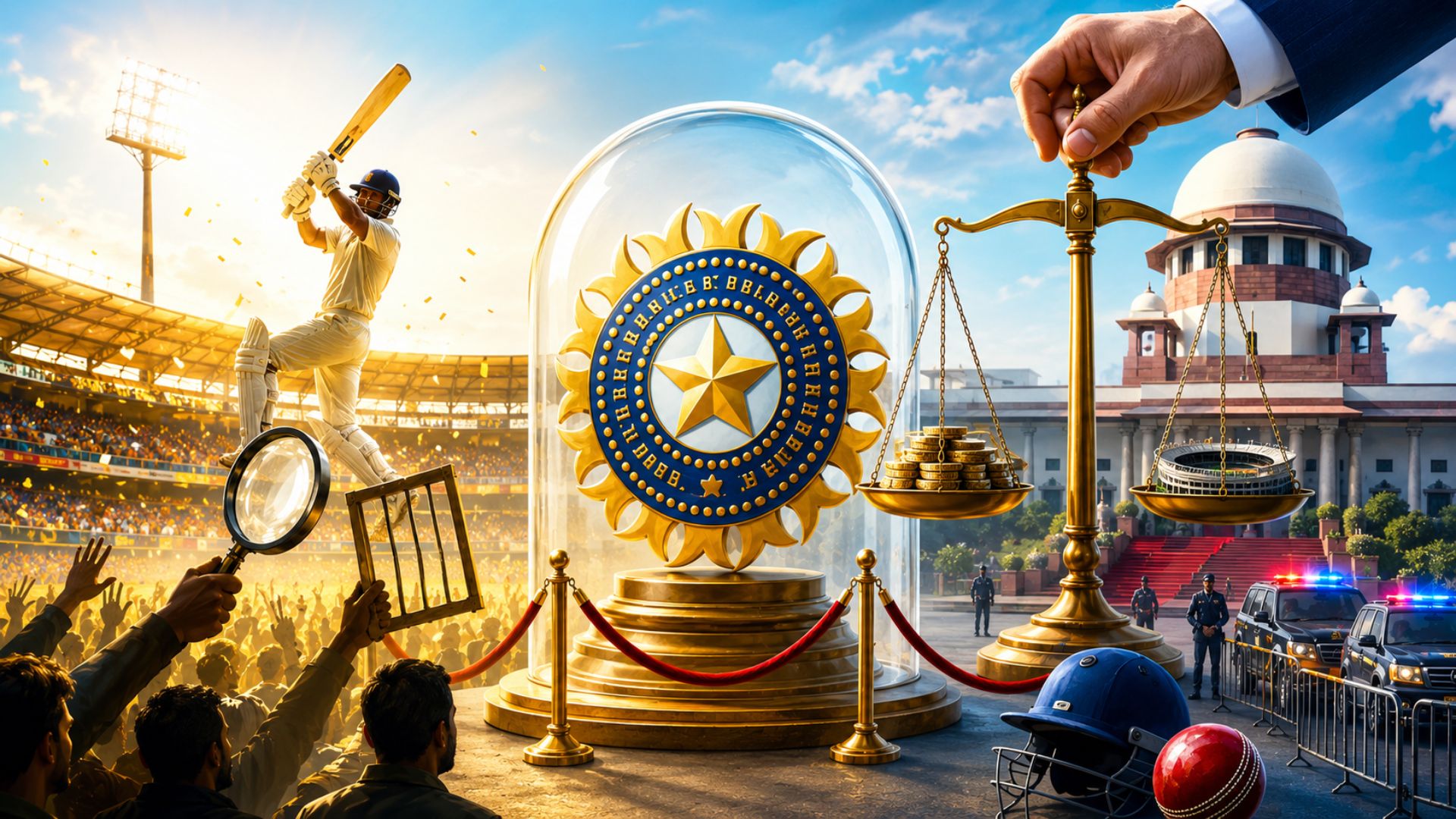
BCCI and the RTI Act: A Need for Greater Transparency
Background: Why the BCCI Escapes Scrutiny
The Right to Information Act, 2005 was conceived as a tool to hold the state accountable — government ministries, public sector bodies, statutory authorities. But India's cricket administration has consistently exposed a grey zone: what happens when a private body wields power indistinguishable from a public institution?
The Board of Control for Cricket in India (BCCI) is technically a private, voluntary association registered under the Tamil Nadu Societies Registration Act. It receives no direct government funding. Yet it controls a sport that is, in practice, India's national religion — commanding billions in revenue, negotiating with foreign boards, and deploying state machinery for its own events.
What the BCCI Gets Away With
Despite its private status, the BCCI draws heavily on public resources and privileges:
- Police deployment at matches, paid for by the state
- Concessional land allotments for stadiums and facilities
- State hospitality for events and officials
- Public stadium infrastructure — Wankhede, Eden Gardens, Chepauk — built and maintained with public money
- Diplomatic overlap — negotiating with foreign cricket boards in ways that mirror sovereign engagement
- Tax exemptions worth ₹2,100 crore between 1997 and 2007 alone, flagged by the Law Commission as foregone state revenue
- De facto monopoly over cricket, a sport of unmatched national significance
BCCI's Dual Character
─────────────────────────────────────────────────
Private Body          |  Public Functions
─────────────────────────────────────────────────
No govt. financing    |  Uses public stadiums
Not a statutory body  |  Police protection (state cost)
Commercial revenues   |  Tax exemptions = state grant
No Ministry control   |  Diplomacy with foreign boards
─────────────────────────────────────────────────
The Legal Battle: A Timeline of Contradictions
The question of whether the BCCI is a "public authority" under Section 2(h) of the RTI Act has been fought across courts and commissions for two decades.
- 2005 & 2013 — RTI disputes first surface; BCCI resists disclosure
- 2015–16 — The Supreme Court, while overseeing the Lodha Committee reforms, held that the BCCI performs public duties, making it subject to writ jurisdiction
- 2018 — The Law Commission recommended bringing the BCCI under RTI, noting it functioned as a de facto National Sports Federation without Sports Ministry recognition
- Former CIC Sridhar Acharyulu ruled the BCCI a public authority under Section 2(h)
- Madras High Court stayed that order
- 2024–25 — The Central Information Commission (CIC) reversed Acharyulu's ruling, excluding the BCCI from RTI's ambit
The CIC's own reasoning contains a telling admission: it acknowledged that the BCCI "exerts significant influence on public life" — yet still excluded it, citing a strict reading of Section 2(h).
The Core Legal Contradiction
Section 2(h) defines a public authority as a body created by the Constitution, by statute, or by government notification — or one that is substantially financed or controlled by the state.
The BCCI satisfies none of these on the surface. But here lies the contradiction:
The Supreme Court affirmed in 2015 that writ jurisdiction applies to the BCCI — meaning courts can compel it to act in public interest. Yet the same body is deemed "private enough" to conceal its internal records, finances, and governance decisions from citizens.
A body cannot simultaneously be subject to constitutional remedies and immune from transparency obligations. One cannot have writ jurisdiction without accountability.
Why the CIC Ruling Will Be Contested
The arguments against bringing the BCCI under RTI — commercial sensitivity, governance flexibility, risk of political misuse — have merit in isolation. But they do not survive the scale of public subsidy and monopoly power the BCCI enjoys. Tax exemptions of over ₹2,100 crore are not a private privilege; the Law Commission was right to treat them as a form of state grant. When the state forgoes revenue on behalf of a body, citizens acquire a legitimate stake in how that body is run.
Civil society concerns are not abstract: conflicts of interest in selection, financial opacity in IPL governance, and the concentration of administrative power in a self-perpetuating elite — all remain beyond public scrutiny.
Way Forward
The resolution lies not in forcing the BCCI into an ill-fitting mould, but in legislative reform:
- Amend Section 2(h) to include any body discharging public duties with monopoly power over a public resource or national sport — even if privately financed
- Create a tiered category within RTI that mandates disclosure on governance, conflicts of interest, and use of public resources, while protecting genuinely commercial information like broadcasting strategy or player contracts
- Judicially recognise tax exemptions as a form of state financing — a precedent the Law Commission already recommended
- Establish a statutory sports regulator for bodies like BCCI, so accountability does not depend entirely on RTI
Conclusion
The BCCI case is ultimately a question about the limits of legal formalism. Section 2(h) was drafted for a world where public power lived neatly inside government. The BCCI represents a new category: private bodies that have accumulated public power without public accountability. Until the law catches up, the accountability deficit will persist — and the contradiction between writ jurisdiction and RTI exclusion will remain one of the more uncomfortable silences in Indian constitutional practice.
Attribution
Original content sources and authors
Syllabus classification
How this article maps to GS papers
Main syllabus
GS2Accountable GovernanceAlso covers
Quick Q&A
What is the core legal debate regarding the inclusion of the BCCI under the RTI Act?
However, critics contend that the BCCI performs several public functions that go beyond ordinary private commercial activity. It regulates cricket in India, selects the national team, represents India internationally, and enjoys monopoly power over the sport. The Supreme Court, during the implementation of the Lodha Committee reforms in 2015-16, observed that the BCCI performs public duties despite being a private body. This has created a constitutional contradiction where the BCCI can be subjected to writ jurisdiction under Article 226, yet claim immunity from transparency obligations.
The issue also involves the interpretation of state support. The Law Commission in 2018 highlighted that tax exemptions granted to the BCCI amounted to significant foregone state revenue. In addition, the organisation benefits from public infrastructure, police deployment, concessional land allotments, and diplomatic facilitation during international cricket events. Supporters of RTI inclusion argue that these privileges amount to indirect state financing and justify public scrutiny.
At the same time, opponents warn that bringing the BCCI fully under RTI may expose commercially sensitive information, reduce operational flexibility, and increase political interference in sports administration. Therefore, the debate is not merely legal but also concerns balancing transparency, autonomy, commercial confidentiality, and public accountability.
Why is the question of transparency in the BCCI important for democratic governance in India?
From a governance perspective, the lack of transparency raises concerns regarding conflicts of interest, financial irregularities, nepotism, and concentration of power. Past controversies such as the IPL spot-fixing scandal and allegations involving administrators highlighted weaknesses in accountability mechanisms. The Lodha Committee was appointed precisely because existing internal reforms were considered inadequate. Civil society groups argue that RTI access would strengthen institutional credibility by allowing scrutiny of administrative decisions, financial dealings, and governance structures.
Transparency is also important because the BCCI enjoys several forms of indirect state support. Matches often require extensive police deployment funded by taxpayers, and many stadiums are built on public land at concessional rates. Additionally, cricket diplomacy frequently intersects with India’s foreign policy, especially in matches involving Pakistan or multilateral sporting events. Therefore, the BCCI’s actions can have implications beyond sports administration.
At a broader democratic level, the issue reflects an evolving challenge in governance where powerful private bodies perform public functions. Similar debates exist globally regarding social media companies, private educational institutions, and sports federations. Ensuring accountability in such entities is necessary to protect public interest while also preserving institutional autonomy. Thus, the BCCI debate is ultimately about defining the boundaries between private authority and public responsibility in a modern democracy.
Critically analyse the arguments for and against bringing the BCCI under the RTI Act.
Another important argument relates to accountability and institutional reform. Past controversies involving IPL corruption, conflict of interest, and opaque decision-making revealed governance deficits within the organisation. RTI could improve transparency in areas such as financial management, appointment processes, and disciplinary actions. It could also strengthen public trust and align sports governance with democratic principles.
On the other hand, opponents argue that the BCCI is fundamentally a private and commercially driven body. Unlike statutory authorities, it was neither created by legislation nor substantially funded by the government. Full RTI disclosure may expose commercially sensitive information, including broadcasting rights negotiations, sponsorship agreements, and strategic decisions. This could weaken India’s competitiveness in global cricket administration.
Critics also fear the possibility of political interference. Since cricket carries massive public influence, governments may misuse transparency provisions to pressure administrators or influence team and policy decisions. Excessive bureaucratic oversight could undermine operational flexibility and professional management.
A balanced approach may therefore be preferable. Instead of blanket RTI coverage, Parliament could amend Section 2(h) to create a special category for private bodies discharging public duties. Such a framework could ensure disclosure of governance-related matters while protecting legitimate commercial confidentiality. This would reconcile the competing objectives of accountability and institutional autonomy.
How does the BCCI case reflect the evolving nature of public authority in India?
The judiciary has increasingly recognised this evolution. In the BCCI-related judgments of 2015-16, the Supreme Court acknowledged that the organisation performs public duties. This recognition expanded the idea that constitutional accountability can apply even to private entities when they exercise monopolistic or quasi-public powers. Similar reasoning has also been used in cases involving private educational institutions, telecom companies, and cooperative societies performing essential public services.
The case also highlights the challenge of balancing private autonomy with public accountability. Modern governance often involves public-private partnerships and non-state actors exercising regulatory influence. If such institutions remain completely outside transparency frameworks, democratic oversight may weaken. At the same time, excessive state control could discourage innovation and professional management.
Globally, similar debates exist in sports governance. International organisations such as FIFA and the International Olympic Committee have faced criticism for corruption and lack of accountability despite their private status. Many countries now demand higher transparency standards for sports bodies because they influence public identity, economic activity, and international diplomacy.
Therefore, the BCCI controversy demonstrates that the definition of ‘public authority’ can no longer be limited only to formal government institutions. India’s legal and governance frameworks may need to evolve to address powerful private entities that exercise public influence, enjoy state privileges, and shape national life.
What lessons can be drawn from the Lodha Committee reforms in the context of accountability in sports governance?
One major lesson from the reforms is that self-regulation alone may not be sufficient in powerful sports organisations. The BCCI had substantial autonomy for decades, yet internal mechanisms failed to prevent controversies linked to corruption and misuse of power. Judicial intervention became necessary because cricket administration had acquired public significance and required institutional safeguards similar to those expected in public bodies.
Another lesson is the importance of institutional checks and balances. The committee emphasised transparency in financial operations, decision-making, and governance structures. This demonstrated that accountability mechanisms do not necessarily weaken sports bodies; instead, they can improve public confidence and long-term legitimacy. Many experts argue that reforms introduced after the Lodha Committee strengthened the credibility of Indian cricket administration.
However, the implementation challenges also reveal limitations. Several recommendations faced resistance from administrators who argued that judicially imposed reforms interfered with the autonomy of sports bodies. This indicates the difficulty of balancing democratic oversight with professional independence.
The broader lesson for India is that sports governance requires a hybrid framework combining autonomy with accountability. As sports bodies increasingly manage large commercial ecosystems and public resources, mechanisms such as independent ethics officers, transparent audits, and limited RTI obligations may become necessary. The Lodha reforms thus serve as an important case study in institutional reform and democratic accountability.
Suppose Parliament amends Section 2(h) of the RTI Act to include bodies performing public duties. What could be the implications for institutions like the BCCI?
One positive implication would be enhanced public trust and institutional legitimacy. Citizens would gain greater access to information regarding decision-making processes, allocation of public resources, and governance standards. This could reduce allegations of opacity and corruption. In the BCCI’s context, issues such as team selection policies, disciplinary procedures, and utilisation of public facilities could become more transparent.
The amendment could also establish a precedent for other powerful non-state entities such as private universities, sports federations, and industry regulators. This would strengthen democratic accountability in sectors where private bodies exercise significant public functions. Internationally, such a move would align with evolving governance standards demanding greater openness from influential institutions.
However, there could be challenges. Commercial confidentiality remains a legitimate concern, particularly in sectors involving media rights, sponsorship negotiations, and competitive strategies. Excessive disclosure obligations may discourage innovation or expose sensitive business information. There is also the risk of politically motivated RTI requests being used to pressure organisations.
Therefore, safeguards would be essential. Parliament may need to create a differentiated transparency framework where public-interest disclosures are mandatory while commercially sensitive information remains protected. Independent oversight bodies and clearly defined exemptions could help maintain balance. In this way, the amendment could promote accountability without undermining institutional efficiency and autonomy.
Practice questions
2 questions for mains preparation