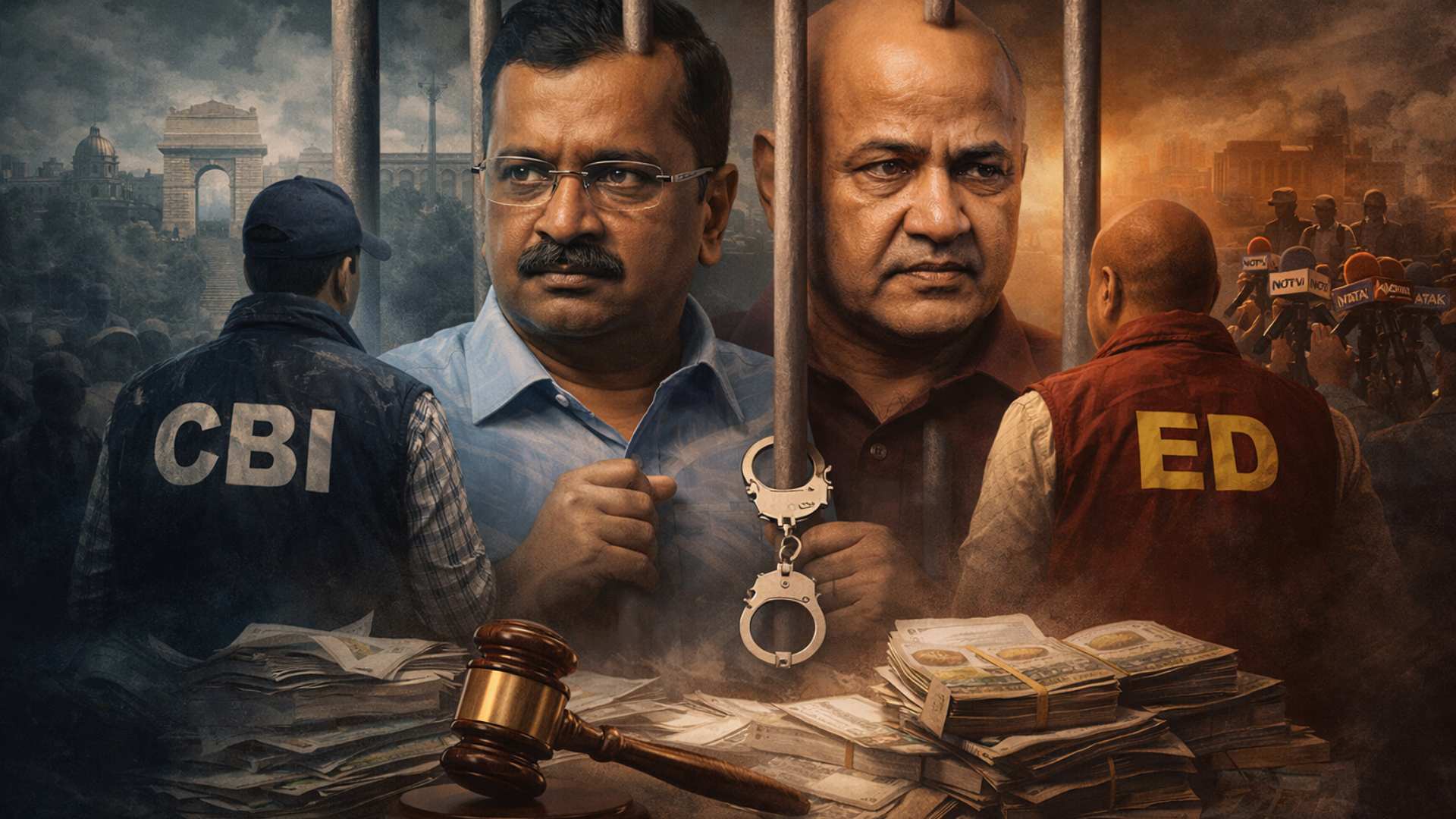
Politicisation of Anti-Corruption Bodies: A Critical Analysis

"Criminal law must not become a weapon in political hands — if arrests and prosecutions are perceived as tools of the political executive, the legitimacy of anti-corruption institutions suffers irreparable damage."
The collapse of India's high-profile Delhi excise policy case — without charges even being framed — raises fundamental questions about the evidentiary standards, institutional independence, and investigative capacity of India's anti-corruption architecture.
| Parameter | Detail |
|---|---|
| Investigating agencies | CBI + Enforcement Directorate (ED) |
| Alleged kickbacks | ₹100 crore |
| Key accused | Delhi CM Arvind Kejriwal, Deputy CM Manish Sisodia |
| Outcome | Trial court declined to frame charges |
| Legal basis for collapse | No prima facie evidence of conspiracy or personal gain |
| Supreme Court on PMLA | Flagged "5,000 cases to 40 convictions" ratio |
Background and Context
The Delhi excise policy case was registered as one of India's most significant corruption prosecutions — involving parallel CBI and ED investigations, high-profile arrests, and months of custody before trial. The trial court's eventual refusal to even frame charges — the lowest evidentiary threshold in criminal proceedings — signals a fundamental failure in the prosecution's evidentiary architecture, not merely a legal technicality.
"Anti-corruption agencies succeed not because they are powerful, but because they are trusted — and trust is built only through demonstrated independence from political control." — Transparency International, Global Corruption Report
Key Concepts
Prima Facie Standard At the charge-framing stage, courts do not determine guilt — they only assess whether sufficient material exists to proceed to trial. The court's refusal to frame charges in this case means the prosecution failed even this minimal threshold, indicating a near-total absence of admissible, corroborated evidence.
Why Corruption is Hard to Prove Unlike violent crimes, corruption rarely leaves direct evidence. Benefits may appear as favourable regulatory decisions, advantageous contracts, or shell company transactions — not cash. Successful prosecution requires an interlocking evidentiary chain:
- Forensic financial trails
- Documentary and digital records
- Beneficial ownership tracing
- Corroborated witness testimony
If any link in this chain is missing, courts decline to infer criminal intent. The Supreme Court has consistently held that policy decisions cannot be criminalised without clear evidence of dishonest intent and personal gain.
CBI vs. ED: Overlapping Jurisdictions India's anti-corruption ecosystem involves multiple agencies — CBI (Prevention of Corruption Act), ED (PMLA) — with uneven coordination and fragmented forensic capacity, unlike specialised single-window agencies in Singapore (CPIB) or Hong Kong (ICAC).
"The selective enforcement of anti-corruption laws is itself a form of corruption — it corrupts the institution entrusted with fighting it." — Journal of Democracy (Larry Diamond, Stanford University)
Structural Challenges in India's Anti-Corruption Framework
| Challenge | Detail |
|---|---|
| Over-reliance on witness statements | Modern corruption requires forensic accounting, not testimony |
| Fragmented agency ecosystem | CBI, ED, state ACBs operate with poor coordination |
| Low conviction rates | ED: ~5,000 PMLA cases, ~40 convictions (SC observation) |
| Political perception risk | Arrests before trial cause reputational damage regardless of outcome |
| Weak financial forensics | Beneficial ownership tracing, cross-border flows remain underdeveloped |
The Political Dilemma: Accountability vs. Weaponisation
India faces a dual crisis of credibility in anti-corruption enforcement:
Under-enforcement: Large policy-level corruption cases — liquor policies, irrigation contracts, land deals — rarely end in successful prosecutions, deepening public cynicism.
Over-reach: High-profile arrests without robust evidentiary foundations create a perception that criminal law is deployed as a tool of partisan contest rather than genuine accountability.
Both pathologies erode institutional legitimacy — one by allowing corruption to go unpunished, the other by making anti-corruption agencies instruments of political executive pressure.
Comparative Perspective
| Country | Agency | Key Strength |
|---|---|---|
| Singapore | CPIB (Corrupt Practices Investigation Bureau) | Single specialised agency, forensic expertise, high conviction rate |
| Hong Kong | ICAC | Independent mandate, financial forensics, community trust |
| India | CBI + ED + State ACBs | Fragmented, politically perceived, low large-case conviction rate |
Way Forward
- Strengthen forensic capacity — forensic accounting, data analytics, beneficial ownership tracing must become standard investigative tools
- Prosecutorial discipline — cases must be built on evidentiary foundations before arrest, not after
- Statutory independence — CBI and ED directors need fixed tenures and insulation from executive interference
- Specialised anti-corruption courts — dedicated fast-track courts for complex financial crime with trained judges
- Whistleblower protection — robust corroboration mechanisms to supplement witness-dependent prosecutions
Conclusion
"Corruption leaves no fingerprints. It requires not just political will to prosecute, but forensic sophistication to prove." — World Justice Project, Rule of Law Index
Credible anti-corruption enforcement demands both institutional independence and evidentiary rigour — without which agencies become perceived as political instruments, and public trust in democratic accountability collapses irreversibly.
Attribution
Original content sources and authors


Syllabus classification
How this article maps to GS papers
Main syllabus
GS2Accountable GovernanceQuick Q&A
What does the collapse of the Delhi excise policy case reveal about the nature of corruption investigations in India?
Key insights from the case:
- Evidentiary challenges: Corruption cases often lack direct evidence and rely on circumstantial links such as financial trails and witness testimony.
- Over-reliance on statements: Indian agencies frequently depend on witness statements rather than forensic financial analysis.
- Institutional fragmentation: Multiple agencies like CBI and ED operate with limited coordination, affecting case-building.
Unlike conventional crimes, corruption involves hidden transactions, shell companies, and indirect benefits, making it inherently difficult to prove.
Conclusion: The case reveals that without robust investigative techniques such as forensic accounting and data analytics, even high-profile prosecutions may fail. It calls for strengthening institutional capacity to ensure that allegations translate into legally sustainable cases.
Why are large-scale corruption cases difficult to prove in courts of law?
Major reasons for difficulty:
- Indirect financial flows: Money is routed through intermediaries, shell companies, or disguised as legitimate transactions.
- Absence of direct evidence: Benefits may take non-monetary forms such as favourable policies or contracts.
- Legal safeguards: Courts require proof of criminal intent and personal gain, especially in policy decisions.
For example, the Supreme Court has held that policy decisions cannot be criminalised unless there is clear evidence of mala fide intent. This protects governance but raises the bar for prosecution.
Implications: While these safeguards prevent misuse of law, they also make convictions rare in high-level corruption cases, contributing to public perception of impunity.
Conclusion: The challenge lies in balancing legal rigor with investigative efficiency, requiring advanced tools like forensic audits and international cooperation to trace financial flows.
How do investigative and prosecutorial limitations affect the outcome of corruption cases in India?
Key limitations include:
- Lack of forensic expertise: Limited use of forensic accounting and data analytics to trace complex financial transactions.
- Poor inter-agency coordination: Fragmentation between agencies like CBI, ED, and State police leads to inefficiencies.
- Inadequate prosecution strategy: Cases may be filed without sufficient evidence to meet judicial standards.
In contrast, countries like Singapore and Hong Kong have specialised anti-corruption agencies with strong technical capabilities, leading to higher conviction rates.
Consequences:
- Cases collapse at the stage of framing charges.
- Public trust in institutions declines.
- Accused individuals face prolonged incarceration without conviction.
Conclusion: Strengthening investigative capacity and ensuring evidence-based prosecution are essential to improve conviction rates and uphold the credibility of anti-corruption efforts.
Critically analyse the risk of politicisation of investigative agencies in high-profile corruption cases.
Concerns associated with politicisation:
- Selective targeting: Opposition leaders are often the focus of high-profile investigations.
- Media trials: Extensive coverage shapes public opinion before judicial determination.
- Pre-trial punishment: Arrests and prolonged custody can damage reputations irrespective of final outcomes.
The collapse of cases like the Delhi excise policy case raises questions about whether prosecutions were initiated with sufficient evidence or driven by political considerations.
Counter-perspective: It is equally important to recognise that corruption must be investigated rigorously, and shielding public officials from scrutiny would undermine accountability.
Conclusion: The challenge lies in ensuring that investigative agencies operate with institutional autonomy, transparency, and accountability, preventing misuse while maintaining their effectiveness in combating corruption.
What lessons can India learn from international best practices in anti-corruption investigations?
Key lessons:
- Specialised expertise: Dedicated teams for forensic accounting and financial intelligence.
- Institutional independence: Agencies operate with minimal political interference.
- Swift prosecution: Faster investigation and trial processes enhance deterrence.
For example, Hong Kong’s ICAC combines investigation, prevention, and public education, creating a holistic anti-corruption ecosystem.
Relevance for India:
- Develop specialised financial investigation units.
- Improve coordination among agencies.
- Ensure transparency and accountability mechanisms.
Conclusion: Adopting global best practices can help India move from high-profile but weak prosecutions to credible and successful conviction-based anti-corruption efforts.
How can the Delhi excise policy case be used as a case study to reform India’s anti-corruption framework?
Key lessons from the case:
- Need for evidence-based investigations: Agencies must prioritise concrete evidence over suspicion.
- Importance of financial forensics: Tracking money trails is crucial in complex corruption cases.
- Judicial safeguards: Courts play a vital role in preventing misuse of criminal law.
Reform measures:
- Establish specialised anti-corruption units with advanced analytical tools.
- Strengthen legal frameworks for financial transparency and disclosure.
- Ensure accountability of investigative agencies for failed prosecutions.
For instance, mandating preliminary evidence thresholds before arrests in high-profile cases could prevent misuse.
Conclusion: The case underscores the need for a balanced approach that ensures effective anti-corruption enforcement without compromising civil liberties, thereby strengthening public trust in democratic institutions.
The collapse of the Delhi excise policy case without charges being framed exposes India's anti-corruption architecture's twin failures — weak forensic capacity and the perception of political weaponisation of agencies like CBI and ED, whose PMLA record stands at just 40 convictions across 5,000 cases. Unlike Singapore's CPIB or Hong Kong's ICAC, India's fragmented multi-agency model lacks prosecutorial discipline and evidentiary rigour, enabling arrests before evidence-building. Credible anti-corruption enforcement demands statutory independence, forensic accounting, and specialised courts — without which agencies remain instruments of partisan contest rather than genuine democratic accountability.
Practice questions
2 questions for mains preparation