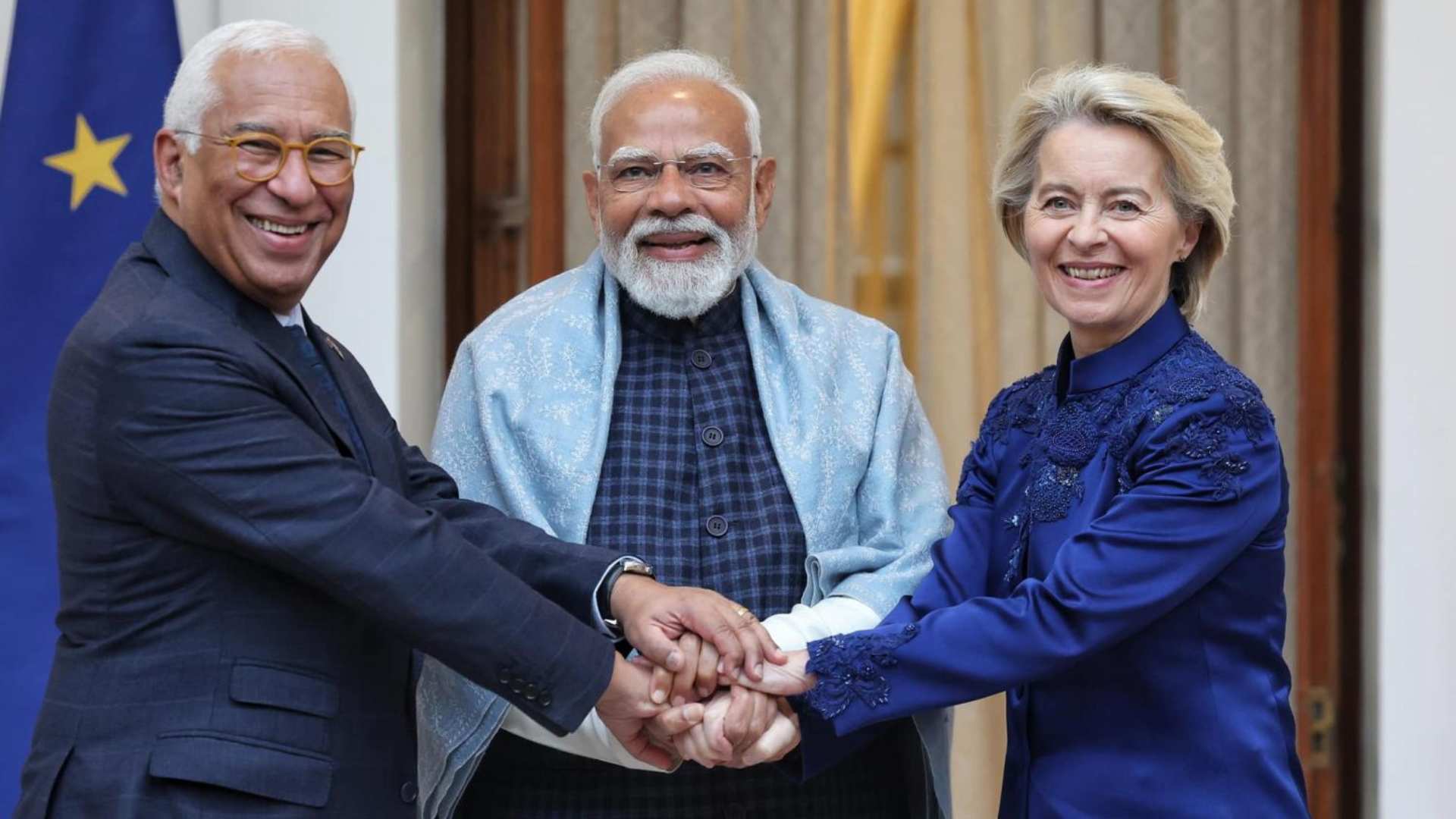
India-EU Trade Pact: A Strategic Shift Toward Growth
India-EU Free Trade Agreement: Implications and Reforms
1. Context and Strategic Significance of the FTA
India’s announcement of a Free Trade Agreement (FTA) with the European Union marks a strategic pivot from historically high-tariff, inward-looking policies toward export-driven growth. While immediate gains are modest, the agreement signals a deliberate shift in India’s economic strategy, emphasizing global competitiveness and trade openness. India accounts for less than 2% of global goods exports despite being the fourth-largest economy. Even a 2-percentage-point increase in market share could effectively double exports, highlighting significant untapped potential.
Global supply chains are increasingly diversifying away from China. European firms are seeking alternative production bases, presenting India with an opportunity to leverage its demographic dividend — nearly 65% of the population under 35 — and manufacturing potential. The FTA with the EU provides preferential access to 450 million consumers across 27 countries, enhancing prospects for trade and employment generation.
2. Challenges in Translating Market Access into Growth
While the FTA expands market access, it does not automatically guarantee higher exports or job creation. Structural impediments, including high tariffs on intermediate goods, costly key inputs, and procedural delays, limit competitiveness. India’s extensive use of Quality Control Orders (QCOs) — over 700 remain active — acts as de facto import barriers, disrupting supply chains and increasing uncertainty for firms.
Impacts:
- High input costs reduce price competitiveness in global markets.
- Procedural bottlenecks delay production cycles and export timelines.
- Over-reliance on protectionist measures may deter firms from scaling production.
3. Investment Protection and FDI Constraints
The EU FTA alone is insufficient to attract large-scale manufacturing investment. India’s bilateral investment framework remains weak following the termination of 77 bilateral investment treaties (BITs) in 2015. The revised model BIT (2016) requires investors to exhaust domestic remedies for five years before international arbitration — terms few global firms accept.
Consequently, Net FDI inflows fell to $0.4 billion in FY2025, the lowest on record. Weak investment safeguards incentivize European firms to operate via exports or minor assembly rather than committing long-term capital to India. Modernizing BITs and providing enforceable protections are crucial to attracting sustained manufacturing FDI.
4. Need for Broader Structural Reforms and Global Integration
Beyond tariff reductions and BIT reforms, India should consider joining high-standard regional trade agreements such as the Comprehensive and Progressive Agreement for Trans-Pacific Partnership (CPTPP). These agreements go beyond market access and encourage domestic reforms in:
- Labour laws
- Intellectual property
- Regulatory transparency
- Competition policy
International commitments create external discipline that can accelerate domestic reform, as seen in China’s WTO accession in 2001, which catalyzed modernization and global integration. High-standard agreements signal policy stability, enhancing investor confidence and facilitating long-term manufacturing investments.
5. Way Forward and Policy Imperatives
To capitalize on the EU FTA and achieve “Viksit Bharat 2047” aspirations, India must:
-
Reduce tariffs on intermediate goods to lower production costs.
-
Simplify customs procedures and regulatory compliance.
-
Rationalize or phase out QCOs that act as trade barriers.
-
Strengthen BITs and provide enforceable investment protections.
-
Actively participate in high-standard regional trade agreements to anchor domestic reforms.
Impacts:
- Enhanced global competitiveness of Indian firms.
- Increased export-led growth and job creation.
- Higher FDI inflows and sustainable industrialization.
6. Conclusion
The India-EU FTA is a pivotal step toward integrating India into global trade networks. However, it must mark the beginning of a sustained commitment to trade liberalization, investment facilitation, and structural reform. Seizing current global supply chain shifts requires fast, decisive action to create a competitive, resilient, and export-oriented manufacturing ecosystem.
"Opportunities don’t wait; neither should policy." — Paraphrased governance principle
Attribution
Original content sources and authors
Syllabus classification
How this article maps to GS papers
Main syllabus
GS2Bilateral RelationsQuick Q&A
What is the significance of the India-EU Free Trade Agreement (FTA) in the context of India's economic strategy?
Key points:
- Offers preferential access to 450 million consumers in one of the world’s wealthiest markets.
- Creates opportunities for Indian firms to expand their global footprint, potentially doubling exports with even a modest increase in market share.
- Reflects confidence in India’s demographic dividend, manufacturing potential, and emerging role as a supply chain alternative to China.
Why does India need domestic reforms alongside FTAs to achieve higher exports and economic growth?
Critical areas for reform:
- Reducing tariffs on intermediate goods to lower production costs.
- Simplifying regulations and streamlining customs to minimize delays.
- Reassessing extensive use of QCOs to provide certainty to exporters.
How can India attract larger manufacturing investments in the wake of new trade agreements?
Challenges: India terminated many bilateral investment treaties (BITs) in 2015, leaving foreign investors with limited recourse in disputes. The revised 2016 BIT requires investors to exhaust domestic remedies for five years, which few countries have accepted. Consequently, net FDI inflows, especially from major global firms, have declined significantly.
Way forward:
- Modernizing BITs to provide enforceable safeguards and faster dispute resolution.
- Ensuring consistent policy direction and legal certainty to build investor confidence.
- Linking trade agreements with domestic reforms to make India a competitive manufacturing hub rather than just an export market.
What are the reasons behind India's limited share in global goods exports despite being the fourth-largest economy?
Key factors:
- High tariffs on intermediate goods increase production costs for exporters.
- Complex customs and regulatory procedures delay trade and reduce competitiveness.
- Excessive quality control orders (QCOs) create uncertainty for domestic firms planning exports.
- Lack of strong investment protection discourages large-scale foreign investments that could boost export capacity.
Critically analyse the potential benefits and limitations of the India-EU FTA for India’s manufacturing sector.
- Provides preferential access to a 450 million-strong consumer base in Europe, enhancing export opportunities.
- Encourages Indian firms to compete globally, fostering efficiency and innovation.
- Signals policy stability and international engagement, which can improve investor confidence.
Limitations:
- Market access alone does not attract large-scale FDI without investment protection and regulatory reforms.
- High input tariffs and bureaucratic hurdles may limit cost-competitiveness of Indian manufacturing.
- Structural domestic reforms are politically and administratively challenging, potentially delaying real gains.
Conclusion: While the FTA is a strategic step, its success depends on India’s ability to complement external opportunities with internal reforms, lower costs, and enhanced investor confidence, thereby transforming trade agreements into sustainable industrial growth.
Illustrate with examples how joining high-standard regional trade agreements can accelerate domestic reforms in India.
China’s entry into the WTO in 2001 serves as a notable example. To comply with WTO rules, China undertook extensive domestic reforms, including modernizing its legal system, reducing trade barriers, and improving regulatory transparency. These reforms helped China attract massive FDI and integrate into global supply chains.
Implications for India: Joining high-standard agreements such as the Comprehensive and Progressive Agreement for Trans-Pacific Partnership (CPTPP) could similarly anchor reforms in areas where India faces domestic challenges, including:
- Labour law modernization
- Intellectual property rights enforcement
- Regulatory transparency and competition policy
Practice questions
2 questions for mains preparation