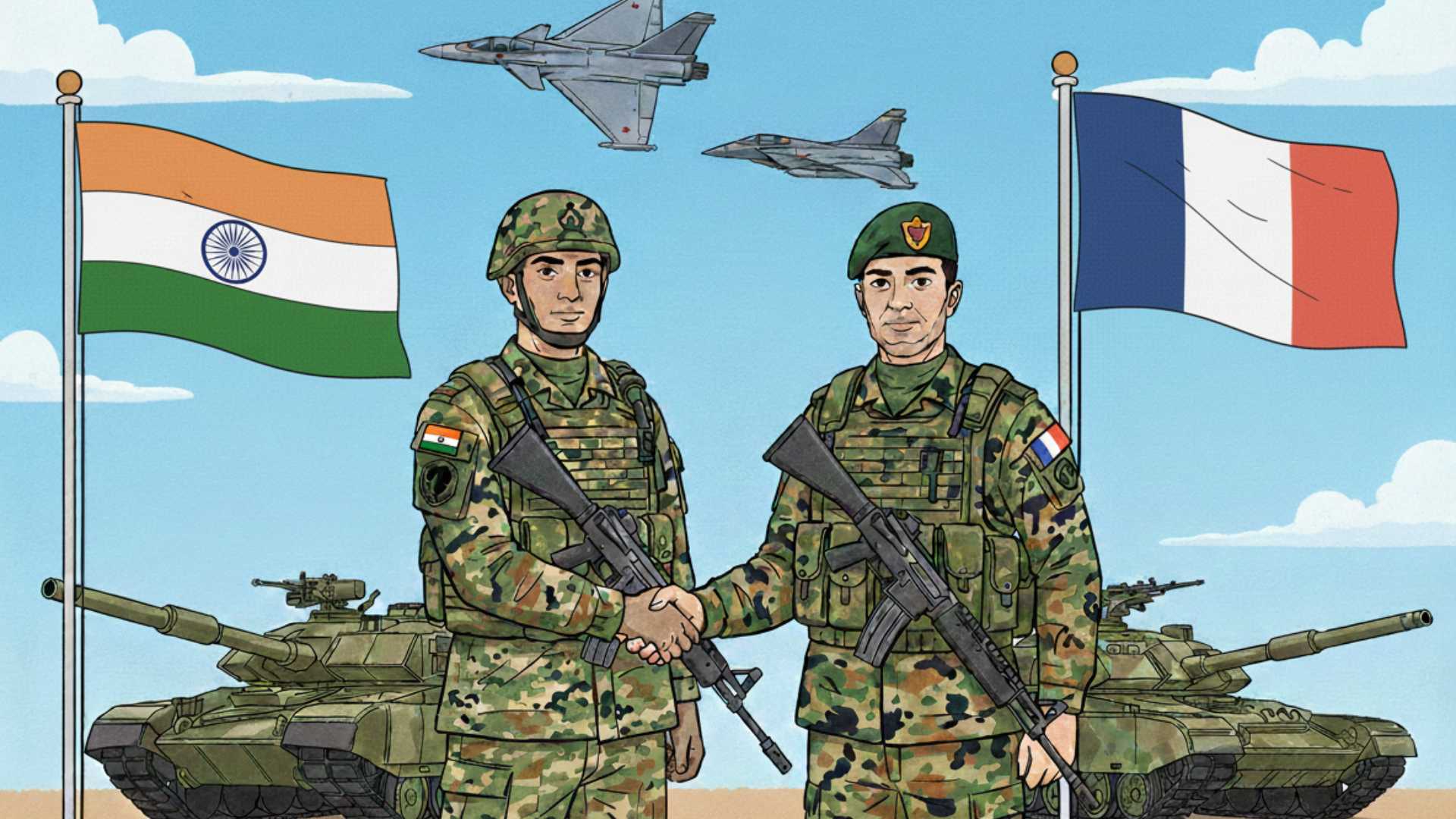
India and France Strengthen Defence Ties for a Decade
1. Renewal of India–France Defence Cooperation Agreement
India and France renewed their defence cooperation agreement for another 10 years during the 6th India–France Annual Defence Dialogue held in Bengaluru on February 17, 2026. The dialogue was co-chaired by India’s Defence Minister and France’s Minister of the Armed Forces and Veterans Affairs, underscoring the high-level political commitment behind the partnership.
The renewal reflects the deepening of the India–France strategic partnership, particularly in defence and security, which has historically been resilient and less vulnerable to geopolitical fluctuations. France remains one of India’s most reliable defence partners, particularly in aerospace and naval domains.
The signing of the agreement by senior defence officials institutionalises long-term collaboration and policy continuity. In addition, both countries announced the appointment of Reciprocal Deployment Officers in each other’s land forces establishments, signalling growing operational familiarity and trust.
The renewal consolidates long-term strategic predictability in defence ties. Without sustained institutional frameworks, defence cooperation risks becoming transactional rather than strategic, weakening India’s capacity to build enduring military capabilities.
2. Push for Indigenisation and Defence Industrial Cooperation
India urged France to increase “indigenous content” in the Rafale fighter aircraft to up to 50%, along with expansion of the maintenance, repair and overhaul (MRO) facility in India. This aligns with India’s broader policy of defence indigenisation under the “Atmanirbhar Bharat” initiative.
Indigenisation in high-end platforms such as Rafale is strategically significant. It reduces long-term dependency on foreign suppliers, enhances technological absorption, and strengthens India’s domestic defence industrial base. Expansion of MRO facilities in India also reduces lifecycle costs and ensures operational readiness.
An MoU was signed between Bharat Electronics Limited (BEL) and Safran Electronics and Defence for the manufacturing of Hammer missiles in India. This marks progress from mere procurement to joint production and industrial partnership.
Key Developments:
- Renewal of defence agreement for 10 years
- Target of up to 50% indigenous content in Rafale
- MoU for Hammer missile manufacturing in India
- Expansion of MRO facilities in India
Strengthening indigenous content builds long-term strategic autonomy and economic resilience. If defence platforms remain import-dependent, India’s operational sovereignty may be constrained during crises.
3. Co-development, Co-production and Niche Technologies
Both Ministers discussed priority areas for co-development and co-production of defence equipment, with emphasis on connecting industries of both nations, particularly in niche technologies.
This reflects a shift in India’s defence partnerships from buyer–seller dynamics to collaborative industrial ecosystems. Such cooperation promotes technology transfer, joint research, and supply-chain integration, which are essential for modern warfare domains such as electronics, aerospace systems, and advanced weaponry.
The focus on niche technologies also positions India within high-value segments of global defence manufacturing, potentially strengthening its export profile and integration into European defence supply chains.
Co-development ensures capability building rather than mere asset acquisition. If India does not leverage such partnerships for technology absorption, it risks remaining a market rather than emerging as a manufacturing hub.
4. Military-to-Military Cooperation and Operational Synergy
The two sides reaffirmed military-to-military cooperation as a key pillar of the strategic partnership. The appointment of Reciprocal Deployment Officers enhances interoperability, doctrinal understanding, and operational coordination.
Such mechanisms improve real-time cooperation during joint exercises, humanitarian assistance and disaster relief (HADR), and maritime security operations. They also enhance strategic trust and situational awareness in critical theatres such as the Indo-Pacific.
The emphasis on closer defence partnership and alignment within the wider European framework suggests convergence beyond bilateral ties, especially in the context of the recently concluded India–EU Security and Defence Partnership.
“Both Ministers agreed to leverage this framework… for tangible outcomes that will strengthen regional stability, enhance joint capabilities, and reinforce the enduring Indo-French strategic alignment.” — Ministry statement
Operational familiarity builds deterrence credibility. Without structured military engagement, strategic partnerships may remain declaratory rather than functional.
5. Indo-Pacific, Indian Ocean and India’s Role as Net Security Provider
India reiterated its role as a “first responder and net security provider” in the Indian Ocean Region (IOR). It emphasised assistance to regional countries in defence, maritime security, and capacity building.
France, with overseas territories and strategic presence in the Indo-Pacific, shares significant convergence with India in maritime security. Their cooperation enhances surveillance, maritime domain awareness, and regional stability in an increasingly contested Indo-Pacific environment.
This dimension connects bilateral defence cooperation with broader regional security architecture and aligns with India’s SAGAR (Security and Growth for All in the Region) vision.
India’s credibility as a net security provider depends on sustained partnerships and capability enhancement. Without reliable partners like France, India’s capacity to shape regional security outcomes could be limited.
6. Counter-Terrorism and Regional Security Concerns
During the dialogue, India highlighted the threat of cross-border terrorism, stating that Pakistan’s long history of nurturing such activities poses a serious threat to regional peace.
This reflects India’s consistent diplomatic position that terrorism remains a core security concern and must be addressed in bilateral and multilateral engagements. By raising the issue in strategic dialogues, India seeks international recognition and support for its security concerns.
The inclusion of counter-terrorism within defence discussions indicates that India views conventional and non-conventional threats as interconnected within its national security framework.
“Pakistan has a long history of nurturing cross-border terrorism… This has created a serious threat to peace in the region.” — Defence Minister Rajnath Singh
Addressing terrorism within strategic partnerships strengthens diplomatic backing and deterrence posture. Ignoring such concerns may undermine regional stability and weaken coordinated responses to non-state threats.
7. Strategic Significance for India (GS-II & GS-III Linkages)
The renewed defence cooperation has multi-dimensional implications:
Strategic:
- Strengthens India’s ties with a major European power
- Enhances Indo-Pacific balancing dynamics
Economic:
- Promotes domestic defence manufacturing
- Encourages technology transfer and industrial integration
Security:
- Improves operational readiness and interoperability
- Reinforces counter-terrorism cooperation
Diplomatic:
- Aligns bilateral partnership with broader India–EU Security and Defence Partnership
- Expands India’s engagement in the European strategic space
The development integrates GS-II (International Relations), GS-III (Defence and Security), and Essay themes such as strategic autonomy and self-reliance.
Strategic partnerships that combine diplomacy, industry, and security enhance comprehensive national power. If defence cooperation remains siloed from industrial and diplomatic dimensions, its transformative potential diminishes.
Conclusion
The renewal of the India–France defence cooperation agreement for another decade marks a transition from transactional defence trade to deeper strategic and industrial integration. By combining indigenisation, co-development, operational coordination, and Indo-Pacific convergence, the partnership strengthens India’s strategic autonomy and regional role.
Sustained implementation and technology absorption will determine whether this partnership becomes a cornerstone of India’s long-term security architecture and defence self-reliance.
Attribution
Original content sources and authors
Syllabus classification
How this article maps to GS papers
Main syllabus
GS2Bilateral RelationsQuick Q&A
What is the strategic significance of the renewal of the India-France Defence Cooperation Agreement for another decade?
The partnership is not limited to procurement but extends to co-development, co-production, and military-to-military engagement. The announcement of Reciprocal Deployment Officers strengthens institutional linkages between the Indian Army and French Land Forces, enhancing interoperability and doctrinal exchange. Additionally, France’s consistent support for India in multilateral forums—such as backing India’s bid for a permanent seat at the UN Security Council—adds diplomatic weight to this defence relationship.
Strategically, this renewal reinforces India’s efforts to diversify its defence partnerships beyond traditional suppliers. At a time of global supply chain disruptions and technological competition, long-term defence agreements help ensure stability in capability development. Therefore, the renewal is not merely administrative but represents a commitment to shared regional stability, particularly in the Indo-Pacific and Indian Ocean Region (IOR).
Why is India insisting on increasing indigenous content up to 50% in Rafale aircraft and expanding MRO facilities domestically?
Expanding Maintenance, Repair and Overhaul (MRO) facilities within India has both economic and strategic implications. Economically, it reduces lifecycle costs and foreign exchange outflows. Strategically, it ensures quicker turnaround times for repairs and upgrades, thereby enhancing combat preparedness. The COVID-19 pandemic demonstrated how supply chain disruptions can affect defence logistics; domestic MRO infrastructure mitigates such vulnerabilities.
Moreover, increasing local content promotes technology transfer and ecosystem development involving public sector units like HAL and BEL, as well as private firms. For example, the MoU between Bharat Electronics Limited and Safran for manufacturing Hammer missiles in India illustrates movement from buyer-seller dynamics to joint value creation. Thus, indigenous content is not merely symbolic but central to long-term capability building.
How does deeper India-France defence cooperation contribute to regional stability in the Indo-Pacific and Indian Ocean Region?
Through joint exercises, coordinated patrols, and information sharing, both countries can address common challenges such as maritime terrorism, illegal fishing, and strategic assertiveness by major powers. India’s role as a ‘net security provider’ in the IOR complements France’s regional presence. For example, humanitarian assistance and disaster relief (HADR) missions in the region benefit from coordinated naval capabilities.
Furthermore, the India-EU Security and Defence Partnership provides a broader framework to leverage bilateral ties within a wider European context. This multilateral dimension enhances deterrence and collective security. By integrating industrial cooperation, technological innovation, and operational coordination, India-France defence ties serve as a stabilizing factor in a volatile geopolitical environment.
Critically analyse the benefits and potential challenges of expanding co-development and co-production between India and France.
However, challenges remain. Technology transfer is often limited by intellectual property concerns and strategic sensitivities. There can be delays due to bureaucratic processes, cost overruns, and differing industrial standards. Additionally, balancing domestic private and public sector participation requires careful policy coordination to avoid inefficiencies.
From France’s perspective, deeper industrial integration must reconcile commercial interests with strategic considerations. For India, the key is ensuring genuine technology absorption rather than mere assembly operations. Therefore, while co-production holds transformative potential, its success depends on transparent agreements, capacity building, and institutional reforms within India’s defence procurement ecosystem.
As India positions itself as a ‘net security provider’ in the Indian Ocean Region, how does the India-France partnership support this objective?
The India-France partnership strengthens this objective through enhanced naval cooperation, intelligence sharing, and interoperability. France’s strategic assets in the western Indian Ocean complement India’s capabilities in the eastern and central IOR. For instance, coordinated maritime surveillance can help monitor sea lanes critical for global trade and energy supplies.
Additionally, collaboration in niche technologies—such as advanced electronics and missile systems—improves India’s deterrence posture. By reinforcing India’s maritime and air capabilities, the partnership indirectly contributes to countering threats like cross-border terrorism and regional instability. Thus, India-France defence cooperation is not merely bilateral but instrumental in shaping a stable and rules-based order in the Indian Ocean Region.
Practice questions
1 question for mains preparation