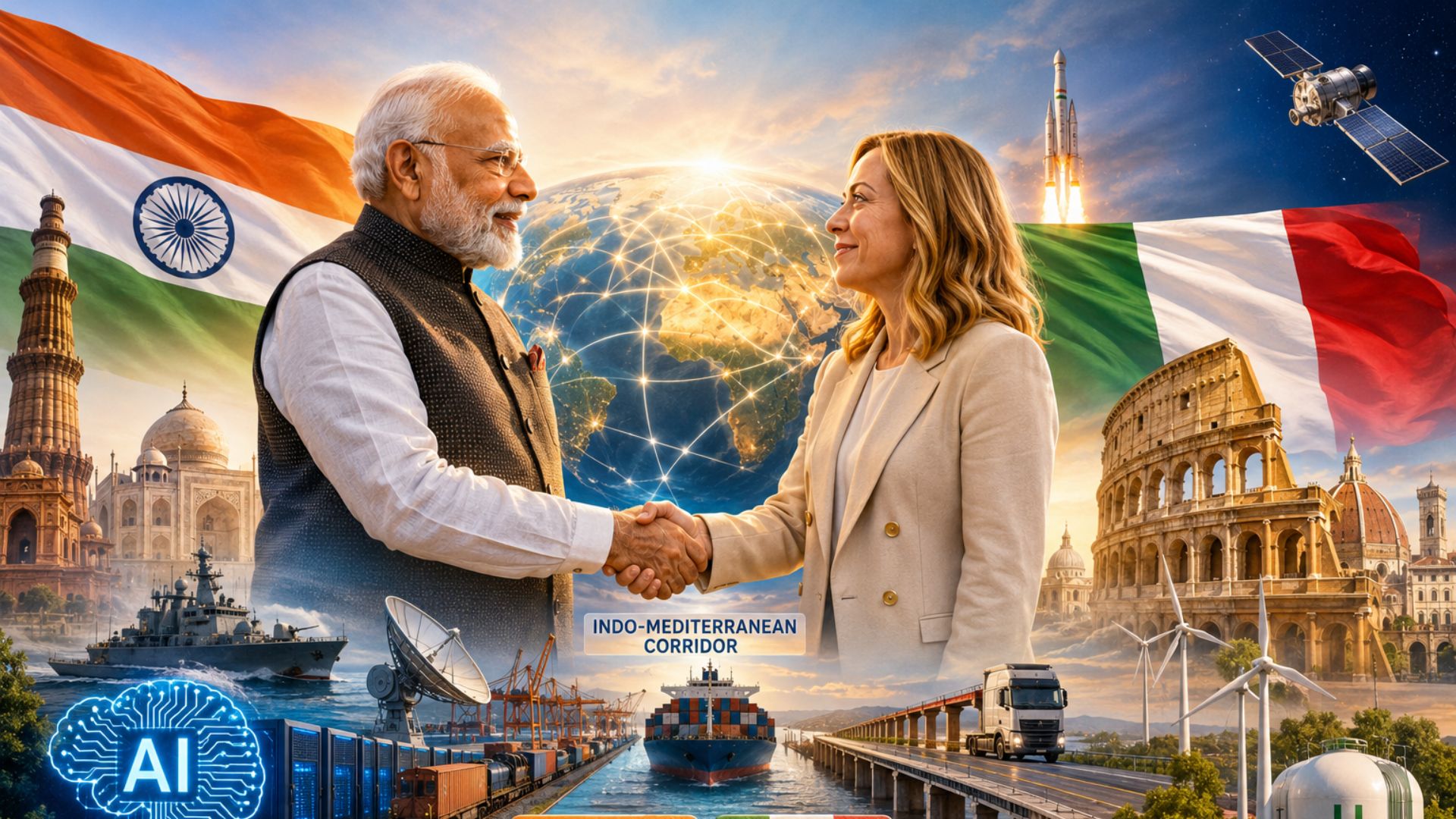
India-Italy Strategic Partnership: The Indo-Mediterranean Vision

In a significant diplomatic signalling, Prime Ministers Narendra Modi and Giorgia Meloni co-authored a joint op-ed on May 20, 2026, laying out an expansive bilateral roadmap under the framework of what they termed the "Indo-Mediterranean" — a new conceptual corridor linking the Indian Ocean to Europe.
From Friendship to Strategic Partnership
The two leaders described the relationship as having reached a "decisive stage", evolving from cordial ties into a Special Strategic Partnership grounded in shared democratic values. The framing is deliberate — India is simultaneously anchored in the Indo-Pacific while Italy sits at the heart of the Mediterranean, and the leaders argue these two zones are no longer separate spheres but increasingly interconnected spaces.
"We are witnessing the emergence of what might be termed the Indo-Mediterranean — an important corridor for trade, technology, energy, data and ideas tying the Indian Ocean to Europe."
This corridor thinking is not merely geographic — it is a strategic articulation of where 21st century prosperity will be shaped: through innovation, energy transitions, and strategic sovereignty.
IMEC: The Structural Backbone
Central to this vision is the India-Middle East-Europe Economic Corridor (IMEC), announced on the sidelines of the G20 Delhi Summit in September 2023. Both countries have committed to working with partners to realise IMEC's promise of connecting regions through:
- Modern transport and infrastructure
- Digital networks and data highways
- Energy systems and resilient supply chains
IMEC gives the Indo-Mediterranean idea a concrete infrastructural spine, moving it from rhetoric to policy architecture.
Economic Complementarity: The €20 Billion Target
The two sides have set an ambitious bilateral trade target of exceeding €20 billion by 2029, with the EU-India Free Trade Agreement (under negotiation) expected to accelerate progress. Key sectors in focus include:
- Defence & aerospace
- Clean technologies and pharmaceuticals
- Machinery, automotive components, textiles
- Agri-food and tourism
The op-ed captures the complementarity succinctly:
"Italian design, manufacturing excellence, and world-class supercomputers — and India's rapid economic growth, engineering talent, scale, and innovation ecosystem with over 100 unicorns and 200,000 start-ups."
Over 1,000 businesses from each side are already present in the other's economy — a foundation for deeper supply chain integration.
Digital Infrastructure and Responsible AI
India's Digital Public Infrastructure (DPI) — UPI, Aadhaar, DigiLocker — is finding resonance globally, particularly in the Global South. Italy and India are now combining:
India's strength        +       Italy's strength
─────────────────────────────────────────────────
Digital scale                   Ethical AI frameworks
Tech ecosystems                 Industrial expertise
DPI model export                Human-centred design
Their shared AI philosophy is clear: technology must serve human dignity, not manipulate democratic processes or undermine fundamental rights. This thinking informed both Italy's G7 Presidency priorities and the AI Impact Summit 2026 held in Delhi.
Strategic and Multilateral Cooperation
Beyond trade and technology, the partnership spans:
- Space and defence collaboration
- Maritime security of critical sea routes
- Renewable energy — hydrogen technologies, smart grids, resilient infrastructure
- Joint participation in India-led multilateral initiatives:
- International Solar Alliance (ISA)
- Coalition for Disaster Resilient Infrastructure (CDRI)
- Global Biofuels Alliance (GBA)
This multilateral dimension elevates the partnership beyond bilateralism — both nations are positioning themselves as co-architects of global governance frameworks.
The Civilisational Thread
The leaders drew a cultural bridge between India's Vasudhaiva Kutumbakam ("the world is one family") and Italy's Renaissance humanism — both traditions centring human dignity and the unifying power of culture. This is not ornamental language; it signals that the partnership is being framed as values-based, not merely transactional.
Way Forward
- Fast-tracking the EU-India FTA remains the single biggest lever for trade expansion.
- Operationalising IMEC requires sustained diplomatic coordination with Gulf partners, especially given regional instability.
- The AI governance framework being co-developed must translate into concrete standards, not remain aspirational.
- India should leverage Italy's G7 position to amplify Global South concerns on climate finance and digital equity.
Conclusion
The India-Italy joint op-ed is more than a diplomatic courtesy — it is a strategic document redefining how two mid-sized powers at opposite ends of a corridor can shape global dynamics together. The Indo-Mediterranean framing is a bold geographical and conceptual bet: that the future of trade, energy, and technology runs precisely through the arc connecting Mumbai to Milan. If IMEC delivers and the FTA concludes, this partnership could emerge as one of India's most consequential European alignments of the decade.
Attribution
Original content sources and authors


Syllabus classification
How this article maps to GS papers
Main syllabus
GS2Bilateral RelationsQuick Q&A
What is meant by the emerging Indo-Mediterranean corridor, and why is it strategically significant for India?
For India, this concept is significant because it strengthens its role as a connectivity hub between East and West. Through initiatives like the India-Middle East-Europe Economic Corridor (IMEC), India seeks to reduce reliance on traditional chokepoints and diversify supply chains. This is especially important in the context of global disruptions such as the Red Sea crisis and Russia-Ukraine conflict, which exposed vulnerabilities in maritime trade routes.
Strategically, the corridor aligns with India’s vision of becoming a leading power in global supply chains, digital governance, and energy transition. It also enables India to deepen partnerships with European countries like Italy, leveraging complementary strengths in manufacturing, technology, and innovation. In UPSC terms, this reflects India’s transition from a regional to a global strategic actor.
Why is the India-Italy partnership being described as a special strategic partnership rather than a conventional bilateral relationship?
Economically, both countries aim to cross the €20-billion trade target by 2029. Italy contributes industrial design, advanced manufacturing, and aerospace expertise, while India offers market scale, skilled manpower, and digital innovation. This creates a mutually beneficial partnership in sectors such as clean technology, pharmaceuticals, defence, and AI.
Politically, the partnership is rooted in common democratic values and commitment to a rules-based international order. Their cooperation in forums such as G20, G7 outreach, ISA, and CDRI demonstrates that the relationship is also global in scope. Thus, it is ‘strategic’ because it extends into critical domains of security, energy, and geopolitics.
How can the India-Middle East-Europe Economic Corridor (IMEC) transform regional connectivity and trade?
The corridor can transform trade by reducing transportation time and logistics costs while strengthening supply chain resilience. It includes not only physical transport infrastructure but also digital cables, green hydrogen pipelines, and integrated customs systems. This creates a holistic framework for 21st-century commerce.
Example: If fully operational, IMEC can enhance exports of Indian manufactured goods to Europe and facilitate energy imports through diversified routes. It may also increase strategic cooperation among India, UAE, Saudi Arabia, and European states. Hence, it is both an economic project and a geopolitical counterbalance to initiatives such as China’s Belt and Road Initiative.
Critically analyse the opportunities and challenges in India-Italy cooperation in AI and digital public infrastructure.
Opportunities include:
- AI-enabled governance and healthcare
- Cybersecurity cooperation
- Digital inclusion for developing countries
- Responsible AI regulation in democratic societies
Challenges remain: data sovereignty concerns, algorithmic bias, cybersecurity threats, and ethical misuse such as disinformation. AI may also deepen inequality if access remains concentrated. Therefore, India and Italy must ensure AI remains human-centred and aligned with democratic accountability, especially as AI increasingly shapes public discourse and political systems.
What are the reasons for growing India-Italy cooperation in energy transition and green technologies?
India requires advanced technologies and investment to meet its net-zero ambitions, while Italy has expertise in green engineering, industrial manufacturing, and renewable innovation. Joint collaboration can accelerate development in sectors like solar, biofuels, and battery ecosystems.
Case example: Italy’s support for India-led initiatives such as the International Solar Alliance and Global Biofuels Alliance demonstrates practical cooperation. Such partnerships also strengthen strategic sovereignty by reducing dependence on dominant global suppliers. Thus, energy collaboration is both developmental and strategic.
How does India-Italy cooperation illustrate the changing nature of middle power diplomacy in the 21st century?
This partnership demonstrates that modern diplomacy increasingly revolves around connectivity corridors, innovation ecosystems, and resilient supply chains. Both countries are leveraging their geographic advantages — India in the Indo-Pacific and Italy in the Mediterranean — to shape transcontinental economic architecture.
Case study: Their collaboration in IMEC, AI governance, ISA, and maritime security shows how middle powers can shape global agendas collectively. For UPSC, this reflects a broader shift from traditional bloc politics to flexible strategic partnerships centred on economic statecraft and technological cooperation.
Practice questions
2 questions for mains preparation