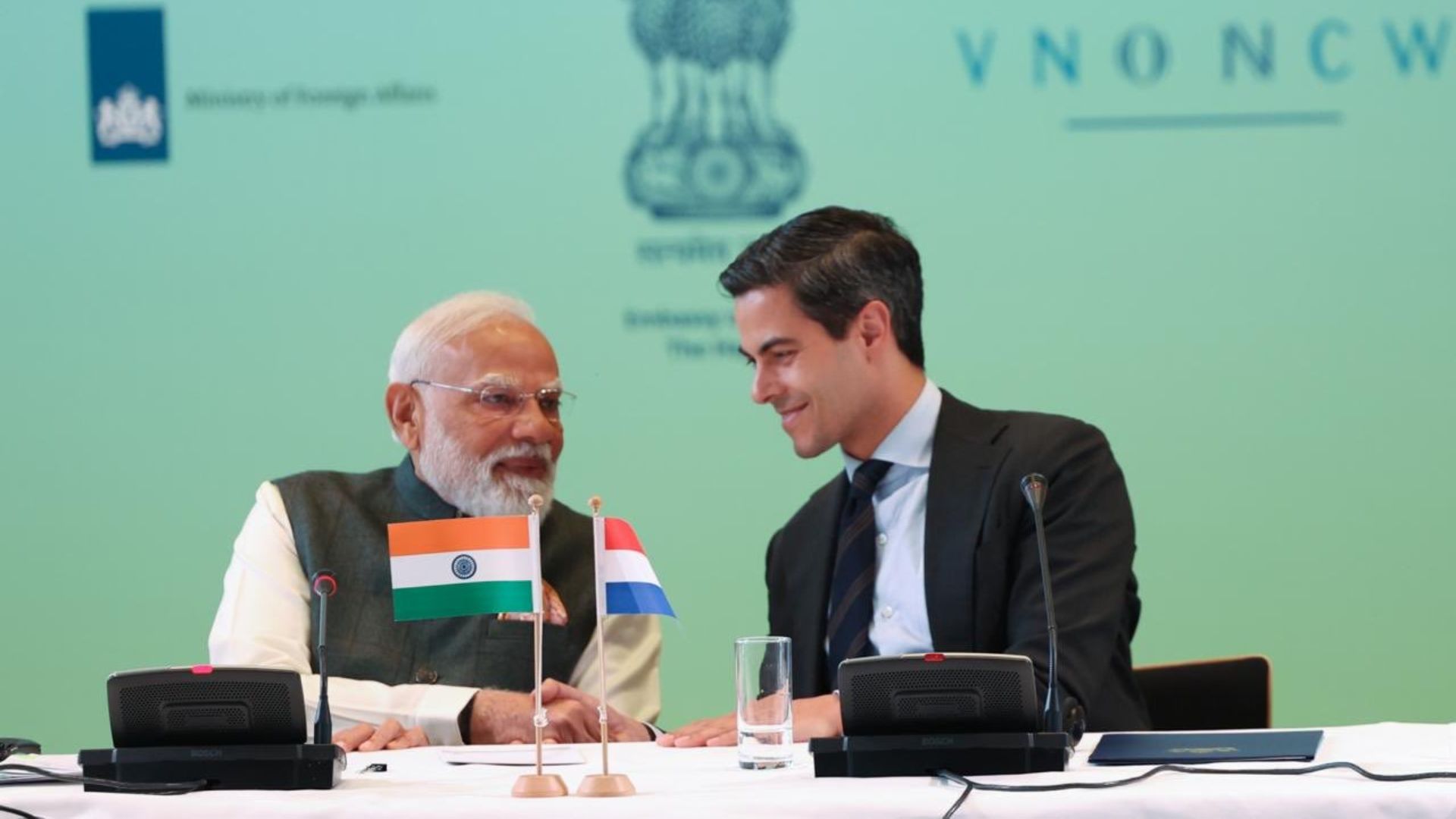
India and Netherlands Elevate Relations to Strategic Partnership

A Relationship Upgraded
When Prime Minister Narendra Modi visited the Netherlands on May 16–17, 2025, the outcome was more than a routine diplomatic exchange. India and the Netherlands formally upgraded their bilateral ties to a Strategic Partnership — a designation that signals sustained, structured engagement across multiple domains rather than transactional cooperation.
The visit produced 17 agreements and MoUs, clustered around a framework the two sides branded "WAH":
WAH Framework — Areas of Cooperation:

W → Water resources management
A → Agriculture
H → Health

Additional domains:
  → Renewable energy
  → Critical minerals
  → Semiconductors (TATA Electronics × ASML)
The TATA-ASML semiconductor fabrication partnership is particularly significant — ASML is the world's only manufacturer of extreme ultraviolet (EUV) lithography machines, which are indispensable for advanced chip manufacturing. India's entry into this partnership signals its seriousness about building a domestic semiconductor ecosystem.
What "Strategic Partnership" Actually Means
The upgrade is not merely ceremonial. PM Modi framed it explicitly:
"From elevating our relationship to a Strategic Partnership to expanding cooperation in water resources, semiconductors, innovation, defence, sustainability and mobility, we have charted an ambitious roadmap for the future."
Newly elected Dutch PM Rob Jetten, for his part, noted:
"The strategic partnership we are entering into today also offers us opportunities to discuss sensitive topics more frequently."
That phrase — sensitive topics — became the defining tension of the visit.
Diplomacy's Uncomfortable Moments
Strategic partnerships between democracies rarely stay purely transactional. The Netherlands visit surfaced three points of friction:
1. The Insiya Case
- Insiya, a Dutch-born child, was allegedly abducted in 2016 by her Indian father Shehzad Hemani from her Dutch mother Nadia Rashid in Amsterdam — when she was just two years old
- Her father was convicted for abduction in the Netherlands; the mother last spoke to Insiya in 2018
- During Modi's meeting with Dutch royalty, Nadia Rashid led protests outside, demanding India help trace and extradite her daughter
- PM Jetten formally raised the case in bilateral meetings — confirmed by India's MEA
- India's position: "It is a case in court, it is sub judice, so I would not like to comment" — MEA Secretary Sibi George
2. Press Freedom and Minority Rights
- Multiple Dutch media outlets reported Jetten raised concerns about press freedoms and minority rights, including those of the Muslim community
- The MEA pushed back firmly, with George responding: "Today we are 1.4 billion people, diverse, living in peace and harmony... You need to have more understanding of India to appreciate what India is"
- Notably, the MEA said the Dutch PM "didn't raise anything like that in the bilateral meetings" — suggesting a gap between what was said publicly and what was discussed privately
3. PM Modi's Absence from Press Conference
- Dutch journalists questioned why Modi did not participate in the joint press conference — a format standard in most democratic bilateral summits
- The MEA attributed the question to a "lack of understanding"
The Broader Strategic Context
The visit was part of a five-nation week-long tour — Netherlands, Sweden, Norway (including the Nordic-India Summit), and beyond. PM Jetten also raised the closure of the Strait of Hormuz and its implications for energy prices — a global concern that India, as a major energy importer, shares directly.
The Netherlands brings specific strengths India needs:
- World leader in water management and delta technology — directly relevant to India's flood and irrigation challenges
- Home to ASML — the irreplaceable node in global semiconductor supply chains
- A gateway to EU-India technology and trade corridors
Way Forward
- India must develop clear bilateral frameworks for child custody and abduction cases — the Insiya case will not be the last such friction point with a democratic partner
- The TATA-ASML semiconductor partnership needs policy support domestically through PLI schemes and R&D infrastructure to translate MoUs into manufacturing reality
- India's engagement with European democracies must anticipate human rights and governance conversations as a routine feature of strategic partnerships, not surprises to be deflected
- The WAH framework offers a replicable model for structuring cooperation with other technology-advanced, resource-efficient nations
Conclusion
The India-Netherlands Strategic Partnership is substantively significant — semiconductors, water technology, and clean energy are precisely the domains where India needs deep international collaboration. But the visit also illustrated a recurring diplomatic reality: when two democracies deepen ties, they also deepen the space for uncomfortable conversations. India's diplomatic maturity will increasingly be measured not just by the agreements it signs, but by how it handles the frictions that strategic partnerships inevitably bring to the surface.
Attribution
Original content sources and authors

Syllabus classification
How this article maps to GS papers
Main syllabus
GS2Bilateral RelationsQuick Q&A
What is the significance of India and the Netherlands upgrading their bilateral relationship to a Strategic Partnership?
The significance lies in sectors identified under the partnership: water, agriculture, health (WAH), semiconductors, renewable energy, and critical minerals. These are core sectors for India’s developmental priorities and its aspiration for technological self-reliance under initiatives like Make in India and Atmanirbhar Bharat.
From a geopolitical perspective, the partnership reflects India’s increasing engagement with Europe amid changing global supply chains. The Netherlands is a major gateway to Europe and a leader in water management and semiconductor equipment through ASML. This helps India diversify partnerships beyond traditional allies.
For UPSC analysis, this partnership demonstrates how economic diplomacy today intersects with strategic technology, climate goals, and resilient supply chains, making bilateral relations multidimensional.
Why are semiconductors and critical minerals central to India’s foreign policy engagements with countries like the Netherlands?
India’s partnership with ASML through Tata Electronics highlights its intent to develop domestic semiconductor capabilities. ASML is globally dominant in advanced chipmaking equipment. Cooperation enables technology transfer, industrial ecosystem development, and reduced dependence on East Asian supply chains.
Critical minerals are equally important because they underpin energy transition. India’s EV and solar ambitions require uninterrupted access. International collaborations are essential since India has limited reserves of many such minerals.
Strategically, this aligns with India’s broader goal of becoming part of trusted global value chains. The issue is also linked to national security, as supply disruptions could affect defense and infrastructure sectors.
How do human rights concerns raised by foreign leaders affect bilateral diplomacy, as seen in the India-Netherlands interaction?
Such interactions show the tension between sovereignty and universal rights discourse. European countries frequently emphasize democracy, rights, and governance in foreign policy. India generally views internal issues as sovereign matters and resists external commentary.
Diplomatically, these issues may not derail strategic ties but can create public perception challenges. They also test the maturity of bilateral relations—whether nations can sustain cooperation despite political differences.
For India, managing such concerns requires balancing strong rebuttals with maintaining constructive strategic engagement, ensuring that disagreements do not overshadow economic or technological cooperation.
Critically analyze the opportunities and challenges in India’s expanding strategic partnerships with European nations.
Opportunities include:
- Technology transfer in strategic sectors
- Diversification from China-centric supply chains
- Support for climate transition and green energy goals
- Enhanced diplomatic leverage in multilateral forums
Challenges remain significant. European nations often link partnerships with normative concerns such as democracy, media freedom, and minority rights. This can create friction. Additionally, regulatory complexity, data norms, and trade barriers may slow implementation.
Thus, while strategic partnerships enhance India’s global standing, they require careful balancing of national sovereignty, economic interests, and diplomatic pragmatism.
How does the Insiya child abduction case illustrate the intersection of consular issues and bilateral diplomacy?
Consular disputes become diplomatic when they involve cross-border jurisdiction, extradition, and custody rights. Such cases attract media attention and political pressure, compelling governments to respond even when matters are sub judice.
The case demonstrates that modern diplomacy is not limited to trade or security but increasingly involves humanitarian and legal cooperation. It also highlights the importance of mutual legal assistance treaties and judicial coordination.
For UPSC perspective, it shows how citizen-related disputes abroad can shape bilateral narratives and test the responsiveness of diplomatic institutions.
What does the India-Netherlands cooperation in water, agriculture and health (WAH) indicate about contemporary development diplomacy?
For India, this is particularly relevant because climate change, urban flooding, food security, and health resilience are national priorities. Dutch expertise in delta management can support India’s coastal adaptation projects, while agricultural technology can improve productivity and sustainability.
Examples include:
- Urban flood management in coastal cities
- Precision farming and greenhouse agriculture
- Joint health innovation and research
Such diplomacy is developmental because it directly supports SDGs and domestic governance priorities. It also creates long-term interdependence beyond conventional strategic sectors.
Practice questions
1 question for mains preparation