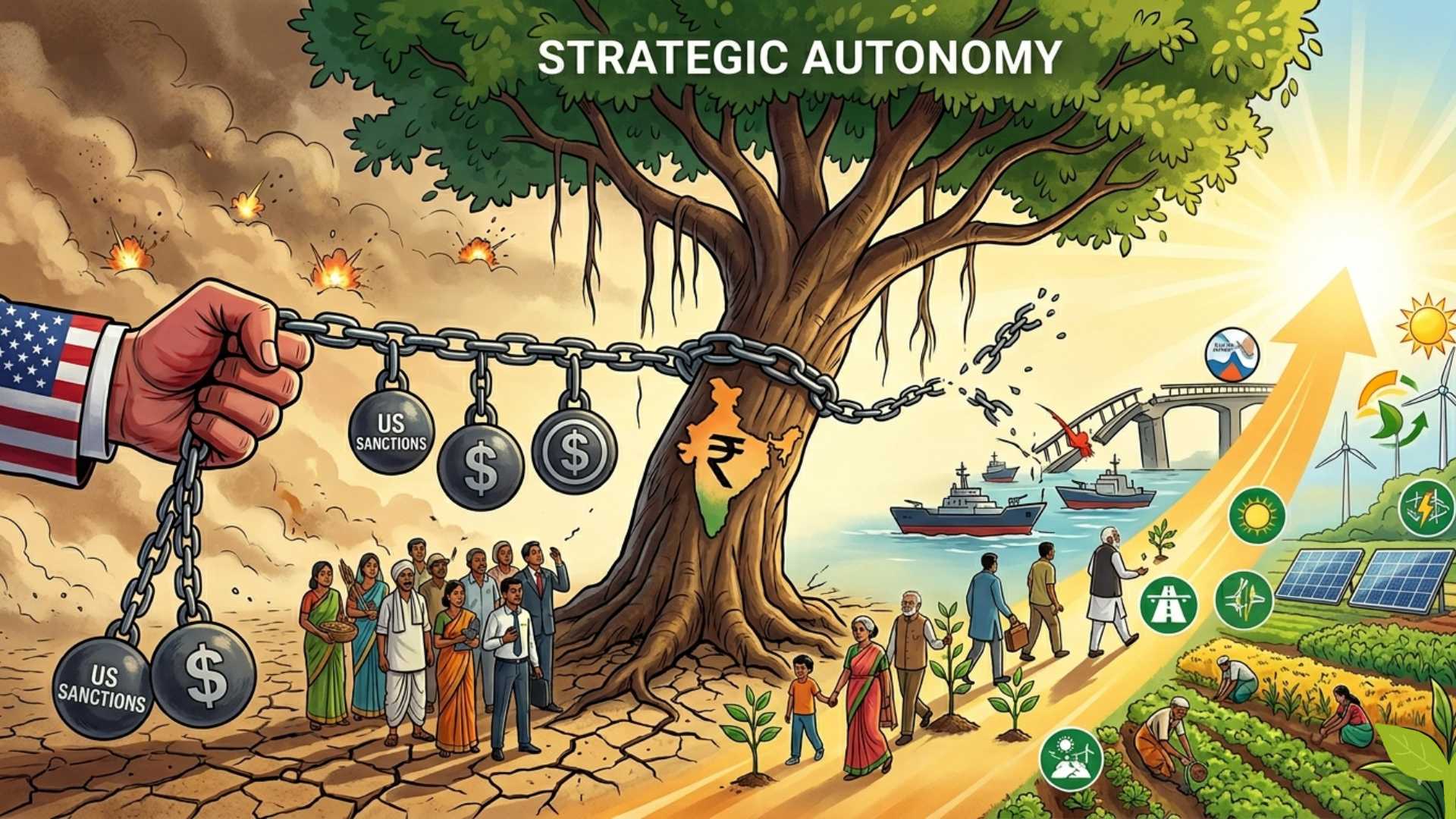
India's Stand on U.S. Unilateral Sanctions: A Red Line?

"The sui generis 'whack-a-mole' nature of these measures only adds to their capriciousness." — Urjit Patel, former RBI Governor, The Great Sanctions Hack
The U.S. has imposed 365 sanctions in the 21st century — more than any other power — while the entire UN Security Council maintains only ~15 active sanction regimes. India, already absorbing U.S. tariff pressure, now faces a compounding crisis: the Strait of Hormuz double blockade has pushed energy bills higher, exports down 7% in March 2026, and the rupee's fall has dropped India from projected 4th to 6th largest economy (IMF). The central question is whether India's decade-long sanctions compliance has served its strategic interests — or systematically undermined them.
Background / Context
U.S. unilateral sanctions have intersected with India's foreign policy at multiple points — Iran oil (2012–14, 2019–present), Russian S-400 (CAATSA, 2018), Russian oil (2025–26), Venezuelan oil (2019–present), and Chabahar port (ongoing waivers). Each compliance episode has come with economic costs and strategic opportunity losses, while non-compliance (S-400) yielded tangible benefits with no penalties.
The current crisis — U.S.-Israel war on Iran, Hormuz blockade, sanctions waiver expiry — forces India to make its most consequential sanctions policy decision since Independence.
U.S. Sanctions — India's Compliance Timeline
| Period | Sanction | India's Response | Cost/Outcome |
|---|---|---|---|
| 2012–14 | Obama-era Iran sanctions (JCPOA leverage) | Reduced Iranian oil 18.5 MT → 11 MT | Partial compliance; never full halt |
| 2015–19 | Post-JCPOA relief | Resumed Iranian oil + Chabahar agreement | Strategic connectivity gains |
| 2019–present | Trump "zero out" Iran + Venezuela | Full compliance — stopped purchases | Lost discounted crude; billions in opportunity cost |
| 2018 | CAATSA (S-400 purchase) | Non-compliance — bought S-400 | No U.S. penalty; strategic benefit (Op Sindoor 2025) |
| Nov 2025–Feb 2026 | Trump Russian oil demand | Halved intake 2 mn → 1 mn bpd | Economic damage; reversed after waivers |
| April 26, 2026 | Chabahar waiver expiry | Decision pending | INSTC + connectivity at stake |
Key Concepts / Definitions
CAATSA (Countering America's Adversaries Through Sanctions Act, 2017) U.S. law imposing sanctions on countries purchasing Russian defence equipment. India bought S-400 despite CAATSA — received presidential waiver; no penalty applied.
IEEPA (International Emergency Economic Powers Act) U.S. law invoked by Trump for sweeping tariffs — found to violate GATT norms by World Trade Institute. Illustrates U.S. pattern of domestic law as international coercion tool.
OFAC (Office of Foreign Assets Control) U.S. Treasury body administering sanctions. Currently maintains sanctions on 23+ countries with 12+ issue-specific regimes.
INSTC (International North-South Transport Corridor) 7,200 km multimodal corridor connecting India → Iran → Russia → Europe. Passes through Bandar Abbas (Iran). Sanctions compliance has stalled India's infrastructure development along this route.
Strategic Autonomy India's foreign policy doctrine of independent decision-making, non-alignment with any power bloc, and freedom to pursue national interest across competing relationships.
Analysis / Significance
The Compliance-Coercion Paradox
COMPLIANCE PATTERN — INDIA'S EXPERIENCE
━━━━━━━━━━━━━━━━━━━━━━━━━━━━━━━━━━━━━━━━━━

India complies with sanction A
→ U.S. imposes sanction B
→ India complies with B
→ U.S. imposes sanction C + penalty threat
→ Pattern: Compliance ≠ reduce U.S. appetite
           Compliance = signal of yielding → more demands ↑

CONTRAST — NON-COMPLIANCE CASE (S-400)
India bought S-400 despite CAATSA
→ No U.S. penalty applied
→ S-400 proved decisive in Op Sindoor (May 2025)
→ Pattern: Firm resolve ≠ automatic punishment
           Strategic value > compliance cost
Opportunity Cost Calculation
Energy: Iranian crude = discounted + "sweeter" grade. Venezuelan oil = available below market. Russian oil (2022–25) = saved billions. Compliance with Iran/Venezuela sanctions (2019–25) = billions in unnecessary import premium paid.
Connectivity: Chabahar + INSTC non-development = India still dependent on Hormuz route. Had infrastructure been built despite sanctions, India would have an alternative energy/trade corridor today — precisely when Hormuz is blockaded.
Multilateral Order: India's compliance with U.S. unilateral sanctions = de facto endorsement of U.S. sanctions architecture over UN multilateral framework — undermines the rules-based order India claims to champion.
Historical Parallel — Indira Gandhi & PL-480
The "ship-to-mouth" crisis of 1966 is the defining historical lesson:
1966 CRISIS → POLICY LESSON
━━━━━━━━━━━━━━━━━━━━━━━━━━━━━━

LBJ's "short-tether" policy
= Monthly approval for wheat shipments to famine-hit India
= Leverage tool after Gandhi's Moscow visit + Vietnam peace call
       ↓
India = humiliated dependency
       ↓
Gandhi's response:
→ Red line declared ≠ repeat this humiliation
→ Green Revolution → agricultural self-sufficiency
→ Strategic autonomy doctrine deepened
       ↓
2026 PARALLEL:
Sanctions compliance = new "short-tether"
→ Response needed: Energy independence + payment sovereignty
= "New Green Revolution" equivalent for energy sector
Challenges / Issues
- Waiver Dependency → On-again/off-again waivers = India cannot plan long-term energy strategy ≠ stable sourcing
- Dollar System Vulnerability → SWIFT + dollar dominance = U.S. can weaponise financial architecture ≠ India has alternative yet
- Private Sector Hesitation → Indian companies fear secondary sanctions = self-censor trade ≠ government stance alone sufficient
- Hormuz Exposure → Sanctions compliance + INSTC neglect = India has no alternative to Hormuz-dependent imports during current blockade
- BRICS Payment Threat → Trump threatened sanctions on BRICS non-dollar mechanisms = India's de-dollarisation options constrained
- COP33 Withdrawal → India withdrew bid to host COP33 (2028) = lost multilateral platform to build alternative energy + payment coalitions
India's Available Instruments
| Instrument | Mechanism |
|---|---|
| Rupee-Rial Trade System | Bilateral payment ≠ dollar-denominated → bypasses OFAC |
| RuPay / UPI Expansion | National payment system → insulated from SWIFT pressure |
| Intra-BRICS Settlement | Multilateral non-dollar mechanism → needs political resolve |
| Air-Gapped Banking | Financial institutions insulated from western correspondent banking |
| Chabahar + INSTC | Physical connectivity → reduce Hormuz dependence |
| Renewable Energy Scale-Up | Structural import substitution → reduce oil import quantum |
| Strategic Petroleum Reserves | Buffer against supply shocks → currently underdeveloped |
Prelims-Relevant Facts
📌 CAATSA was passed by the U.S. Congress in 2017 targeting Russia, Iran, and North Korea. India is the only country to have purchased S-400 despite CAATSA without facing penalties.
📌 Chabahar Port is located in Sistan-Baluchestan province, Iran. India signed a 10-year contract with Iran for Chabahar Port operations in May 2024 — the waiver for which expires April 26, 2026.
📌 PL-480 (Food for Peace Act, 1954) allowed the U.S. to supply surplus agricultural commodities to food-deficit countries — used as diplomatic leverage against India in 1966.
📌 Strait of Hormuz — between Iran and Oman — is the world's most strategically important oil chokepoint. ~20% of global oil trade passes through it daily.
Way Forward
IMMEDIATE   → Declare red line on Chabahar waiver expiry (April 26)
              ≠ allow connectivity corridor to lapse again
              + Resume Iranian + Venezuelan oil without apology

SHORT-TERM  → Rupee-Rial + RuPay deployment for sanctioned trade
              = Payment sovereignty ≠ dollar dependency
              + Expedite INSTC infrastructure → Bandar Abbas rail/road

MEDIUM-TERM → Build Strategic Petroleum Reserves to 90-day cover
              (IEA standard; India currently = ~9 days cover only)
              + Air-gapped banking entities for sanctioned country trade

LONG-TERM   → Renewable energy scale-up → reduce oil import quantum structurally
              + Lead Global South coalition on sanctions reform in UNGA
              = Rules-based order ≠ U.S.-defined order

STRUCTURAL  → New Green Revolution equivalent for energy
              = Self-sufficiency doctrine applied to energy as Indira did to food
              + BRICS non-dollar settlement → political resolve needed ↑
India's strategic autonomy is not merely a foreign policy slogan — it is an economic survival imperative. The 1966 food crisis taught India that dependency is a weapon. The 2026 energy crisis must teach the same lesson about import dependence and sanctions compliance. New Delhi's response in the coming weeks — on Chabahar, on Iranian oil, on payment mechanisms — will define whether India is a rule-shaper or a rule-taker in the emerging multipolar order.
Attribution
Original content sources and authors


Syllabus classification
How this article maps to GS papers
Main syllabus
GS2Bilateral RelationsQuick Q&A
What are the economic implications of the U.S.-Israel-Iran conflict on India’s economy?
Key economic impacts include:
- Inflationary pressures: Higher fuel prices have a cascading effect on transportation and essential commodities.
- Decline in exports: India’s exports fell by 7% in March, reflecting weakened global demand and logistical challenges.
- Currency depreciation: The rupee’s fall has affected India’s global economic ranking and increased import bills.
Additionally, the disruption has compounded existing challenges such as U.S. tariffs, further straining India’s growth trajectory. The conflict highlights India’s vulnerability to external shocks due to its reliance on energy imports and global supply chains.
In conclusion, the crisis underscores the urgent need for diversification of energy sources, strengthening domestic resilience, and adopting strategic economic policies to mitigate external risks.
Why is India’s compliance with unilateral U.S. sanctions a matter of strategic concern?
The concerns can be understood as follows:
- Economic costs: Compliance has led to missed opportunities to procure cheaper oil and build strategic reserves.
- Policy constraints: It limits India’s ability to pursue an independent foreign policy aligned with its national interests.
- Precedent of coercion: Continued compliance may encourage further demands from the U.S.
For instance, India’s reduction in Russian oil imports under pressure in 2025 demonstrates how sanctions can directly impact national energy security. Conversely, India’s defiance in purchasing the S-400 system from Russia without facing penalties shows that resistance is sometimes feasible.
Thus, the issue is not merely economic but also strategic, as it affects India’s sovereignty in decision-making and its role as an independent global actor.
How can India mitigate the adverse effects of sanctions and external economic shocks?
Key strategies include:
- Energy diversification: Expanding sources of oil and gas imports, including renewable energy investments.
- Alternative payment systems: Developing mechanisms like rupee-rial trade and intra-BRICS settlements to bypass dollar dependency.
- Infrastructure development: Strengthening projects like Chabahar port and the International North-South Transport Corridor (INSTC).
Additionally, India can explore air-gapped financial systems insulated from Western sanctions and enhance domestic production capacities. Building strategic reserves, as China has done, can also provide a buffer against supply disruptions.
In conclusion, resilience lies in reducing dependence on any single country or system and fostering self-reliance while maintaining diversified global partnerships.
What explains the ‘whack-a-mole’ nature of U.S. sanctions and their increasing global impact?
Key reasons include:
- Financial hegemony: The dominance of the U.S. dollar enables enforcement of sanctions through global financial institutions.
- Geopolitical objectives: Sanctions are used as tools to influence the behaviour of other nations.
- Unilateral approach: Unlike UN sanctions, U.S. sanctions are often imposed without multilateral consensus.
According to data, the U.S. has imposed far more sanctions than any other country, targeting over 23 nations and multiple sectors. This creates uncertainty for countries like India, which must constantly adjust policies to comply or resist.
The implications are significant:
- Disruption of global trade and investment flows
- Erosion of multilateral institutions like the UN
- Increased pressure on developing countries
Thus, the unpredictable nature of sanctions necessitates strategic planning and diversification by affected countries.
Critically analyse the costs and benefits of India complying with U.S. sanctions.
Benefits of compliance include:
- Strengthened bilateral ties: Aligning with the U.S. can enhance cooperation in defence, technology, and trade.
- Avoidance of penalties: Compliance helps prevent secondary sanctions and economic disruptions.
However, the costs are substantial:
- Economic losses: Missed opportunities to import cheaper oil from Iran and Venezuela.
- Strategic dependence: Reduced autonomy in foreign policy decisions.
- Infrastructure setbacks: Delays in projects like Chabahar port and INSTC.
The S-400 case illustrates that selective defiance can yield benefits without necessarily triggering punitive measures. Moreover, compliance may embolden further demands, as seen in repeated pressures on oil imports.
In conclusion, India must adopt a calibrated approach, balancing cooperation with the U.S. while firmly protecting its strategic and economic interests.
How does the historical example of the 1966 ‘ship-to-mouth’ crisis inform India’s current policy choices?
Key lessons from this episode include:
- Importance of self-reliance: The crisis led to the Green Revolution, transforming India into a food-secure nation.
- Risks of external dependence: Over-reliance on a single country can lead to political and economic pressure.
- Need for strategic autonomy: Independent decision-making is crucial for national sovereignty.
In the current context, similar vulnerabilities are visible in India’s dependence on energy imports and compliance with external sanctions. The lesson is that crises can serve as catalysts for structural reforms.
Thus, just as the Green Revolution ensured food security, India must now pursue energy independence and economic resilience to avoid future vulnerabilities.
As an economic policy advisor, how would you design a strategy for India to maintain strategic autonomy while navigating global sanctions regimes?
Key elements of the strategy would include:
- Diversification of energy sources: Increase imports from multiple countries and invest in renewables.
- Alternative financial systems: Develop non-dollar payment mechanisms and strengthen domestic banking systems.
- Strategic reserves: Build reserves of critical resources such as oil and fertilizers.
Diplomatic measures:
- Engage in multilateral forums like BRICS and G20 to advocate for fairer global rules
- Maintain balanced relations with major powers
- Promote South-South cooperation
Domestic reforms:
- Enhance manufacturing and reduce import dependence
- Encourage private sector participation in global markets
- Invest in research and innovation
Effective communication and policy clarity will also be essential to build investor confidence and international credibility.
In conclusion, a combination of economic resilience, diplomatic agility, and institutional innovation is key to maintaining strategic autonomy in a complex global environment.
Practice questions
1 question for mains preparation