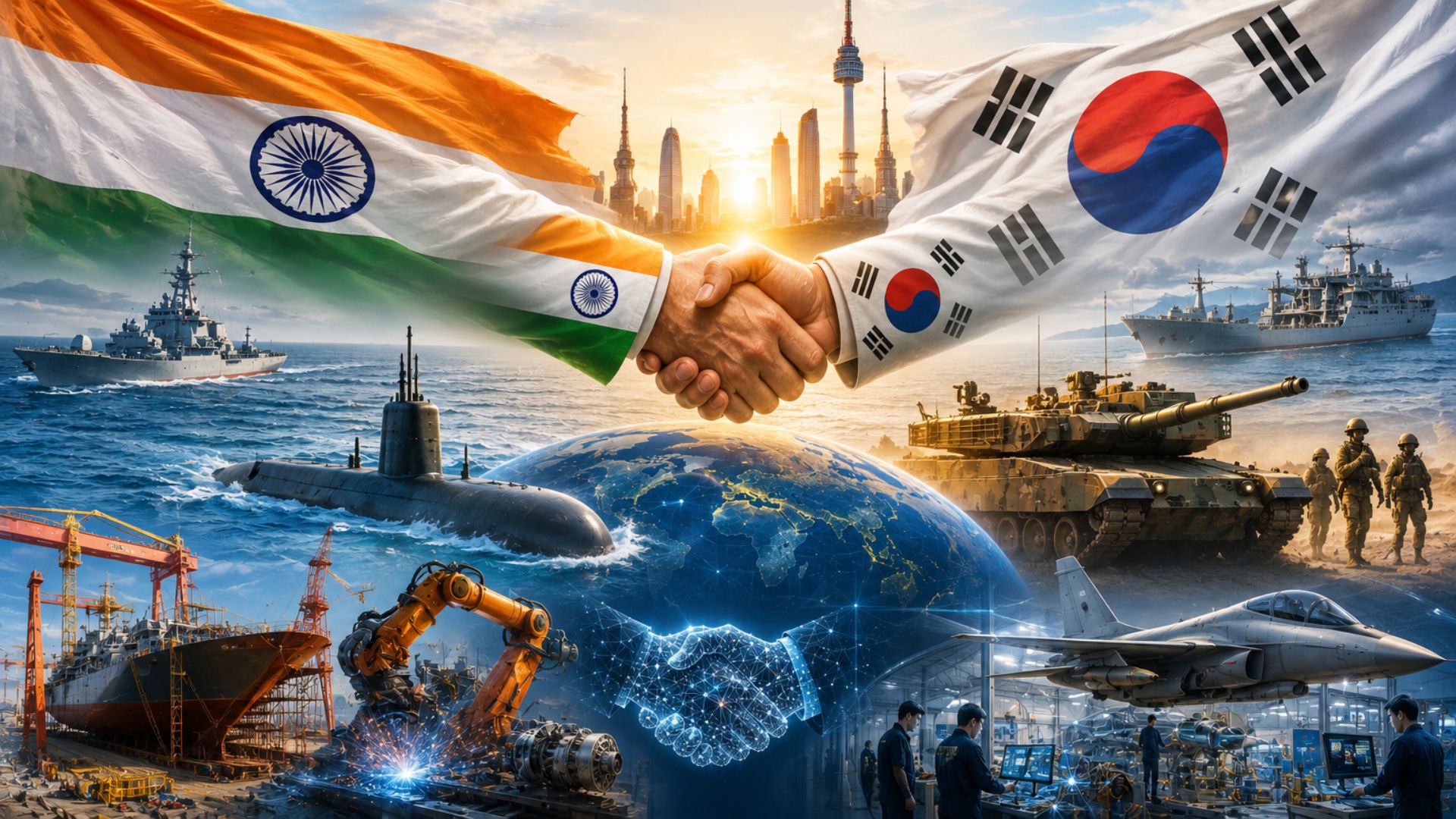
Strategic Growth in India-South Korea Defence Collaboration

"What began as limited defence engagement has evolved into a multidimensional partnership in defence manufacturing, technology transfer, and military modernisation."
The Indian Defence Minister's visit to Seoul (May 19–21, 2026), coming just a month after the South Korean President's visit to India (April 19–21), signals that the India-South Korea defence partnership has entered a new phase — one defined by both industrial depth and strategic urgency. The bilateral relationship, once anchored in a single artillery programme, is now expanding across submarines, aerospace, shipbuilding, and defence innovation ecosystems.
From K9 Vajra to a Comprehensive Partnership
The K9 Vajra-T self-propelled howitzer, developed under Make in India with South Korea's Hanwha Defence, remains the flagship of bilateral defence cooperation — a proof-of-concept that technology transfer, joint manufacturing, and indigenisation can coexist productively.
Building on this foundation, cooperation has expanded rapidly:
Current and Emerging Project Areas:
- Submarines: Conventional submarines, lithium-ion battery systems,
  air-independent propulsion (Hanwha Ocean)
- Aerospace: KF-21 fighter programme, FA-50 light combat aircraft,
  engines, avionics, missile integration, maintenance systems
- Shipbuilding: Destroyers, logistics vessels, submarine support
  systems, smart shipyards, naval propulsion technologies
- Land systems: Light tanks, future ready combat vehicles,
  utility helicopters
- Electronics: Military lithium batteries, defence electronics
- Innovation: Korea-India Defence Accelerator (KIND-X) — linking
  startups, universities, research institutions, and investors
For India, South Korea offers advanced technology and manufacturing expertise. For South Korea, India provides a large market, strategic geography, and long-term industrial opportunity. The complementarity is structural, not incidental.
The Indo-Pacific Context: Why Strategy Must Follow Industry
Confining this partnership to defence-industrial cooperation alone would be, as the article notes, "a serious strategic miscalculation." The geopolitical environment around both countries is shifting in ways that demand a broader strategic framework.
South Korea faces a converging set of pressures:
- North Korea — Growing missile and nuclear capabilities remain a persistent and escalating threat
- Russia-North Korea military cooperation — Reshaping Northeast Asia's security architecture in ways that directly affect Seoul's strategic calculus
- China's naval assertiveness — Around the Korean Peninsula and in the South China Sea, through which a significant share of South Korea's energy imports and maritime trade passes
- Demographic vulnerability — A declining population and shrinking military recruitment pool are weakening the long-term sustainability of South Korea's conventional defence posture
These are not peripheral concerns for India. South Korea's stability is a prerequisite for the defence-industrial partnership India is investing in. A strategically weakened South Korea undermines the entire cooperation architecture.
India's Strategic Interest in Korean Peninsula Stability
India's Indo-Pacific strategy has thus far been more focused on the western and central Indo-Pacific — the Indian Ocean, the Quad, and Southeast Asia. Northeast Asia has remained at the periphery of India's strategic attention.
This needs to change:
- China's growing naval presence in the South China Sea is as consequential for South Korea's trade routes as it is for India's
- Russia-North Korea military alignment has implications for the broader balance of power that India cannot afford to ignore
- India's Act East Policy finds its natural extension in deeper strategic engagement with a democratic, technologically advanced South Korea
The proposed Korea-India Defence Accelerator (KIND-X) represents the innovation layer of this relationship — linking defence startups, universities, and research institutions across both countries. This is where the next generation of defence technology collaboration will be incubated.
Way Forward
- Institutionalise a Defence Road Map — Move beyond project-by-project cooperation to a formal, forward-looking bilateral defence framework covering the wider Indo-Pacific
- Expand military-to-military engagement — Naval exercises, coast guard cooperation, and defence dialogues must be deepened to build interoperability and mutual trust
- Support South Korea's strategic resilience — India must recognise that strengthening South Korea's ability to manage its security challenges is central to sustaining the partnership
- Activate KIND-X — The defence innovation accelerator must be operationalised with concrete funding, institutional linkages, and jointly identified technology priorities
- Broaden India's Indo-Pacific lens — Northeast Asia must find a more prominent place in India's strategic thinking, not just its trade and technology diplomacy
Conclusion
The India-South Korea defence partnership has graduated from a single artillery contract to one of Asia's most promising bilateral strategic relationships. But its full potential will only be realised if both countries treat it as a strategic alliance — not merely a defence procurement arrangement. As the Indo-Pacific's security architecture grows more complex, India and South Korea share too many convergent interests to remain industrial partners alone. The Defence Minister's Seoul visit should mark the beginning of that larger conversation.
Attribution
Original content sources and authors

Syllabus classification
How this article maps to GS papers
Main syllabus
GS2Bilateral RelationsQuick Q&A
What is the strategic significance of the evolving India-South Korea defence partnership in the Indo-Pacific region?
This partnership is significant because both countries occupy strategic maritime positions in Asia. India sits astride the Indian Ocean, while South Korea is located at a critical geopolitical junction near China, Japan, and the Korean Peninsula. Their cooperation creates an opportunity for a stable Asian security architecture based on shared strategic interests.
Strategic dimensions include:
- Defence industrial collaboration
- Technology transfer and co-production
- Maritime security in the Indo-Pacific
- Supply chain diversification in defence systems
Why should India move beyond defence manufacturing and pursue broader strategic engagement with South Korea?
India’s own Indo-Pacific interests intersect with these developments. Since South Korea is deeply connected to East Asian trade routes and regional security networks, instability there can affect India’s strategic and economic interests. Thus, broader engagement in maritime security, intelligence exchange, and regional dialogues becomes necessary.
Importance for India:
- Secures East Asian strategic partnerships
- Enhances balancing options against regional coercion
- Expands diplomatic influence in Northeast Asia
- Strengthens Indo-Pacific coalitions
How can India and South Korea strengthen defence cooperation in emerging military technologies?
A structured partnership can integrate research institutions, startups, and defence industries of both countries. Initiatives like the proposed Korea-India Defence Accelerator (KIND-X) can facilitate co-development of dual-use technologies and indigenous platforms.
Potential areas:
- Submarines and propulsion systems
- Fighter aircraft components
- Artificial intelligence in defence
- Military batteries and electronics
- Shipbuilding infrastructure
What geopolitical factors are driving closer India-South Korea strategic convergence?
For South Korea, much of its trade and energy imports pass through the South China Sea, making maritime security vital. India also seeks to ensure open sea lanes and prevent unilateral dominance in the Indo-Pacific. These shared concerns create natural alignment.
Key factors:
- China’s naval expansion
- North Korea’s military posture
- Russia-North Korea strategic links
- Maritime trade security
Critically analyse the opportunities and limitations of India-South Korea defence cooperation.
However, challenges remain. South Korea’s security priorities are still heavily focused on the Korean Peninsula, while India’s are broader across the Indian Ocean and continental borders. Policy alignment may therefore be uneven. Additionally, South Korea’s demographic decline could affect long-term military capacity and industrial labour availability.
Opportunities:
- Technology transfer
- Indigenous manufacturing
- Regional security cooperation
- Different strategic priorities
- Political transitions
- Regional sensitivities involving China
As a policy advisor, what roadmap would you recommend to deepen India-South Korea strategic defence cooperation over the next decade?
Second, defence industrial cooperation should move toward co-development of systems rather than licensed assembly. Collaborative innovation involving universities, startups, and research institutions must be prioritised through platforms like KIND-X.
Recommended measures:
- Annual 2+2 defence dialogue
- Joint naval exercises in Indo-Pacific waters
- Co-development of submarines and aerospace systems
- Technology incubation partnerships
- Maritime logistics and intelligence sharing
Practice questions
1 question for mains preparation