U.S. Forced Labour Tariffs and India: Implications for Trade Relations

Why in News?
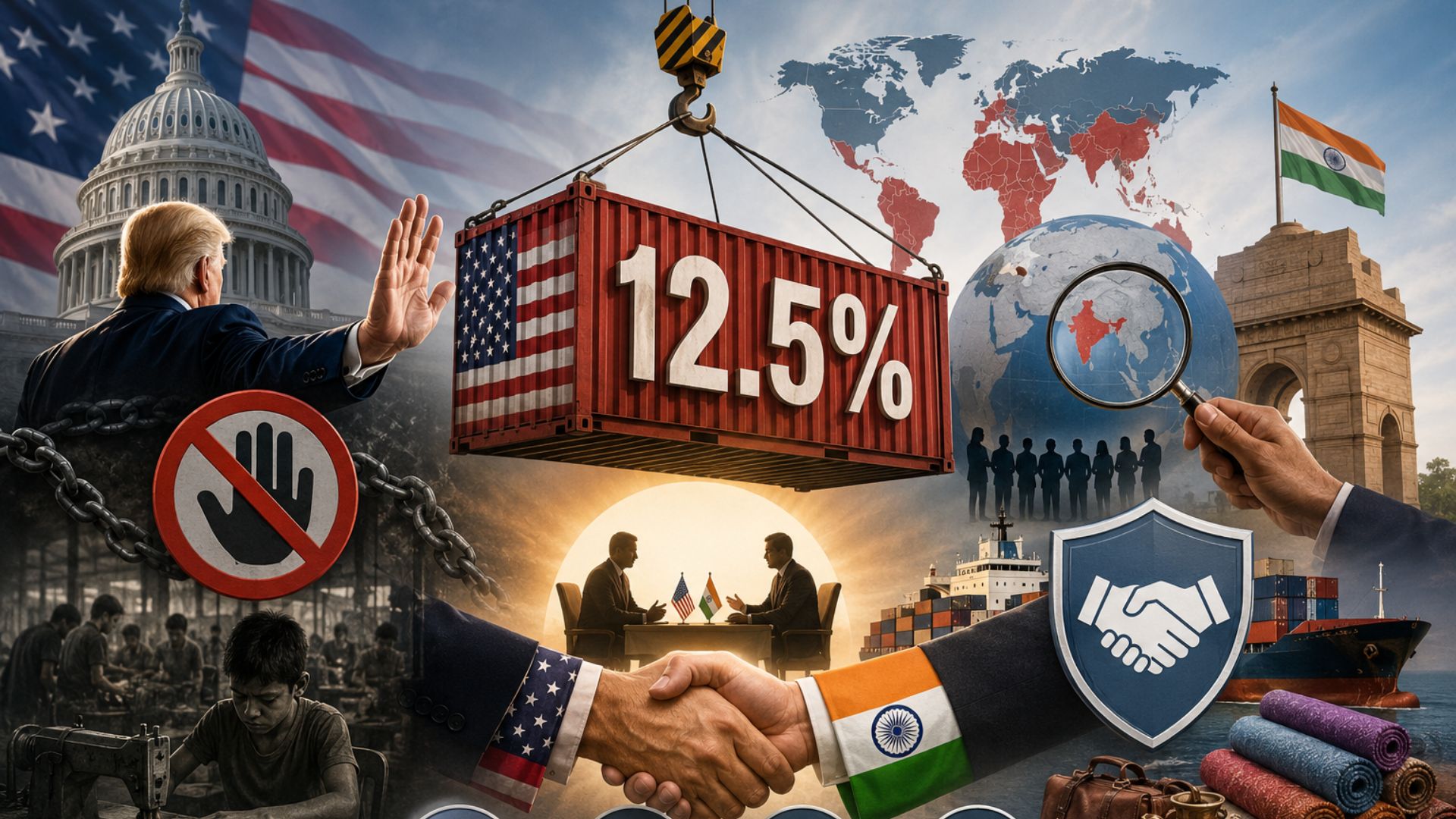
The United States has proposed a 12.5% tariff on imports from 54 countries, including India, alleging that these countries have failed to effectively prohibit the import of goods produced through forced labour.
The move is part of an investigation conducted under Section 301 of the U.S. Trade Act, 1974.
“The failure of our most important trading partners to address the importation of goods made with forced labour is unacceptable.” — USTR Jamieson Greer
What Triggered the Investigation?
-
In March 2026, the U.S. Trade Representative (USTR) launched a Section 301 investigation.
-
Objective:
- Examine whether trading partners have laws and enforcement mechanisms to prevent imports made using forced labour.
- Assess whether such practices disadvantage American workers and industries.
Key Finding
The USTR concluded that India and 53 other countries have:
- Failed to impose adequate prohibitions on forced-labour imports.
- Failed to effectively enforce existing regulations.
- Created conditions that allegedly burden U.S. commerce.
As a result, a 12.5% additional tariff has been proposed on imports from these countries.
Why is the U.S. Taking This Route?
Trade experts believe the move has both economic and strategic motivations.
1. Alternative Tariff Mechanism
- In February 2026, the U.S. Supreme Court struck down reciprocal tariffs imposed by President Donald Trump.
- The ruling weakened Washington's ability to impose broad tariffs.
The forced-labour investigation provides a new legal basis to maintain tariff protection.
2. Pressure During Trade Negotiations
-
The U.S. is simultaneously negotiating:
- An Interim Trade Agreement with India.
- A broader Bilateral Trade Agreement (BTA).
Many analysts view the tariff proposal as leverage in these negotiations.
Impact on India
India has been placed in the same tariff category as:
- China
- Bangladesh
- Vietnam
- Thailand
- Malaysia
Sectors Likely to be Affected
- Textiles
- Garments
- Carpets
- Leather products
- Brassware
- Other labour-intensive exports
Additional tariffs may reduce competitiveness in the U.S. market and increase export costs.
Example:

An Indian textile exporter selling garments worth
$100 million to the U.S. could face an additional
12.5% tariff burden, making Indian products
more expensive compared to competitors.
India's Response
The Ministry of Commerce and Industry has stated that:
- India remains actively engaged with the U.S. under the Section 301 process.
- Simultaneously, negotiations on the Interim Agreement and the broader BTA are continuing.
Upcoming Opportunities
Countries can:
- Request participation in hearings by June 22.
- Submit written comments by July 6.
- Participate in public hearings on July 7.
Experts have advised India to make detailed submissions challenging the USTR's conclusions.
Divergent Expert Views
View 1: Continue Engagement
According to trade policy experts:
- India should use hearings and consultations to defend its position.
- Securing recognition that Indian supply chains do not rely on forced labour would be beneficial.
- A framework agreement could reduce future trade uncertainty.
View 2: Reassess Trade Negotiations
Some analysts argue:
- The rationale behind the proposed BTA has weakened after the U.S. court struck down reciprocal tariffs.
- India may be asked to make substantial concessions without receiving equivalent benefits.
- Trade negotiations and Section 301 investigations should be treated as separate issues.
Example:

Malaysia has reportedly adopted a more cautious
approach toward similar trade pressures,
highlighting that countries need not automatically
accept trade concessions under external pressure.
Broader Significance
The development reflects:
- Growing use of labour standards in trade policy.
- Increasing linkage between human rights and market access.
- Expansion of unilateral trade measures beyond traditional tariff disputes.
- Intensifying strategic competition in global supply chains.
It also signals that future trade barriers may increasingly emerge through regulatory and compliance requirements rather than conventional tariffs alone.
Way Forward
- Strengthen monitoring of supply chains and labour standards.
- Enhance transparency in export-oriented industries.
- Present evidence-based submissions during the Section 301 consultation process.
- Continue trade negotiations while protecting national interests.
- Diversify export destinations to reduce dependence on any single market.
- Align domestic labour compliance mechanisms with evolving global standards.
Conclusion
The proposed U.S. tariffs represent more than a trade dispute; they reflect the growing intersection of labour rights, supply-chain governance, and geopolitics. While the tariffs are not yet final, they could significantly affect India's labour-intensive exports. A calibrated strategy combining diplomatic engagement, robust compliance measures, and balanced trade negotiations will be essential to safeguard India's economic interests while maintaining its position in global value chains.
Attribution
Original content sources and authors


Syllabus classification
How this article maps to GS papers
Main syllabus
GS2Bilateral RelationsAlso covers
Quick Q&A
What is the significance of the U.S. Section 301 investigation on forced labour imports and how does it affect India–US trade relations?
Why is the proposed 12.5% U.S. tariff on forced labour-related imports important for UPSC aspirants and current policy debates?
How could the proposed Section 301 tariffs influence India's export sectors, trade negotiations and broader economic strategy?
What are the major reasons behind the United States using the forced labour framework as a basis for imposing tariffs on trading partners?
What is the critical analysis of India's approach toward Bilateral Trade Agreement negotiations with the United States amid Section 301 pressures?
What lessons can be drawn from the India–US Section 301 dispute as a contemporary case study in economic diplomacy and international trade?
Practice questions
2 questions for mains preparation