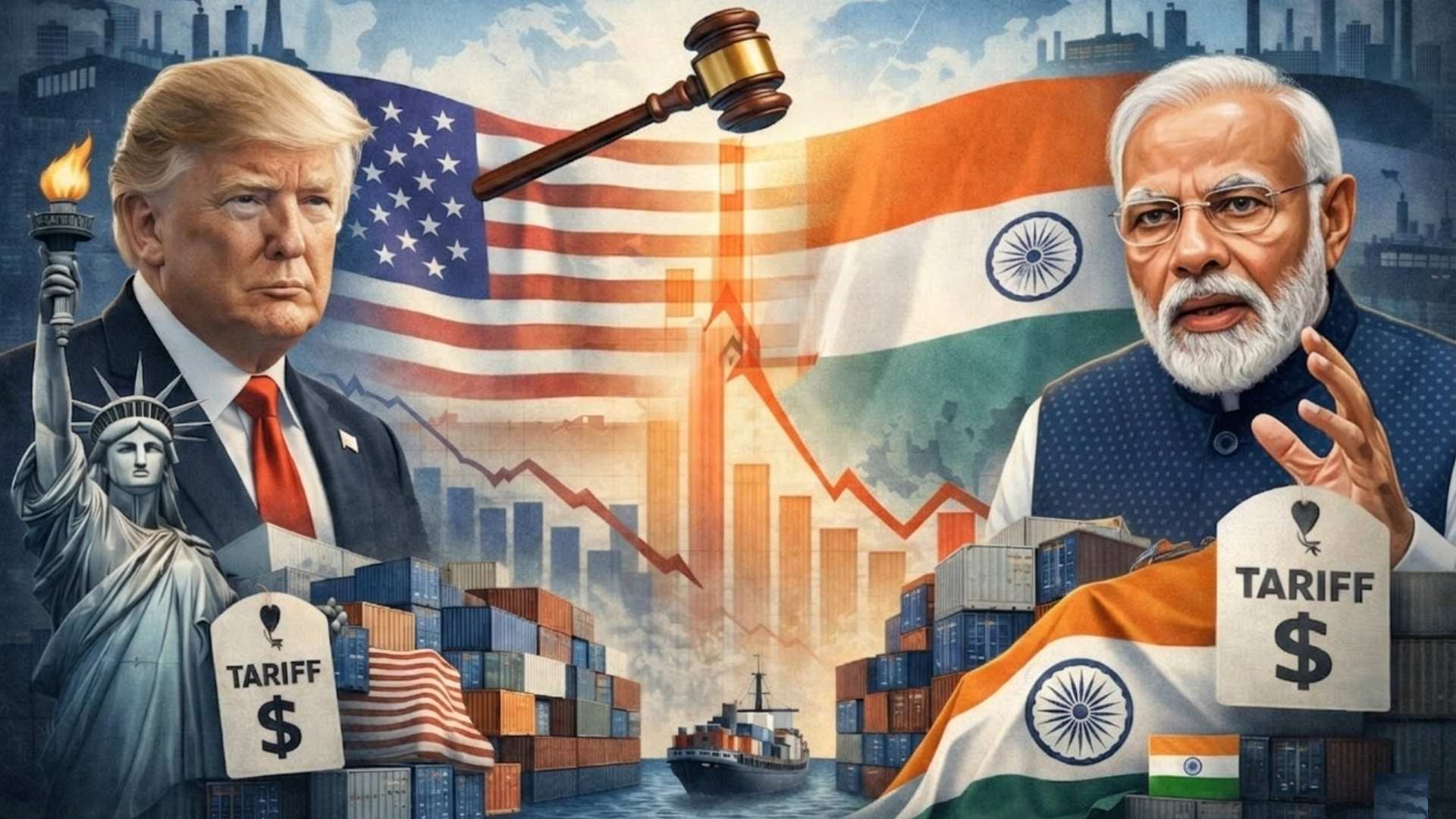
U.S. Launches Investigation into Trade Policies Impacting India
Introduction
Global trade relations are entering a new phase of uncertainty as the United States launches Section 301 investigations against 16 economies, including India, alleging that their policies may be “unreasonable or discriminatory” and harmful to U.S. commerce.
This move comes shortly after the U.S. Supreme Court struck down President Donald Trump’s reciprocal tariff policy, forcing the administration to search for alternative mechanisms to protect domestic industries.
The development highlights the growing trend of trade protectionism in the global economy, where countries increasingly use tariffs and trade investigations to safeguard domestic manufacturing.
As economist Adam Smith once observed:
“Nothing is more inconsistent with freedom of trade than restraints on the importation of goods.”
The ongoing trade tensions raise important questions about the future of global trade rules and their impact on emerging economies like India.
What is Section 301 of the U.S. Trade Act?
Section 301 of the Trade Act of 1974 allows the United States to investigate and respond to foreign trade practices that it considers unfair.
| Provision | Explanation |
|---|---|
| Section 301 | Allows the U.S. to investigate unfair trade practices |
| Authority | U.S. Trade Representative (USTR) |
| Possible Action | Tariffs, sanctions, or trade restrictions |
The law enables the U.S. government to impose tariffs if it concludes that another country’s policies harm American commerce.
Section 301 has previously been used in major trade disputes, including the U.S.–China trade war.
Why the Investigation Was Initiated
The investigation was announced after the U.S. Supreme Court invalidated reciprocal tariffs imposed by the Trump administration.
To maintain trade pressure on partner economies, the U.S. imposed a temporary 10% tariff on imports for 150 days while exploring alternative legal tools such as Section 301.
Trade experts believe the investigation could pave the way for new tariffs once the temporary tariffs expire.
Allegations Against India
The United States claims that certain sectors in India have “structural excess capacity”, meaning production significantly exceeds domestic demand.
Sectors Highlighted in the Investigation
| Sector | Concern Raised by U.S. |
|---|---|
| Solar modules | Manufacturing capacity nearly three times domestic demand |
| Petrochemicals | Large production capacity |
| Steel | Significant industrial output |
| Textiles | Export competitiveness |
| Automotive goods | Trade surplus with U.S. |
The U.S. argues that excess production may lead to dumping of goods in global markets, affecting American industries.
India–U.S. Trade Balance
India currently enjoys a significant trade surplus with the United States.
| Indicator | Value |
|---|---|
| India’s trade surplus with U.S. (2025) | $58 billion |
| Major Indian exports to U.S. | Engineering goods, textiles, pharmaceuticals |
A trade surplus occurs when a country exports more goods to a trading partner than it imports from that partner.
The U.S. administration views persistent trade deficits as harmful to domestic manufacturing.
Impact on Indian Industries
The investigation could have implications for several export sectors.
| Sector | Possible Impact |
|---|---|
| Engineering goods | Higher tariffs could reduce competitiveness |
| Textiles and apparel | Increased trade uncertainty |
| Steel and aluminium | Existing tariffs already in place |
| Auto components | Potential new trade barriers |
Indian export sectors are already facing pressure due to geopolitical tensions and global supply chain disruptions.
Comparison: Section 301 vs Other U.S. Trade Tools
The United States uses multiple legal provisions to impose trade restrictions.
| Provision | Purpose | Example Use |
|---|---|---|
| Section 301 | Address unfair trade practices | U.S.–China trade dispute |
| Section 232 | National security concerns | Steel and aluminium tariffs |
| Reciprocal tariffs (struck down) | Match foreign tariff levels | Trump administration policy |
Section 301 investigations are slower and legally more constrained because they require evidence of specific unfair practices.
Global Scope of the Investigation
India is not the only country targeted.
Countries Under Investigation
| Region | Countries |
|---|---|
| Asia | India, China, Vietnam, South Korea, Taiwan, Japan |
| Southeast Asia | Indonesia, Malaysia, Thailand, Cambodia |
| Europe | European Union, Switzerland, Norway |
| Others | Mexico, Bangladesh, Singapore |
The broad scope indicates a systemic shift in U.S. trade policy toward protecting domestic manufacturing.
Concept of Excess Capacity
Excess capacity occurs when industries produce more goods than domestic markets can absorb.
| Cause | Result |
|---|---|
| Rapid industrial expansion | Oversupply |
| Export-driven growth | Trade surpluses |
| Government incentives | Global price competition |
Countries with excess production often export surplus goods, which may trigger trade disputes and anti-dumping actions.
Global Trend: Rising Protectionism
The investigation reflects a wider shift in global trade policy.
| Period | Trade Policy Trend |
|---|---|
| 1990s–2000s | Trade liberalisation |
| Post-2008 crisis | Gradual protectionism |
| Post-COVID era | Supply chain nationalism |
Many countries are now prioritising domestic manufacturing and strategic industries.
Implications for India
For India, the investigation highlights several strategic concerns.
| Issue | Implication |
|---|---|
| Export vulnerability | Dependence on U.S. market |
| Industrial policy scrutiny | Subsidies may face global challenges |
| Trade negotiations | Potential pressure in bilateral trade talks |
India must balance export competitiveness with compliance with international trade norms.
Way Forward
India’s response to trade tensions should include diversifying export markets, strengthening domestic competitiveness, engaging in diplomatic trade negotiations, and promoting value-added manufacturing.
Strengthening regional trade partnerships and expanding agreements with other markets could reduce dependence on any single trading partner.
Conclusion
The U.S. Section 301 investigation marks a significant moment in the evolving global trade landscape. As major economies increasingly adopt protectionist policies to protect domestic industries, trade disputes are becoming more frequent.
For India, the challenge lies in maintaining export growth while navigating geopolitical and trade tensions.
As Nobel laureate Paul Krugman observed:
“Trade conflicts often arise not because trade fails, but because success in trade creates new competition.”
Attribution
Original content sources and authors
Syllabus classification
How this article maps to GS papers
Main syllabus
GS2Bilateral RelationsQuick Q&A
What is Section 301 of the U.S. Trade Act of 1974, and how does it function as a tool in international trade policy?
The process usually begins when the USTR identifies evidence that a foreign government’s policies violate trade agreements or restrict U.S. trade. After an investigation, the USTR may impose unilateral trade measures, including additional tariffs on imports from the targeted country. For example, the U.S. used Section 301 during the U.S.–China trade dispute (2018–2019) to impose tariffs on hundreds of billions of dollars worth of Chinese goods, citing intellectual property violations and unfair industrial policies.
Key features of Section 301 include:
- Investigation of unfair trade practices by foreign governments
- Authority to impose tariffs or other trade restrictions
- Encouragement of negotiations to resolve disputes
- Protection of domestic industries and workers
However, critics argue that Section 301 can sometimes bypass multilateral institutions such as the World Trade Organization (WTO), raising concerns about unilateralism in global trade governance. In the current context, the U.S. investigation into countries like India under Section 301 reflects Washington’s attempt to address concerns related to excess production capacity and trade imbalances.
Why has the United States initiated investigations against India and other economies regarding excess capacity and trade practices?
In the case of India, the U.S. cited several sectors where production capacity appears to exceed domestic demand. For instance, the solar module manufacturing sector reportedly has production capacity nearly three times India’s annual domestic demand. Similar concerns have been raised in sectors such as petrochemicals, steel, textiles, construction materials, and automotive goods. Additionally, India’s $58 billion bilateral trade surplus with the U.S. in 2025 has contributed to American concerns about trade imbalance.
The broader motivations behind these investigations include:
- Protecting the U.S. manufacturing base and employment
- Addressing perceived trade imbalances
- Preventing dumping caused by excess production
- Encouraging reshoring of supply chains to the United States
From a strategic perspective, these investigations also reflect a shift in U.S. trade policy toward economic nationalism and supply-chain security. Policymakers in Washington increasingly view industrial capacity, especially in strategic sectors like steel and renewable energy, as critical for economic resilience and national security.
How could the Section 301 investigation potentially affect India–U.S. trade relations and key export sectors?
One of the most immediate risks is that the U.S. may impose targeted tariffs once the temporary 10% global tariff introduced for 150 days expires. For instance, sectors already facing high duties—such as steel, aluminium, and auto components—may experience further tariff escalation. Industry bodies like the Engineering Exports Promotion Council of India have already expressed concern that such measures could weaken India’s engineering export sector.
Possible impacts include:
- Reduced export competitiveness due to higher tariffs
- Increased uncertainty for Indian exporters and investors
- Disruptions in supply chains for sectors integrated with U.S. markets
- Potential retaliatory measures or negotiations between the two countries
However, the situation may also encourage India to diversify export markets, strengthen regional trade agreements, and improve domestic competitiveness. Diplomatic engagement and trade negotiations will likely play a crucial role in preventing escalation and maintaining the strategic partnership between the two countries.
Critically analyze the advantages and limitations of using Section 301 investigations as a trade policy instrument.
Advantages of Section 301 include:
- Protection of domestic industries: It enables the U.S. to respond to practices such as dumping, subsidies, or intellectual property violations.
- Negotiation leverage: The threat of tariffs can push trading partners to negotiate policy changes.
- Strategic economic policy: It can support industrial policy objectives such as reshoring manufacturing.
However, the mechanism also has significant limitations. Critics argue that unilateral trade actions can undermine the rules-based multilateral trading system governed by the WTO. Furthermore, such measures may trigger retaliatory tariffs, leading to trade wars that harm global economic stability.
Key limitations include:
- Potential escalation of trade conflicts
- Reduced predictability in international trade rules
- Economic costs for consumers due to higher import prices
Therefore, while Section 301 can be an effective tool for addressing trade disputes, many economists argue that it should ideally be used in coordination with multilateral institutions and diplomatic negotiations to ensure long-term stability in the global trading system.
What is meant by ‘excess industrial capacity’ in global trade, and why does it create tensions between trading partners?
Such conditions frequently lead to accusations of dumping, where products are sold in foreign markets below their normal value or production cost. For instance, global concerns about excess capacity have been particularly prominent in industries such as steel, solar panels, petrochemicals, and textiles. Countries with large manufacturing bases may produce more than the global market can sustainably absorb, pushing prices downward and harming producers in importing countries.
Excess capacity creates tensions due to several reasons:
- Domestic industries in importing countries face unfair competition
- Market prices fall due to oversupply
- Governments may impose tariffs or anti-dumping duties
- Trade disputes escalate between major economies
In the present case, the United States has raised concerns that several economies, including India and China, are exporting surplus production in sectors such as solar modules and steel. Addressing excess capacity therefore requires international cooperation, transparent industrial policies, and balanced trade practices to maintain stability in the global trading system.
Consider a scenario where the U.S. imposes additional tariffs on Indian exports following the Section 301 investigation. How should India strategically respond to protect its economic interests?
The first step would involve diplomatic engagement and negotiation. India could use bilateral trade dialogues to address U.S. concerns regarding excess capacity and market access. Simultaneously, India could raise the issue within the framework of the World Trade Organization if the tariffs are perceived to violate global trade rules. Such institutional engagement helps preserve the rules-based trading system.
Strategic policy responses could include:
- Export diversification: Expanding trade with regions such as the European Union, Africa, and Southeast Asia.
- Strengthening domestic competitiveness: Improving productivity and reducing logistical costs under initiatives like Make in India.
- Value-chain integration: Moving toward high-value manufacturing and technology-intensive exports.
- Trade agreements: Negotiating comprehensive economic partnerships with other major economies.
For example, India’s approach during previous trade disputes—such as negotiations over Generalized System of Preferences (GSP) benefits with the U.S.—shows that a combination of diplomacy and economic adaptation can mitigate the impact of trade tensions. In the long run, strengthening India’s manufacturing ecosystem and export competitiveness would be the most sustainable response.
Practice questions
2 questions for mains preparation