GS2 Education

From rote learning to discovery, teachers in Punjab are reimagining early childhood education.

Bringing Montessori to Government Schools: Reimagining Early Childhood Education in Punjab

A pioneering initiative in Hoshiarpur is bringing hands-on learning, child-led exploration and self-reliance to government Anganwadis and pre-primary schools.
Surya Surya
4 mins read

Why in News?

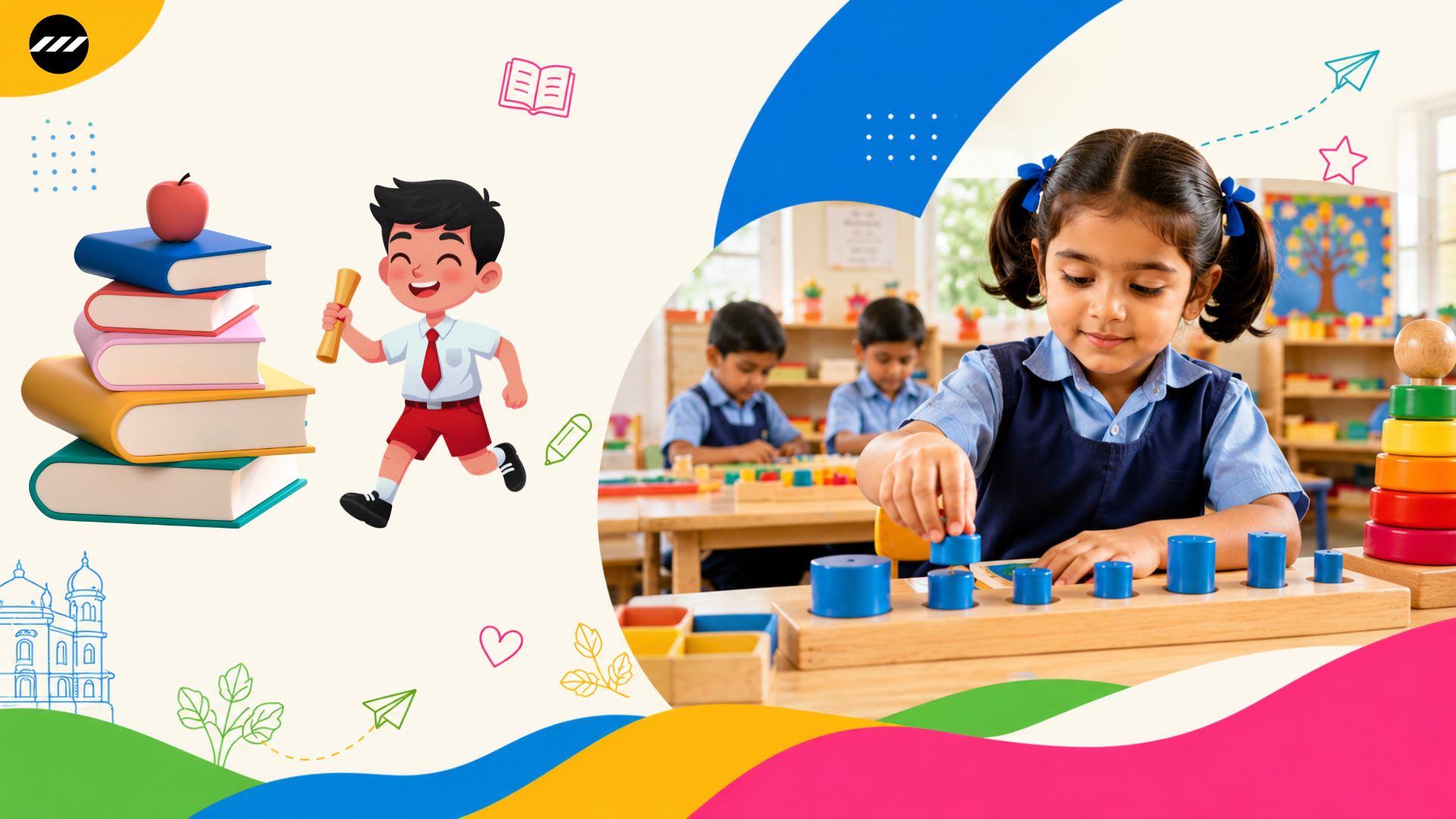
Punjab has launched its first Montessori education initiative in government Anganwadis and pre-primary schools in Hoshiarpur district. Implemented in collaboration with the Vivek High Montessori Institute (VHMI), Chandigarh, the project aims to transform early childhood education through experiential, child-centred, and activity-based learning.

"The child is naturally curious. The teacher's role is not to control, but to guide."


What is the Initiative?

The programme was launched in January 2026 through a partnership involving:

  • Hoshiarpur District Administration
  • Indian Red Cross Society
  • Vivek High Montessori Institute (VHMI)

Core Objective

To integrate Montessori teaching methodologies into the government education system and improve the quality of early childhood education in rural and semi-urban areas.


Understanding the Montessori Approach

The Montessori method focuses on:

  • Child-centred learning.
  • Self-directed exploration.
  • Practical activities.
  • Learning through experience.
  • Development of independence.

Unlike conventional classrooms where teachers largely instruct, Montessori classrooms encourage children to actively engage with their surroundings.

Traditional Model:
Teacher teaches → Child listens

Montessori Model:
Child explores → Teacher guides

Transformation Inside Classrooms

The initiative has led to significant changes in classroom environments.

Key Changes

Earlier PracticeMontessori Approach
Teacher-directed learningChild-led exploration
Fixed classroom setupAccessible learning spaces
Book-based instructionHands-on activities
Repetition and memorisationDiscovery and experimentation
Teacher controlGuided learning

Classroom Innovations

  • Child-sized furniture.
  • Accessible books and toys.
  • Practical learning materials.
  • Activity-based learning stations.

Teachers now encourage children to:

  • Choose activities independently.
  • Learn through play.
  • Develop self-confidence and decision-making skills.

Capacity Building of Educators

A major focus of the initiative is teacher training.

Training Components

  • Theoretical understanding of Montessori philosophy.
  • Practical classroom application.
  • Child psychology and observation.
  • Activity-based pedagogy.

The training is conducted under the Community Rooted Education Practitioners Programme of VHMI.

Educator Perspective

Teachers report that the programme has helped them:

  • Develop greater patience.
  • Understand children's natural curiosity.
  • Shift from instruction to facilitation.
  • Encourage self-learning among children.

Pilot Implementation

The project has been designed as a district-wide pilot.

Institutional Coverage

Institution TypeNumber Selected
Anganwadis25
Pre-primary Schools25
Total Centres50

Selection Strategy

  • Five institutions chosen from each development block.
  • Balanced geographical representation.
  • Creation of model learning centres.

These centres are expected to serve as demonstration sites for future expansion.


Continuous Mentoring System

The initiative goes beyond one-time training.

Support Mechanism

  • 19 Anganwadi supervisors have completed intensive training.
  • Three-phase training programme continues until September 2026.
  • VHMI facilitators conduct monthly classroom visits.
  • Continuous mentoring ensures practical implementation.
Training → Classroom Practice →
Mentoring → Feedback →
Improved Learning Outcomes

The focus is on embedding Montessori principles into everyday teaching practices.


Expected Impact

Short-Term Impact

  • Around 2,000 children expected to benefit initially.

Long-Term Vision

  • Expansion to all Anganwadis in Hoshiarpur district.
  • Potential coverage of nearly 20,000 children.

Educational Benefits

  • Improved cognitive development.
  • Greater self-reliance.
  • Enhanced creativity.
  • Better problem-solving skills.
  • Increased engagement with learning.

Why is it Significant?

The initiative challenges the perception that innovative pedagogies are limited to elite private schools.

Broader Significance

  • Democratization of quality early childhood education.
  • Improved learning opportunities in rural areas.
  • Strengthening foundational literacy and numeracy.
  • Alignment with child-centric educational reforms.
  • Greater equity in educational access.
Earlier Belief:
Montessori is for elite urban schools.

Emerging Reality:
Montessori can strengthen government schools
and Anganwadis as well.

The project demonstrates how global educational practices can be adapted to local contexts.


Way Forward

  • Expand Montessori-based learning to more districts.
  • Strengthen continuous teacher training programmes.
  • Integrate experiential learning into foundational education.
  • Develop locally relevant learning materials.
  • Increase community participation in early childhood education.
  • Monitor learning outcomes and best practices.
  • Scale successful models through state-wide adoption.

Conclusion

Punjab's Montessori initiative represents an innovative shift in early childhood education by moving from rote instruction to experiential learning. By empowering teachers, redesigning classrooms, and placing children's curiosity at the centre of learning, the programme seeks to build stronger educational foundations. If successfully scaled, it could become a model for transforming government-run Anganwadis and pre-primary schools across India.

Attribution

Original content sources and authors

Vikas Vasudeva Author Vikas Vasudeva The Hindu Source The Hindu

Syllabus classification

How this article maps to GS papers

Main syllabus

GS2Education

Quick Q&A

What is the Montessori method of education and why is its integration into government Anganwadis significant for early childhood development in India?
The Montessori method is a child-centric educational philosophy developed by Italian physician and educator Dr. Maria Montessori in the early twentieth century. It emphasizes experiential learning, self-directed activity, independence, and the role of teachers as facilitators rather than instructors. The approach uses age-appropriate learning materials, practical activities, and carefully designed environments to encourage curiosity and creativity among children. In India, the significance of introducing Montessori practices into government Anganwadis and pre-primary schools lies in improving the quality of Early Childhood Care and Education (ECCE). Anganwadis, established under the Integrated Child Development Services (ICDS) scheme in 1975, are central to providing nutrition, health services, and preschool education. The initiative launched in Hoshiarpur district in Punjab in January 2026, in collaboration with the Vivek High Montessori Institute (VHMI), represents Punjab's first attempt to mainstream Montessori education in public institutions. Fifty centres, including twenty-five Anganwadis and twenty-five pre-primary schools, have been selected as pilot centres. The model aims to benefit around 2,000 children initially and nearly 20,000 children in the long run. The initiative aligns with the National Education Policy (NEP) 2020, which prioritizes foundational literacy, experiential learning, and holistic development. For UPSC aspirants, the topic is relevant to General Studies Paper II and Paper IV because it highlights issues of social sector governance, educational reforms, child development, and inclusive public policy.
Why is the introduction of Montessori pedagogy in rural and semi-urban government schools important from a policy and developmental perspective?
The introduction of Montessori pedagogy in government educational institutions is important because it addresses longstanding concerns about rote learning, inadequate foundational skills, and unequal access to quality preschool education. Traditionally, high-quality Montessori education has largely remained confined to urban private institutions, creating disparities in educational opportunities. The Hoshiarpur initiative seeks to bridge this divide by making experiential learning accessible to children in rural and semi-urban areas. From a policy perspective, this initiative supports the objectives of the National Education Policy 2020, which emphasizes play-based learning, cognitive development, and foundational literacy and numeracy. Research indicates that nearly 85 percent of brain development occurs before the age of six, making early childhood education critical for long-term human capital formation. By redesigning classrooms with child-sized furniture and activity-based learning tools, the programme seeks to create enabling environments for holistic growth. The initiative also contributes to Sustainable Development Goal 4, which aims to ensure inclusive and equitable quality education. Economically, investment in early childhood education yields high social returns through improved learning outcomes and workforce productivity. However, challenges such as resource constraints, teacher training, scalability, and monitoring remain significant. Critics argue that Montessori methods require substantial investment and adaptation to local contexts. For UPSC preparation, this topic connects with General Studies Paper II, social justice, governance, education policy, and India's demographic dividend. It also demonstrates how innovative public-private collaborations can strengthen social sector delivery.
How does the Hoshiarpur Montessori initiative function and what institutional mechanisms support its implementation?
The Hoshiarpur Montessori initiative functions through a collaborative model involving the district administration, the Red Cross, and the Chandigarh-based Vivek High Montessori Institute (VHMI), which is affiliated with the Association Montessori Internationale. Launched in January 2026, the programme aims to transform early childhood education through structured training, mentoring, and classroom redesign. In the pilot phase, fifty institutions, comprising twenty-five Anganwadis and twenty-five pre-primary schools, were selected from different development blocks to ensure balanced geographical representation. The implementation process focuses heavily on teacher capacity building. Nineteen Anganwadi supervisors have already completed intensive practical training, while a three-phase training programme for Anganwadi workers and teachers is scheduled to continue until September 2026. Monthly visits by trained VHMI facilitators provide ongoing mentorship and ensure that Montessori principles are implemented effectively. Classrooms are redesigned with child-friendly furniture, practical learning apparatus, and accessible books and toys that encourage self-learning. Teachers transition from authoritarian methods to facilitative approaches that nurture curiosity and independence. Such institutional mechanisms demonstrate the importance of continuous professional development and monitoring in educational reforms. The initiative also reflects decentralized governance and district-level innovation. From the UPSC perspective, the programme illustrates the significance of public-private partnerships, local administration, educational governance, and capacity-building mechanisms. It has relevance for General Studies Paper II, governance and social sector development, and serves as a practical example of policy implementation at the grassroots level.
What are the potential advantages and limitations of adopting Montessori education within India's public education system?
The adoption of Montessori education in India's public education system offers several advantages but also raises important concerns regarding scalability and implementation. One major advantage is the shift from rote memorization to experiential learning. Children develop problem-solving skills, creativity, self-discipline, and independence through hands-on activities. Teachers become facilitators who encourage exploration rather than imposing rigid instructions. Such an approach aligns with the recommendations of the National Education Policy 2020 and contemporary learning theories. Another advantage is the promotion of inclusive and child-friendly classrooms, which can improve learning outcomes and reduce early dropouts. The Hoshiarpur experiment demonstrates how even rural institutions can implement such models successfully. However, several limitations exist. Montessori education requires extensive teacher training, specialized learning materials, and well-designed infrastructure, which may strain limited public resources. Ensuring quality across thousands of Anganwadis and schools can be challenging. There are also concerns regarding adaptation to local languages and cultural contexts. Some critics argue that excessive emphasis on self-directed learning may require balancing with structured academic instruction. Furthermore, India's diverse educational landscape demands flexible models rather than a uniform approach. Despite these challenges, the initiative highlights the possibility of combining traditional strengths with innovative pedagogies. For UPSC aspirants, the issue is relevant to debates on educational reforms, human capital development, and governance. It also reflects broader themes of inclusiveness, social equity, and sustainable development, making it important for General Studies Paper II and essay examinations.
How can the Hoshiarpur Montessori project be examined as a case study of innovative governance and educational reform in India?
The Hoshiarpur Montessori project serves as an important case study of grassroots innovation and collaborative governance in the education sector. Initiated in January 2026, it represents Punjab's first attempt to integrate Montessori principles into government Anganwadis and pre-primary schools. The project involves cooperation among the district administration, the Indian Red Cross, and the Vivek High Montessori Institute. Such partnerships demonstrate how governmental and non-governmental institutions can work together to improve public service delivery. The initiative is significant because it focuses on teacher empowerment and mentoring rather than merely infrastructure creation. Through structured training and monthly classroom visits, educators are encouraged to shift from teacher-centred methods to child-centred learning. The pilot covers fifty institutions and is expected to benefit approximately 2,000 children initially, with plans to expand to nearly 20,000 children across Hoshiarpur district. The project also exemplifies decentralized administration and evidence-based policymaking, where successful pilot models can be replicated elsewhere. Similar innovations have been witnessed in initiatives such as Delhi's Happiness Curriculum and Kerala's educational reforms. Nevertheless, the long-term sustainability of the project depends on adequate funding, institutional support, and continuous monitoring. For UPSC interviews, this case study can be cited while discussing governance innovations, district administration, educational reforms, and public-private partnerships. It is particularly relevant for General Studies Paper II and ethics discussions concerning empathy, patience, and citizen-centric governance.
What practical examples from the Hoshiarpur initiative demonstrate the transformation from rote learning to experiential education?
The Hoshiarpur Montessori initiative offers several practical examples that illustrate the transition from traditional rote learning to experiential and child-centred education. Earlier, many teachers relied heavily on repetition, dictation, and book-based instruction. Under the new system, classrooms have been reorganized to allow children easy access to books, toys, and learning materials. Child-sized furniture and practical activity tools encourage independent exploration. Anganwadi worker Geetika explained that instead of controlling children, educators now guide their natural curiosity and involve them in everyday tasks. Similarly, Anganwadi supervisor Sharmila Rani highlighted that practical learning encourages children to become self-dependent and also cultivates patience among educators. Pre-primary teacher Rajni Devi observed that Montessori education, once perceived as suitable only for elite urban schools, could effectively serve rural children as well. These examples reveal how educational reforms can change attitudes among teachers and learners alike. The transformation also aligns with the principles of constructivist learning theory, which emphasizes learning through active participation. Internationally, countries such as Finland and Italy have adopted child-centred approaches with positive outcomes. In India, similar trends are visible in the National Education Policy 2020, which promotes experiential learning and foundational literacy. For UPSC aspirants, these examples demonstrate how policy innovations translate into ground-level changes. They provide practical illustrations for discussions related to education, governance, social development, and human resource formation in General Studies Paper II and essay papers.

Practice questions

1 question for mains preparation

Early childhood care and education play a crucial role in shaping human capital and lifelong learning outcomes. Discuss the significance of introducing Montessori-based child-centred learning approaches in Anganwadis for improving foundational education in India.

10 marks · 150 words · 8 mins
