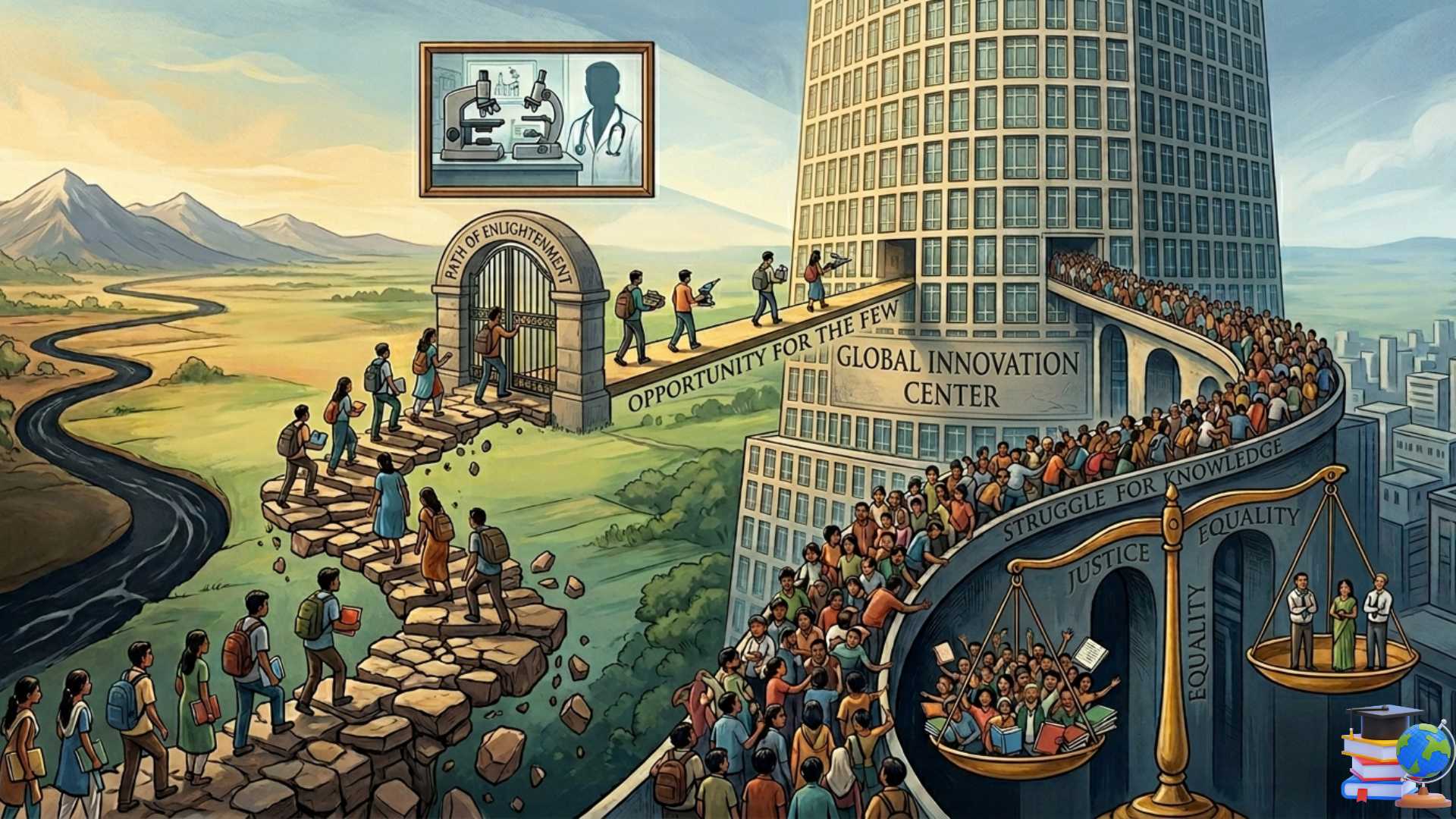
"India's higher educational system must shift its focus from institutional expansion to ensuring equity and quality education." — State of Working India 2026 Report, Azim Premji University
India's Gross Enrolment Ratio (GER) in higher education has nearly doubled from 16% (2011) to 28% (2022), yet this quantitative expansion conceals deep structural inequities in access, quality, and faculty availability across regions, income groups, and social categories.
| Parameter | Data |
|---|---|
| Total colleges/universities (1950) | ~1,600 |
| Total colleges/universities (2022) | 69,000+ |
| GER in higher education (2011) | 16% |
| GER in higher education (2022) | 28% |
| College density (2010) | 29 per lakh youth |
| College density (2021) | 45 per lakh youth |
| SC enrolment rate (2011→2022) | 11% → 26% |
| ST enrolment rate (2011→2022) | 8% → 21% |
Background and Context
India's higher education expansion has been driven predominantly by private providers, with the number of institutions growing from 1,600 in 1950 to over 69,000 by 2022. While enrolment has risen across gender and social categories — with male-female participation rates nearly converging — this expansion has not been matched by commensurate growth in faculty capacity, institutional quality, or geographical equity.
Key Issues
1. Teacher Shortage — The Invisible Crisis Regulatory norms recommend a student-teacher ratio of 15–25:1. Reality tells a different story:
| Year | Average Student-Teacher Ratio |
|---|---|
| 2010 | 24:1 |
| 2016 | 35.4:1 |
| 2021 | 32:1 |
Many northern districts report ratios as high as 50–210:1. Faculty numbers have not kept pace with either institutional growth or enrolment surge — creating a quality deficit that institutional expansion alone cannot mask.
2. Regional Disparities College density varies sharply across India. Many districts in northern and eastern states have fewer than 18 colleges per lakh youth population — far below the national average of 45. These regions also report the highest student-teacher ratios, compounding access and quality deficits simultaneously.
3. The Cost Barrier — A Course-of-Privilege Problem What students study is as unequal as whether they study at all. Higher household income strongly correlates with enrolment in engineering and professional courses; lower-income students are disproportionately concentrated in humanities and commerce — lower-earning streams.
| Course | Annual Cost (2017–18) | Accessibility |
|---|---|---|
| Medicine degree | ₹97,400 | High-income households |
| Engineering degree | ₹72,600 | Middle/high-income |
| Humanities/Commerce | Significantly lower | Low-income households |
For poor households, professional degree fees routinely exceed annual per capita consumption expenditure — making professional education structurally inaccessible regardless of merit.
4. Social Group Participation — Progress but Persistent Gap Enrolment among SC and ST students has improved significantly over 2011–2022. However, graduates remain disproportionately drawn from the richest households. The share of graduates from poorer households has risen but remains far from equitable distribution.
Structural Implications
Expansion ≠ Equity Quantitative growth in institutions without addressing faculty shortage, regional gaps, and cost barriers produces a two-tiered system — one for the privileged accessing professional education, another for the rest channelled into lower-return streams.
Private Sector Dominance Most recent expansion has been private-led, driven by market incentives rather than equity goals. Private institutions concentrate in urbanised, better-connected regions — deepening rather than bridging regional disparities.
NEP 2020 and Unfinished Agenda The National Education Policy 2020 targets a GER of 50% by 2035. Achieving this without simultaneously addressing faculty deficits, regional imbalances, and affordability barriers risks inflating enrolment numbers without improving human capital outcomes.
Conclusion
India's higher education story is one of impressive expansion and stubborn inequity — bridging regional gaps, investing urgently in faculty capacity, and dismantling cost barriers to professional education are the three non-negotiables for translating enrolment growth into genuine economic opportunity.
Attribution
Original content sources and authors
Syllabus classification
How this article maps to GS papers
Main syllabus
GS2EducationQuick Q&A
What are the key trends in the expansion of higher education in India, and how do they reflect structural changes in the sector?
Key Structural Trends:
- Increased college density: From 29 colleges per lakh youth in 2010 to 45 in 2021.
- Rising enrolment: Gross Enrolment Ratio (GER) improved from 16% in 2011 to 28% in 2022.
- Greater inclusion: Participation among women, SCs, and STs has improved significantly.
However, this expansion has been uneven. Regional disparities persist, especially in northern and eastern India, where access remains limited. Additionally, the growth in institutions has not been matched by proportional increases in faculty capacity.
Implications: While expansion reflects progress in democratizing education, it also highlights a transition from elite to mass education. However, without corresponding improvements in quality and equity, this expansion risks becoming quantitative rather than transformative. Thus, India’s higher education system stands at a crossroads between access and excellence.
Why has the expansion of higher education in India not translated into equitable access and quality outcomes?
Key Reasons:
- Regional disparities: Many districts in northern and eastern India have fewer than 18 colleges per lakh youth.
- Faculty shortages: Student-teacher ratio worsened from 24:1 (2010) to 32:1 (2021), affecting quality.
- Economic inequality: Students from richer households dominate higher education participation.
- Cost barriers: Professional courses like medicine and engineering are prohibitively expensive.
Quality Concerns: Rapid privatization has often prioritised profit over pedagogy, leading to inadequate infrastructure and faculty shortages. Regulatory oversight has struggled to keep pace with expansion.
Implications: The system risks creating a two-tier structure—elite institutions offering quality education and a large number of low-quality colleges. This undermines the role of higher education as a tool for social mobility and inclusive growth. Therefore, expansion alone is insufficient without addressing systemic inequalities.
How do student-teacher ratios and faculty shortages impact the quality of higher education in India?
Current Scenario:
- Recommended ratio: 15–25 students per teacher.
- Actual ratio: Increased to 35.4 in 2016 and remains around 32 in 2021.
Impacts on Quality:
- Reduced individual attention: Teachers cannot cater to diverse learning needs.
- Decline in research output: Overburdened faculty have limited time for research.
- Poor learning outcomes: छात्रों may graduate without adequate skills.
Case Example: Many state universities in northern India report overcrowded classrooms and reliance on contractual faculty, affecting continuity and quality of teaching.
Broader Implications: Faculty shortages undermine India’s aspiration to become a knowledge economy. Without investing in teacher training, recruitment, and retention, the demographic dividend may turn into a liability. Strengthening faculty capacity is thus critical for ensuring both quality and global competitiveness.
What are the underlying socio-economic reasons for inequality in access to professional courses in India?
Key Reasons for Inequality:
- High fees: Annual costs for medical (~₹97,400) and engineering (~₹72,600) exceed the consumption capacity of poorer households.
- Lack of financial support: Limited access to scholarships and affordable loans.
- Information asymmetry: Poorer students often lack awareness about opportunities.
- Schooling disadvantage: कमजोर foundational education reduces eligibility for competitive exams.
Outcome Patterns: Students from affluent families dominate professional courses, while those from lower-income groups are concentrated in humanities and commerce streams.
Implications: This creates a cycle of inequality where high-return professions remain inaccessible to disadvantaged groups. For instance, engineering and medical graduates typically have higher earning potential, reinforcing income disparities.
Way Forward: Policies must focus on fee regulation, targeted scholarships, and public investment in professional education. Bridging this divide is essential for ensuring that higher education acts as an engine of inclusive development rather than perpetuating inequality.
Critically analyse whether India’s higher education expansion can be considered a success story.
Positive Outcomes:
- Massification of education: Transition from elite to mass higher education.
- Social inclusion: Increased participation of SCs, STs, and women.
- Private sector contribution: Rapid infrastructure expansion.
Limitations and Concerns:
- Quality deficit: Poor faculty strength and infrastructure in many institutions.
- Inequality: استمرار dominance of affluent groups in high-value courses.
- Regional imbalance: Uneven distribution of institutions.
Critical Perspective: The expansion is necessary but not sufficient. It has improved access but not ensured equitable or high-quality outcomes. The focus on quantity over quality has diluted the transformative potential of education.
Conclusion: India’s higher education expansion is a qualified success. It has laid the foundation for broader access but requires systemic reforms in quality, equity, and governance to realise its full potential. Without these, the expansion risks becoming a missed opportunity.
As a policymaker, how would you design interventions to make higher education in India more equitable and inclusive?
Key Interventions:
- Bridging regional gaps: Establish public institutions in underserved districts, particularly in northern and eastern India.
- Faculty development: Launch national मिशन for teacher recruitment, training, and incentives.
- Financial inclusion: Expand scholarships, income-based fee waivers, and low-interest education loans.
- Affordable professional education: Increase public investment in medical and engineering colleges.
Case Example: Schemes like PM-USHA and expansion of IITs/IIMs demonstrate how targeted public investment can improve access and quality simultaneously.
Institutional Reforms:
- Strengthen regulation: Ensure quality standards in private institutions.
- Promote digital learning: Use platforms like SWAYAM to reach remote areas.
- Skill integration: Align courses with industry needs to enhance employability.
Outcome Vision: Such a multi-pronged approach can ensure that higher education becomes a tool for social mobility, economic growth, and national development. The focus must shift from mere expansion to equity-driven excellence.
India's Gross Enrolment Ratio in higher education has nearly doubled to 28% (2022), but this quantitative expansion conceals deep inequities in faculty availability, regional access, and course affordability — with student-teacher ratios reaching 50–210:1 in northern districts. Private-sector dominance has deepened regional disparities, while cost barriers make professional education structurally inaccessible to lower-income students regardless of merit. Achieving NEP 2020's target of 50% GER by 2035 demands urgent focus on faculty capacity, affordability reform, and geographical equity — not mere institutional expansion.
Practice questions
1 question for mains preparation