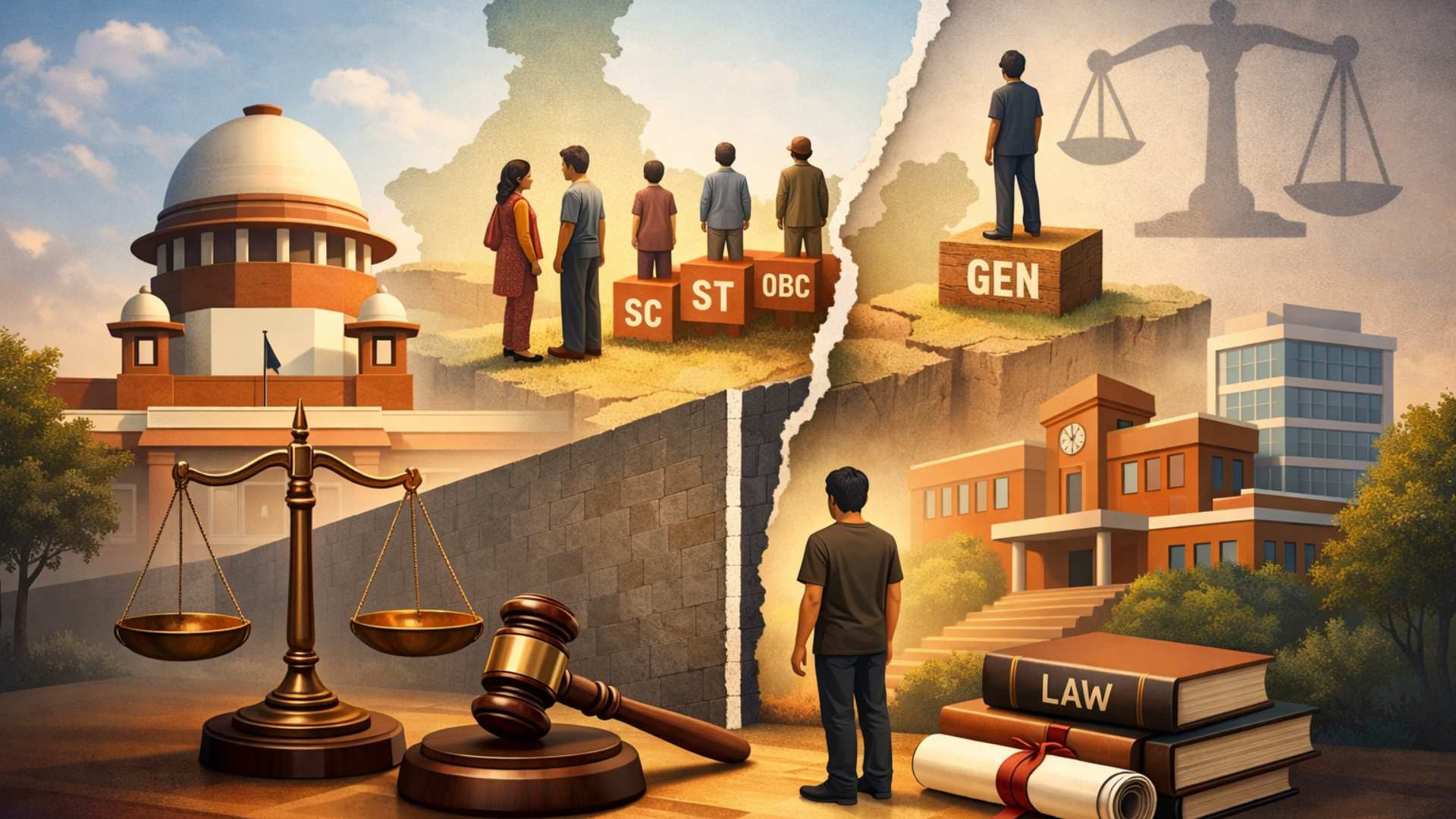
Controversies Surrounding UGC Regulations: Supreme Court's Ruling
1. Judicial Stay on UGC Regulations, 2026: Immediate Context
The Supreme Court’s decision to stay the University Grants Commission (Promotion of Equity in Higher Education Institutions) Regulations, 2026 reflects judicial concern over regulatory clarity and potential misuse. The Court held that the 2026 regulations are ambiguous and could lead to unintended consequences if enforced in their present form.
By issuing notice to the Union government and restoring the UGC Regulations of 2012 for the interim period, the Court has prioritised continuity in campus-level equity safeguards while scrutinising the revised framework. This prevents a regulatory vacuum in addressing discrimination in higher education institutions.
From a governance perspective, the stay underscores the judiciary’s role in ensuring that delegated legislation aligns with constitutional principles. If such scrutiny is ignored, regulatory overreach may undermine both equality norms and institutional trust.
Judicial intervention acts as a corrective when regulatory design risks arbitrariness; absence of such checks can weaken constitutional governance.
2. Evolution of the Equity Framework in Higher Education
The UGC Regulations of 2012 were framed to promote equity and prevent discrimination within universities. They provided a comprehensive definition of discrimination, encompassing denial of access, imposition of humiliating conditions, and segregation on grounds such as caste, religion, gender, language, or disability.
These regulations institutionalised grievance redressal through Equal Opportunity Cells and designated anti-discrimination officers, embedding equity concerns into university administration. Their relevance increased following reported instances of caste discrimination on campuses.
The suicides of Rohith Vemula (2016) and Payal Tadvi (2019), and the subsequent petitions filed by their mothers, highlighted gaps in enforcement rather than absence of regulation. This pressure prompted judicial monitoring and eventual regulatory review.
Robust frameworks lose effectiveness without enforcement; failure to act can convert protective regulations into symbolic gestures.
3. Content and Controversy of the UGC Regulations, 2026
The 2026 regulations broadened the definition of discrimination to include unfair or biased treatment against any stakeholder—students, faculty, or staff—on multiple grounds. This aimed to create a more inclusive and uniform protection regime across campuses.
However, controversy centred on the specific definition of “caste-based discrimination,” which was restricted to discrimination solely based on caste or tribe against SC, ST, and OBC communities. Critics argued that this formulation implicitly presumes intent and culpability, potentially excluding other forms of caste-linked grievances.
Additionally, the absence of safeguards against false or motivated complaints raised concerns about reputational harm and procedural fairness. If unresolved, such ambiguity could polarise campuses rather than foster equity.
Precision in definitions is central to fair enforcement; ambiguity risks delegitimising equity mechanisms.
4. Supreme Court’s Observations and Substantive Questions of Law
In Mritunjay Tiwari vs Union of India, the Supreme Court identified ambiguities that could enable misuse of the 2026 regulations. The Court framed key questions to test their constitutional and regulatory validity.
The first concerns whether a separate definition of caste-based discrimination has a rational nexus with the objectives of the regulations, given that caste is already included within the broader definition of discrimination. The second relates to whether such a definition could affect sub-classification among underprivileged groups.
These questions go to the heart of proportionality and necessity in regulatory design. Ignoring them may expose the framework to constitutional infirmities.
Regulations must be narrowly tailored to objectives; over-classification can undermine both equity and legality.
5. Constitutional Principles: Formal and Substantive Equality
Articles 14 and 15 of the Constitution enshrine the principle of equality before law and prohibit discrimination by the State on enumerated grounds. This reflects the doctrine of formal equality, essential for rule-based governance.
Simultaneously, Article 15 permits special provisions for SCs, STs, and OBCs, recognising that historical disadvantage requires differential treatment. This embodies substantive equality, which seeks to correct structural imbalances rather than merely ensure uniform treatment.
India’s legal framework, including the Protection of Civil Rights Act, 1955 and the SC/ST (Prevention of Atrocities) Act, 1989, demonstrates constitutional acceptance of asymmetric protections to address entrenched discrimination.
“Equality before the law does not mean that things which are different shall be treated as though they were the same.” — E.P. Royappa v. State of Tamil Nadu (1974)
Balancing formal and substantive equality is crucial; privileging one at the cost of the other weakens constitutional justice.
6. Policy Dilemma: Campus Equity and Social Transformation
It is arguable that a separate definition of caste-based discrimination may not add operational value when general discrimination is already prohibited. However, the State is constitutionally empowered to recognise caste-based discrimination as a distinct and severe form of exclusion in India’s social context.
At the same time, educational campuses are envisaged as spaces for transcending inherited social identities. Any regulatory ambiguity that entrenches identities or fosters mistrust can undermine this transformative role.
Therefore, stakeholder consultation and regulatory refinement are essential to ensure both protection of vulnerable groups and campus harmony.
Equity regulation must protect without polarising; poorly designed rules can impede social integration.
Conclusion
The Supreme Court’s stay on the UGC Regulations, 2026 highlights the delicate balance between preventing discrimination and ensuring constitutional fairness in higher education governance. While caste-based discrimination remains a critical concern warranting focused protection, regulatory clarity and proportionality are indispensable. Going forward, refined regulations combined with strict enforcement of existing safeguards are essential to uphold equity, trust, and constitutional values on university campuses.
Attribution
Original content sources and authors
Syllabus classification
How this article maps to GS papers
Main syllabus
GS2EducationQuick Q&A
What were the objectives of the UGC Regulations, 2012, and how did they seek to promote equity in higher education institutions?
A key institutional innovation under the 2012 framework was the establishment of Equal Opportunity Cells and the appointment of Anti-Discrimination Officers. These mechanisms were intended to provide accessible grievance redressal within campuses, especially for students from marginalised backgrounds who may hesitate to approach external authorities. The design recognised that discrimination often operates subtly and institutionally, rather than only through overt acts.
The importance of these regulations became evident after tragic cases such as the suicides of Rohith Vemula (2016) and Payal Tadvi (2019), where allegations of caste-based discrimination highlighted gaps between legal safeguards and campus realities. For UPSC interviews, the 2012 regulations illustrate how administrative law instruments can operationalise constitutional values of equality and dignity in everyday institutional settings.
Why did the Supreme Court stay the UGC Regulations, 2026, and what concerns did it raise regarding their implementation?
A central concern was whether introducing a separate and narrower definition of caste-based discrimination was necessary, given that ‘discrimination’ was already comprehensively defined to include caste. The Court questioned whether this new definition bore a reasonable nexus with the objectives of promoting equity, or whether it risked creating confusion and legal vulnerability. Another concern was whether such a definition could affect the sub-classification and internal diversity among underprivileged groups themselves.
From a governance perspective, the stay reflects judicial caution in balancing social justice objectives with procedural fairness. The Court did not reject the aim of preventing caste discrimination but emphasised that regulatory clarity is essential in sensitive domains like education. For UPSC aspirants, this case highlights the judiciary’s role as a constitutional gatekeeper, ensuring that well-intentioned policies do not undermine equality before the law.
How does the debate around the 2026 regulations reflect the tension between formal equality and substantive equality under the Indian Constitution?
At the same time, Article 15(4) and Article 15(5) recognise substantive equality, allowing the State to make special provisions for historically disadvantaged groups. This approach acknowledges that identical treatment may perpetuate inequality where social hierarchies are deeply entrenched. Laws such as the SC/ST (Prevention of Atrocities) Act, 1989 exemplify this logic by recognising the asymmetric nature of caste oppression in India.
The challenge, as highlighted by the Court, lies in designing regulations that address real structural disadvantages without creating perceptions of arbitrariness or overreach. For UPSC interviews, this debate is a classic illustration of how constitutional principles are not abstract ideals but require continuous balancing in policy design and implementation.
What are the reasons behind the opposition to the definition of ‘caste-based discrimination’ in the UGC Regulations, 2026?
Another major concern is the absence of provisions addressing false or motivated complaints. In highly competitive academic environments, allegations of discrimination can have serious reputational and career consequences. Critics argue that without procedural safeguards, the regulations may be weaponised, thereby eroding trust in grievance redressal systems.
However, it is also important to contextualise this opposition. Caste-based discrimination in India has historically been asymmetric, disproportionately affecting marginalised communities. The policy challenge lies in acknowledging this reality while ensuring fairness and due process. For UPSC candidates, this issue underscores the importance of designing social justice frameworks that are both empathetic and procedurally robust.
Critically analyse whether a separate definition of ‘caste-based discrimination’ is necessary within the broader framework of anti-discrimination regulations.
However, critics argue that when ‘discrimination’ is already comprehensively defined to include caste, a separate definition may be redundant. Worse, if poorly drafted, it can introduce ambiguity, overlap, and selective interpretation. Educational campuses, ideally spaces for transcending caste identities, may instead become arenas of heightened suspicion and litigation if definitions are unclear.
A balanced approach may lie in retaining a broad definition of discrimination while issuing detailed guidelines and safeguards for handling caste-related complaints. For UPSC interviews, this question invites candidates to demonstrate nuance—acknowledging structural injustice while cautioning against regulatory excess.
How do the cases of Rohith Vemula and Payal Tadvi illustrate the challenges of enforcing anti-discrimination norms on university campuses?
They reveal that discrimination often manifests not through explicit exclusion but through subtle practices—social isolation, academic harassment, and lack of institutional support. Even where regulations exist, enforcement may be weak due to power hierarchies, fear of retaliation, or lack of awareness among students and faculty.
For policymakers, these cases underline that regulations must be accompanied by sensitisation, accountability, and monitoring. For UPSC aspirants, they highlight the importance of implementation capacity and institutional culture in translating constitutional ideals into social justice outcomes.
Practice questions
1 question for mains preparation