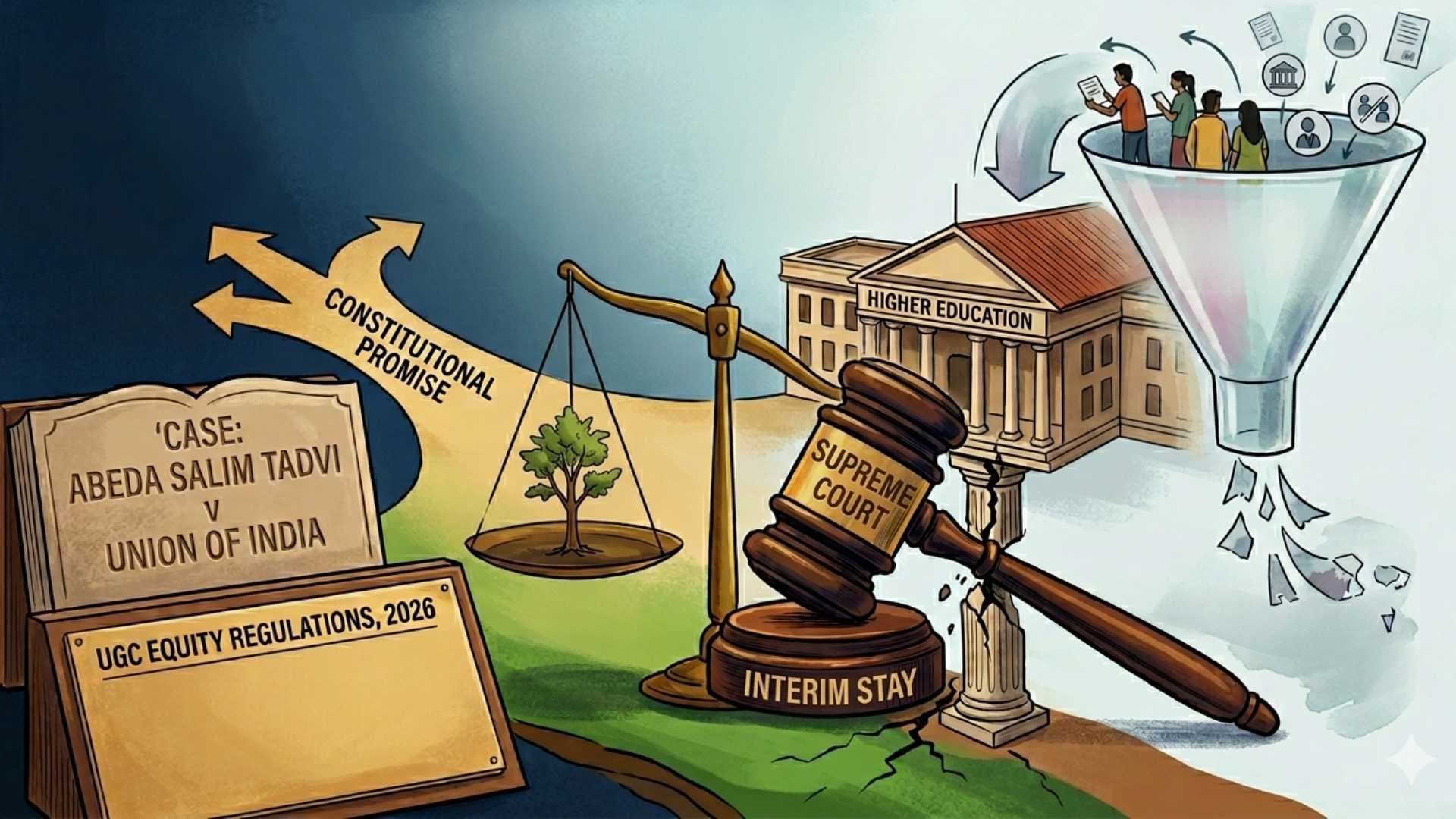

When marginality is structural, neutrality is not fairness — it is erasure. The Supreme Court's interim stay on the UGC's Promotion of Equity in Higher Education Institutions Regulation, 2026 has reopened a foundational debate: whether constitutional equality demands uniform treatment or targeted protection for the historically excluded.
| Indicator | Detail |
|---|---|
| Regulation in question | UGC Promotion of Equity in Higher Education Institutions Regulation, 2026 |
| Origin case | Abeda Salim Tadvi v. Union of India (pending before Supreme Court) |
| Subject matter of origin case | Caste-based discrimination and student suicides in higher educational institutions |
| Definition of caste discrimination (Reg. 3c) | Discrimination based on caste/tribe against SC, ST, and OBC members |
| Constitutional provisions at stake | Articles 14, 15, 21 |
| Current status | Supreme Court interim stay granted |
| Key issue | Whether a caste-neutral definition should replace the targeted definition |
Background & Context
Caste-based discrimination in Indian higher education is not anecdotal — it is structurally documented:
- SC/ST students face social exclusion, academic bias, institutional humiliation, and unequal access to resources
- Several cases of student suicides have been directly linked to caste-based institutional discrimination — most prominently Rohith Vemula (University of Hyderabad, 2016)
- The Abeda Salim Tadvi case arose from the death of a tribal medical student who faced persistent caste discrimination from senior doctors
- The UGC regulations were formulated directly in response to these systemic concerns — not as abstract policy
Formal Equality vs. Substantive Equality: The Core Debate
This is the central jurisprudential fault line the UGC regulation controversy exposes:
| Dimension | Formal Equality | Substantive Equality |
|---|---|---|
| Core premise | Treat everyone identically | Treat people according to their actual social position |
| Constitutional basis | Article 14 (equality before law) | Articles 14 + 15(4) + 15(5) read together |
| View of discrimination | Symmetrical — anyone can be discriminated against | Asymmetrical — caste operates through power hierarchies |
| Risk of caste-neutral definition | Equates systemic oppression with isolated interpersonal bias | — |
| Indian constitutional design | Permits differential treatment to remedy disadvantage | Endorsed by Supreme Court in multiple judgments |
The Constitution does not mandate abstract, one-size-fits-all neutrality. Articles 14 and 15 permit — indeed require — differential treatment to remedy historical and social disadvantage.
Why a Caste-Neutral Definition Would Weaken the Law
Critics of the UGC regulation argue that excluding "general category" students from the definition of caste discrimination violates Article 14. This argument misreads both constitutional design and social reality:
- Caste is not a symmetrical system. It operates through graded hierarchies — Brahminical varna order, untouchability, social exclusion — that systematically disadvantage specific groups
- A caste-neutral definition collapses structural inequality into a universal grievance framework, equating systemic oppression with isolated interpersonal incidents
- It shifts focus from structural exclusion to abstract individual grievances — weakening the law's capacity to address caste as a system of power
- The Supreme Court has consistently held — from State of Madras v. Champakam Dorairajan (1951) through Indra Sawhney v. Union of India (1992) — that targeted protection for backward classes is constitutionally valid and necessary
Constitutional Framework: Articles 14, 15, and 21
| Article | Provision | Relevance |
|---|---|---|
| Article 14 | Equality before law; equal protection of laws | Permits reasonable classification — not blind uniformity |
| Article 15(1) | Prohibition of discrimination on grounds of religion, race, caste, sex, place of birth | General anti-discrimination norm |
| Article 15(4) | State may make special provisions for socially and educationally backward classes + SC/ST | Enables targeted protection — constitutional basis for UGC regulation |
| Article 15(5) | Special provisions for backward classes in educational institutions | Direct constitutional backing for equity regulations in higher education |
| Article 21 | Right to life and personal dignity | Custodial of dignity in educational spaces — violated by caste harassment |
The Real Problem: Implementation, Not Definition
The article's most important insight is that the definitional debate, while important, distracts from the deeper failure — enforcement:
| Enforcement Gap | Impact |
|---|---|
| Weak institutional complaint mechanisms | Victims discouraged from reporting; complaints suppressed |
| Absence of independent inquiry bodies | Internal committees capture by faculty/administration |
| No time-bound resolution requirements | Cases drag on; complainants face continued harassment |
| Lack of transparency in outcomes | No public accountability for institutional responses |
| No consequences for institutional non-compliance | Universities face no meaningful penalty for inaction |
What is needed:
- Independent complaint mechanisms — not internal committees controlled by the same faculty hierarchy
- Time-bound inquiries with mandatory outcomes
- Regular UGC audits of institutional compliance
- Meaningful consequences for non-compliant institutions — funding penalties, accreditation impact
- Monitoring and oversight with publicly reported data
Implications and Challenges
- Student mental health: Caste-based exclusion directly links to academic underperformance, psychological distress, and suicide — making this a public health issue as well as a rights issue
- Faculty accountability: Discrimination often flows from faculty — the power asymmetry between student and teacher makes internal redressal structurally compromised
- SC/ST/OBC representation in faculty: Underrepresentation of marginalised groups in teaching and administrative positions perpetuates institutional bias
- Private universities: UGC regulations apply to all recognised institutions — but enforcement in private universities is practically weaker
- Intersectionality: Gender + caste discrimination compounds vulnerability — women from SC/ST communities face layered exclusion
Conclusion
The UGC equity regulations represent a constitutionally grounded, empirically necessary framework to address structural caste discrimination in India's higher education institutions. The demand for a "caste-neutral" definition misreads the Constitution's design — which explicitly permits differential treatment to achieve substantive equality. The Supreme Court's interim stay must not become a pretext for diluting a regulation whose origins lie in documented suffering and institutional failure. The real imperative is not to debate definitional purity but to build the enforcement architecture — independent complaint bodies, transparent processes, institutional accountability — without which even the most perfectly worded regulation remains a dead letter for students facing everyday exclusion.
Attribution
Original content sources and authors


Syllabus classification
How this article maps to GS papers
Main syllabus
GS2EducationQuick Q&A
What is the significance of the UGC Promotion of Equity in Higher Education Institutions Regulations, 2026?
Key significance includes:
- Providing a clear legal framework to identify and address caste discrimination
- Institutionalising mechanisms to ensure equity and dignity within campuses
- Responding to serious concerns such as student suicides linked to caste-based exclusion
For example, several tragic incidents in premier institutions like IITs and central universities have highlighted how subtle and overt discrimination can affect mental health and academic outcomes. These regulations aim to prevent such occurrences by mandating institutional accountability.
Overall, the regulations mark a shift from a passive acknowledgment of inequality to an active, policy-driven intervention grounded in constitutional values of justice and equality.
Why is a caste-specific definition of discrimination preferred over a caste-neutral approach?
Constitutional reasoning:
- Article 14 ensures equality before law but does not mandate identical treatment
- Article 15 explicitly allows special provisions for socially and educationally backward classes
This reflects the idea of substantive equality, which seeks to correct historical disadvantages rather than treat unequal groups as equals.
For instance, including "general category" students under the same framework risks equating systemic oppression with isolated grievances. This could dilute the focus on historically marginalised communities who face persistent exclusion.
Thus, a caste-specific definition is not exclusionary but context-sensitive, ensuring that policies effectively target those most affected by discrimination.
How does the concept of substantive equality differ from formal equality in the context of caste discrimination?
Key differences:
- Formal equality: Treats everyone the same, ignoring social hierarchies
- Substantive equality: Accounts for systemic disadvantages and provides targeted support
In the context of caste, discrimination is not random but embedded in graded hierarchies that affect access to education, social mobility, and institutional power. Therefore, a purely formal approach would fail to address these deep-rooted inequalities.
For example, reservation policies in education are based on substantive equality, aiming to level the playing field for SCs, STs, and OBCs. Similarly, the UGC regulations adopt this approach by focusing on historically marginalised groups.
Thus, substantive equality ensures that justice is outcome-oriented, not merely procedural, aligning with the broader constitutional vision of social justice.
What are the key reasons behind the persistence of caste-based discrimination in higher education institutions?
Major reasons include:
- Institutional bias: Faculty attitudes, evaluation practices, and peer interactions may reflect caste prejudices
- Lack of accountability: Weak grievance redressal mechanisms fail to address complaints effectively
- Social exclusion: Marginalised students often face isolation, discrimination in hostels, and lack of mentorship
For example, several reports have documented how Dalit and Adivasi students in elite institutions face subtle discrimination, such as biased grading or exclusion from academic networks. These experiences can lead to mental distress and, in extreme cases, suicides.
Additionally, there is often a culture of silence where victims hesitate to report discrimination due to fear of stigma or retaliation. Institutions may also prioritise reputation over accountability.
Therefore, the persistence of caste discrimination is not due to absence of laws but due to gaps in implementation and institutional will.
Critically analyse the argument that caste-neutral policies promote equality better than targeted interventions.
Limitations of caste-neutral policies:
- They ignore historical disadvantages faced by marginalised communities
- They risk diluting protections by equating systemic oppression with individual grievances
- They fail to address power structures embedded in caste hierarchies
On the other hand, targeted interventions like reservations and equity regulations aim to correct these imbalances by focusing on disadvantaged groups. These are constitutionally supported under Article 15.
For instance, if caste-neutral policies were applied in higher education, issues like underrepresentation of SC/ST students or discrimination in campuses might remain unaddressed. A one-size-fits-all approach could reinforce existing inequalities rather than reduce them.
However, criticisms exist: Some argue that targeted policies may create perceptions of reverse discrimination or exclusion. Yet, this concern must be weighed against the need for social justice and inclusion.
In conclusion, while caste-neutrality promotes formal equality, targeted interventions are more effective in achieving substantive equality in a deeply unequal society.
How can higher education institutions effectively implement the UGC equity regulations to prevent caste-based discrimination? Illustrate with a case-based approach.
Key measures include:
- Establishing independent complaint committees with diverse representation
- Ensuring time-bound investigations and clear penalties for violations
- Conducting regular audits and sensitisation programmes
Consider a hypothetical case: A Dalit student in a central university faces repeated discrimination from peers and subtle bias in evaluation. Under an effective framework, the student should be able to approach an independent body that ensures confidentiality and fairness. The institution must investigate promptly, take corrective action, and provide psychological support.
In reality, many institutions fail due to lack of independence and transparency in grievance mechanisms. Strengthening oversight by bodies like the UGC and involving external experts can improve credibility.
Ultimately, the success of these regulations depends on whether institutions are held answerable for outcomes, not just compliance. A proactive approach can transform campuses into inclusive spaces aligned with constitutional values.
Practice questions
2 questions for mains preparation