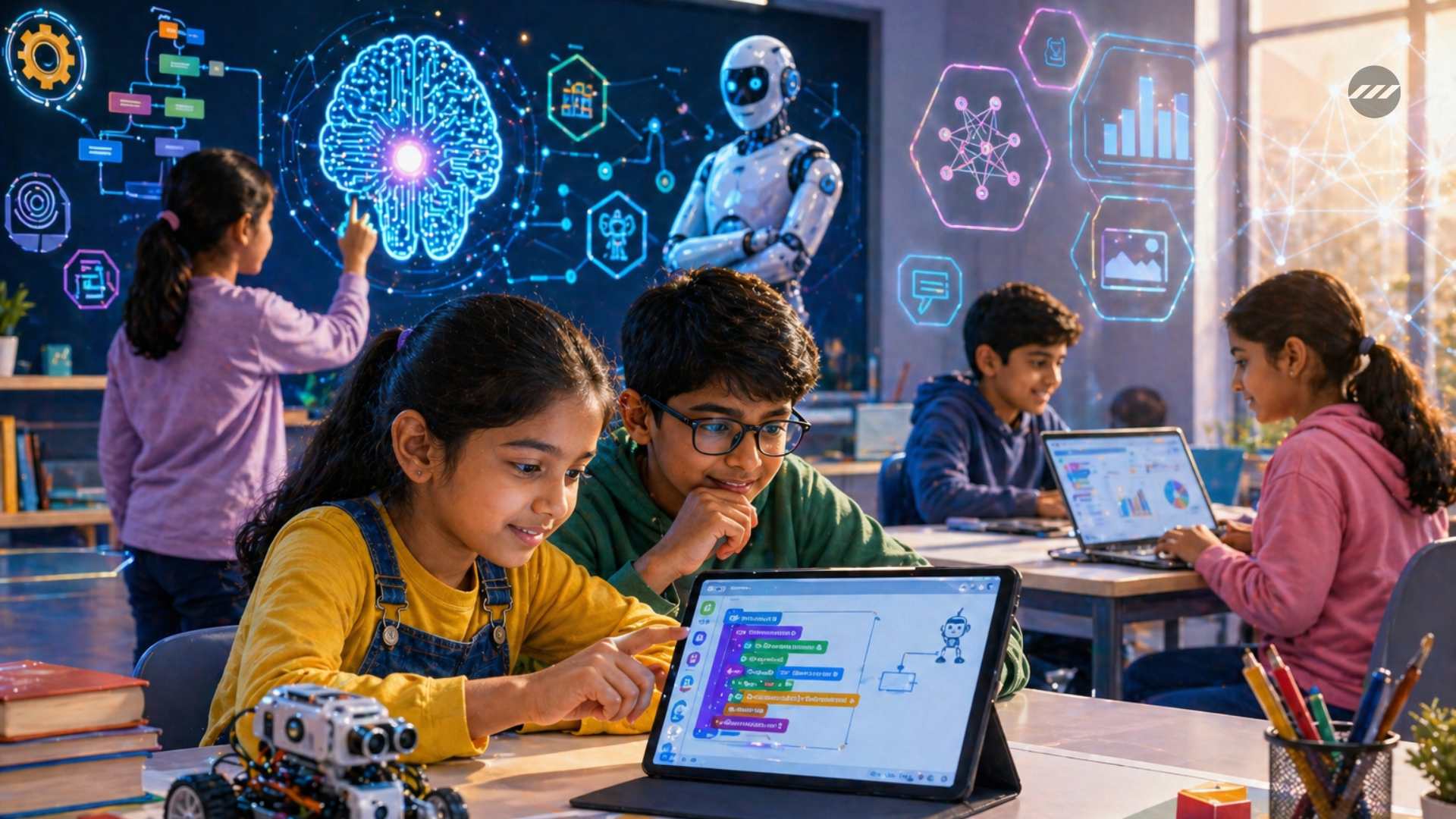
Engaging Middle School Students with Artificial Intelligence

Introduction
- With AI projected to contribute $15.7 trillion to the global economy by 2030 (PwC), early digital literacy is becoming essential.
- India’s push under NEP 2020 reflects a shift from rote learning to skill-based, future-ready education.
- Education must equip learners not just with knowledge, but with ways of thinking.
“The aim of education is not to fill minds, but to train them to think.”
Background / Context
-
The Central Board of Secondary Education (CBSE) has introduced Computational Thinking (CT) and Artificial Intelligence (AI) curriculum for Classes 3–8 (from 2026–27).
-
Aligns with:
- NEP 2020
- NCF-SE 2023
👉 Objective:
- Build logical reasoning, problem-solving, and digital literacy from an early age
Key Concepts
1. Computational Thinking (CT)
-
Core skills:
- Abstraction (simplifying problems)
- Decomposition (breaking tasks)
- Pattern recognition
- Algorithmic thinking
👉 Acts as foundation for AI learning
2. Artificial Intelligence (AI) Literacy
-
Understanding:
- Machine learning vs rule-based systems
- Data and algorithms
-
Focus on:
- Practical application
- Ethical awareness
Global Benchmarks
| Framework | Key Insight |
|---|---|
| OECD & EU AI Framework | CT is precursor to AI learning |
| AI4K12 (USA) | CT forms base of AI education |
| UNESCO | Emphasises data literacy & AI basics |
👉 CBSE aligns broadly with global curricular practices
Pedagogical Design
1. Age-Appropriate Learning
-
Research shows:
-
Children aged 10–14 can grasp:
- AI concepts
- Predictive models
-
👉 CBSE curriculum matches cognitive development stage
2. Cross-Disciplinary Integration
-
CT integrated into:
- Mathematics
- Environmental studies
👉 Enhances:
- Logical reasoning
- Problem-solving across subjects
3. Experiential Learning
-
Use of:
- No-code tools
-
Enables:
- Hands-on AI projects
- Real-world problem-solving
Benefits of CT-AI Curriculum
1. Shift from Rote Learning
-
Encourages:
- Inquiry-based learning
- Critical thinking
2. Future-Ready Skills
-
Prepares students for:
- Digital economy
- AI-driven workplaces
3. Ethical Awareness
-
Introduces:
- AI bias
- Responsible use
- Digital safety
4. Cognitive Development
-
Improves:
- Analytical thinking
- Structured reasoning
Challenges & Risks
1. Age Appropriateness Concerns
-
Risk:
- Overloading young learners
2. Misconceptions about AI
-
Children may:
- Attribute human traits to AI
3. Teacher Preparedness
-
Need for:
- Training in AI concepts
4. Infrastructure Gaps
-
Digital divide:
- Rural vs urban schools
Case Insight (Global Evidence)
-
Studies in U.S. schools show:
- Students aged 11–13 can engage with AI concepts effectively
-
No-code tools:
- Enhance accessibility
- Reduce complexity
Comparative Insight
| Traditional Education | CT-AI Approach |
|---|---|
| Rote learning | Inquiry-based learning |
| Subject isolation | Interdisciplinary |
| Passive learning | Active experimentation |
Implications for India
1. Education Reform
-
Aligns with:
- NEP 2020 vision
2. Skill Development
-
Builds:
- Digital workforce
3. Innovation Ecosystem
-
Encourages:
- Early exposure to technology
Way Forward (Expanded)
1. Teacher Capacity Building
Teachers must be trained not only in technical concepts but also in pedagogical methods to teach AI in an age-appropriate manner. Continuous professional development programs are essential.
2. Infrastructure Development
Bridging the digital divide is critical. Schools need:
- Devices
- Internet access
- AI learning tools
3. Contextual Learning
AI education should be linked to:
- Local problems
- Real-life applications
This ensures better engagement and relevance.
4. Ethical & Responsible AI Education
Curriculum must continue emphasising:
- Bias awareness
- Data privacy
- Responsible usage
Conclusion
The introduction of CT and AI in school education represents a transformational shift from rote learning to cognitive skill-building. While challenges remain in implementation and accessibility, the initiative aligns well with global practices and India’s long-term vision of becoming a knowledge-driven digital economy. The success of this reform will depend on effective pedagogy, infrastructure support, and inclusive access.
Attribution
Original content sources and authors


Syllabus classification
How this article maps to GS papers
Main syllabus
GS2EducationQuick Q&A
What is Computational Thinking (CT) and how is it linked to Artificial Intelligence (AI) in the CBSE curriculum?
The link between CT and AI is conceptually significant because AI systems rely on structured logic, data interpretation, and algorithmic processes. Global frameworks, such as the OECD AI Literacy Framework and the AI4K12 initiative in the United States, identify CT as a precursor to AI learning. These frameworks emphasize that students must first develop logical reasoning and computational skills before engaging with AI concepts like machine learning and predictive modeling.
In the CBSE curriculum, this relationship is reflected through a progressive learning approach. Students begin with CT concepts in early classes and gradually move toward AI applications in middle school. This ensures that learners not only understand how AI works but also develop the cognitive skills necessary to critically engage with intelligent systems. Thus, CT serves as the intellectual backbone for AI literacy, enabling students to move beyond passive use to informed understanding.
Why is the introduction of CT and AI at the middle school level considered important in the Indian education system?
From a systemic perspective, this initiative supports the vision of the National Education Policy (NEP) 2020, which emphasizes skill-based and interdisciplinary learning. By integrating CT and AI into school education, India aims to prepare a workforce that is future-ready and capable of adapting to emerging technological challenges. Global competitiveness is another key factor, as countries worldwide are embedding AI literacy into their school curricula.
Additionally, introducing these concepts early helps address the long-standing issue of rote learning in Indian education. CT and AI encourage inquiry-based learning, experimentation, and reflection. For example, students working on simple AI models using no-code tools can understand real-world applications like recommendation systems or image recognition. This shift from memorization to understanding enhances both analytical and creative thinking, making education more meaningful and relevant.
How does the CBSE curriculum ensure age-appropriate pedagogy while introducing complex concepts like AI?
One key strategy is the use of no-code tools, which allow students to design and test AI models without requiring programming knowledge. This reduces cognitive overload and makes learning more accessible. For instance, students can create simple classification models or chatbot simulations, enabling them to grasp core AI principles like pattern recognition and decision-making without technical complexity.
Furthermore, the curriculum integrates AI topics into existing subjects like Mathematics and Environmental Studies (‘The World Around Us’), ensuring a cross-disciplinary learning experience. Ethical considerations such as fairness, bias, and digital safety are also introduced through discussions and real-life examples. This holistic approach ensures that students not only understand AI concepts but also develop critical awareness and responsible usage habits, making the learning process both effective and meaningful.
Critically analyze the challenges and risks associated with introducing AI education at an early age.
Another critical issue is the tendency of children to anthropomorphize AI systems, attributing human-like intelligence or emotions to machines. This can lead to misconceptions about the capabilities and limitations of AI. Additionally, exposure to AI tools raises concerns about data privacy, algorithmic bias, and digital safety. If not addressed adequately, these issues can have long-term implications for students’ understanding of technology and its societal impact.
However, these challenges can be mitigated through structured pedagogy and ethical education. The CBSE curriculum includes modules on responsible AI use, fairness, and critical evaluation, which are essential for addressing these risks. International case studies, such as classroom interventions in U.S. middle schools, show that with guided instruction, students can meaningfully engage with both technical and ethical dimensions of AI. Thus, while challenges exist, they are not insurmountable and can be effectively managed through thoughtful curriculum design.
Can you provide examples of how no-code AI tools can be used effectively in middle school education?
A practical classroom example could involve students building a simple image recognition system to classify objects like plants or recyclable materials. Through this activity, they learn how datasets are created, how models are trained, and how predictions are made. Another example is designing a basic chatbot to answer frequently asked questions, which introduces them to natural language processing concepts in an intuitive way.
These activities also promote project-based learning, where students identify real-world problems and develop AI-based solutions. For instance, a group project could involve predicting weather patterns or analyzing survey data. Such applications not only enhance technical understanding but also foster collaboration, creativity, and critical thinking. Empirical studies have shown that these hands-on approaches significantly improve engagement and conceptual clarity among middle school learners.
Examine a case study or global example that supports the feasibility of introducing AI concepts to school students.
Empirical studies conducted in U.S. middle schools have shown that students aged 11–13 can successfully understand foundational AI concepts such as supervised learning and predictive modeling. For instance, students were able to train simple models to classify data and identify biases in datasets. These interventions also included discussions on ethical issues, enabling students to critically evaluate the implications of AI technologies.
Another example is the OECD and UNESCO frameworks, which recommend early introduction of digital and AI literacy. These frameworks highlight the importance of building CT skills from primary school onwards. The success of such initiatives globally demonstrates that the CBSE’s approach is both practical and aligned with international standards. It reinforces the idea that with structured guidance and appropriate tools, young learners can meaningfully engage with AI, making early education in this field both feasible and beneficial.
Practice questions
1 question for mains preparation