INTRODUCTION
- Judicial credibility is central to democratic governance; globally, surveys by Transparency International show that nearly 30–40% of citizens perceive the judiciary as corrupt in several countries.
- In India, over 5 crore pending cases (2025) highlight systemic delays, raising concerns about access to justice.
- Recent Supreme Court directions banning an NCERT textbook have reignited debates on judicial accountability, free speech, and institutional transparency.
- The issue underscores the tension between judicial dignity and democratic criticism.
BACKGROUND AND CONTEXT
-
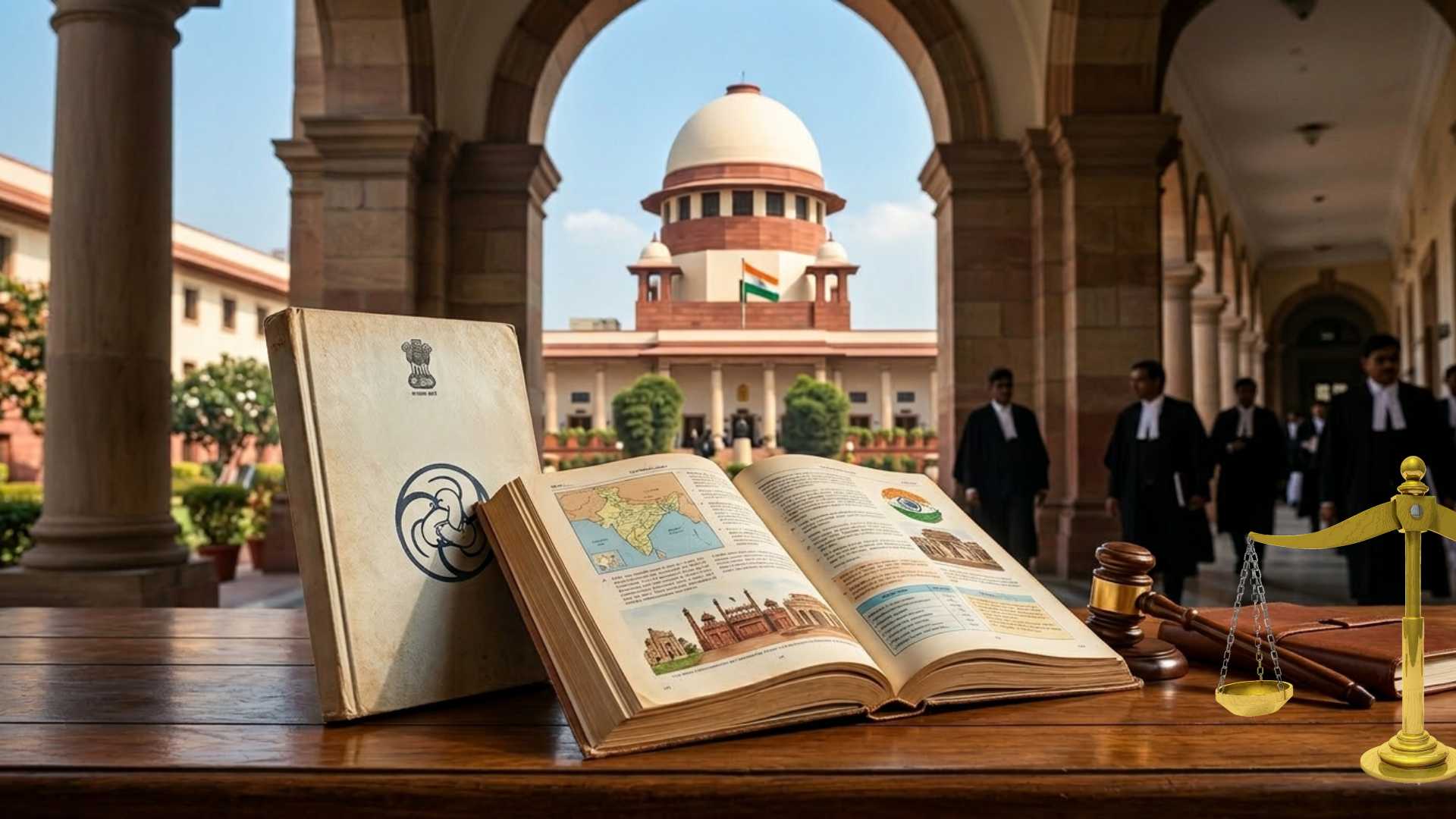
Supreme Court ordered a blanket ban on an NCERT Class 8 textbook citing selective portrayal of judicial corruption and delays.
-
Directed disassociation of authors, raising concerns of lack of due process.
-
The textbook included:
- Case backlog data
- Reference to Bangalore Principles of Judicial Conduct
- Mechanisms for judicial accountability (removal, in-house procedures)
KEY CONSTITUTIONAL AND LEGAL ISSUES
Freedom of Speech (Article 19)
-
Article 19(1)(a) guarantees freedom of speech and expression.
-
Restrictions under Article 19(2) must be:
- Imposed by law, not judicial orders alone
- Based on specific grounds (public order, defamation, contempt, etc.)
Judicial Orders vs ‘Law’
| Aspect | Explanation |
|---|---|
| Judicial Orders | Case-specific directions |
| Law (Art. 19 context) | Legislation enacted by the state |
| Key Case | Naresh Shridhar Mirajkar (1966) – judicial orders ≠ law under Article 19 |
CONTEMPT OF COURT: LEGAL THRESHOLD
-
Defined under Section 2(c), Contempt of Courts Act, 1971
-
Includes:
- Scandalising the court
- Interference with justice delivery
Key Issue
-
Mere discussion of:
- Judicial delays
- Corruption concerns may not meet the high threshold of criminal contempt.
KEY CONCERNS ARISING FROM THE BAN
Impact on Fundamental Rights
- Curtails academic freedom and free expression
- Sets precedent for judicial censorship
Violation of Natural Justice
- Punitive directions (disassociation) issued without hearing authors
Judicial Overreach
- Courts acting as censors rather than constitutional adjudicators
- Reduces scope for judicial review remedies
Chilling Effect
-
Discourages:
- Academic critique
- Public discourse on institutional reforms
NEED FOR JUDICIAL ACCOUNTABILITY AND TRANSPARENCY
-
Judiciary itself has acknowledged:
- Presence of “bad apples”
- Need for high ethical standards
Important Case
-
K. Veeraswami vs Union of India (1991)
- Judges classified as public servants under Prevention of Corruption Act
- Emphasized absolute integrity standards
Quote
- “A single dishonest judge… jeopardises the integrity of the entire judicial system.”
GLOBAL BEST PRACTICES
| Country | Reform Measures | Outcome |
|---|---|---|
| Kenya | Judicial ombudsman, user committees, performance tracking | Trust rose from 27% (2009) to 61% (2013) |
| Global Trend | Transparency & accountability mechanisms | Improved institutional credibility |
Key Insight
- Reform succeeds through acknowledgment, not suppression of criticism.
ROLE OF MEDIA AND CIVIL SOCIETY
-
Essential for:
- Democratic accountability
- Exposing systemic issues
-
Max Boot’s thesis highlights:
- Media scrutiny as a corrective force for judiciary
BALANCING JUDICIAL DIGNITY AND DEMOCRATIC CRITICISM
Judicial Perspective
- Protect institutional legitimacy
- Prevent misinformation
Democratic Perspective
-
Allow:
- Criticism
- Academic debate
- Public awareness
Core Principle
- Dissent strengthens institutions; suppression weakens them
WAY FORWARD
-
Promote institutional self-reform rather than censorship
-
Strengthen:
- Judicial accountability frameworks
- Transparency mechanisms
-
Encourage:
- Academic freedom
- Evidence-based critique
-
Develop clear guidelines on contempt vs criticism
CONCLUSION
- Judicial credibility depends not only on authority but also on public trust and openness to scrutiny.
- Suppressing critical discourse risks weakening democratic foundations.
- A self-correcting, transparent judiciary is essential for sustaining constitutional democracy and rule of law.
UPSC MAINS QUESTION (250 WORDS)
- “Judicial accountability and freedom of expression often come into conflict in a democracy.” Critically examine in the context of recent debates on judicial censorship in India.
Attribution
Original content sources and authors
Syllabus classification
How this article maps to GS papers
Main syllabus
GS2EducationQuick Q&A
What are the constitutional and legal issues involved in the Supreme Court’s decision to impose a ban on an NCERT textbook?
Key legal concerns include:
- Absence of statutory backing: The ban was not based on any specific legislation, raising questions about its constitutional validity.
- Violation of due process: The directive to ‘disassociate’ authors from future work was issued without a hearing, contravening principles of natural justice.
- Judicial overreach: Courts are expected to review laws, not act as executive authorities imposing censorship.
Judicial precedents, such as Naresh Shridhar Mirajkar vs State of Maharashtra (1966), clarify that judicial orders do not constitute ‘law’ under Article 19. Thus, the ban may not meet constitutional standards for restricting free speech.
In essence, the issue reflects a tension between protecting institutional dignity and upholding democratic freedoms. The decision risks setting a precedent where courts assume powers beyond their constitutional mandate.
Why is freedom of expression, including criticism of the judiciary, essential in a democratic system?
Its importance can be understood through:
- Accountability: Public criticism helps identify systemic issues such as judicial delay or corruption.
- Transparency: Open discussion fosters trust in institutions by demonstrating their willingness to engage with criticism.
- Democratic participation: नागरिकों को informed opinions बनाने और governance में भाग लेने की अनुमति देता है.
International experiences show that suppressing criticism often backfires. For example, reforms in Kenya’s judiciary succeeded because problems were openly acknowledged rather than censored.
Therefore, restricting critical discourse—especially in educational materials—can undermine democratic values. A judiciary that tolerates and responds to criticism strengthens its legitimacy, whereas censorship may erode public confidence.
How should the judiciary balance its institutional dignity with the need for transparency and public criticism?
A balanced approach would involve:
- Encouraging constructive criticism: Differentiating between malicious attacks and genuine academic or public discourse.
- Strengthening internal accountability: Mechanisms like in-house procedures and judicial oversight bodies can address misconduct.
- Promoting transparency: Publishing data on case pendency and reforms enhances credibility.
Legal safeguards such as the Contempt of Courts Act, 1971, already provide protection against actions that scandalise the court or obstruct justice. However, its application must be cautious and proportionate.
Ultimately, dignity is best preserved not through censorship but through consistent fairness, integrity, and openness. A judiciary that engages with criticism rather than silencing it is more likely to command long-term public trust.
What are the reasons behind concerns about judicial corruption and delay in India, and how do they impact governance?
Key reasons include:
- Case backlog: Millions of pending cases due to inadequate judge-to-population ratio and procedural delays.
- Institutional opacity: Limited transparency in judicial appointments and disciplinary mechanisms.
- Isolated corruption: While rare, even a few instances can damage the credibility of the entire system.
Judicial observations, such as in K. Veeraswami vs Union of India (1991), emphasise that even a single dishonest judge can undermine public trust. This highlights the high ethical standards expected from the judiciary.
The impact on governance is profound. Delays weaken rule of law, discourage investment, and deny timely justice. Corruption, even if limited, erodes institutional legitimacy.
Thus, addressing these issues is essential not only for judicial efficiency but also for strengthening democratic governance and public confidence.
Can you provide an international example where judicial reforms improved public trust, and what lessons can India draw from it?
Key initiatives included:
- Establishment of ombudspersons: To address public grievances against the judiciary.
- Court users’ committees: Facilitating dialogue between citizens and judicial institutions.
- Performance management systems: Monitoring efficiency and accountability.
The results were notable. Public trust in the judiciary increased from 27% in 2009 to 61% in 2013, demonstrating the effectiveness of reform through openness rather than suppression.
Lessons for India include:
- Acknowledging problems openly: Denial or censorship can hinder reform.
- Institutional innovation: Creating independent oversight mechanisms can enhance accountability.
- Citizen engagement: Involving the public builds trust and legitimacy.
Thus, India can strengthen its judiciary by embracing transparency and reform-oriented approaches rather than limiting critical discourse.
Critically analyse whether banning educational content is a justified means to protect the dignity of the judiciary.
Arguments in favour include:
- Preventing misinformation: If content is factually incorrect or misleading, restrictions may be justified.
- Protecting institutional integrity: Courts may seek to prevent erosion of public confidence.
However, the counterarguments are more compelling:
- Violation of free speech: Blanket bans undermine Article 19(1)(a) and academic freedom.
- Chilling effect: Such actions discourage scholars and citizens from engaging in critical analysis.
- Lack of proportionality: Less restrictive alternatives, such as rebuttals or clarifications, are available.
Critically, the judiciary’s role is to adjudicate, not censor. By banning content, courts risk overstepping their constitutional mandate and weakening their moral authority.
Therefore, while protecting institutional dignity is important, it must be balanced with fundamental rights. A लोकतांत्रिक system thrives on debate and dissent, not suppression.
As a policymaker, how would you address issues of judicial accountability while preserving judicial independence?
Key policy measures would include:
- Strengthening in-house mechanisms: Enhancing existing procedures for investigating complaints against judges.
- Independent oversight bodies: Establishing judicial councils or ombudspersons to handle grievances.
- Transparency in appointments: Reforming the collegium system to include objective criteria and public disclosure.
Additionally, technological interventions such as digitisation of court records and case management systems can reduce delays and improve efficiency.
Balancing independence and accountability is crucial. While judges must be protected from political pressure, they must also be answerable for misconduct. Mechanisms like impeachment or prosecution under the Prevention of Corruption Act, as recognised in K. Veeraswami case, provide legal avenues.
Ultimately, the goal should be to build a judiciary that is both independent and accountable, thereby strengthening public trust and the rule of law.
Practice questions
1 question for mains preparation