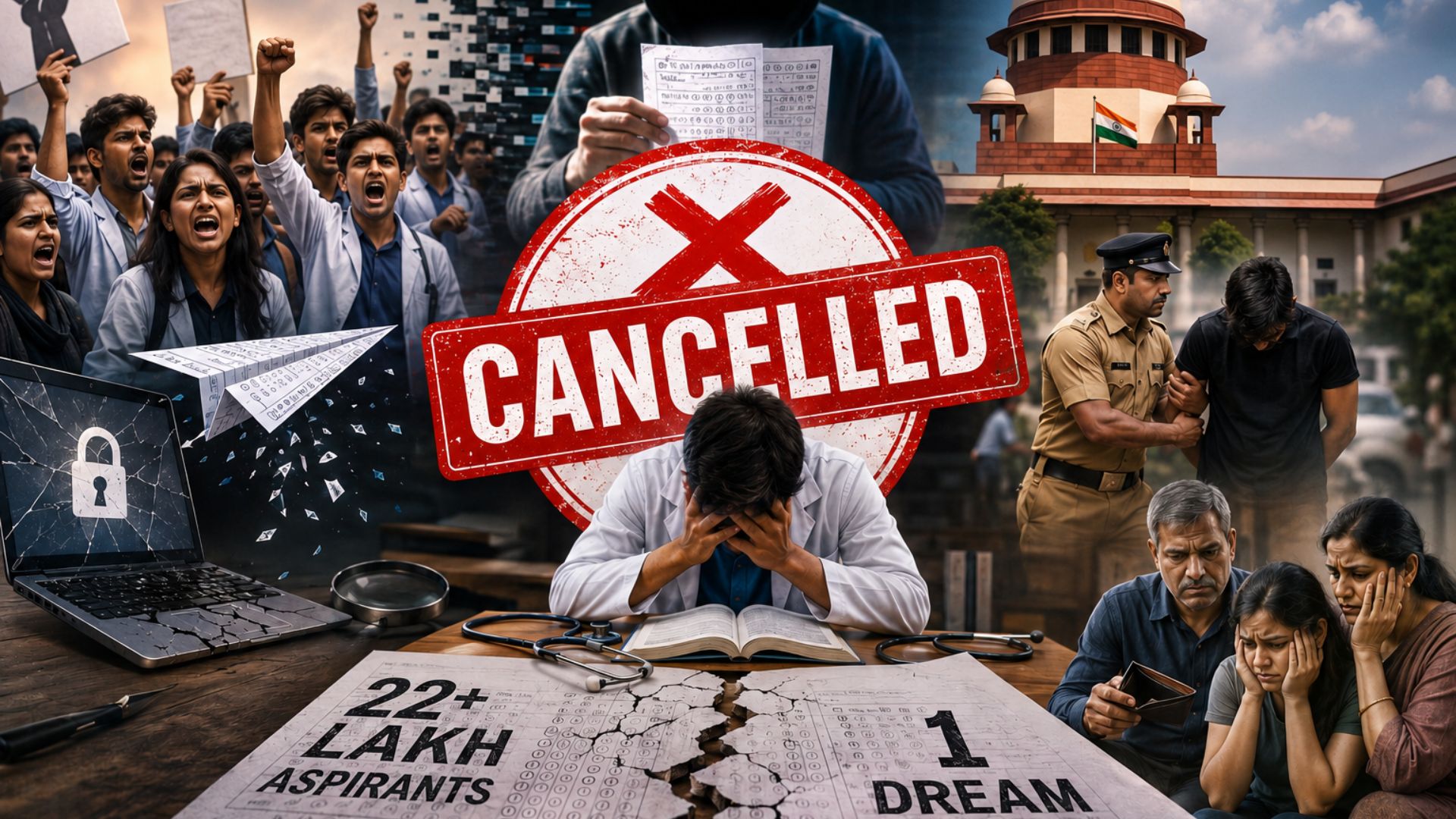
NEET-UG 2026 Exam Cancelled Amid Paper Leak Allegations

On May 12, 2026, the National Testing Agency (NTA) cancelled the NEET-UG 2026 examination — held on May 3 — following allegations of a paper leak investigated by the Rajasthan Special Operations Group (SOG). The government simultaneously referred the matter to the CBI for a comprehensive inquiry. For over 22 lakh medical aspirants, it was the second such crisis in three years.
What Happened: The Chain of Events
May 3, 2026     → NEET-UG conducted across India
Post-exam       → Allegations of paper leak surface
                → Rajasthan SOG begins investigation
May 12, 2026    → NTA cancels exam with govt approval
                → CBI registers FIR, takes custody of accused from Nashik
                → NTA DG announces re-exam schedule in 7–10 days
The NTA stated the cancellation was necessary to prevent "greater and more lasting damage" to trust in the examination system, while acknowledging it would cause "real and significant inconvenience" to candidates. No additional fee will be charged for the re-examination, and prior registration data and centre allotments will be carried forward.
The Human Cost
The cancellation landed on students without warning. A Telangana aspirant, Kevin, described the moment:
"My exam went really well. I was finally enjoying my summer break. Now I am completely blank about what to do. We do not know when the exam will happen again or how to mentally prepare for another attempt."
A Tamil Nadu candidate appearing for the third time said:
"How could the NTA be so careless? We sacrificed our college years, our youth, and many comforts to prepare for this exam. Now the stress and anxiety are back."
The psychological toll — on students who had already appeared, performed well, and begun to decompress — is a dimension that institutional responses have largely failed to address.
Institutional Accountability: NTA Under Scanner
Experts flagged three core failures:
- Lax operational capacity — inability to secure a pen-and-paper exam conducted across thousands of centres nationwide
- Porous cybersecurity — 120 Telegram channels were blocked pre-exam under a declared zero-tolerance policy, yet the leak still occurred
- Poor crisis communication — delayed public acknowledgement and inadequate transparency with affected candidates and families
The NTA DG, Abhishek Singh — who assumed charge only 40 days prior under a declared "Zero Error Zero Tolerance" policy — acknowledged institutional responsibility directly:
"The question is not whether the leak was localised or not — if integrity of the process was violated, it was violated."
The Nashik-based accused — a BAMS student who had changed his appearance to evade arrest — was tracked using technical surveillance and handed over to the Rajasthan Police, indicating an organised, multi-state fraud network rather than an isolated incident.
The Systemic Pattern
This is not a one-off failure. NEET has accumulated a damaging record:
- 2024 — Limited retest for 1,563 grace-mark candidates; paper leak allegations; high-level reform committee constituted
- 2026 — Full-scale cancellation; CBI FIR; SOG investigation across multiple states
- The Public Examinations (Prevention of Unfair Means) Act, 2024 criminalised paper leaks and cheating syndicates — but has not demonstrably deterred organised fraud networks operating across state lines
FAIMA Doctors Association captured the institutional concern directly:
"We will not stay silent while 'guess papers' and mafias decide who becomes a doctor."
What Needs to Change
Experts and educationalists have converged on structural rather than procedural fixes:
- Transition to Computer-Based Testing — eliminates physical paper trails and dramatically reduces leak points
- Habitat restoration equivalent for exams — securing the entire chain of custody from printing to distribution, treating each node as a vulnerability
- Stronger independent oversight of the NTA with audit mechanisms beyond self-reporting
- Multiple attempts per year to reduce the all-or-nothing pressure that sustains the cheating economy
- Faster, enforceable compensation for affected candidates — not just re-examination announcements
Conclusion
The NEET-UG 2026 cancellation is not merely an administrative lapse — it is a crisis of institutional credibility. When a centralised examination determining access to medical education for 22 lakh students fails repeatedly, the question shifts from one bad exam cycle to whether the architecture of centralised high-stakes testing, as currently designed and administered, is structurally fit for purpose. The CBI investigation and re-examination are necessary — but insufficient without fundamental reform of how India conducts examinations at scale.
Attribution
Original content sources and authors


Syllabus classification
How this article maps to GS papers
Main syllabus
GS2EducationQuick Q&A
What does the cancellation of NEET-UG 2026 indicate about the challenges in managing large-scale public examinations in India?
The issue is not limited to one examination but points to a systemic challenge in India’s public testing architecture. When an exam is cancelled after completion, the damage extends beyond administration to public trust. Students invest years of preparation, families spend significant resources, and any irregularity shakes confidence in merit-based recruitment. This creates a legitimacy crisis for institutions like the NTA.
Key governance concerns include:
- Centralised exam management without robust local accountability.
- Inadequate security protocols for paper-based exams.
- Delayed communication during crises.
- Weak institutional capacity to prevent organised fraud.
Why is examination integrity crucial for social justice and equal opportunity in a country like India?
The cancellation particularly affects vulnerable groups. Students from rural areas and government schools often prepare without expensive coaching. A compromised system allows affluent candidates with access to illegal channels to gain unfair advantage. This undermines the constitutional promise of equality under Article 14 and fairness in state action.
Its significance lies in:
- Preserving meritocracy in public systems.
- Protecting equal access to education.
- Maintaining trust in institutions.
- Preventing socio-economic exclusion.
How can India strengthen examination systems to prevent paper leaks and restore trust?
However, technology alone is not enough. Institutional reforms are equally important. Independent auditing, third-party cybersecurity checks, and decentralised oversight are necessary. Timely communication during crises is essential to avoid panic among candidates and maintain transparency.
Important reforms include:
- Transition to digital examination systems.
- Real-time monitoring and analytics.
- Independent regulatory oversight.
- Stronger coordination with law enforcement.
What are the underlying reasons behind repeated examination paper leaks despite legal reforms?
Another major factor is intense competition. Medical admissions have limited seats, creating enormous pressure. This high-stakes environment fuels demand for unfair means, making paper leaks a profitable criminal enterprise. Organised groups involving brokers, coaching centres, and intermediaries exploit this demand.
Main causes include:
- Weak enforcement of existing laws.
- Corruption and insider involvement.
- High demand-low seat mismatch.
- Lack of deterrent accountability.
Critically analyse whether a single national examination like NEET is suitable for a diverse federal country like India.
On the other hand, a single exam may not account for India’s linguistic, regional, and educational diversity. Students from state boards may face disadvantages compared to those from national boards. Overreliance on one test also magnifies the consequences of leaks, as seen in 2026. Coaching culture further skews outcomes.
A more balanced model could include:
- NEET score combined with school performance.
- Multiple attempts annually.
- Regional flexibility in admissions.
- Aptitude-based evaluation.
As an administrator, how would you address the NEET-UG 2026 crisis while balancing accountability and student welfare?
Long-term measures require fixing accountability. A time-bound CBI probe should identify all actors involved, including any internal collusion. Examination processes should be redesigned using secure digital infrastructure. Independent oversight and regular audits must become mandatory.
Administrative priorities would be:
- Transparent public communication.
- Swift but fair re-examination process.
- Institutional accountability.
- Structural examination reforms.
Practice questions
1 question for mains preparation