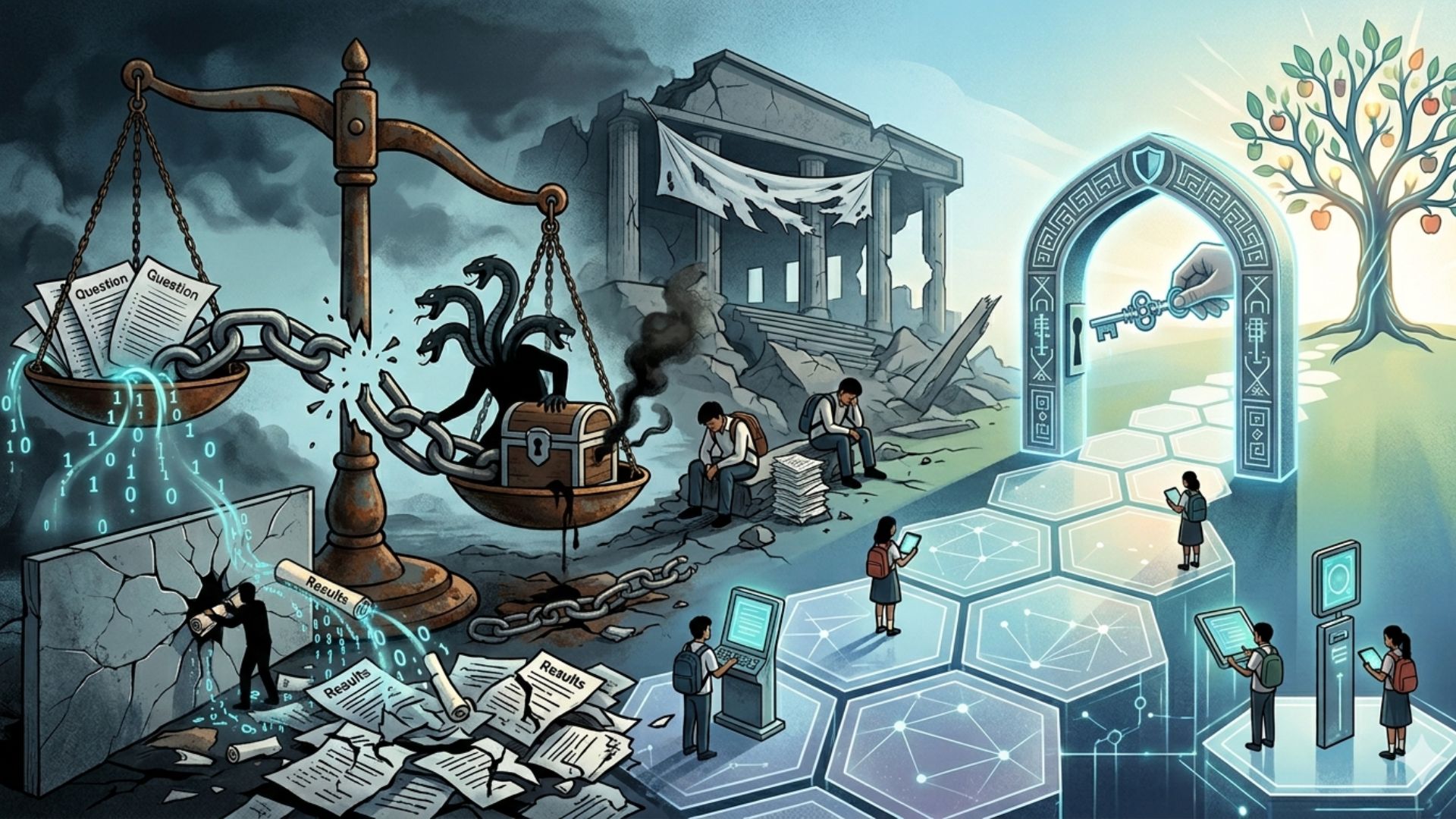

The cancellation of NEET-UG 2026 — the first full-scale cancellation in the exam's history — has once again put the National Testing Agency (NTA) under intense scrutiny. Experts are pointing to three core institutional failures: lax operational capacity, porous cybersecurity, and poor crisis communication.
A Rocky History, Now at Breaking Point
NEET has never had a clean run. Since its introduction in 2013, the exam has been plagued by recurring controversies:
- Impersonation fraud reported by multiple states year after year
- Candidates and coaching institutes paying large sums for leaked question papers and answer keys
- Photos of papers being circulated just before exam time, with prepared answers for students to memorise
- Suspiciously inflated scores and rankings
- Full-scale "organised cheating centres" operating with near-impunity
The 2024 edition saw a limited retest for 1,563 candidates who received grace marks due to lost exam time — but that was a patch, not a fix. The 2026 cancellation is the system finally cracking under the weight of unresolved structural rot.
Why Paper-Based Exams Are the Weakest Link
Dr. Rajeev Jayadevan, former president of the Indian Medical Association (Kochi), puts his finger on the fundamental problem:
"The question paper has to be physically printed, distributed, stored, and transported to individual centres — each is a point of vulnerability where a leak can occur. Even a single photograph of the question paper is sufficient to breach the system."
Consider the chain of custody for a single NEET paper:
Printing press → Storage facility → Transit vehicle
→ District hub → Exam centre → Invigilator → Candidate
Every arrow in that chain is a potential breach point. With 20–24 lakh candidates appearing annually across hundreds of centres — including centres abroad — the attack surface is enormous.
The Scale Makes It Uniquely Vulnerable
NEET is one of the largest entrance examinations in the world — over 20 lakh candidates compete each year for approximately 2.5 lakh seats across more than 10 undergraduate medical courses. The sheer demand, combined with the life-altering stakes, creates powerful financial incentives for fraud syndicates to operate.
As Dr. Lakshya Mittal, Chairperson of the United Doctors Front, notes:
"Repeated incidents over the years clearly indicate the existence of a deep-rooted nexus and systemic failure which cannot be ignored any longer."
Merely cancelling the exam, he argues, is not a solution — it is a postponement of accountability.
What Reforms Are Being Demanded
Experts are coalescing around a set of structural interventions:
- Shift to Computer-Based Testing (CBT): Digital delivery eliminates physical paper trails, enables encrypted distribution, and dramatically reduces leak points. Dr. Jayadevan notes that today's students are far more digitally literate than previous generations, making a transition feasible.
- Stronger cybersecurity infrastructure for digital exam delivery
- Decentralisation of admissions to reduce single-point failure risk
- Multiple attempts per year, reducing the all-or-nothing pressure that fuels the cheating economy
- Hybrid scoring incorporating school performance and aptitude scores alongside the entrance test
What the Government Has Already Done — and Why It Hasn't Been Enough
Following the 2024 NEET controversy, the Central government and NTA introduced a slate of reforms:
- The Public Examinations (Prevention of Unfair Means) Act, 2024 — criminalising paper leaks, cheating syndicates, impersonation, and organised exam fraud
- A high-level reform committee to review NTA's functioning and recommend structural changes
- A proposed shift to digital or hybrid formats with enhanced cybersecurity
The 2026 cancellation is a verdict on those reforms: they were either not implemented fast enough, not implemented seriously enough, or simply not sufficient for a system this broken.
The Larger Question
NEET was created to bring uniformity to chaotic, fragmented state-level medical admissions. That goal remains valid. But a unified exam is only as trustworthy as the institution running it. Right now, the NTA has neither the operational credibility nor the technical infrastructure to justify the extraordinary power it holds over the futures of millions of students.
The demand from the medical community is clear: a high-level, time-bound, and transparent investigation — not another round of cosmetic fixes.
Attribution
Original content sources and authors


Syllabus classification
How this article maps to GS papers
Main syllabus
GS2EducationQuick Q&A
What are the major institutional challenges exposed by the cancellation of NEET-UG 2026, and what does it reveal about India’s examination governance system?
The issue is not merely administrative but institutional. The National Testing Agency (NTA), created to professionalise national testing, has faced criticism over operational capacity, inadequate cybersecurity preparedness, and weak crisis communication. A major concern is that once credibility is damaged, even genuine outcomes become suspect. This creates distrust among students and families, turning an educational assessment into a public controversy.
From a governance perspective, this reflects three concerns:
- Centralised management of a massive examination without sufficient decentralised checks.
- Dependence on outdated paper-based processes.
- Inadequate accountability mechanisms for failures.
Why does the continued controversy around NEET matter for social justice and equal access to education in India?
Social justice concerns arise because students from privileged sections may gain access to expensive coaching networks, leaked papers, or organised cheating systems. This widens existing educational inequalities. Candidates from government schools or economically weaker families often invest years of effort, and a compromised exam destroys their confidence in meritocracy.
The broader implications include:
- Erosion of faith in public institutions.
- Psychological stress and uncertainty among students.
- Reduced legitimacy of professional admissions.
How can digitisation of national examinations improve integrity, and what challenges may arise in shifting NEET to a computer-based system?
A digital system can also randomise questions, use AI-based proctoring, biometric verification, and real-time monitoring. This makes impersonation and organised copying more difficult. Several Indian examinations such as JEE Main and banking recruitment tests already use CBT successfully, demonstrating operational feasibility.
However, challenges remain:
- Digital divide between urban and rural candidates.
- Technical failures such as server crashes.
- Cybersecurity threats including hacking.
- Need for large-scale infrastructure and training.
What are the reasons behind recurring examination leaks despite legal reforms such as the Public Examinations (Prevention of Unfair Means) Act, 2024?
The demand side is equally significant. Medical education in India remains highly competitive, with very limited seats compared to aspirants. This creates a market where unethical actors exploit desperation. Coaching centres, brokers, and criminal networks benefit financially from leaked papers, making the ecosystem difficult to dismantle.
Recurring leaks are caused by:
- Weak implementation of legal provisions.
- Poor internal oversight and audit systems.
- High economic incentives for malpractice.
- Lack of independent accountability.
Critically analyse whether a single national examination like NEET is the best model for medical admissions in India.
However, critics argue that one exam for such a large and diverse country may not adequately reflect student aptitude. It favours coaching-based preparation and may not account for school performance, language differences, or regional disparities. Dependence on a single test also means any irregularity affects millions at once, as seen in 2026.
A balanced approach may involve:
- NEET score plus school academic record.
- Multiple attempts in a year.
- Aptitude and interview components.
- Decentralised state-specific weightage.
As a policymaker, how would you redesign the medical entrance system to prevent future crises like NEET-UG 2026?
The long-term reform would involve a hybrid model. Computer-based exams should be introduced in phases, with encrypted question delivery and biometric verification. Admissions should not rely solely on one score; school marks and aptitude assessment should be integrated to reduce overdependence on a single exam. Multiple attempts per year can reduce stress and the stakes of one-day performance.
Policy measures would include:
- Independent exam regulatory authority.
- Third-party cybersecurity audits.
- AI-enabled surveillance.
- Strict criminal prosecution of organised cheating syndicates.
- Public communication protocols during crises.
Practice questions
2 questions for mains preparation