
Introduction
India’s Right to Education (RTE) Act, 2009 mandates that 25% of seats in private unaided schools be reserved for children from Economically Weaker Sections (EWS) and disadvantaged groups. Since its implementation, over 5 million children have accessed such schools, with retention rates exceeding 90%.
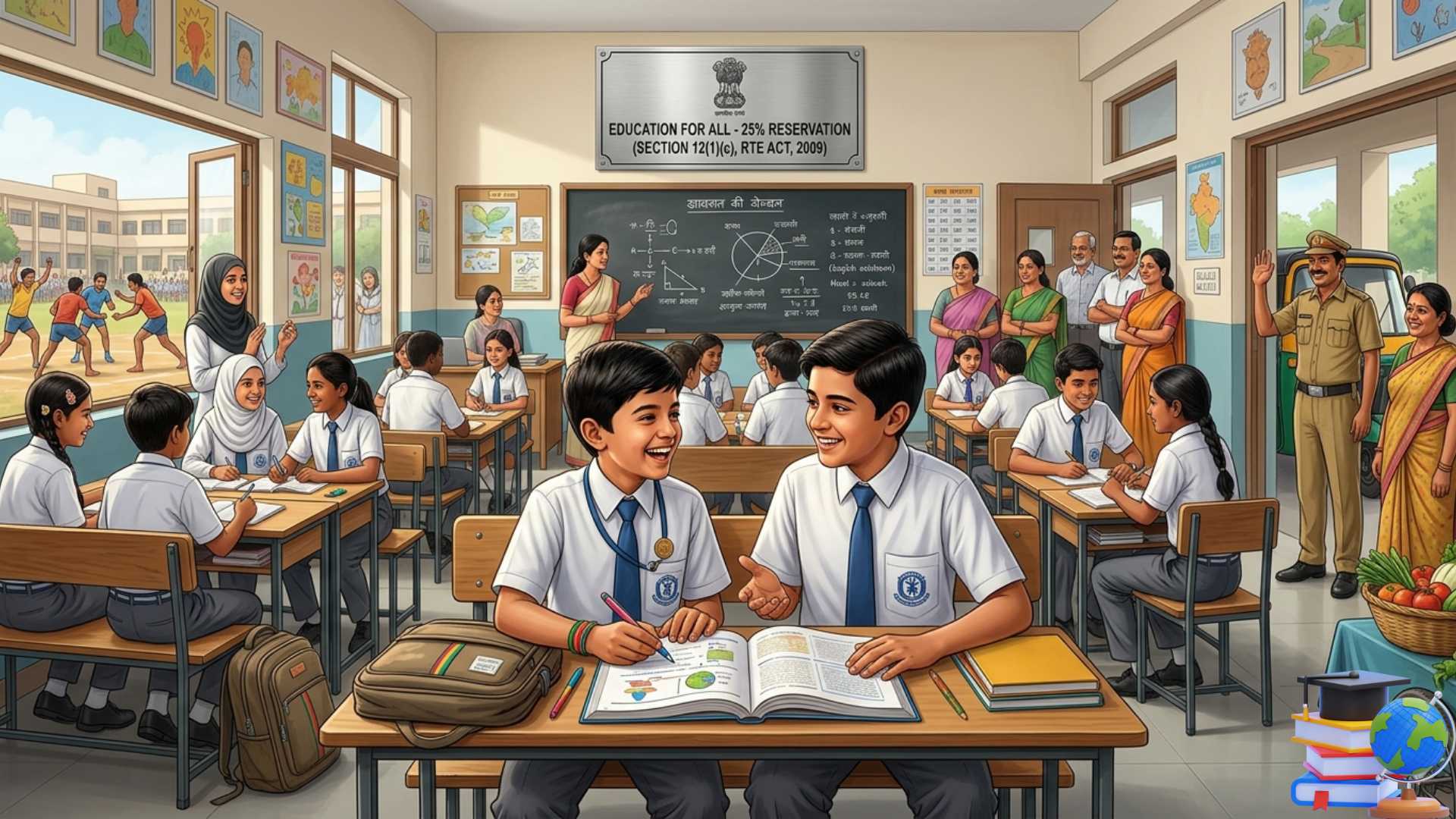
In its 2026 judgment, the Supreme Court emphasized that this provision enables children from vastly unequal socio-economic backgrounds to learn together in the same classroom, thereby translating the constitutional promise of equality of status into reality.
“Education is the most powerful weapon which you can use to change the world.” — Nelson Mandela
Key Data Snapshot
| Indicator | Details |
|---|---|
| Legal Provision | Section 12(1)(c), RTE Act, 2009 |
| Reservation | 25% seats in private unaided schools |
| Beneficiaries | Over 5 million children |
| Retention Rate | Above 90% |
| Core Objective | Social integration + equitable access to quality education |
1. Background & Constitutional Context
The insertion of Article 21A through the 86th Constitutional Amendment made education a fundamental right for children aged 6–14 years. The RTE Act operationalises this right.
Section 12(1)(c) emerges from a broader constitutional philosophy:
- It reflects the Preamble’s commitment to equality of status and opportunity.
- It aligns with Directive Principles of State Policy, particularly those related to social justice and reducing inequalities.
- It recognises that formal equality (access) must be complemented by substantive equality (integration).
The Supreme Court (2026) clarified that this provision is not merely about schooling access but is a deliberate constitutional design to create shared social spaces, where children from different socio-economic backgrounds interact and grow together.
2. Core Objective: From Access to Social Integration
While traditional policies focused on expanding access to education, Section 12(1)(c) goes a step further by targeting social integration.
-
It seeks to dismantle structural segregation in schooling, where children from affluent families and disadvantaged groups study in separate institutions.
-
By placing children from diverse backgrounds in the same classroom, it promotes:
- Mutual understanding
- Reduction of prejudice
- Development of inclusive social values
Thus, the provision aims not only to educate but also to reshape social relations and mobility pathways.
3. Key Features of Section 12(1)(c)
| Feature | Explanation |
|---|---|
| Reservation Policy | Mandates 25% seats in entry-level classes (Class I or pre-primary) |
| Target Beneficiaries | Children from EWS and disadvantaged groups |
| Applicability | Private unaided schools (excluding minority institutions) |
| Admission Process | Transparent, lottery-based system to ensure fairness |
| Financial Mechanism | Government reimburses schools based on per-child expenditure |
| Age Group | 6–14 years (elementary education) |
The design ensures that economic disadvantage does not restrict access to quality private education, while maintaining a non-discriminatory admission process.
4. Misconceptions vs Reality
A number of criticisms have emerged regarding Section 12(1)(c), but many are based on incorrect assumptions.
| Misconception | Reality |
|---|---|
| It promotes privatisation of education | It integrates private schools into fulfilling a constitutional mandate |
| It weakens government schools | Decline in public school enrolment predates RTE (ASER 2006) |
| It allows the state to withdraw responsibility | The state remains obligated to strengthen public education |
The ASER Report (2006) already documented a shift towards private schooling due to concerns such as infrastructure, teacher absenteeism, and perceived quality gaps. Hence, Section 12(1)(c) is not the cause but a response within an evolving educational ecosystem.
5. Impact & Evidence
A. Educational Outcomes
Empirical studies suggest that the inclusion of EWS students:
- Does not negatively impact academic performance of other students.
- Does not disrupt classroom discipline or learning outcomes.
B. Social Outcomes
Research (Rao & Gautam, 2019) highlights:
- Increased pro-social behaviour among students
- Reduction in social discrimination
- Development of empathy and cooperation
C. Psychological and Aspirational Impact
For children from disadvantaged backgrounds:
-
Exposure to better infrastructure and teaching methods enhances learning outcomes.
-
Interaction with diverse peer groups builds:
- Self-confidence
- Aspirational capacity
- Social capital
Thus, the policy contributes to intergenerational mobility and social transformation.
6. Governance & Implementation Mechanisms
Over time, the implementation framework has evolved to improve efficiency and transparency:
- Digital admission systems reduce discretion and corruption.
- Management Information Systems (MIS) track applications, admissions, and reimbursements.
- Direct benefit mechanisms streamline reimbursements to schools.
States such as Rajasthan, Gujarat, and Delhi have demonstrated improvements through:
- Online portals
- Automated seat allocation
- Real-time monitoring systems
7. Key Challenges
A. Institutional Resistance
Some private schools:
- Resist admitting EWS students
- Segregate them informally within classrooms or activities
B. Hidden Costs
Despite free education provisions, families often incur:
- Expenses for uniforms
- Books and study materials
- Transportation costs
These hidden barriers can limit effective access.
C. Administrative Gaps
- Delays in reimbursement discourage school participation
- Weak grievance redress mechanisms reduce accountability
- Lack of awareness among eligible families affects enrolment
D. Uneven Implementation
Performance varies significantly across states due to:
- Differences in governance capacity
- Varying political commitment
8. Illustrative Case Insight
Ground-level experiences show that access to private schooling:
- Opens doors to better academic opportunities
- Provides exposure to structured environments and extracurricular activities
- Enables children from low-income families to build peer networks and aspirations
Such cases highlight that education under this provision is not just about schooling but about transforming life trajectories.
9. Way Forward
To strengthen the effectiveness of Section 12(1)(c), the following measures are essential:
- Ensure timely reimbursements to maintain school participation
- Eliminate hidden costs through stricter regulation and support mechanisms
- Strengthen monitoring and compliance frameworks
- Improve grievance redress systems for parents and students
- Enhance awareness campaigns to reach eligible beneficiaries
- Simultaneously invest in public school infrastructure and quality
A balanced approach is necessary to ensure that integration complements, rather than substitutes, public education reforms.
Conclusion
Section 12(1)(c) represents a bold constitutional intervention aimed at bridging socio-economic divides through education. By creating shared learning environments, it moves beyond mere access to foster social cohesion and equality. The real challenge lies not in the idea but in its execution—ensuring that administrative systems are robust enough to translate this vision into everyday reality.
Attribution
Original content sources and authors


Syllabus classification
How this article maps to GS papers
Main syllabus
GS2EducationQuick Q&A
What is the constitutional and legal significance of Section 12(1)(c) of the Right to Education (RTE) Act, 2009?
From a constitutional perspective, the provision operationalises the principle of equality of status and opportunity by ensuring that children from diverse backgrounds learn together. The Supreme Court’s 2026 judgment emphasized this symbolic and substantive integration, highlighting how it enables children of vastly different socio-economic strata to share the same classroom environment.
Legally and socially, Section 12(1)(c) represents a shift from formal equality to substantive equality. It acknowledges that equal treatment alone is insufficient and that proactive measures are required to level the playing field. By embedding inclusion within private institutions, it extends the reach of public policy into a mixed schooling ecosystem, thereby reinforcing the State’s commitment to inclusive development.
Why is Section 12(1)(c) considered a critical instrument for achieving social integration in India?
The importance lies in its long-term societal impact:
- It fosters mutual understanding and empathy among children.
- It reduces stereotypes and discrimination through everyday interaction.
- It builds social cohesion, which is essential in a diverse country like India.
For disadvantaged children, the benefits extend beyond academics. They gain access to social capital, networks, and aspirations that would otherwise remain inaccessible. For instance, cases like Karthik’s son illustrate how exposure to quality education and peer networks can alter life trajectories, potentially breaking cycles of poverty. Thus, the provision is a powerful tool for nation-building and inclusive growth.
How does Section 12(1)(c) function within India’s broader educational ecosystem without undermining public education?
Functionally, the provision requires private schools to admit eligible children and receive government reimbursements for their education. This ensures that financial constraints do not deter schools from participation while maintaining the principle of free and compulsory education for beneficiaries. Additionally, digital Management Information Systems (MIS) in several states have streamlined admissions and reimbursements, improving transparency and efficiency.
Importantly, the decline in government school enrolment predates the RTE Act and is linked to structural issues such as infrastructure deficits and teacher absenteeism. Section 12(1)(c) does not create a zero-sum competition but instead promotes integration across school types. It recognizes private schools as stakeholders in fulfilling a public mandate, thereby strengthening the overall system rather than weakening it.
Critically analyse the challenges in the implementation of Section 12(1)(c) and their implications.
Administrative challenges also persist. These include delays in reimbursement to schools, lack of effective grievance redress mechanisms, and uneven implementation across states. In some regions, awareness among eligible families remains low, leading to underutilization of available seats. Such gaps dilute the effectiveness of the policy and risk turning a rights-based provision into a procedural formality.
However, these challenges are not insurmountable. States like Delhi, Gujarat, and Rajasthan have demonstrated that digital admission systems and robust monitoring can significantly improve outcomes. The key implication is that the success of the policy depends less on its design and more on administrative will and enforcement. Strengthening accountability mechanisms and ensuring inclusion norms are strictly followed can help realize its full potential.
Can you illustrate with examples how Section 12(1)(c) impacts the lives of beneficiaries?
Such examples are not isolated. Across India, over five million children have benefited from this policy, with retention rates exceeding 90%. In cities like Delhi and Ahmedabad, blended classrooms have become common, fostering inclusive environments where children learn from each other’s experiences. Research indicates that these interactions enhance empathy, cooperation, and social understanding among students.
Beyond individual success, the provision has intergenerational effects. Families gain a renewed sense of hope and aspiration, often investing more in education and skill development. These outcomes demonstrate that Section 12(1)(c) is not just about schooling but about breaking cycles of poverty and enabling social mobility.
As a policymaker, how would you strengthen the implementation of Section 12(1)(c) to ensure its objectives are fully realized?
Second, hidden costs must be eliminated by enforcing strict guidelines on schools and providing additional financial support for uniforms, books, and other essentials. Establishing robust grievance redress mechanisms at the district and state levels would empower parents and ensure accountability.
Third, awareness campaigns and last-mile outreach are essential to ensure that eligible families can access the scheme. Leveraging local bodies, NGOs, and digital platforms can improve outreach. Additionally, periodic audits and social impact assessments should be conducted to evaluate outcomes.
Finally, fostering an inclusive school culture is critical. Teacher training programs should emphasize sensitivity and inclusion to ensure that EWS students are not marginalized within classrooms. By combining administrative efficiency with social sensitivity, the policy can truly realize its goal of operationalizing constitutional equality.
Practice questions
2 questions for mains preparation