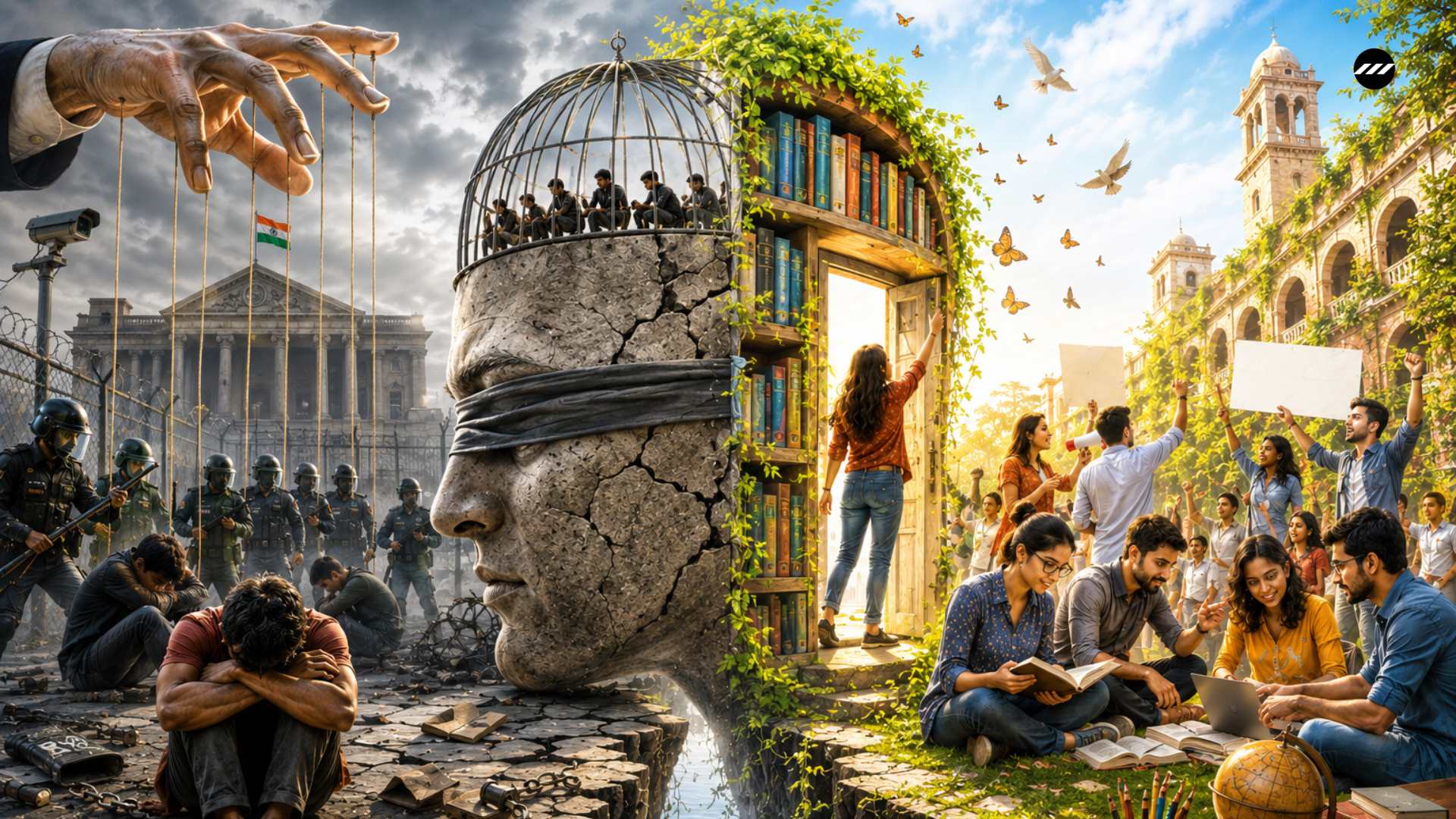
Silencing Academia: A Blow to Democratic Discourse
Introduction
"When scholars are silenced and dissent is criminalised, the foundation upon which democratic accountability rests is dismantled — brick by brick, case by case, silence by silence."
The V-Dem Institute 2026 report classifies India as an "electoral autocracy", placing it among the "worst autocratizers" globally. The Scholars at Risk 2024 report rates India's academic freedom as "completely restricted". With 62 academics facing punitive action (2014–26) and a steady contraction of civil society space, the health of India's knowledge institutions has become a direct measure of its democratic vitality.
| Index / Report | Classification | Key Concern |
|---|---|---|
| V-Dem Institute 2026 | Electoral Autocracy | Decline in free expression, media, civil society |
| Scholars at Risk 2024 | Completely Restricted | University autonomy, political interference |
| Freedom House | Declining | Press freedom, institutional independence |
| India Academic Freedom Network | Documented violations | Arrested faculty, disrupted events, visa hurdles |
Background & Context
Academic Freedom as a Democratic Pillar
Democracy beyond elections rests on three foundations: a strong civil society, open access to evidence-based information, and space for genuine public debate. Universities are the institutional home of all three. When academic freedom contracts, democratic accountability loses its intellectual infrastructure.
Constitutional Guarantees vs. Ground Reality
India's Constitution provides robust textual protection:
→ Article 14 — Right to Equality
→ Article 19 — Freedom of Speech and Expression
→ Article 21 — Right to Life and Personal Liberty (expansively interpreted by the Supreme Court)
The Supreme Court has repeatedly drawn upon international human rights norms to expand these rights. Yet the gap between constitutional text and institutional practice has widened — making academic freedom a live GS2 and GS4 issue.
Key Concepts
1. Academic Freedom — Definition and Scope
Academic freedom encompasses the right of faculty and students to:
→ Teach and research without political interference
→ Question orthodox thinking and majority opinion
→ Access and disseminate evidence-based knowledge
→ Host and attend events without institutional fear
It is not merely an individual right — it is a systemic condition for knowledge production and democratic renewal.
2. The Chilling Effect
The chilling effect occurs when punitive action against a few creates self-censorship among many. When 62 academics face action over 12 years, the message received by thousands of others is unambiguous: certain topics are off-limits, certain questions are dangerous. The visible cases are the tip; the invisible self-censorship is the iceberg.
3. India's International Human Rights Posture
| Instrument | India's Status | Implication |
|---|---|---|
| ICCPR (International Covenant on Civil and Political Rights) | Party since 1979 | Bound by treaty obligations |
| First Optional Protocol to ICCPR | Not signed | Citizens cannot seek UN complaint mechanism after exhausting domestic remedies |
| Supreme Court jurisprudence | Uses international norms | Domestic interpretation progressive; international accountability absent |
India accepts the ICCPR's substantive obligations but refuses the complaint mechanism — meaning citizens from marginalised communities, who disproportionately face violations, have no international recourse when domestic courts fail them.
Implications & Challenges
1. Institutional Capture
The proposed Viksit Bharat Shiksha Adhisthan Bill seeks to further centralise control over higher education — prioritising conformity over autonomy. Regulatory pressure, funding cuts, and curriculum changes are documented instruments of institutional capture.
Internal Complaints Committees — mandated oversight bodies — are described as "ornamental": present for formal compliance, absent for substantive accountability.
2. Asymmetric Justice
A pattern of asymmetric legal treatment has been documented:
→ Academics and activists face prolonged undertrial detention (Umar Khalid, Sharjeel Imam — five years as undertrials; bail rejected January 2026)
→ Journalists (Irfan Mehraj) and civil society figures (Sonam Wangchuk) face extended legal battles even for bail
→ High-profile accused in serious criminal cases secure parole and furlough with relative ease
This asymmetry is not incidental — it signals whose freedoms the system structurally protects and whose it quietly abandons.
3. The Cost of Homogenisation
Universities have historically been refuges for heterodox thinking — the source of India's intellectual and scientific renewal. The J.B.S. Haldane example is instructive: a British scientist who became an Indian citizen in the 1960s and openly criticised the government while working here. That space has demonstrably narrowed.
When knowledge institutions produce conformity rather than inquiry, democratic society loses its early-warning system against policy failure, institutional corruption, and majoritarian excess.
4. Caste, Religion, and Knowledge Production
The Scholars at Risk report specifically flags the enforcement of a Hindu nationalist agenda within higher education — through curriculum changes, limited scholarly exploration, and reduced space for dissent. This intersects with caste and religious marginalisation: when certain voices are structurally disadvantaged in academia, the knowledge produced by those institutions reflects and reinforces existing power hierarchies rather than challenging them.
Comparison: Democratic Erosion Patterns
| Feature | Sudden Authoritarianism | Gradual Democratic Erosion |
|---|---|---|
| Arrival | Coup, military takeover | Incremental institutional capture |
| Visibility | Immediately visible | Normalised over time |
| Mechanism | Force | Manufactured victimhood, cultivated fear |
| Academic impact | Immediate closure | Slow self-censorship, funding pressure |
| Reversal difficulty | High | Very high — norms eroded are hard to rebuild |
History's lesson: authoritarianism more often emerges from within democracies than conquers them from outside — through the gradual acquiescence of citizens and institutions to the dismantling of their own freedoms.
Way Forward
→ Statutory protection for academic autonomy — insulate university governance from executive interference through legislation with independent oversight
→ Strengthen Internal Complaints Committees — move from compliance bodies to genuinely empowered, independently staffed accountability mechanisms
→ Sign the First Optional Protocol to ICCPR — allow citizens exhausted by domestic remedies to access international complaint mechanisms; signal genuine human rights commitment
→ Undertrial reform — implement Supreme Court guidelines on bail, speedy trial, and proportionality; academic and civil society actors should not face longer pretrial detention than convicted persons serve
→ Civil society protection framework — legislate protections for researchers, journalists, and activists against retaliatory use of service rules and sedition-adjacent provisions
Conclusion
"Academic freedom is not a luxury of prosperous democracies — it is a precondition for them."
-
A nation that calls itself the "Mother of Democracy" while systematically narrowing the space for dissent, inquiry, and heterodox thought is not merely failing its universities — it is dismantling the intellectual foundations that make self-governance possible.
-
The V-Dem and Scholars at Risk indices measure something real: the capacity of a society to think freely, criticise power, and renew itself through knowledge. India's constitutional architecture provides the tools for course correction.
-
The question is whether institutions — judicial, legislative, and academic — will reclaim their original purpose before the silence becomes irreversible.
Attribution
Original content sources and authors
.jpeg)

Syllabus classification
How this article maps to GS papers
Main syllabus
GS2EducationQuick Q&A
What is meant by the classification of India as an “electoral autocracy”, and how does it differ from a liberal democracy?
In contrast, a liberal democracy goes beyond elections. It ensures protection of civil liberties, judicial independence, academic freedom, and a vibrant civil society. These elements enable citizens to question authority, access unbiased information, and participate meaningfully in governance. The decline noted in India’s ranking reflects concerns about shrinking space for dissent and increasing control over institutions.
The distinction is crucial because it highlights that democracy is not just about voting, but about maintaining a system where power is accountable and diverse voices are protected. The classification serves as a warning that erosion of democratic norms can occur gradually, even while formal electoral processes continue to function.
Why is academic freedom considered essential for the health of a democracy?
When academic freedom is restricted, it weakens the broader democratic ecosystem. Scholars and students may engage in self-censorship, avoiding sensitive or controversial topics. This limits the diversity of perspectives available in society and reduces the ability of citizens to critically evaluate government policies. Over time, this can lead to a decline in accountability and transparency.
The article highlights how restrictions in Indian universities—through political interference, funding pressures, and punitive actions—are eroding these freedoms. This has implications beyond academia, as it undermines the role of education in sustaining a pluralistic and informed democracy.
How does the erosion of academic and civil society freedoms impact democratic accountability?
When these spaces are constrained—through censorship, legal pressures, or institutional control—the flow of information becomes restricted. This limits public awareness and reduces the ability of citizens to make informed decisions. For example, disruptions of academic events, arrests of scholars, and restrictions on research create an environment where dissent is discouraged and critical inquiry is suppressed.
Furthermore, the weakening of internal accountability mechanisms, such as institutional committees, exacerbates the problem. When these bodies fail to act independently, trust in institutions declines. This creates a chilling effect, where individuals refrain from speaking out due to fear of repercussions, ultimately undermining the democratic principle of checks and balances.
Critically analyse the argument that democratic erosion in India is gradual and institutional rather than abrupt.
For instance, reports highlighting declining academic freedom, media independence, and civil liberties suggest a systematic weakening of democratic institutions. The use of legal and administrative tools to regulate speech, influence curricula, and control funding illustrates how institutional frameworks can be reshaped over time. This gradual process can make it difficult for citizens to recognize the extent of the बदलाव (change) until it becomes deeply entrenched.
However, it is also important to critically examine this narrative. Some may argue that regulatory measures are necessary for maintaining order or national cohesion. The challenge lies in balancing these objectives with the need to preserve fundamental freedoms. Ultimately, the concern is that incremental erosion can normalize restrictions, making it harder to restore democratic norms once they are weakened.
Provide examples that illustrate the decline of academic freedom in India.
Another example is the disruption of academic events and the arrest of students and researchers, as documented in various reports. Visa restrictions on foreign scholars further limit international collaboration and intellectual exchange. These measures create an environment where certain topics are considered sensitive or off-limits, discouraging open inquiry.
The contrast with historical figures like J.B.S. Haldane, who openly criticized the government while working in India, underscores the shrinking space for dissent. Such examples demonstrate how institutional pressures and political interference can constrain the role of universities as centers of critical thought and innovation.
Analyse the issue of prolonged detention of scholars as a case study of challenges to civil liberties in India.
This case highlights broader issues related to the use of legal provisions in handling dissent. When individuals associated with academic or activist backgrounds face extended incarceration, it creates a perception that dissenting voices are being treated as threats. This has a chilling effect on academic and civil society spaces, discouraging open debate and participation.
At the same time, comparisons with cases where individuals accused of serious crimes receive bail or parole raise questions about consistency and fairness in the justice system. While each case has its own legal context, such contrasts influence public perception of institutional impartiality. This case study underscores the need for timely justice, transparency, and adherence to constitutional principles to maintain trust in democratic institutions.
What are the reasons behind India’s reluctance to accept the First Optional Protocol to the ICCPR, and what are its implications?
However, this position has significant implications. While India is a signatory to the ICCPR and its Constitution guarantees fundamental rights under Articles 14, 19, and 21, the absence of an international complaint mechanism limits avenues for redress in cases where domestic systems fail. This is particularly relevant for marginalized communities who may face systemic barriers in accessing justice.
The refusal also creates a contrast between India’s constitutional commitments and its international stance. While courts have often relied on international norms to expand rights, the عدم (absence) of external accountability mechanisms raises questions about the robustness of rights protection. Balancing sovereignty with accountability remains a key challenge in this context.
Practice questions
3 questions for mains preparation