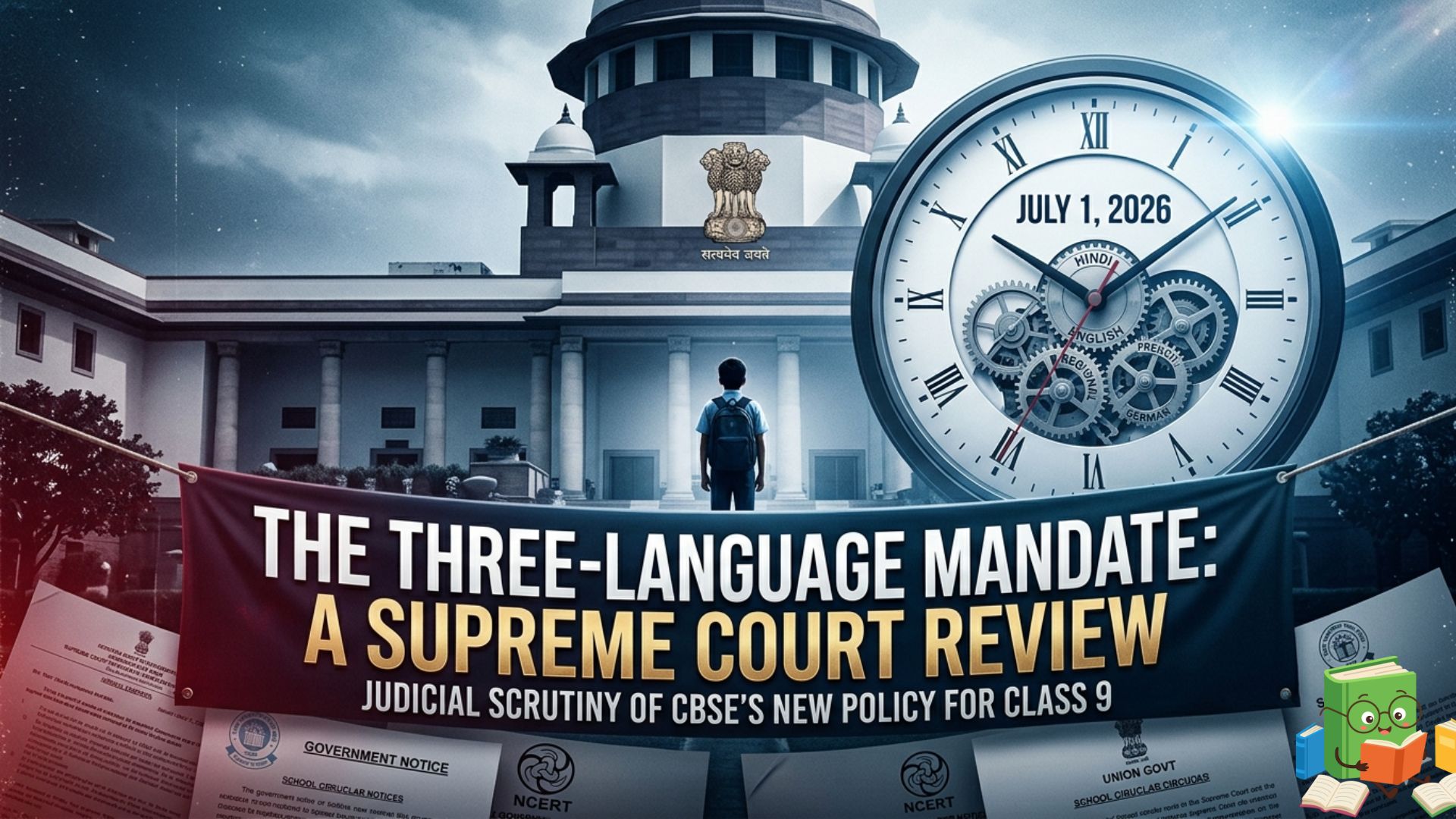
What is the three-language formula in Indian education, and why has its implementation through CBSE generated significant debate?
The three-language formula is an educational policy framework designed to promote multilingualism and national integration by encouraging students to learn three languages during their school education. It was originally recommended by the Kothari Commission (1964-66) and later incorporated into the National Policy on Education, 1968. Under the recent CBSE directive aligned with the National Education Policy (NEP) 2020 and the National Curriculum Framework for School Education (NCF-SE) 2023, Class 9 students are required to study three languages, with at least two being Indian languages. Foreign languages may be offered only under specified conditions.
The controversy arises from concerns regarding educational autonomy, constitutional rights, administrative preparedness, and federalism. Critics argue that language learning should remain a matter of personal choice rather than state-imposed policy. Petitioners before the Supreme Court have contended that the NEP 2020 itself guarantees flexibility and explicitly states that no language shall be imposed on any student or State. Questions have also been raised regarding whether CBSE, as an executive educational body, possesses the authority to impose such a significant mandate without explicit parliamentary legislation.
From an implementation perspective, schools have reported shortages of trained language teachers, inadequate textbooks, and curriculum challenges. Parents and educators fear increased academic pressure on students preparing for Board examinations. The debate also reflects broader issues in Indian polity, including linguistic diversity, cultural identity, federal relations, and educational governance. For UPSC aspirants, the issue is relevant to GS-II topics such as education policy, constitutional governance, cooperative federalism, and the role of institutions in balancing national objectives with regional sensitivities.
Why is the Supreme Court’s intervention in the CBSE three-language formula case important for educational governance and constitutional accountability?
The Supreme Court's intervention is significant because it highlights the judiciary's role in ensuring constitutional accountability, administrative fairness, and protection of citizens' rights. By seeking detailed reports from the Union Government, CBSE, and NCERT regarding their logistical preparedness, the Court has emphasized that educational reforms must be implemented through due process and practical planning rather than abrupt administrative directives.
The Court's decision not to grant an immediate stay while simultaneously acknowledging concerns about hardship and inconvenience demonstrates judicial balance. It allows policy implementation to be examined on constitutional, legal, and administrative grounds without prematurely halting government action. Such an approach reflects the principle of judicial review, a cornerstone of India's constitutional framework.
The case raises important constitutional questions relating to Articles 14, 19, 21A, and the broader federal structure. Petitioners argue that language choice is linked to individual liberty and educational freedom. There is also debate regarding whether executive policies such as the NEP 2020 can serve as the basis for mandatory educational requirements without legislative backing.
From a governance perspective, the case underscores the importance of stakeholder consultation involving students, parents, teachers, and state governments. Educational reforms affect millions of learners and therefore require adequate infrastructure, teacher training, curriculum support, and transition mechanisms.
For UPSC aspirants, this case illustrates the interaction between the executive, judiciary, and educational institutions. It also connects with GS-II themes such as constitutional governance, judicial activism versus judicial restraint, public policy implementation, and accountability mechanisms. The outcome may establish important precedents regarding educational policymaking, administrative powers, and the limits of executive authority in India.
How does the National Education Policy 2020 approach language education, and what challenges arise in translating policy objectives into practice?
The National Education Policy (NEP) 2020 emphasizes multilingualism as a means of improving cognitive development, cultural awareness, and educational outcomes. The policy encourages the learning of multiple languages, especially Indian languages, while simultaneously stressing flexibility, student choice, and respect for India's linguistic diversity. NEP 2020 also states that no language shall be imposed on any student or State, reflecting India's pluralistic character.
In theory, multilingual education can strengthen communication skills, preserve linguistic heritage, and promote national integration. Research by UNESCO and various educational institutions suggests that multilingual learners often demonstrate stronger cognitive flexibility and problem-solving abilities. India's linguistic diversity, with 22 scheduled languages and hundreds of regional languages, makes multilingual education particularly relevant.
However, implementation challenges are substantial. The recent CBSE directive has exposed issues such as shortages of qualified language teachers, lack of standardized teaching materials, curriculum restructuring difficulties, and insufficient preparation time for schools. Educational institutions require significant investments in teacher recruitment, training, and resource development before such reforms can be effectively implemented.
Another challenge involves balancing national objectives with regional aspirations. States have historically adopted different language policies based on local linguistic realities. Therefore, centrally driven reforms may encounter resistance if perceived as undermining regional autonomy.
For UPSC aspirants, this issue illustrates the gap between policy formulation and policy implementation, a recurring theme in governance studies. It is relevant to GS-II topics including education reforms, cooperative federalism, administrative capacity, and public service delivery. The debate demonstrates that successful policymaking depends not only on noble objectives but also on institutional readiness, stakeholder acceptance, and practical feasibility.
Critically analyze the constitutional and federal dimensions of the debate surrounding the mandatory three-language formula in CBSE schools.
The debate surrounding the mandatory three-language formula extends beyond education and touches upon fundamental constitutional and federal questions. India's Constitution recognizes linguistic diversity as a core feature of its democratic framework. While the Constitution promotes the development of Hindi and other Indian languages, it simultaneously protects linguistic minorities and respects the federal distribution of powers.
One constitutional issue concerns whether language learning can be mandated without infringing upon individual choice and educational freedom. Critics argue that compelling students to study particular languages may conflict with principles of liberty and autonomy. Supporters, however, contend that reasonable educational requirements are common across school systems and serve legitimate national objectives.
Another significant question involves the authority of executive institutions. Petitioners argue that CBSE lacks independent legislative authority to impose sweeping educational mandates solely on the basis of executive policy documents such as the NEP 2020. This raises broader concerns about the distinction between policy intentions and legally enforceable obligations.
The federal dimension is equally important. Education appears in the Concurrent List following the 42nd Constitutional Amendment of 1976, enabling both the Union and States to legislate. However, language remains deeply tied to regional identity and political culture. Several states have historically opposed perceived linguistic centralization, viewing it as inconsistent with cooperative federalism.
Supporters of the three-language formula argue that multilingual education promotes national integration, mobility, and cultural understanding. Critics counter that implementation without adequate consultation may undermine trust between the Centre and States.
For UPSC preparation, this debate is relevant to GS-II topics such as federalism, constitutional governance, Centre-State relations, and educational administration. It highlights the challenge of balancing national cohesion with regional diversity, a recurring theme in India's democratic development.
What are the major reasons behind stakeholder opposition to the immediate implementation of the three-language mandate from July 2026?
Stakeholder opposition to the immediate implementation of the three-language mandate stems from a combination of pedagogical, administrative, legal, and political concerns. One of the most frequently cited reasons is the suddenness of the policy shift. CBSE had reportedly indicated earlier that implementation would be deferred until the 2029-30 academic year, leading schools and families to plan accordingly. The abrupt acceleration has created uncertainty and confusion.
Parents are concerned about the additional academic burden on students, particularly those entering Classes 9 and 10, which are critical years for Board examination preparation. Even though the third language may be assessed through internal evaluation rather than a Board examination, students must still devote time and effort to learning it.
Teachers and school administrators have highlighted practical challenges. Many schools lack qualified language instructors, especially for less commonly taught Indian languages. There are also concerns regarding textbook availability, curriculum design, teacher training, and assessment frameworks. Implementing a large-scale educational reform without adequate preparation risks compromising educational quality.
Legal objections constitute another major factor. Petitioners argue that language choice should remain voluntary and that CBSE may have exceeded its authority by imposing the requirement through administrative circulars. Questions regarding consistency with NEP 2020's promise of flexibility have further intensified the debate.
Political and cultural concerns also play a role. Language has historically been a sensitive issue in India, linked to identity, regional pride, and federal relations. Policies perceived as imposing linguistic preferences often attract resistance.
For UPSC aspirants, these reasons demonstrate the importance of stakeholder analysis in public policy. Effective governance requires balancing policy objectives with administrative feasibility, legal validity, and public acceptance. The issue provides valuable insights into educational governance, democratic consultation, and implementation challenges.
What lessons can policymakers learn from the CBSE three-language formula controversy as a case study in educational policy implementation?
The CBSE three-language formula controversy serves as an important case study in educational policy implementation and offers several lessons for policymakers. First, it demonstrates that successful reforms require adequate planning, institutional preparedness, and stakeholder consultation. Even well-intentioned policies can face resistance if implementation appears rushed or inadequately supported.
Second, the case highlights the importance of administrative capacity. Educational reforms affecting millions of students require trained teachers, learning materials, assessment systems, and clear operational guidelines. Without these foundational elements, policy objectives may remain unrealized. Reports of teacher shortages and textbook constraints indicate the risks of launching reforms before infrastructure is fully prepared.
Third, the controversy underscores the significance of communication and transparency. Policy reversals or sudden changes can undermine public trust. Consistent messaging and phased implementation strategies are essential for ensuring stakeholder confidence and cooperation.
Fourth, the case illustrates the need to align policy implementation with constitutional principles and legal frameworks. Educational authorities must ensure that administrative actions remain within their statutory powers and are consistent with constitutional values such as federalism, equality, and individual rights.
Fifth, the dispute demonstrates the value of judicial oversight in democratic governance. Courts can act as institutional safeguards by reviewing whether reforms are legally valid, procedurally fair, and practically feasible.
From a UPSC perspective, this case study connects with GS-II topics including governance, public policy, education reforms, judicial review, and Centre-State relations. It also offers broader lessons applicable across sectors: stakeholder engagement, evidence-based policymaking, administrative readiness, and constitutional compliance are essential ingredients for effective governance. The controversy reminds policymakers that implementation is often as important as policy design itself.