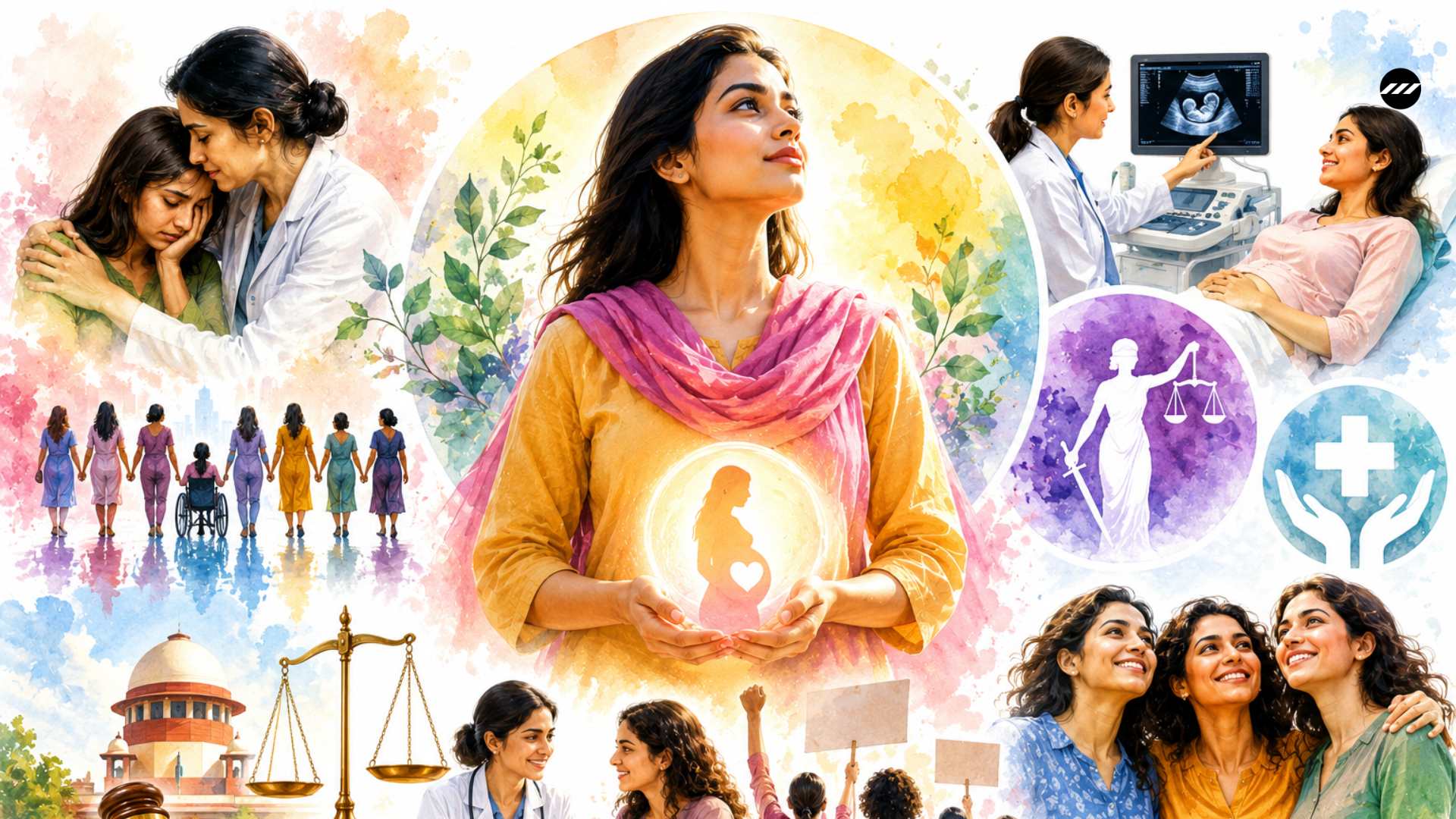
Amending Abortion Law for Minor Rape Victims: A Call for Change

Introduction
"India's abortion laws occupy a paradoxical space — liberal on paper, restrictive in practice. "
With over 1,000 court petitions filed in the last decade by women seeking pregnancy termination beyond legal limits, the gap between statutory intent and ground reality demands urgent examination for any student of governance, rights, and public health.
The Legal Framework: Two Parallel Laws
India's abortion regime is governed by two overlapping instruments:
- Sections 88–94, Bharatiya Nyaya Sanhita (BNS) — criminalises abortion by default
- Medical Termination of Pregnancy (MTP) Act, 1971 — carves out a conditional exception
"Abortion in India is legal based on certain circumstances and conditions... it is a conditional, qualified framework." — Dipika Jain
MTP Amendment 2021 — What Changed, Simply Put:
-
Before 2021, abortions were legally allowed only up to 20 weeks — and only for married women in most practical interpretations
-
After 2021, the time limit was extended to 24 weeks — meaning a pregnant person has 4 extra weeks to decide and access services
-
"Special categories" who get this 24-week window:
- Rape survivors
- Minors
- Women with disabilities
- Those whose marital status changed during pregnancy (widowed, divorced)
-
Unmarried women included — before this, the law's language implicitly assumed only married women sought abortions; the amendment fixed this gap
-
Transgender persons covered — anyone who can become pregnant, regardless of gender identity, is now within the law's protection
-
Supreme Court 2022 went one step further — said the decision to terminate ultimately belongs to the pregnant person, not the doctor or the government; this is called decisional autonomy and is protected under Article 21 (Right to Life and Personal Liberty)
20 weeks vs 24 weeks — What it actually means:
A pregnancy is counted in weeks from the last menstrual period. Full term is around 40 weeks.
Why the extra 4 weeks matters:
- 20 weeks = roughly 4.5 months into pregnancy
- 24 weeks = roughly 6 months into pregnancy
That 4-week gap sounds small but is critical in real life:
- A rape survivor may take weeks to process trauma before she can even think about pregnancy
- A minor often doesn't realise she is pregnant until 3–4 months in
- A woman in a remote area may need weeks just to travel to a certified facility
- A foetal anomaly (birth defect) is often only detectable around 18–20 weeks via detailed ultrasound — leaving almost no time under the old 20-week limit to decide and act
So under the old law:
Anomaly detected at 19 weeks
+ travel time + doctor approval needed
= already past 20 weeks → legally stuck
= forced to go to court or carry the pregnancy
Under the new law:
Anomaly detected at 19 weeks
+ 5 weeks remaining within legal limit
= enough time to process, decide, access services
Bottom line: 20 weeks was a cliff edge. 24 weeks is a more humane window — recognising that real life doesn't move at legal speed.
Why Women Still Approach Courts
Despite progressive judicial pronouncements, structural barriers persist:
- Doctor-centric decision-making — law vests authority in providers, not pregnant persons
- Shortage of certified providers especially for later-gestation cases requiring complex procedures
- Husband's consent sought informally despite no legal mandate
- Stigma and criminalisation fear — providers avoid late-term cases to escape prosecution
Example: In 2021, a doctor in Meghalaya was jailed for a month
for a termination he did not even perform — illustrating how
criminalisation creates a chilling effect on providers.
The result: women who cannot access timely services are forced into unsafe alternatives — the exact outcome the MTP Act was designed to prevent.
The Time Limit Problem
The MTP Act sets a 24-week outer limit, with only two exceptions — substantial foetal anomaly (certified by a medical board) and risk to the pregnant person's life. This rigid ceiling fails to account for:
- Survivors of sexual assault who report late due to trauma and stigma
- Minors and adolescents who often don't recognise pregnancy until late stages
- Women with restricted mobility — geographic, economic, or social
"Delayed access is not out of choice but because institutions, family structures, violence prevent them from timely access. This kind of time limit actually perpetuates the violence which they are subjected to." — Alka Barua
The ask from experts: replace statutory cut-offs with clinical judgment — if a termination can be safely performed, it should be permitted.
POCSO Complications
Section 19 of the POCSO Act mandates reporting of child sexual abuse cases. When a minor seeks abortion, the doctor is obligated to report — effectively deterring minors from seeking services for fear of exposing the partner to statutory rape charges.
Scenario: A 16-year-old in a consensual relationship
seeks termination. Mandatory reporting means the 17-year-old
partner faces prosecution for statutory rape.
Result: The minor avoids hospitals and seeks unsafe alternatives.
The Supreme Court (2022) harmonised POCSO with MTP — allowing minors to access services without identity disclosure. But protocols have not been updated at facility level, and without Ministry of Health directives, providers remain wary.
The Case for Delinking from Criminal Law
The core argument: criminalisation is incompatible with a healthcare framework.
- Creates fear-driven refusals by providers
- Socially stigmatises abortion seekers
- Pushes women toward unsafe providers
Many countries offer abortion on demand for early-term pregnancies — treating it as a healthcare decision, not a criminal exception. India's Supreme Court has itself acknowledged decisional autonomy as fundamental, yet the law remains condition-laden.
"If a pregnant person decides to terminate, why should the State impose so many conditions? Why can't it be based on decisional autonomy and on demand?" — Dipika Jain
The 'Good' vs. 'Bad' Abortion Problem
Courts tend to permit terminations more readily in cases of foetal anomaly or rape — deemed "morally justifiable." Cases involving married women with children, or socioeconomic distress, face stricter scrutiny — creating a judicial hierarchy of acceptable abortions with no basis in law or medicine.
Way Forward
- Delink abortion from criminal law → shift to a reproductive justice, rights-based healthcare framework
- Remove rigid gestational limits → replace with clinical assessment protocols
- Mandatory referral obligation → individual provider refusal must not result in denial of access
- Updated facility protocols in sync with Supreme Court rulings
- Awareness programmes for providers, enforcers, and service seekers on legal entitlements
Conclusion
The MTP Act was born out of a public health imperative — to prevent maternal deaths from unsafe abortions. Fifty years on, its implementation has drifted from that intent. Harmonising legal text with lived reality requires not just judicial pronouncements but administrative action, provider training, and above all, a decisive shift from conditional tolerance to rights-based access.
Attribution
Original content sources and authors


Syllabus classification
How this article maps to GS papers
Main syllabus
GS2Government PoliciesQuick Q&A
What is the legal framework governing abortion in India, and how has it evolved over time?
The legal framework has evolved gradually toward recognising reproductive autonomy. The 2021 amendments to the MTP Act extended the upper gestational limit for certain categories of women from 20 to 24 weeks and expanded access for unmarried women. Subsequently, the 2022 Supreme Court judgment recognised reproductive decisional autonomy as part of the fundamental right to dignity, privacy, and bodily integrity under Article 21. The Court also clarified that unmarried women and transgender persons are entitled to access abortion services under the law.
However, several structural limitations remain:
- The law continues to place decision-making authority substantially in the hands of doctors
- Abortions beyond statutory limits often require judicial intervention or medical board approval
- Fear of criminal prosecution creates hesitation among healthcare providers
- Ground-level implementation remains inconsistent across States
The debate today is increasingly shifting from a medical-permission model toward a rights-based reproductive justice framework. Critics argue that as long as abortion is linked to criminal law, stigma and barriers to access will continue. Thus, India’s abortion jurisprudence reflects an ongoing tension between State regulation, medical gatekeeping, and constitutional rights.
Why are many pregnant persons approaching courts for permission to terminate pregnancies in India?
One major reason is the delay in accessing healthcare services. Survivors of rape, adolescents, and women in vulnerable social conditions often discover pregnancies late due to trauma, lack of awareness, restricted mobility, or fear of stigma. By the time they approach healthcare providers, they may have crossed the statutory gestational limit. Since the law permits exceptions only under narrow circumstances, many are compelled to file petitions before High Courts or the Supreme Court.
Other reasons contributing to court interventions include:
- Doctors’ fear of criminal prosecution under the BNS, POCSO, and PCPNDT laws
- Lack of clarity regarding legal obligations and documentation requirements
- Inadequate availability of trained providers and equipped facilities
- Social stigma associated with unmarried pregnancies or adolescent pregnancies
- Absence of uniform interpretation of abortion laws by courts and hospitals
The judiciary itself has delivered varying judgments depending on the facts of individual cases. Courts are often more sympathetic in cases involving foetal abnormalities or rape survivors, while other categories may face stricter scrutiny. This creates what scholars describe as a distinction between “acceptable” and “unacceptable” abortions.
The phenomenon highlights a deeper governance issue: reproductive healthcare is becoming excessively judicialised. Access to abortion should ideally be a healthcare decision based on safety and consent, not prolonged litigation. Frequent court involvement indicates inadequacies in public health systems, legal clarity, and rights-based implementation of reproductive laws.
Critically analyse the debate on removing gestational limits for abortion in India.
Supporters of removing or relaxing gestational limits argue that clinical safety, not arbitrary timelines, should guide abortion decisions. Cases involving rape survivors, minors, mental health crises, and late discovery of pregnancy often arise after the legal limit has expired. Delays are frequently caused by trauma, social stigma, family pressure, or institutional barriers rather than deliberate choice. In such situations, forcing continuation of pregnancy may violate bodily autonomy and mental well-being.
Arguments in favour of flexibility include:
- Recognition of reproductive decisional autonomy under Article 21
- Reduction in unsafe abortions and maternal mortality
- Accommodation of exceptional social and medical circumstances
- Alignment with global trends toward abortion on request in early stages
However, critics raise concerns regarding late-term abortion ethics and medical complications. As pregnancy advances, procedures become medically more complex and may require specialised facilities and expertise. There are also moral and legal debates regarding foetal rights and viability. Some fear that unrestricted access without safeguards may create regulatory challenges in a country with uneven healthcare infrastructure.
A balanced approach may involve replacing rigid legal cut-offs with case-specific clinical assessments. Experts suggest empowering trained medical professionals to make evidence-based decisions while ensuring accountability and informed consent. Simultaneously, investments in early pregnancy detection, reproductive education, and accessible healthcare can reduce delays.
Ultimately, the debate reflects a broader transition from a paternalistic legal framework toward a rights-based reproductive healthcare system. The challenge lies in designing laws that protect autonomy while maintaining ethical and medical safeguards.
How does the criminalisation of abortion affect healthcare providers and access to safe abortion services?
Healthcare providers often worry about legal liability, police involvement, and professional repercussions. The burden of proving compliance with legal conditions rests heavily on doctors. Cases involving minors, rape survivors, or pregnancies close to gestational limits become especially sensitive because they may trigger obligations under other laws such as POCSO and the PCPNDT Act. The arrest of a doctor in Meghalaya in 2021, despite allegations that he had not even conducted the abortion, intensified fears within the medical community.
The consequences of criminalisation include:
- Reluctance among doctors to perform abortions, especially later-term procedures
- Demand for unnecessary permissions such as husband’s or parents’ consent
- Refusal of services due to fear of prosecution
- Increased delays that push pregnancies beyond legal limits
- Growth of unsafe and unregulated abortion practices
This environment particularly harms vulnerable groups such as adolescents, unmarried women, rural populations, and economically weaker sections. When safe and legal services are inaccessible, many resort to unsafe methods, undermining the original purpose of the MTP Act, which was enacted to reduce maternal deaths from unsafe abortions.
Critics therefore advocate for a shift toward a rights-based healthcare framework where abortion is treated primarily as a medical and constitutional issue rather than a criminal matter. Such reforms could include decriminalisation, clearer medical protocols, provider protection mechanisms, and mandatory referral systems where individual doctors object on personal grounds.
The issue demonstrates how criminal law can indirectly undermine public health objectives. Effective reproductive healthcare requires trust, confidentiality, medical clarity, and accessibility rather than fear-driven regulation.
Why is there tension between the POCSO Act and the Medical Termination of Pregnancy (MTP) Act?
For example, if a pregnant adolescent approaches a hospital for termination, the doctor is legally required to report the case under POCSO. In many situations involving consensual adolescent relationships, this mandatory reporting may expose the partner to prosecution for statutory rape. Consequently, minors may avoid hospitals out of fear of police involvement, family backlash, or social stigma. This often delays access to care until pregnancies advance beyond legal limits.
The conflict creates several practical problems:
- Reduced willingness among minors to seek timely medical assistance
- Increased unsafe abortions outside formal healthcare systems
- Fear and confusion among healthcare providers
- Violation of confidentiality and privacy concerns
- Excessive judicial intervention in sensitive cases
In 2022, the Supreme Court attempted to harmonise both laws by permitting minors to access abortion services without public disclosure of their identities. However, implementation challenges remain because many hospitals and local authorities continue to follow older protocols. Ground-level awareness among police officials, doctors, and administrators remains inadequate.
The issue reveals the broader challenge of balancing child protection with reproductive autonomy and healthcare access. While the State has a legitimate interest in preventing sexual abuse, rigid enforcement mechanisms can unintentionally discourage vulnerable adolescents from accessing safe healthcare services.
A more balanced approach could include confidential reporting mechanisms, adolescent-friendly reproductive healthcare services, clearer medical protocols, and better coordination between legal and health systems. The goal should be to ensure both protection from exploitation and access to safe, non-judgmental healthcare.
How do international approaches to abortion rights influence the debate on reproductive autonomy in India?
Countries such as Canada, several European nations, and parts of Latin America have adopted more liberal approaches that prioritise decisional autonomy, privacy, and healthcare access. These systems generally reduce bureaucratic barriers and focus on ensuring safe medical procedures rather than criminal penalties. Advocates in India argue that such models reduce unsafe abortions, improve maternal health outcomes, and treat reproductive healthcare as a constitutional entitlement.
The international experience offers several lessons:
- Decriminalisation can reduce stigma and fear among healthcare providers
- Accessible abortion services lower maternal mortality rates
- Comprehensive reproductive education improves early healthcare seeking
- Rights-based approaches strengthen gender equality and bodily autonomy
At the same time, India’s situation differs because of its socio-economic diversity, healthcare infrastructure gaps, and complex legal environment. Rural-urban disparities, social conservatism, and shortage of trained providers pose implementation challenges. Therefore, simply copying foreign models may not be feasible without adapting them to Indian realities.
The Indian Supreme Court’s recognition of reproductive decisional autonomy under Article 21 indicates movement toward global constitutional trends. However, the continued linkage of abortion with criminal law limits practical realisation of these rights. Experts argue that if reproductive autonomy is constitutionally protected, the law should reflect that principle consistently in practice.
The debate ultimately concerns whether abortion should be viewed primarily as a matter of State control and criminal regulation or as an essential component of healthcare, dignity, and gender justice. International experiences provide valuable policy lessons, but India’s reforms must remain sensitive to local social and institutional realities.
Suppose you are a district health officer handling a case where a 17-year-old rape survivor seeks termination beyond the statutory limit. How would you balance legal obligations, medical ethics, and reproductive rights?
The case would require coordination among medical experts, legal authorities, child welfare institutions, and psychological support services. Since the pregnancy exceeds the statutory limit, a specialised medical board should assess whether termination can be performed safely without endangering the survivor’s life or health. Simultaneously, confidentiality protections must be strictly maintained in line with Supreme Court guidance.
The response framework should include:
- Immediate medical examination and risk assessment
- Psychological counselling and informed consent procedures
- Confidential compliance with POCSO reporting obligations
- Fast-track legal coordination to avoid procedural delays
- Referral to specialised healthcare facilities if required
Ethically, forcing continuation of pregnancy in such circumstances may deepen trauma and violate dignity and bodily autonomy. Therefore, decision-making should prioritise the survivor’s best interests while relying on scientific medical opinion rather than rigid procedural formalism.
At the administrative level, this case also reveals systemic deficiencies. Delayed reporting, stigma, lack of awareness, and institutional hesitation often push vulnerable individuals into prolonged litigation. District authorities should therefore strengthen adolescent reproductive health awareness, improve access to counselling services, and sensitise healthcare workers regarding legal entitlements.
The case highlights the need for a rights-based and survivor-centric reproductive healthcare framework. Effective governance in such situations requires empathy, confidentiality, legal clarity, and institutional coordination. For UPSC interviews, this scenario demonstrates the importance of balancing constitutional morality, public health administration, and child protection laws in real-life governance.
Practice questions
1 question for mains preparation