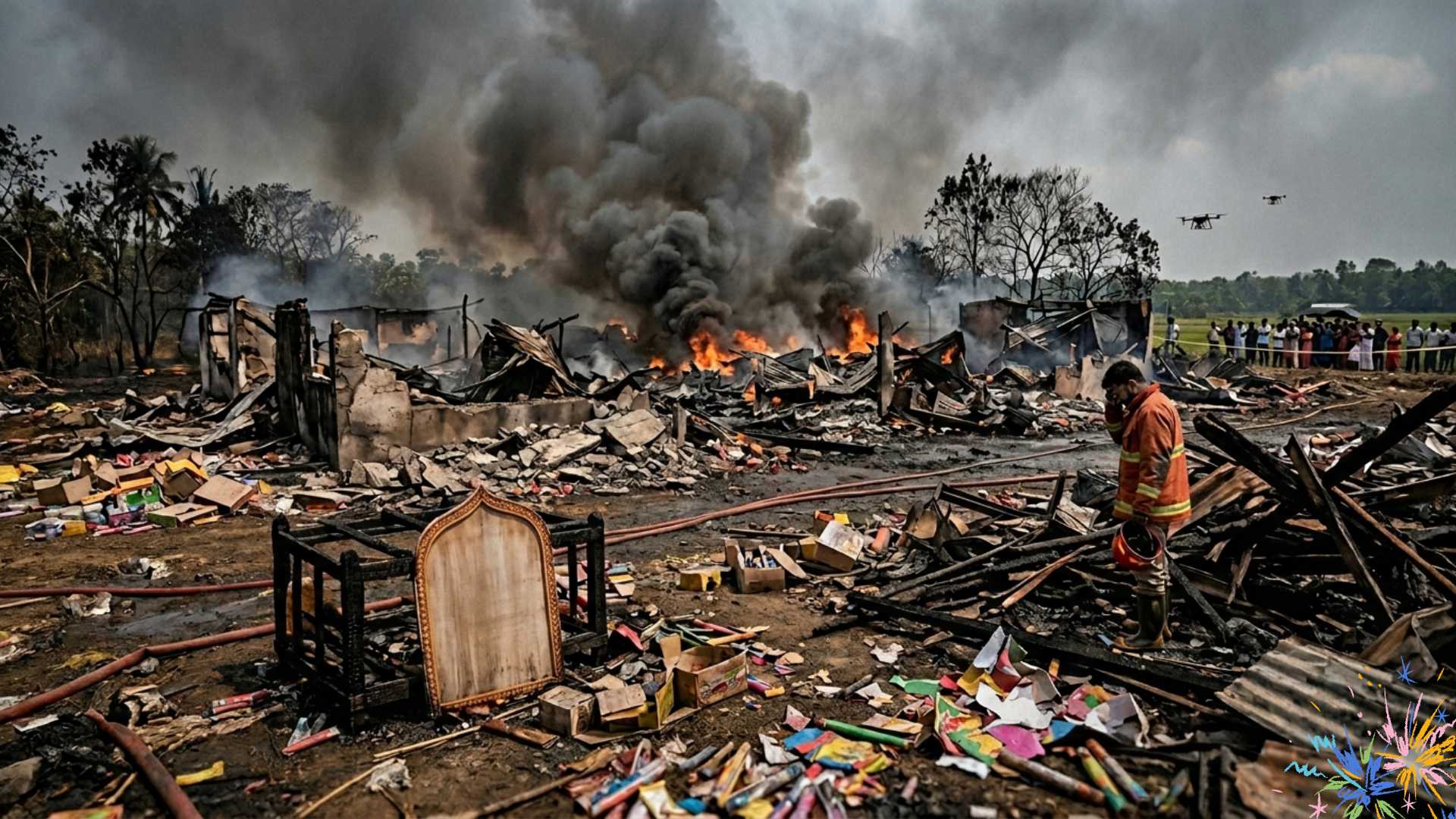
Tragic Fireworks Blast in Kerala Claims 13 Lives

"The recurring nature of fireworks tragedies in India points not to accidents but to systemic regulatory failure — licensing without monitoring is permission without responsibility." — National Disaster Management Authority (NDMA) Report on Industrial Accidents
Two major fireworks explosions within 48 hours — 25 killed in Virudhunagar, Tamil Nadu (April 20) and 13 killed in Thrissur, Kerala (April 22) — have brought India's fireworks manufacturing safety framework under sharp scrutiny. India is the world's third-largest fireworks producer, with Tamil Nadu alone accounting for over 80% of domestic output, yet regulatory enforcement remains chronically weak.
Background / Context
India's fireworks industry is concentrated in a few clusters — Sivakasi (Tamil Nadu), Kolkata (West Bengal), and Bareilley (UP). Sivakasi alone houses 800+ licensed units employing over 3 lakh workers, many of them daily wage labourers with minimal safety training.
Fireworks manufacturing involves highly volatile chemicals — potassium nitrate, aluminium powder, sulphur — in confined shed environments. Combination of heat, friction, and improper storage regularly produces catastrophic chain explosions, as seen in both the Virudhunagar and Thrissur incidents.
Key Concepts / Definitions
Explosives Act, 1884 Primary legislation governing manufacture, possession, use, and sale of explosives including fireworks. Administered by the Petroleum and Explosives Safety Organisation (PESO) under DPIIT.
PESO (Petroleum and Explosives Safety Organisation) Central licensing authority for explosive manufacturing units. Issues licences, conducts inspections, and enforces the Explosives Rules, 2008.
Explosives Rules, 2008 Governs: shed construction standards, inter-shed distances, quantity limits per shed, worker safety norms, and storage protocols for explosive materials.
Magisterial Inquiry District-level executive inquiry ordered by District Collector. Conducted by SDM/RDO. Examines cause, liability, and administrative lapses. ≠ replaces police/CBI investigation.
What Went Wrong — Thrissur Incident
| Factor | Detail |
|---|---|
| Location | 5-acre paddy field, Mundathikode near Thrissur |
| Trigger | Fire → chain explosions across multiple sheds |
| Sheds affected | 5 of 8 gutted; 3 housed large explosive stockpiles |
| Casualties | 13 killed, 40+ injured (5 critical; burns 70–90%) |
| Rescue challenge | Continuous secondary blasts + narrow access roads |
| Licence status | Issued to Mundathikode Satheesh (among injured) |
| Investigation | Magisterial inquiry ordered by District Collector |
Regulatory Framework — Key Provisions
| Law / Body | Role |
|---|---|
| Explosives Act, 1884 | Primary legislation — manufacture to sale |
| Explosives Rules, 2008 | Technical safety standards for units |
| PESO | Central licensing + inspection authority |
| Factory Act, 1948 | Worker safety, working hours, hazardous process norms |
| NDMA Guidelines | Disaster response protocols for industrial accidents |
| State Fire Services | On-ground inspection + NOC for operations |
Analysis / Significance
Multi-Dimensional Impact
Safety & Regulatory: Licences are issued but monitoring is episodic — inspections happen at licensing stage, rarely during operations. Chain explosions indicate inter-shed distance violations and excess material storage — both detectable through routine checks.
Labour: Workers are predominantly daily wage, informal, low-literacy — with no meaningful safety training, no PPE enforcement, and no effective grievance mechanism. Fatalities disproportionately affect marginalised communities.
Economic: Fireworks industry supports 3+ lakh livelihoods in Sivakasi cluster alone. Over-regulation without support = industry goes underground. Under-regulation = repeat tragedies. Balance requires structured compliance + worker welfare.
Disaster Management: Both incidents exposed last-mile rescue failures — narrow roads, secondary blast risk, and absence of pre-positioned specialised response units near known hazardous industrial clusters.
SYSTEMIC FAILURE CHAIN
━━━━━━━━━━━━━━━━━━━━━━━━━━━━━━━━━━━━━━

Licence issued → Monitoring absent
       ↓
Excess material storage ↑ + Inter-shed distance ≠ maintained
       ↓
Heat / friction / spark → Primary explosion
       ↓
Chain reaction across sheds → Mass casualty
       ↓
Narrow access + secondary blasts → Rescue failure
       ↓
Magisterial inquiry → Report → No structural reform
       ↓
Next incident (cycle repeats)
Challenges / Issues
- Licence ≠ Compliance → PESO issues licences; field inspections are infrequent and understaffed ≠ real-time monitoring
- Quantity Violations → Rules prescribe maximum explosive quantity per shed; stockpiling for festival seasons routinely exceeds limits
- Informal Workforce → Workers = daily wage, unregistered ≠ covered under ESI/PF + no safety training mandate enforced
- Cluster Concentration Risk → Sivakasi model = high density of units in small geography → one incident triggers multiple
- Weather Factor → Extreme heat + dry conditions = elevated ignition risk; ≠ factored into seasonal operational advisories
- Rescue Infrastructure Gap → Specialised hazmat/explosives response units absent near industrial clusters; fire services ill-equipped for continuous blast scenarios
Government Response — Immediate & Institutional
| Level | Action |
|---|---|
| District (Thrissur) | Magisterial inquiry by SDM/RDO ordered |
| State (Kerala) | Health Minister directed specialised burn care; emergency hospital protocols |
| State Fire Force | Drones deployed for aerial damage assessment |
| NDMA framework | Standard operating procedures for industrial disasters |
| PESO | Expected to conduct post-incident licence review |
Way Forward
IMMEDIATE   → Mandatory post-incident PESO audit of ALL licensed units
              ≠ wait for next tragedy → proactive inspection surge

SHORT-TERM  → GPS-tagged inventory tracking per shed
              = Real-time quantity monitoring ≠ manual inspection only
              + Seasonal operational caps during high-heat months

MEDIUM-TERM → Worker registration mandate → ESI + safety training
              = Formalise informal workforce ≠ leave them unprotected
              + Specialised hazmat response units near industrial clusters

LONG-TERM   → Technology upgrade incentives → safer chemical substitutes
              + Cluster-level safety zones with buffer distances enforced
              + Independent third-party safety audits ≠ self-certification

STRUCTURAL  → Amend Explosives Act 1884 → modern industrial safety standards
              = 140-year-old law ≠ adequate for contemporary manufacturing scale
India cannot celebrate its cultural heritage through fireworks while tolerating the deaths of those who make them. Regulatory reform must move from reactive inquiry to proactive monitoring — every licence issued is a responsibility assumed, not merely a permission granted.
Attribution
Original content sources and authors


Syllabus classification
How this article maps to GS papers
Main syllabus
GS2Government PoliciesQuick Q&A
What are the key causes and characteristics of industrial disasters in fireworks manufacturing units in India?
Key characteristics of such disasters include:
- High casualty rates due to dense labour presence and poor evacuation systems
- Chain reactions of explosions due to clustered storage of chemicals
- Rapid spread of fire, often exacerbated by environmental conditions
Additionally, regulatory lapses such as weak enforcement of licensing norms, poor inspection mechanisms, and non-compliance with safety standards contribute significantly. Often, units operate in semi-rural areas with limited oversight, increasing vulnerability.
In conclusion, these disasters are not merely accidental but are systemic failures involving governance, infrastructure, and risk management. Addressing them requires a multi-pronged approach involving stricter regulation, technological upgrades, and worker training.
Why is ensuring safety in fireworks manufacturing units particularly important in the Indian context?
The importance can be understood through multiple dimensions:
- Human safety: Workers are often unskilled or semi-skilled and lack awareness of safety measures, making them highly vulnerable.
- Economic implications: Frequent accidents disrupt local economies dependent on fireworks industries, particularly in regions like Sivakasi.
- Governance credibility: Repeated incidents highlight regulatory inefficiencies and erode public trust in administration.
Moreover, these disasters also strain public health infrastructure, as seen in the need for emergency care, specialised burn treatment, and resource mobilisation in the Thrissur case.
Therefore, ensuring safety is not merely a regulatory requirement but a socio-economic necessity that impacts livelihoods, governance, and public welfare.
How can disaster response mechanisms be improved in high-risk industrial accidents like fireworks explosions?
Key improvements include:
- Use of technology: Deployment of drones, as seen in this case, helps in real-time assessment without risking human lives.
- Infrastructure planning: Wider access roads and proper layout design can facilitate quicker emergency response.
- Specialised training: Fire and rescue personnel should be trained specifically for chemical and explosive hazards.
Further, inter-agency coordination between fire services, police, medical teams, and district administration is crucial. Establishing standard operating procedures (SOPs) and conducting mock drills can enhance preparedness.
In addition, strengthening healthcare response through burn units, emergency ambulances, and trauma care systems is essential. A holistic approach combining prevention and response can significantly reduce fatalities and damage.
What are the underlying reasons for recurring accidents in fireworks industries despite existing regulations?
Major underlying reasons include:
- Weak enforcement: Inspections are often infrequent or superficial, allowing violations to go unnoticed.
- Economic pressures: Small-scale manufacturers prioritise cost-cutting over safety investments.
- Informal labour practices: Workers are often unregistered and lack formal training.
Additionally, geographical clustering of units, as seen in regions like Sivakasi and parts of Kerala, increases the risk of large-scale disasters due to proximity. Environmental factors like high temperatures may also exacerbate the volatility of chemicals, though their role requires scientific validation.
Ultimately, the persistence of such accidents reflects a gap between policy and practice. Strengthening accountability mechanisms and incentivising compliance are crucial to addressing this issue.
Critically analyse the role of regulatory authorities and governance in preventing such industrial disasters.
On the positive side:
- Authorities conduct licensing and periodic inspections
- Guidelines for storage and handling of explosives exist
- Post-disaster responses, such as magisterial inquiries, ensure accountability
However, critical limitations include:
- Regulatory capture and corruption, leading to compromised enforcement
- Resource constraints in inspection agencies
- Lack of real-time monitoring systems
The reliance on post-incident inquiries rather than preventive mechanisms reflects a reactive governance model. Moreover, coordination between central and state agencies often lacks clarity.
In conclusion, while the regulatory framework is robust on paper, its effectiveness depends on transparent implementation, technological integration, and accountability. Strengthening these aspects is essential for preventing future tragedies.
As a district administrator, how would you respond to and manage a fireworks factory explosion like the one in Thrissur?
Immediate actions would include:
- Establishing a command and control centre for coordination
- Evacuating nearby السكان and securing the area to prevent further casualties
- Using technology such as drones to assess damage and locate victims
Simultaneously, ensuring adequate medical response is critical. This includes mobilising ambulances, arranging specialised burn care, and coordinating with private hospitals if needed.
In the medium to long term:
- Ordering a magisterial inquiry to determine causes and accountability
- Providing compensation and rehabilitation for victims and families
- Reviewing safety compliance of similar units in the district
Effective communication with the public and media is also essential to prevent panic and misinformation. Overall, a balance of immediate response, transparent investigation, and systemic reform is necessary for comprehensive disaster management.
Practice questions
1 question for mains preparation