Understanding Industrial Accidents: Risks and Responsibilities
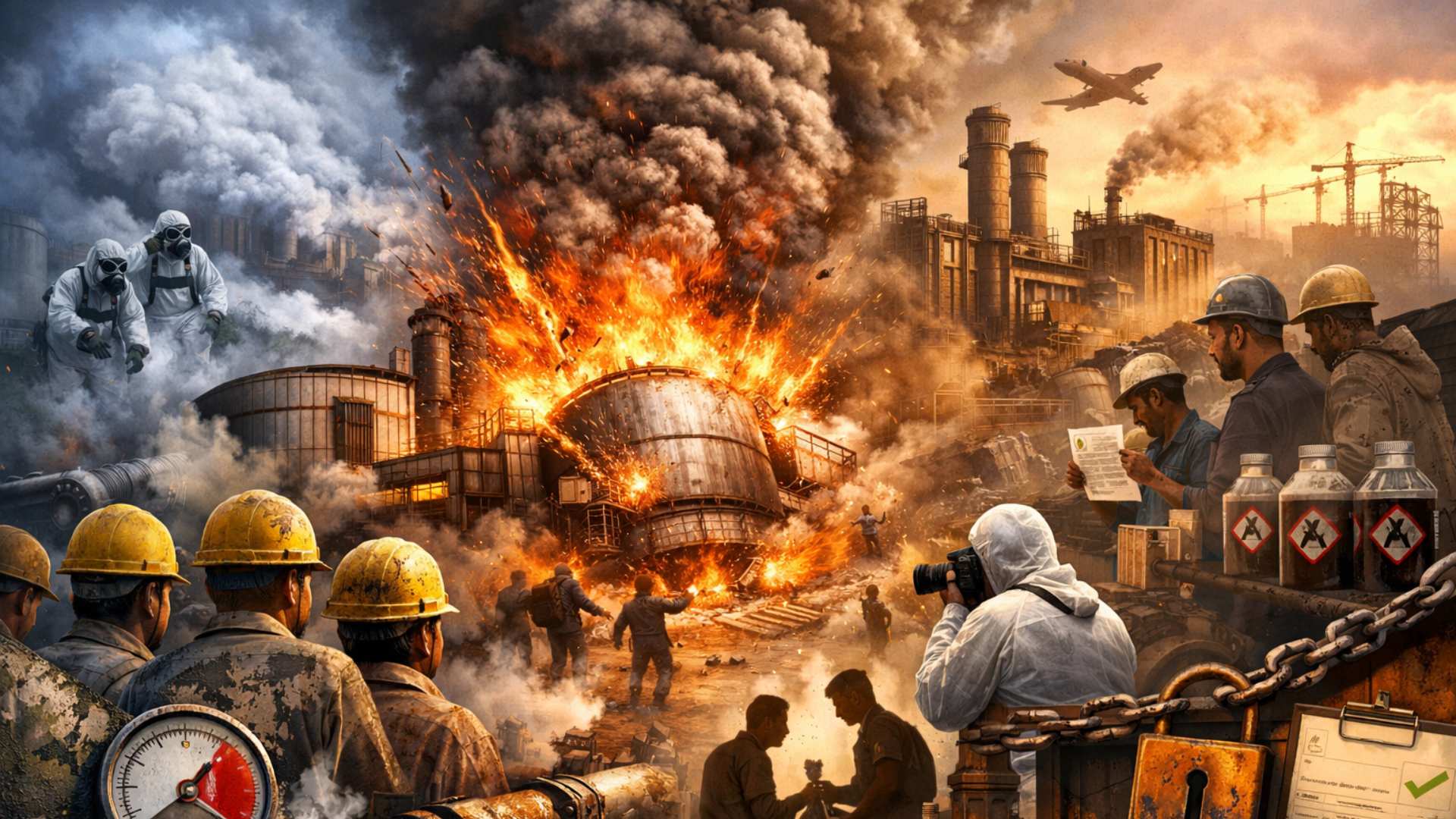
India's industrial sector employs over 50 million workers in registered factories, yet the country records hundreds of boiler accidents annually. The 2025 Sakti boiler explosion (20 dead) joins a grim pattern alongside the 2020 Visakhapatnam gas leak and the Neyveli thermal plant blast — all sharing a common thread: preventable failures amplified by regulatory gaps.
"Safety is not a gadget but a state of mind." — Eleanor Everet; a principle conspicuously absent in India's industrial governance framework.
| Incident | Year | Cause Pattern | Deaths |
|---|---|---|---|
| Visakhapatnam Gas Leak | 2020 | Post-lockdown restart; inactive safety systems | 12 |
| Neyveli Power Plant Blast | 2020 | Plant restart triggering pressure imbalance | 6 |
| Sakti Boiler Explosion | 2025 | Recent acquisition + commissioning + under-capacity ops | 20 |
| Sangareddy Explosions | 2024–25 | Chemical hazard unawareness among workers | Multiple |
Background and Context
Boiler failures are rarely sudden. Risk accumulates through overpressure, mineral scaling, mismanaged water levels, and revival stress — all time-dependent processes. The danger is highest during transitional phases: post-shutdown restarts, new commissioning, or sub-capacity operations, when transient thermal and pressure imbalances are most likely.
India's expanding industrial capacity is simultaneously pushing ageing infrastructure closer to operational limits, making flaws in management more consequential.
Key Concepts
Unstable Operating Regimes Plants recently acquired, freshly commissioned, or running below rated capacity face disproportionate failure risk. Thermal and pressure systems have not stabilised, yet no special oversight protocol applies during these windows.
Regulatory Architecture The Indian boiler inspection regime is governed by the Boilers Act, 1923, with inspection under respective State Boiler Directorates. Certificates remain valid for up to a year — a static standard applied to conditions that change daily.
OSHW Code 2020 The Occupational Safety, Health and Working Conditions Code (2020) consolidated 13 older labour laws but does not clearly establish criminal liability for principal employers when contractor-managed operations fail. Liability is qualified by proof of negligence — a high evidentiary bar.
Structural Gaps in the Regulatory Framework
| Gap | Impact |
|---|---|
| Annual certification cycle | Does not reflect daily variation in boiler conditions |
| Focus on fabrication standards | Ignores continuous instrumentation and live auditing |
| Self-certification + scheduled audits | Replaces surprise inspections; reduces deterrence |
| No heightened oversight during restart/commissioning | Highest-risk phases left unmonitored |
| Ease of doing business priority | Safety compliance traded off against procedural simplicity |
| Boiler Accident Inquiry Rules (2025) | Notified but structural gaps unaddressed yet |
Labour Vulnerability: The Contractor Shield
Contract labour constitutes a growing share of India's industrial workforce. This arrangement creates a diffusion of accountability that systematically disadvantages workers:
- Workers are hired through subcontractors who deflect blame to operators after disasters
- Safety manuals and hazard signage are often unavailable in workers' native languages
- Workers in the Pune industrial belt (post-2021) and Sangareddy (2024–25) were found to be unaware of the chemical names and properties present in their own workplaces
- Migrant workers, geographically isolated from their support networks, are the most exposed demographic
This is not incidental negligence — it is a structural feature of how industrial risk is distributed downward.
Governance and Policy Implications
- Ease of doing business vs. ease of dying at work: The Centre's regulatory rationalisation has consistently favoured industry compliance costs over worker safety outcomes.
- Incentive misalignment: The current framework penalises downtime rather than unsafe operations, disincentivising voluntary maintenance shutdowns.
- Data opacity: Boiler accident reporting is fragmented across states, preventing national-level pattern recognition.
- Chronic normalisation: These events may represent the visible surface of hazardous conditions workers have been exposed to for years, now receiving media and political attention as industrial expansion increases the frequency of catastrophic outcomes.
Conclusion
The Sakti explosion is not an outlier — it is evidence of a system that consistently prices worker safety below industrial output. Effective reform requires moving from periodic certification to continuous monitoring, from self-reporting to surprise auditing, and from ambiguous contractor liability to strict principal employer accountability. The Boiler Accident Inquiry Rules of 2025 offer an opening; unless they address these structural incentives directly, India's industrial accidents will remain, in the words of critics, not accidents at all — but predictable outcomes of policy choices.
Attribution
Original content sources and authors
Syllabus classification
How this article maps to GS papers
Main syllabus
GS2Government PoliciesQuick Q&A
What are the key engineering causes behind boiler explosions, and why are they rarely ‘sudden’ events?
- Overpressure: Excessive pressure buildup due to malfunctioning safety valves
- Scaling: Deposition of minerals on boiler walls reducing heat transfer efficiency
- Water level mismanagement: Low water levels can lead to overheating and structural failure
- Revival stress: Thermal stress during restart after shutdown
These factors rarely act in isolation. Instead, they interact over time, weakening the system until a triggering event—such as a restart or load fluctuation—causes catastrophic failure. For instance, the Sakti boiler explosion and similar incidents like Neyveli (2020) demonstrate how restart conditions can destabilise already compromised systems.
Thus, the notion of ‘accidental’ explosions is misleading. Most incidents are predictable outcomes of ignored warning signs and inadequate monitoring. This highlights the importance of continuous inspection and real-time instrumentation rather than periodic certification. Understanding these engineering realities is essential for designing effective safety and regulatory frameworks.
Why do industrial accidents like boiler explosions continue to occur despite regulatory frameworks in India?
Key systemic issues include:
- Periodic certification: Boiler inspections are valid for up to a year, despite daily variations in operating conditions
- Focus on compliance over safety: Emphasis on documentation and fabrication standards rather than real-time monitoring
- Self-certification and reduced inspections: Policies promoting ease of doing business have limited surprise government checks
- Incentive distortions: Firms are penalised for downtime rather than unsafe operations, discouraging preventive shutdowns
For example, incidents like the Visakhapatnam gas leak (2020) and Neyveli explosion (2020) revealed lapses in safety systems during restart phases, which were not adequately regulated. Similarly, the Sakti explosion occurred under unstable operating conditions that were not subject to heightened scrutiny.
Therefore, the issue is not the absence of regulation but its design and implementation. A shift is needed from static, compliance-based frameworks to dynamic, risk-based oversight that prioritises continuous safety assurance. Without addressing these structural gaps, accidents will continue to be treated as isolated events rather than systemic failures.
How do operational conditions such as plant restarts and under-capacity functioning increase the risk of industrial accidents?
Key risk factors during such phases include:
- Thermal imbalances: Rapid heating or cooling can induce stress in boiler materials
- Pressure fluctuations: Inconsistent load conditions can destabilise pressure control systems
- Inactive safety systems: Equipment may not be fully calibrated after shutdowns
- Human error: Restart procedures often involve complex manual interventions
For instance, the Visakhapatnam gas leak occurred after a post-lockdown restart, while the Neyveli explosion was triggered during a restart process. Similarly, the Sakti plant was operating below full capacity, a condition that can lead to inefficient and unpredictable system behaviour.
These examples highlight the need for enhanced regulatory oversight during transitional phases. Currently, inspection regimes do not differentiate between stable and unstable operating conditions. Introducing phase-specific safety protocols and real-time monitoring can significantly reduce risks. Thus, understanding operational dynamics is crucial for preventing industrial disasters.
Critically analyse the impact of ‘ease of doing business’ reforms on industrial safety in India.
Positive aspects include:
- Reduced compliance burden for industries
- Faster approvals and operational flexibility
- Encouragement of private sector participation
Key concerns include:
- Self-certification: Firms are allowed to assess their own compliance, leading to potential conflicts of interest
- Reduced inspections: Replacement of surprise checks with scheduled audits reduces deterrence
- Neglect of real-time safety: Focus remains on documentation rather than actual operational safety
For example, the Sakti boiler explosion and similar incidents reveal how inadequate oversight during critical phases can lead to catastrophic outcomes. The emphasis on minimising downtime also discourages preventive maintenance.
Thus, while ease of doing business is important for economic growth, it must be balanced with robust safety mechanisms. A hybrid approach combining regulatory flexibility with strict, technology-driven monitoring and accountability is essential to ensure sustainable industrial development.
What are the underlying labour-related factors contributing to industrial accidents in India?
Key contributing factors include:
- Contractualisation of labour: Workers are hired through subcontractors, diluting accountability
- Lack of awareness: Many workers are unaware of the chemicals or processes they handle
- Language barriers: Safety manuals and signage are often not available in workers’ native languages
- Weak legal liability: The OSHW Code 2020 does not clearly fix criminal liability on principal employers
Investigations in industrial belts like Pune and incidents in Sangareddy have shown that workers often lack basic knowledge of workplace hazards. This significantly increases the likelihood of human error and reduces the effectiveness of safety protocols.
These issues reflect deeper structural problems in India’s labour governance. Without addressing worker vulnerability and ensuring clear accountability, safety measures will remain ineffective. Strengthening labour rights, improving training, and enforcing stricter liability norms are essential steps toward reducing industrial accidents.
Using the Sakti boiler explosion as a case study, analyse the systemic gaps in India’s industrial safety framework.
Key observations from the case include:
- Unstable operating conditions: The plant was recently commissioned and operating below full capacity
- Inadequate oversight: No additional scrutiny during high-risk operational phases
- Regulatory gaps: Annual certification failed to capture real-time risks
- Labour vulnerabilities: Workers were exposed to unsafe conditions without adequate safeguards
The incident also mirrors patterns seen in earlier disasters like Neyveli and Visakhapatnam, indicating recurring systemic failures rather than isolated lapses.
From a policy perspective, the case underscores the limitations of current regulatory approaches, which focus on compliance rather than continuous risk assessment. The introduction of Boiler Accident Inquiry Rules (2025) is a step forward, but their effectiveness will depend on addressing these underlying gaps.
Thus, the Sakti explosion illustrates the need for a paradigm shift toward proactive, technology-driven, and worker-centric safety frameworks to prevent future tragedies.
What reforms can be introduced to improve industrial safety in India, based on recent accident trends?
Key reform measures include:
- Real-time monitoring: Use of IoT-based sensors for continuous tracking of pressure, temperature, and other parameters
- Dynamic inspection regimes: Increased scrutiny during high-risk phases such as restarts
- Strengthened accountability: Clear legal liability for principal employers under labour laws
- Worker empowerment: Training programmes and multilingual safety communication
For example, countries with advanced industrial systems use predictive maintenance technologies to identify risks before they escalate. India can adopt similar approaches to move from reactive to preventive safety management.
Additionally, aligning incentives is crucial. Policies should reward preventive maintenance and penalise unsafe operations rather than downtime. Integrating safety into corporate governance and ESG frameworks can also drive compliance.
Ultimately, a holistic approach combining technology, regulation, and human factors is essential to ensure sustainable industrial growth while safeguarding worker lives.
Practice questions
1 question for mains preparation