GS2 Government Policies

Lucknow Building Fire Exposes Serious Safety Lapses

Lucknow Commercial Building Fire: Lessons in Urban Fire Safety and Regulatory Enforcement

How lapses in building standards, emergency preparedness and enforcement can turn a local fire into a major urban disaster
Gopi Gopi
4 mins read

"Disasters are often not caused by hazards alone, but by vulnerabilities created through neglect and weak compliance."

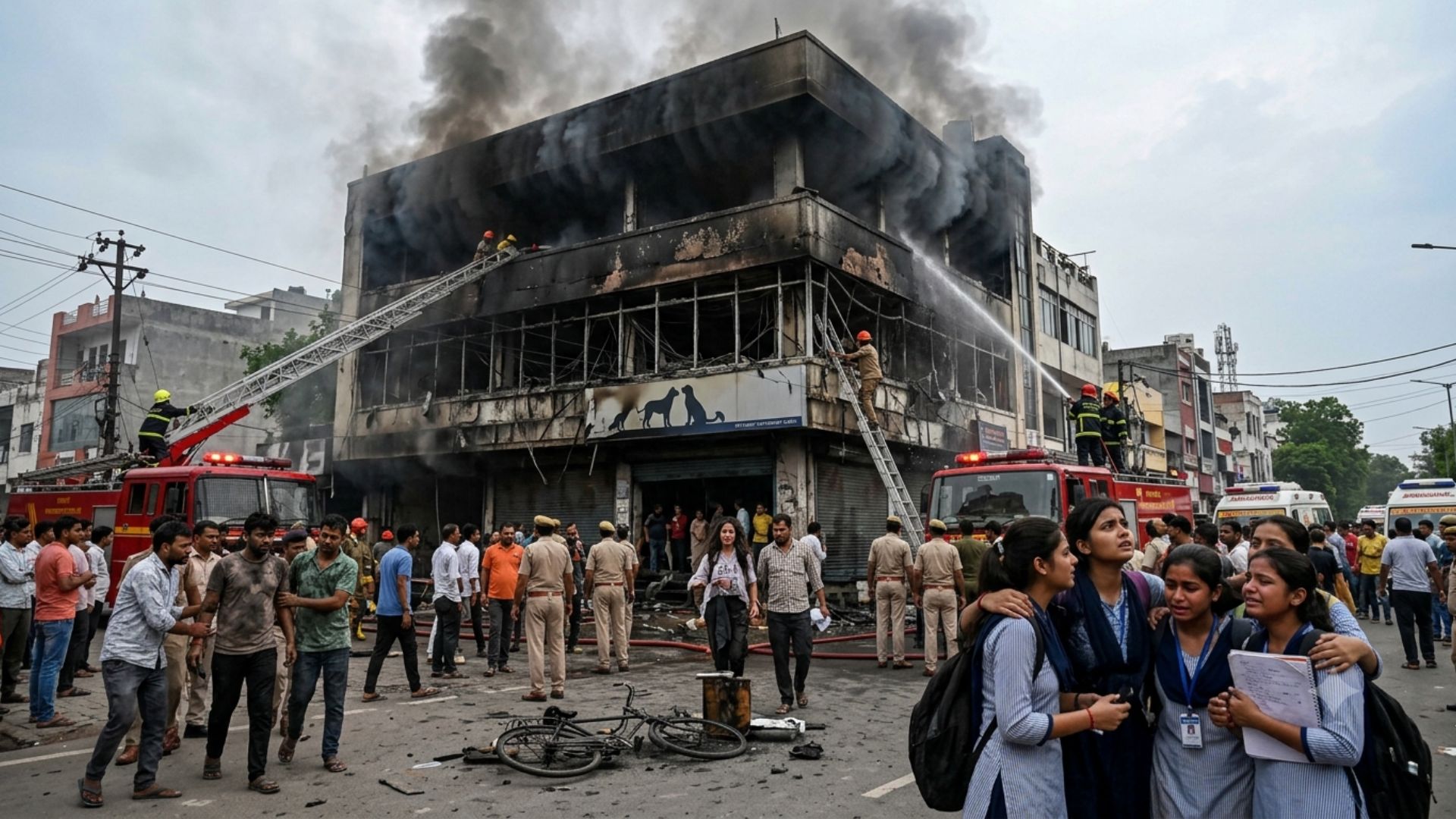
A devastating fire in a three-storey commercial building in Lucknow's Aliganj area claimed at least 15 lives, most of them students attending classes at a graphics animation centre. The tragedy has raised serious concerns regarding fire safety compliance, building regulations and emergency preparedness in urban areas.


What Happened?

AspectDetails
LocationAliganj, Lucknow
Building TypeThree-storey commercial building
Death Toll15 people
Injured5 persons
Major VictimsStudents attending animation classes
Time of FireAround 2:30 p.m.
Fire Control TimeApproximately 3 hours
Fire Tenders Deployed12

The building housed:

  • Graphics animation centre (second floor)
  • Library
  • Pet shop-cum-veterinary clinic (ground floor)

Most victims were trapped on the second floor during classes.


Preliminary Cause

According to initial findings shared by the State government:

• Fire may have originated in an AC duct.
• Smoke spread rapidly through the building.
• Lack of proper exit routes worsened the situation.
• Suffocation appears to have caused many deaths.

The exact cause remains under investigation.


Why Did Casualties Rise?

The incident highlights how structural vulnerabilities can transform a fire into a mass-casualty event.

Reported Factors

FactorImpact
Absence of adequate exit routesPeople trapped inside
Rapid smoke accumulationIncreased suffocation risk
Occupied educational facilityHigh concentration of students
Difficult rescue accessDelayed evacuation

Eyewitnesses reported that several students jumped from the building in an attempt to escape.

• Around eight students reportedly jumped.
• Firefighters broke a rear wall to reach trapped occupants.
• Local residents assisted in rescue operations.

More than four animals in the pet clinic were also charred to death.


Rescue and Emergency Response

Emergency services mounted a large-scale rescue operation.

Response Measures

  • Twelve fire tenders deployed.
  • Fire brought under control after nearly three hours.
  • Rescue teams evacuated trapped individuals.
  • Injured shifted to nearby hospitals.
  • Local residents assisted first responders.

"Many people jumped from the building, and we immediately took them to hospital." — Eyewitness account


Accountability Measures Taken

The administration initiated multiple actions following the tragedy.

Arrests

Police arrested:

• Ram Krishna Upadhyay
• Virendra Prasad Shukla
• Tushar Krishna Jaiswal

(Building owners)

Suspension of Officials

Four government officials were suspended:

  • Executive Engineer
  • Food Safety and Standards Officer
  • Assistant Engineer
  • Junior Engineer

The suspensions indicate possible administrative lapses that are being examined.


Government Response

AuthorityAction Taken
Chief MinisterOrdered thorough investigation
State GovernmentConstituted two-member SIT
Fire DepartmentInvestigating cause of fire
Urban Development DepartmentExamining building standard violations

The Special Investigation Team has been directed to submit its report within seven days.


Broader Urban Governance Concerns

The incident highlights recurring challenges in Indian cities.

Key Issues

  • Weak enforcement of building codes.
  • Inadequate fire safety audits.
  • Poor emergency evacuation planning.
  • Unauthorized modifications in commercial buildings.
  • Insufficient monitoring of high-occupancy establishments.

"The matter will be thoroughly investigated and those found responsible will be brought to justice." — Chief Minister


Political Reactions

Leaders across the political spectrum expressed grief and demanded accountability.

Responses Included

• Prime Minister announced ex-gratia assistance.
• President and Vice-President conveyed condolences.
• Opposition parties demanded accountability.
• Calls made for an honest and transparent investigation.

Ex-gratia announced:

  • ₹2 lakh to next of kin of each deceased.
  • ₹50,000 to each injured person.

Way Forward

  • Mandatory periodic fire safety audits of commercial buildings.
  • Strict enforcement of building and occupancy regulations.
  • Installation of emergency exits and smoke management systems.
  • Regular evacuation drills in educational and commercial establishments.
  • Digital monitoring of fire safety compliance.
  • Personal accountability for officials approving unsafe structures.
  • Strengthening urban disaster preparedness and response capacity.

Conclusion

The Lucknow fire tragedy underscores that urban disasters are often the result of accumulated regulatory failures rather than isolated accidents. While the immediate cause is under investigation, the incident highlights the importance of fire safety compliance, effective enforcement of building standards and robust emergency preparedness. Preventing future tragedies requires moving from reactive inquiries to proactive risk reduction and accountability.

Attribution

Original content sources and authors

Mayank Kumar Author Mayank Kumar The Hindu Source The Hindu

Syllabus classification

How this article maps to GS papers

Main syllabus

GS2Government Policies

Also covers

GS1Urbanisation

Quick Q&A

What are the major policy challenges in urban fire safety governance and why are they significant for public administration?
Urban fire safety governance refers to the framework of laws, building regulations, inspection mechanisms and emergency response systems designed to prevent fire-related disasters and protect lives and property. The June 2026 Lucknow commercial building fire, which claimed at least 15 lives, highlights the consequences of weak implementation of safety standards despite the existence of regulatory mechanisms. Preliminary findings indicated inadequate exit routes and possible faults in AC duct systems, pointing to deficiencies in compliance and monitoring. From a governance perspective, the issue falls under GS Paper II (Governance and Government Policies) and GS Paper III (Disaster Management). India's National Building Code (NBC) 2016 and provisions of the Disaster Management Act, 2005 prescribe fire safety measures, evacuation procedures and occupancy norms. However, implementation remains uneven due to administrative negligence, corruption, inadequate inspections and unauthorized alterations in buildings. The suspension of engineers and officials in the Lucknow case demonstrates administrative accountability mechanisms. However, such post-disaster actions often raise questions regarding preventive governance. Experts advocate risk-based inspections, digital monitoring, geotagged audits and stricter penalties for violations. Rapid urbanization, increasing commercialization and the proliferation of mixed-use buildings have intensified these challenges. According to NCRB data, thousands of fire accidents are reported annually in India, causing significant casualties and economic losses. For UPSC interviews, this issue illustrates the distinction between policy formulation and policy implementation. Effective governance requires not merely laws but institutional capacity, transparency, citizen awareness and inter-agency coordination to ensure safer and resilient urban spaces.
Why is smart implementation of government policies considered more important than merely framing regulations and standards?
Smart implementation refers to the efficient, technology-driven and accountable execution of public policies to achieve intended outcomes. While India possesses elaborate legal frameworks and standards, many tragedies occur because compliance and enforcement remain weak. The Lucknow fire incident of June 2026 exemplifies this gap between policy intent and actual implementation. The National Building Code, municipal regulations and disaster management guidelines already provide comprehensive safety provisions. Yet, deficiencies such as blocked exits, overcrowding, poor inspections and unauthorized commercial usage often undermine these safeguards. Consequently, governance failures emerge not because of absence of rules but because of inadequate execution. This issue is highly relevant to GS Paper II, which emphasizes governance, accountability and transparency. The Second Administrative Reforms Commission stressed that effective service delivery depends on institutional capacity and citizen-centric administration. Smart implementation involves digital approvals, GIS mapping, AI-based risk assessment, periodic safety audits and online monitoring systems. International experiences from Japan and Singapore demonstrate that strict compliance mechanisms and technological interventions significantly reduce disaster-related casualties. In India, initiatives under Smart Cities Mission and Digital India provide opportunities to integrate such innovations. Political debates often arise after disasters, with opposition parties accusing governments of negligence and ruling parties emphasizing investigations and compensation. While ex gratia payments provide relief, they cannot substitute preventive governance. For UPSC aspirants, the broader lesson is that governance success depends on outcomes rather than announcements. Effective implementation strengthens public trust, reduces administrative failures and contributes to sustainable urban development and disaster resilience.
How can technology and smart governance mechanisms improve urban disaster preparedness and fire safety management in India?
Technology-driven governance has emerged as an essential component of modern disaster management. Urban fire safety can be substantially improved through smart monitoring systems, real-time surveillance and integrated emergency response mechanisms. The Lucknow fire tragedy of June 2026 underscores the necessity of shifting from reactive approaches to preventive and predictive governance. Under the Smart Cities Mission, Indian cities are increasingly establishing Integrated Command and Control Centres (ICCCs). These centres can monitor building safety, coordinate emergency services and facilitate faster response during disasters. Artificial Intelligence, Internet of Things (IoT) sensors and GIS-based mapping can detect abnormal temperatures, smoke accumulation and electrical faults before fires escalate. Digital records of building approvals and geotagged inspections can reduce corruption and ensure accountability among municipal authorities. Drones and thermal imaging technologies may assist rescue operations, while emergency communication systems can alert occupants in real time. Countries like South Korea and Japan have successfully adopted such systems to enhance urban resilience. The Disaster Management Act, 2005, National Disaster Management Authority (NDMA) guidelines and National Building Code provide institutional support for integrating technology into disaster preparedness. However, challenges include financial constraints, lack of trained manpower and fragmented coordination among departments. Experts advocate periodic fire drills, citizen awareness campaigns and mandatory safety certifications for commercial establishments. Public-private partnerships can also contribute to infrastructure modernization. For UPSC interviews, this topic connects with GS Paper III (Science and Technology and Disaster Management) and GS Paper II (Governance). Smart governance represents a transition from traditional administration to evidence-based, technology-enabled and citizen-centric policy implementation.
What are the underlying reasons behind recurring fire accidents and regulatory failures in Indian urban areas?
Recurring fire accidents in India are symptoms of deeper structural and governance-related deficiencies. Although regulatory frameworks exist, implementation gaps continue to result in preventable tragedies. The Lucknow fire of June 2026, involving students trapped in a commercial building, reflects these systemic shortcomings. One major reason is non-compliance with building codes and fire safety norms. Unauthorized modifications, overcrowding and mixed-use occupancy increase vulnerability. Rapid urbanization has outpaced the capacity of municipal authorities to conduct regular inspections. In many cities, shortage of trained personnel and outdated equipment further weaken enforcement. Administrative negligence and corruption constitute another important factor. Post-disaster suspensions of engineers and officials often indicate failures in routine monitoring. Weak accountability mechanisms and delayed corrective actions allow violations to persist. Economic considerations also influence safety standards. Small businesses and educational institutions sometimes prioritize cost reduction over compliance, resulting in inadequate emergency exits and insufficient firefighting infrastructure. Public awareness regarding evacuation procedures and disaster preparedness remains low. Climate change and increasing temperatures may further aggravate fire risks. Electrical overloading, aging infrastructure and poor maintenance contribute to accidental fires. According to NCRB statistics, thousands of fire incidents occur annually, causing substantial loss of life and property. Debates frequently revolve around whether responsibility lies with building owners, local bodies or governments. Experts argue that accountability should be shared across stakeholders. This issue is relevant to GS Papers II and III, covering governance and disaster management. Sustainable urbanization requires preventive regulation, institutional reforms, citizen participation and stronger administrative capacity to reduce recurring tragedies.
How does the Lucknow commercial building fire of 2026 serve as a case study in administrative accountability and crisis management?
The June 2026 Lucknow fire provides a significant case study in administrative accountability, emergency response and disaster governance. The incident occurred in a three-storey commercial building housing an animation centre, library and pet clinic, resulting in the deaths of at least 15 people, mostly students. Preliminary reports suggested that smoke inhalation and lack of proper exit routes aggravated the tragedy. The response of the Uttar Pradesh government demonstrates multiple dimensions of crisis management. Chief Minister Yogi Adityanath returned to Lucknow immediately and ordered a high-level inquiry. A two-member Special Investigation Team was constituted with instructions to submit its report within seven days. Four officials, including engineers and a food safety officer, were suspended, while building owners were arrested. Emergency services deployed twelve fire tenders and rescue teams, though the operation lasted nearly three hours. The Prime Minister announced ex gratia assistance of ₹2 lakh for the families of deceased victims and ₹50,000 for the injured through the Prime Minister's National Relief Fund. The incident also generated political debate. Opposition leaders alleged governance failures and demanded accountability, whereas the government emphasized investigations and relief measures. Such debates are characteristic of democratic systems and contribute to institutional scrutiny. For UPSC aspirants, the case highlights themes under GS Paper II (Governance and Accountability) and GS Paper III (Disaster Management). It demonstrates the importance of preparedness, coordination among agencies, transparency, compensation mechanisms and preventive regulation. The case reinforces the principle that effective governance must prioritize prevention rather than merely post-disaster response.
What is the critical analysis of India’s disaster governance framework in preventing urban fire tragedies and ensuring accountability?
India possesses a relatively comprehensive disaster governance architecture, including the Disaster Management Act, 2005, the National Disaster Management Authority (NDMA), state disaster management authorities and the National Building Code. However, repeated urban fire incidents reveal a persistent implementation deficit. The Lucknow fire tragedy of 2026 provides an opportunity to critically evaluate this framework. On the positive side, institutional arrangements for disaster response have improved considerably since the early 2000s. Coordination among police, fire services and district administrations has become more structured. Compensation mechanisms and investigation procedures are also well established. Nevertheless, preventive governance remains weak. Fire safety inspections are often irregular, and municipal bodies suffer from staff shortages and inadequate technical expertise. Many buildings continue to violate occupancy norms and safety regulations. Post-disaster suspensions and arrests indicate accountability but also expose failures that should have been identified earlier. Another criticism concerns fragmented governance. Urban local bodies, electricity departments, development authorities and disaster management agencies frequently operate without adequate coordination. Budgetary constraints and low public awareness further aggravate vulnerabilities. Experts recommend adopting a resilience-based approach emphasizing risk assessment, periodic audits and technological interventions. International best practices from Japan and Singapore show that strict enforcement and civic participation significantly reduce disaster losses. From a constitutional perspective, disaster management involves cooperative federalism and local self-governance under the 74th Constitutional Amendment. Therefore, strengthening urban local bodies becomes essential. For UPSC interviews, a balanced assessment is important. India's disaster framework is institutionally robust but operationally inconsistent. The challenge lies not in creating new laws but in enhancing capacity, accountability and citizen participation.
What practical reforms and policy measures can strengthen urban fire safety and prevent similar tragedies in the future?
Preventing urban fire disasters requires a combination of regulatory reforms, technological innovation and citizen participation. The Lucknow fire incident of June 2026 serves as a reminder that reactive measures are insufficient and that preventive governance must become the priority. One important reform is the mandatory digitalization of building approvals and safety certificates. Geotagged inspections and online records can improve transparency and reduce opportunities for corruption. Periodic third-party safety audits should be made compulsory for educational institutions, commercial complexes and mixed-use buildings. Strengthening fire departments is equally important. Modern firefighting equipment, adequate staffing and continuous training are essential. Integration of fire services with Smart Cities Mission command centres can facilitate real-time monitoring and faster emergency responses. IoT-based smoke detectors and AI-powered predictive systems can provide early warnings. Public awareness campaigns and regular evacuation drills can improve disaster preparedness among citizens. Educational institutions should incorporate basic disaster management training. Community participation and resident welfare associations can assist authorities in identifying safety violations. Policy experts also recommend stricter penalties for non-compliance and clear accountability mechanisms for municipal officials. International examples from Singapore and Japan demonstrate the effectiveness of rigorous inspections and public education. These reforms align with SDG 11, which seeks to create sustainable and resilient cities. They are relevant to GS Papers II and III, involving governance, urban development and disaster management. Ultimately, urban safety is a shared responsibility involving governments, businesses and citizens. A preventive and technology-driven approach can save lives, enhance public trust and promote sustainable urbanization in India.

Practice questions

1 question for mains preparation

Urban fire disasters are often the result of inadequate preparedness and weak enforcement of safety regulations rather than the hazard itself. Discuss in the context of recent fire accidents in India.

10 marks · 150 words · 8 mins
