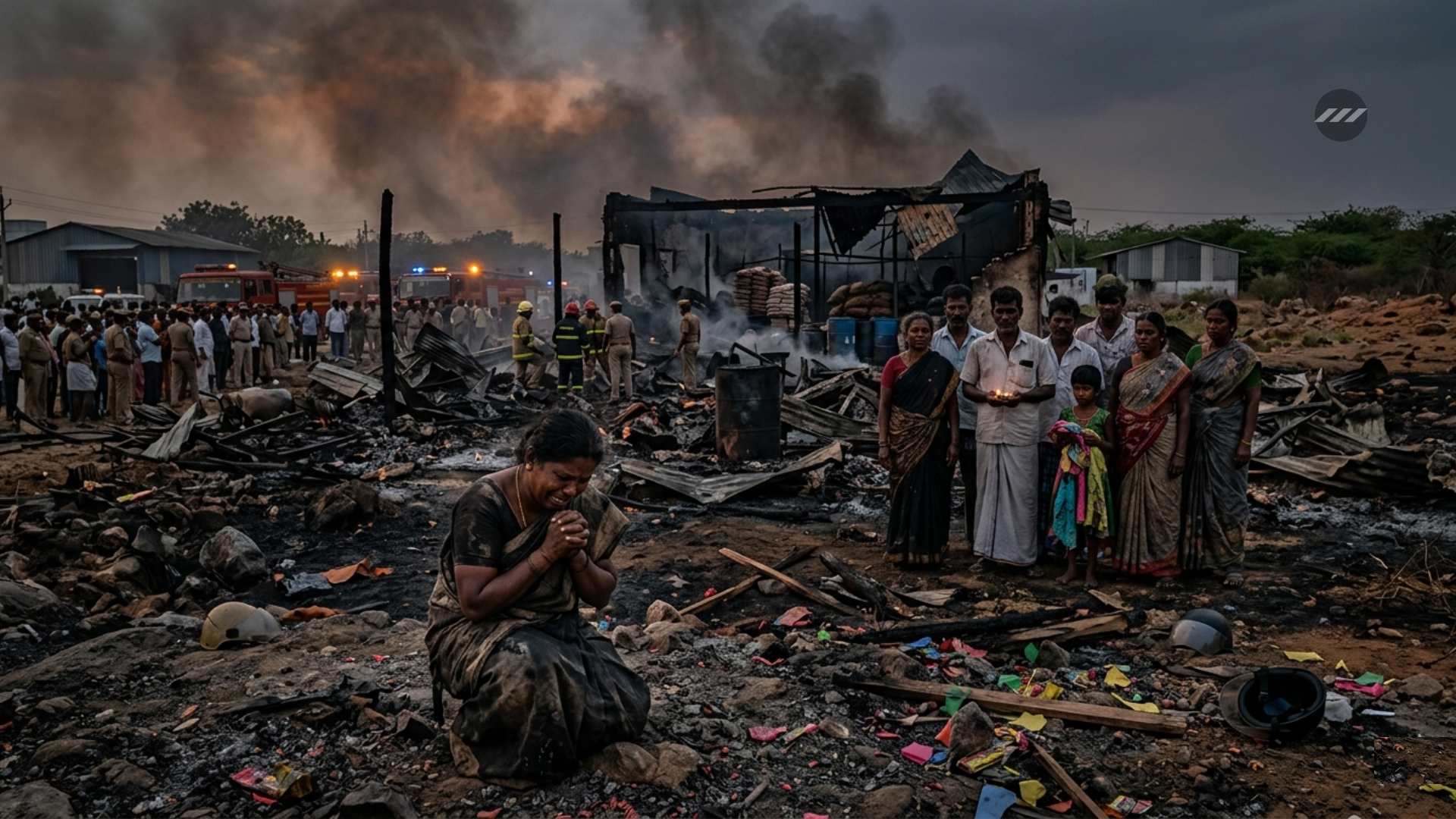
The Tragic Consequences of Negligence: Virudhunagar Blast
 Surya
Surya
Introduction
"It is an outright misnomer to describe this type of explosion as an accident — accidents are associated with elements of surprise. In Virudhunagar, every worker knows the industry is hazardous."
On April 19, 2025, a fireworks unit explosion in Virudhunagar, Tamil Nadu killed 25 workers and injured 20 others including policemen and firefighters. In the past four years alone, 134 people have died and 89 injured in similar explosions in the same district. This is not a disaster — it is a governance failure hiding behind the word 'accident'.
| Statistic | Figure |
|---|---|
| Deaths in April 19 explosion | 25 |
| Injured (including police, firefighters) | 20 |
| Deaths in Virudhunagar (past 4 years) | 134 |
| Injured in Virudhunagar (past 4 years) | 89 |
| Licence-permitted workers per unit | 12 |
| Workers present at explosion site | 40 |
| Day of explosion | Sunday (industry holiday — no permission) |
Background & Context
Virudhunagar district in southern Tamil Nadu is India's largest concentration of fireworks manufacturing units, supplying a significant share of the country's cracker demand. The industry employs lakhs of workers in a region that is largely arid and dependent on rain-fed agriculture — making it the primary livelihood source for economically weaker communities.
The structural paradox: the same industry that sustains the region's economy systematically endangers its workers, with regulatory frameworks that exist on paper but collapse in practice.
Why "Accident" Is the Wrong Word
Accident = surprise + unanticipated occurrence

Virudhunagar explosions:
  ✗ Not surprising — occur at REGULAR INTERVALS
  ✗ Not unanticipated — every worker knows the hazard
  ✗ Not random — same district, same pattern, same victims

Correct framing:
  Predictable outcome of KNOWN negligence
  + ABSENT enforcement
  + STRUCTURAL impunity
  = Systemic failure, not accident
Key Violations in the April 19 Case
| Norm | Requirement | Reality |
|---|---|---|
| Working day | Sunday = industry holiday | Operating without permission |
| Worker limit per unit | 12 (as per licence) | 40 workers present |
| Safety inspection | Meaningful, regular | Ritual, not substantive |
| Licensing compliance | Mandatory | Widespread violation normalised |
Layers of Governance Failure
╔═══════════════════════════════════════════════════════════════════╗
║     VIRUDHUNAGAR, SIVAKASI FIREWORKS DISASTERS — LAYERS OF GOVERNANCE      ║
║          Failure by Design: 5 Structural Reasons It Repeats      ║
╚═══════════════════════════════════════════════════════════════════╝

1. REGULATORY CAPTURE & RITUAL INSPECTION
   ┌───────────────────────────────────────────────────────────┐
   │ Inspections exist on paper — fail in practice             │
   │ Manpower shortage cited BUT pattern = institutional will  │
   │ Historical evidence:                                      │
   │  • 2012 Sivakasi explosion → 40 dead → same promises     │
   │  • 2018 Virudhunagar → 23 dead → inquiry ordered         │
   │  • 2021 → multiple blasts → committees formed            │
   │  • 2025 → 25 dead → condolences repeated                 │
   └───────────────────────────────────────────────────────────┘
   Every explosion → inquiry → report → forgotten
   Inspection = ritual, NOT risk prevention

2. LICENCE VIOLATION AS INDUSTRY NORM

   What licence says          What actually happens
   ─────────────────────────────────────────────────
   Max 12 workers/unit   →    40 workers present
   No Sunday operation   →    Running without permission
   Safety distances      →    Ignored routinely
   Storage limits        →    Exceeded regularly

   Historical pattern:
   • PESO (Petroleum & Explosives Safety Org.) audits
     repeatedly flag violations → no sustained action
   • Unlicensed units operate openly in Sivakasi belt
   • SC 2012 order on fireworks safety → partial compliance only

   ⚠ Violation is not exception — it IS the operating model

3. FAILURE OF ACCOUNTABILITY CHAIN

   Explosion occurs
        ↓
   State govt → condolences + ₹X lakh solatium
        ↓
   Centre → expresses concern
        ↓
   Inquiry committee formed
        ↓
   Report submitted (or not)
        ↓
   No structural reform
        ↓
   Next explosion ──────────────────────────────┐
        ↑                                        │
        └────────────────────────────────────────┘

   Historical evidence:
   • 134 deaths in 4 years = same cycle, same response
   • Factories Act 1948 → Chapter IV (Safety) unenforced
   • No dedicated Fireworks Safety Authority exists
   • Bhopal Gas Tragedy 1984 → showed same accountability
     vacuum → 40 years later, industrial safety still weak

4. SOCIOECONOMIC VULNERABILITY OF WORKERS
   ┌───────────────────────────────────────────────────────────┐
   │ Virudhunagar = arid district, rain-fed agriculture       │
   │ Fireworks = PRIMARY livelihood for lakhs of workers      │
   │ Workers = overwhelmingly EWS, daily wage, no contracts   │
   └───────────────────────────────────────────────────────────┘

   Worker has two choices:
   Accept hazard → earn livelihood ✓ (but risk death)
   Refuse hazard → unemployment  ✗ (no alternative)

   Historical parallel:
   • Khetri copper mines (Rajasthan) — workers accepted
     silicosis risk for decades: no alternative livelihood
   • Dhanbad coal mines — illegal rat-hole mining persists
     despite bans: same economic compulsion
   • Child labour in Sivakasi fireworks historically:
     SC intervention 1996 (M.C. Mehta case) → reduced
     but EWS adult vulnerability remains unaddressed

   Vulnerability = structural, not individual choice

5. ABSENCE OF AUTOMATION PUSH

   Global best practice:
   ┌─────────────────────────────────────────────────────┐
   │ China (world's largest fireworks producer):         │
   │  → Semi-automated mixing + pressing units           │
   │  → Remote ignition systems for testing             │
   │  → Reduced human presence in hazard zones          │
   │                                                     │
   │ EU fireworks regulation (2013/29/EU):               │
   │  → Mandates mechanical handling of pyrotechnic      │
   │    compositions above threshold quantities          │
   └─────────────────────────────────────────────────────┘

   India:
   • Sivakasi/Virudhunagar belt = almost entirely manual
   • No government incentive scheme for automation
   • Industry resists: automation = job loss fear
   • But: manual mixing of oxidisers = highest death risk

   ⚠ Technology exists. Political will does not.

═══════════════════════════════════════════════════════════════════
CORE PATTERN ACROSS ALL 5 LAYERS:

  Known risk + Weak enforcement + EWS workers
  + No alternatives + No automation
  = Predictable death, called "accident"

  Bhopal 1984 → Sivakasi 2012 → Virudhunagar 2025
  Same failure. Different names. Same workers pay.

  Reform equation:
  Enforce law + Automate hazard zones
  + Build alternative livelihoods
  = Break the cycle
═══════════════════════════════════════════════════════════════════
The Governance Tightrope
The challenge is not simply enforcement — it requires balancing three competing imperatives:
Strict safety enforcement
        ↕
Livelihood protection for lakhs of workers
        ↕
Prevention of harassment of legitimate units
Crackdown without economic alternative = workers lose jobs. Leniency without enforcement = workers lose lives. The solution requires calibrated regulation, not a binary choice.
Way Forward
| Intervention | Purpose |
|---|---|
| Real-time digital monitoring of unit activity | Replace ritual inspection with continuous oversight |
| Strict Sunday/holiday enforcement with surveillance | Close the permission-violation loophole |
| Worker limit enforcement via biometric entry | Technology-backed compliance, not paper-based |
| Fast-track automation incentives for units | Reduce human exposure to hazardous processes |
| Alternative livelihood schemes for the region | Reduce worker dependency on hazardous employment |
| Independent safety audit body | Depoliticise inspections, end regulatory capture |
| Mandatory accident insurance + compensation fund | Beyond solatium — structured worker protection |
Relevant Legal & Policy Framework
- Explosives Act, 1884 — Primary legislation governing manufacture, storage, and transport of explosives including firecrackers.
- Factories Act, 1948 — Worker safety, working hours, inspection norms.
- Disaster Management Act, 2005 — NDMA/SDMA roles in industrial disaster response.
- Petroleum and Explosives Safety Organisation (PESO) — Nodal body for explosives licensing under DPIIT.
- SC Guidelines on Firecrackers — Supreme Court orders on green crackers, emission norms (relevant but not enforced at production end).
Conclusion
Virudhunagar is not a story of bad luck — it is a story of predictable death enabled by systemic negligence. When 134 people die in four years in the same district, the same industry, the same pattern, the word "accident" becomes an alibi for inaction. Meaningful reform requires three simultaneous moves: enforce existing law without ritual, incentivise automation to reduce human exposure, and build alternative livelihoods so that workers are not forced to choose between safety and survival. The fireworks that light up India's festivals must not be manufactured at the cost of the lives of those who make them.
Attribution
Original content sources and authors


Syllabus classification
How this article maps to GS papers
Main syllabus
GS2Government PoliciesQuick Q&A
What are the structural safety challenges associated with the fireworks industry in districts like Virudhunagar?
Key structural issues include:
- Non-compliance with safety norms: Units frequently exceed worker limits and operate during prohibited times.
- Weak monitoring mechanisms: Inspections are often ritualistic rather than rigorous.
- Informal labour practices: Workers lack proper training, safety gear, and social security.
- Overdependence on manual labour: Limited automation increases human exposure to risk.
For instance, the April 19 explosion revealed multiple violations such as unauthorized Sunday operations and overcrowding. These are not aberrations but recurring patterns, indicating systemic governance failure. Addressing these challenges requires not just stricter enforcement but also structural reforms in labour practices and industrial safety frameworks.
Why is it problematic to term recurring industrial explosions as 'accidents' in the context of Virudhunagar?
This mischaracterization has several implications:
- Shifts focus away from responsibility: Authorities and employers escape scrutiny.
- Normalizes preventable risks: Workers continue to operate in unsafe conditions.
- Weakens policy response: Emphasis remains on compensation rather than prevention.
For example, repeated incidents over the past four years, causing over 130 deaths, highlight a pattern of negligence rather than chance. A more accurate framing would be to treat these as industrial safety failures, which would demand stricter enforcement, legal accountability, and systemic reform. Thus, terminology shapes both public perception and policy action.
How can regulatory and enforcement mechanisms be strengthened to prevent such industrial disasters?
Key measures include:
- Enhancing inspection quality: Move from routine checks to risk-based, surprise inspections.
- Use of technology: Install CCTV monitoring, digital attendance systems, and real-time compliance tracking.
- Capacity building: Increase staffing and provide specialized training to enforcement agencies.
- Strict penalties: Enforce deterrent punishments for violations, including license cancellation.
For instance, integrating GIS-based mapping of units and AI-driven alerts for irregular operations can improve oversight. Additionally, community reporting mechanisms can empower workers to flag violations. However, enforcement must balance strictness with fairness to avoid harassment of compliant units. A transparent and accountable system is essential for sustainable industrial safety.
What are the underlying socio-economic factors that perpetuate unsafe practices in the fireworks industry?
Key contributing factors include:
- Poverty and lack of alternatives: Workers accept hazardous conditions due to economic necessity.
- Informal employment structures: Absence of contracts reduces employer accountability.
- Low awareness and bargaining power: Workers often lack knowledge of safety rights.
- Cost-cutting by employers: Safety measures are compromised to maximize profits.
For example, employing more workers than permitted increases output but significantly raises risk. Similarly, operating on holidays reflects economic pressures overriding safety norms. These factors create a cycle where economic vulnerability fuels regulatory violations. Addressing this requires not only enforcement but also economic diversification, skill development, and social protection measures to reduce dependence on hazardous industries.
Critically analyse the role of government authorities in balancing industrial growth and worker safety in such sectors.
On one hand, the government's role includes:
- Regulation and enforcement: Ensuring compliance with safety standards.
- Economic facilitation: Supporting industries that generate employment.
- Welfare measures: Providing compensation and rehabilitation.
However, shortcomings are evident:
- Reactive approach: Focus on compensation rather than prevention.
- Weak enforcement: Inspections lack rigor and consistency.
- Institutional constraints: Manpower shortages and bureaucratic inefficiencies.
For instance, the continued occurrence of explosions despite regulations indicates enforcement failure. At the same time, overly stringent measures without support could harm livelihoods. Thus, a balanced approach requires proactive safety governance, stakeholder consultation, and investment in safer technologies. The goal should be sustainable industrial growth that does not compromise human lives.
Can you provide examples of technological or policy interventions that can reduce risks in hazardous industries like fireworks manufacturing?
Technological interventions include:
- Automation of high-risk processes: Machines can handle mixing and filling of chemicals.
- Remote monitoring systems: CCTV and IoT devices can track operations in real time.
- Safety infrastructure: Blast-resistant buildings and proper ventilation systems.
Policy interventions include:
- Cluster-based regulation: Centralized monitoring of industrial clusters.
- Mandatory safety training: Certification programs for workers and supervisors.
- Incentives for compliance: Subsidies or tax benefits for adopting safety measures.
For example, countries like China have introduced automation in fireworks production to reduce accidents. In India, similar measures, combined with stricter enforcement and worker awareness programs, can yield positive results. These interventions must be tailored to local contexts to ensure both safety and economic viability.
As a district administrator, how would you address recurring industrial accidents in a region like Virudhunagar?
Short-term measures:
- Strict enforcement drives: Conduct surprise inspections and shut down non-compliant units.
- Emergency preparedness: Strengthen disaster response systems and medical facilities.
- Accountability: Initiate legal action against violators.
Long-term measures:
- Promote automation: Encourage industry to adopt safer technologies.
- Worker welfare: Ensure social security, insurance, and safety training.
- Economic diversification: Develop alternative livelihood opportunities.
For example, creating an industrial safety task force with multi-agency coordination can improve oversight. Additionally, engaging with industry stakeholders and worker unions can foster a culture of safety. The approach must balance strict regulation with economic sensitivity to ensure sustainable and safe industrial development.
Practice questions
1 question for mains preparation