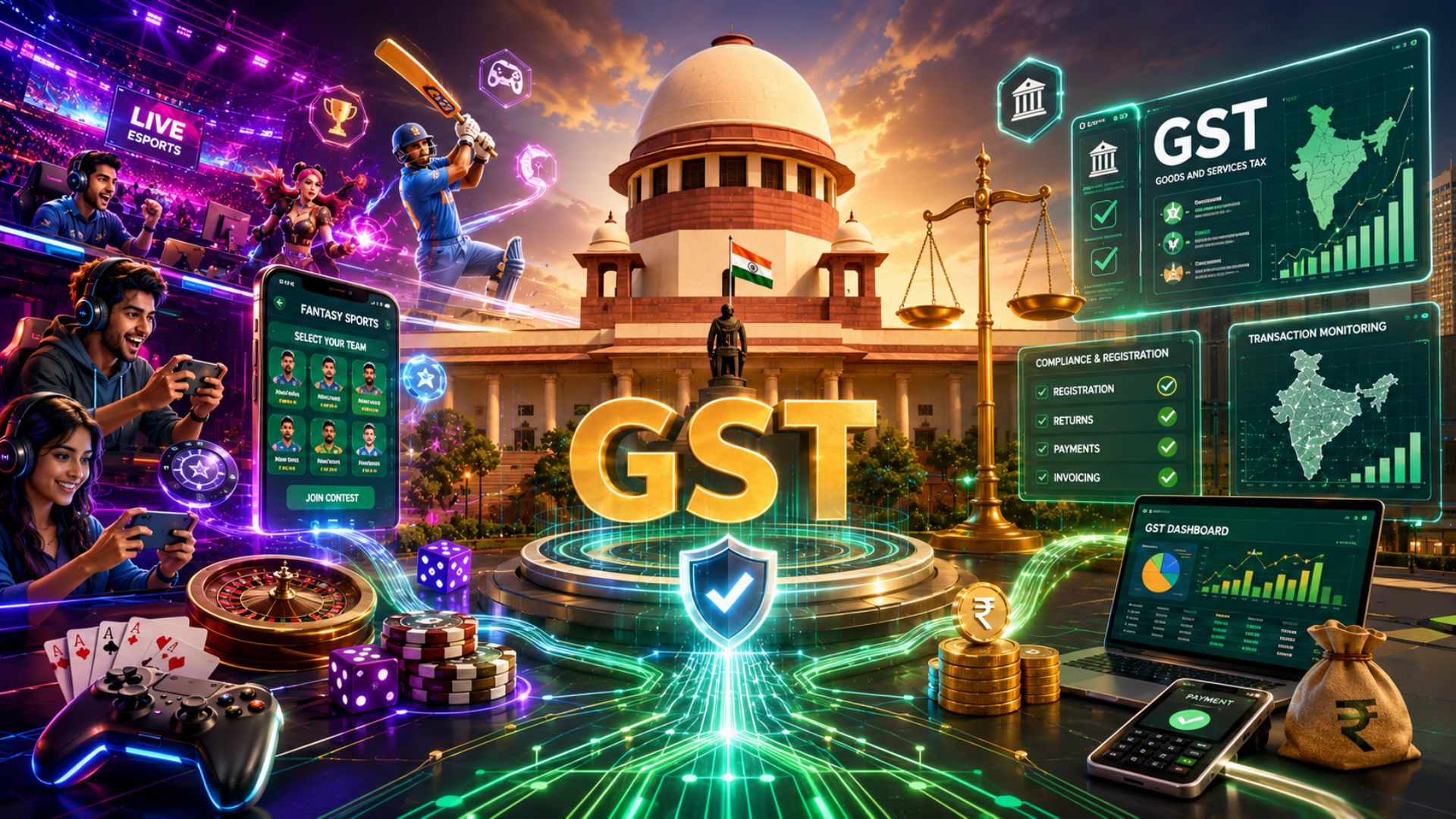
Online Gaming Under GST: The Supreme Court Settles the "Skill vs Stake" Debate

On May 27, 2026, the Supreme Court confirmed the constitutional validity of bringing organised online gaming activities with money stakes under the Goods and Services Tax (GST) regime. The verdict, delivered by a Bench of Justices J.B. Pardiwala and R. Mahadevan, settles a long-contested question: does the presence of skill in a game exempt money-staked play from being treated as betting and gambling? The Court's answer is a clear no.
"Such betting would not enjoy immunity merely because it is taking place in a game of skill."
What the Court Decided
The Bench declined challenges against the levy of GST on actionable claims arising from organised online gaming and fantasy sports, classifying them under the betting and gambling head:
- Online games—including fantasy sports and others played on digital platforms—that involve staking upon uncertain outcomes constitute betting and gambling for GST purposes.
- The Court also upheld the statutory ban on games like rummy and poker when played online for a wager, bet, money or other stakes.
The Core Reasoning: Skill Does Not Equal Immunity
The petitioners' central argument was that games of skill should fall outside "gambling." The Court accepted this only in part—and drew a sharp distinction:
THE COURT'S DISTINCTION
Game of skill (no stake)
   → may NOT be 'gambling'
Betting ON a game of skill (with money stake)
   → falls within State legislative competence
   → does NOT enjoy immunity
Two elements proved decisive regardless of skill:
- Substantial money was involved.
- There was uncertainty at stake on the outcome.
Rejecting the Horse-Racing Comparison
The gaming companies relied on an earlier ruling categorising horse racing as a game of skill, arguing online games deserved the same treatment. Justice Pardiwala rejected the analogy:
- Horse races and wagers upon them are heavily regulated and organised by the State.
- Online gaming, by contrast, carries an "uncertainty and veil of invisibility"—whether of skill or chance.
"The earlier decision on horse racing has no relevance to the case at hand."
The two, the Court held, simply cannot be compared.
A Public Health and Public Order Lens
Beyond taxation, the Court framed the issue as one of State responsibility:
- States have a duty to maintain public tranquillity and public health.
- This was set against the growing problems of addiction and deaths due to financial losses suffered online.
The Court also gave weight to the evidentiary basis of State action:
- The Tamil Nadu law was based on empirical data collected through a panel chaired by a former Madras High Court judge.
The Federal Dimension
The judgment restored the authority of State legislatures over this domain:
- The Court allowed the appeals of the Tamil Nadu and Karnataka governments.
- It set aside the Madras and Karnataka High Court decisions that had struck down the laws.
- In 2021, the Madras HC had found the Tamil Nadu Gaming and Police Laws (Amendment) Act, 2021 violative of the fundamental right to practise a profession, occupation or trade.
By upholding the bans, the Court affirmed that betting on online games of skill threatens "the State and well-being of the masses" and falls squarely within legislative competence.
Way Forward
The ruling settles the constitutional question but opens the door to careful execution:
- Distinguish gaming from gambling: Policy must protect legitimate skill-based gaming and esports while regulating money-staked play, so innovation is not stifled along with harm.
- Strengthen consumer safeguards: Age verification, deposit limits, self-exclusion tools and addiction-warning measures should be built into the regulatory framework.
- Address addiction as public health: Given the Court's emphasis on deaths and addiction, de-addiction support and awareness campaigns are essential complements to the ban.
- Ensure regulatory clarity: A coherent national framework—balancing the GST levy, State bans and the legitimate digital economy—would reduce litigation and uncertainty for the sector.
Conclusion
The verdict marks a decisive shift in how India treats the fast-growing online gaming economy: the presence of skill no longer shields money-staked play from regulation or taxation. By weighing revenue interests alongside public health and federal authority, the Court has placed the welfare of vulnerable users at the centre of the debate. The challenge ahead is to translate this principle into a regulatory regime that curbs the documented harms of addiction and financial ruin without extinguishing a legitimate and innovative digital industry.
Attribution
Original content sources and authors


Syllabus classification
How this article maps to GS papers
Main syllabus
GS2Government PoliciesQuick Q&A
What was the Supreme Court’s ruling regarding GST on online gaming and fantasy sports, and what constitutional principles were involved?
The judgment involved important constitutional principles relating to legislative competence and reasonable restrictions. The Court examined whether States possess the authority to regulate and prohibit betting activities under the Constitution. It reaffirmed that States can legislate on betting and gambling under the State List of the Seventh Schedule. Furthermore, the Court held that restrictions imposed on online gaming businesses do not automatically violate Article 19(1)(g), which guarantees freedom to practice any profession or trade, because reasonable restrictions can be imposed in the interest of public order, morality, and health.
The ruling also reflects the evolving nature of digital governance in India. Online gaming has become a rapidly expanding sector involving significant financial transactions, raising concerns regarding addiction, financial distress, and tax evasion. By treating such activities as taxable and regulatable, the Court has attempted to strike a balance between economic innovation and public welfare. The judgment is likely to shape future debates concerning digital economy regulation, platform accountability, and taxation of virtual activities.
Why did the Supreme Court classify online gaming involving stakes as betting and gambling despite the argument that some games involve skill?
The Court distinguished between ‘games of skill’ and ‘betting on games of skill.’ It stated that while games of skill may not independently amount to gambling, wagering on such games can still fall within the legislative domain of betting and gambling. The judgment highlighted that online gaming platforms often create an ecosystem involving anonymity, continuous engagement, and financial inducements, thereby increasing the possibility of addiction and economic harm. The Court particularly noted the growing incidents of debt, suicides, and public disorder associated with online betting platforms.
The Court also rejected comparisons with horse racing. Earlier judicial decisions had categorized horse racing as a game of skill because it involved substantial regulation, licensing, and transparency. However, the Bench emphasized that online gaming platforms operate in a vastly different environment marked by digital invisibility and weaker oversight mechanisms. Therefore, horse racing precedents could not automatically be extended to online gaming.
This interpretation has broader implications for digital governance. It demonstrates that constitutional courts may adopt a public-interest-oriented approach while evaluating emerging technologies and business models. The judgment reinforces the principle that economic freedoms cannot override concerns of social welfare and public health.
How does this judgment strengthen the regulatory powers of States in matters related to online gaming and public welfare?
The Court emphasized the doctrine of reasonable restriction under Article 19(6). Although businesses engaged in online gaming may invoke the right to trade under Article 19(1)(g), the State can impose restrictions when larger public interests are involved. In this case, the Tamil Nadu government relied upon empirical evidence collected through a committee headed by a former Madras High Court judge. The data reportedly highlighted increasing addiction, financial exploitation, and social distress caused by online betting platforms.
The ruling also validates evidence-based policymaking. Instead of acting arbitrarily, the State justified its legislation through studies and reports. This strengthens the legitimacy of regulatory intervention. The Court thereby established that States need not wait for complete societal breakdown before acting against potentially harmful digital activities.
The judgment may influence future regulation of other digital sectors. Similar reasoning could be applied in areas such as cryptocurrency speculation, digital lending apps, or algorithm-driven addictive platforms. It demonstrates that States possess considerable flexibility to regulate emerging technologies when public welfare concerns arise.
From a governance perspective, the decision underlines the importance of cooperative federalism. While the Union government handles taxation through GST, States retain substantial powers regarding public health and gambling regulation. Thus, the judgment balances economic regulation with constitutional federalism.
Critically analyse the implications of imposing GST and stricter regulations on India’s online gaming industry.
From a social perspective, stricter regulation can help address issues of addiction and financial vulnerability. Many young users are attracted to online gaming through aggressive advertising and reward mechanisms. Cases of debt accumulation, mental stress, and suicides linked to online betting have become serious public concerns. By empowering States to regulate these activities, the judgment prioritizes public health and social stability.
However, critics argue that excessive taxation and blanket restrictions may negatively affect innovation and investment. India’s gaming industry has emerged as a major component of the digital economy, generating employment opportunities in software development, animation, esports, and digital payments. High GST burdens may discourage startups and push users toward unregulated offshore platforms that escape Indian jurisdiction.
Another concern relates to the distinction between games of skill and games of chance. Some experts argue that skill-based gaming platforms should not be treated on par with pure gambling activities. Excessive regulation may create legal uncertainty and discourage entrepreneurship in legitimate sectors.
Therefore, the challenge lies in balancing economic growth with social responsibility. India requires a nuanced regulatory framework involving age restrictions, financial safeguards, transparent algorithms, grievance redressal systems, and differentiated taxation models. A balanced approach can protect citizens while allowing innovation in the digital gaming ecosystem.
What are the broader socio-economic concerns associated with online gaming and betting platforms in India?
Another major concern is household financial distress. Reports from several States indicate that individuals have incurred large debts due to online betting losses. In extreme cases, financial collapse has reportedly contributed to suicides and family breakdowns. The Supreme Court itself referred to public health and tranquility concerns while upholding State restrictions. Such developments transform online gaming from a private recreational activity into a wider societal challenge.
There are also concerns regarding money laundering, cyber fraud, and tax evasion. Digital platforms often involve anonymous transactions, cross-border payment systems, and complex financial structures. Without strong regulatory oversight, these platforms may become channels for illegal financial activities. The GST framework seeks to improve traceability and formalization of financial flows within the gaming ecosystem.
At the same time, the sector contributes positively to economic growth. India’s online gaming industry generates employment and promotes technological innovation. Therefore, policymakers face the challenge of preventing misuse without completely stifling the industry.
The way forward requires a multi-dimensional strategy. This may include digital literacy campaigns, stricter age verification systems, financial transaction limits, mental health support mechanisms, and stronger cybersecurity regulations. A balanced regulatory approach can help India harness the economic benefits of online gaming while minimizing social harm.
Suppose you are a policymaker in a State government facing rising complaints regarding online betting addiction. How would you design a balanced policy framework?
The regulatory framework should include multiple safeguards.
- Mandatory age verification mechanisms to prevent participation by minors
- Limits on daily financial transactions and playing hours
- Compulsory disclosure of risks and probabilities
- Strong grievance redressal systems for consumers
- Licensing requirements and periodic audits for gaming companies
Public awareness and mental health interventions are equally important. The government should launch campaigns highlighting the dangers of addictive betting behavior. Counseling centers and helplines can support affected individuals and families. Collaboration with educational institutions can help create awareness among youth regarding financial risks associated with online gambling.
Economic and technological considerations must also be incorporated. The State should encourage legitimate innovation in gaming, esports, and digital entertainment while targeting exploitative betting models. Regulatory technology tools, including AI-based monitoring systems, can help detect suspicious financial activities and fraudulent practices.
Finally, coordination with the Union government is essential. Since taxation, cybersecurity, and digital commerce involve multiple jurisdictions, cooperative federalism is necessary for effective implementation. Such a balanced approach would protect public welfare while ensuring that India’s digital economy continues to grow responsibly.
Practice questions
2 questions for mains preparation