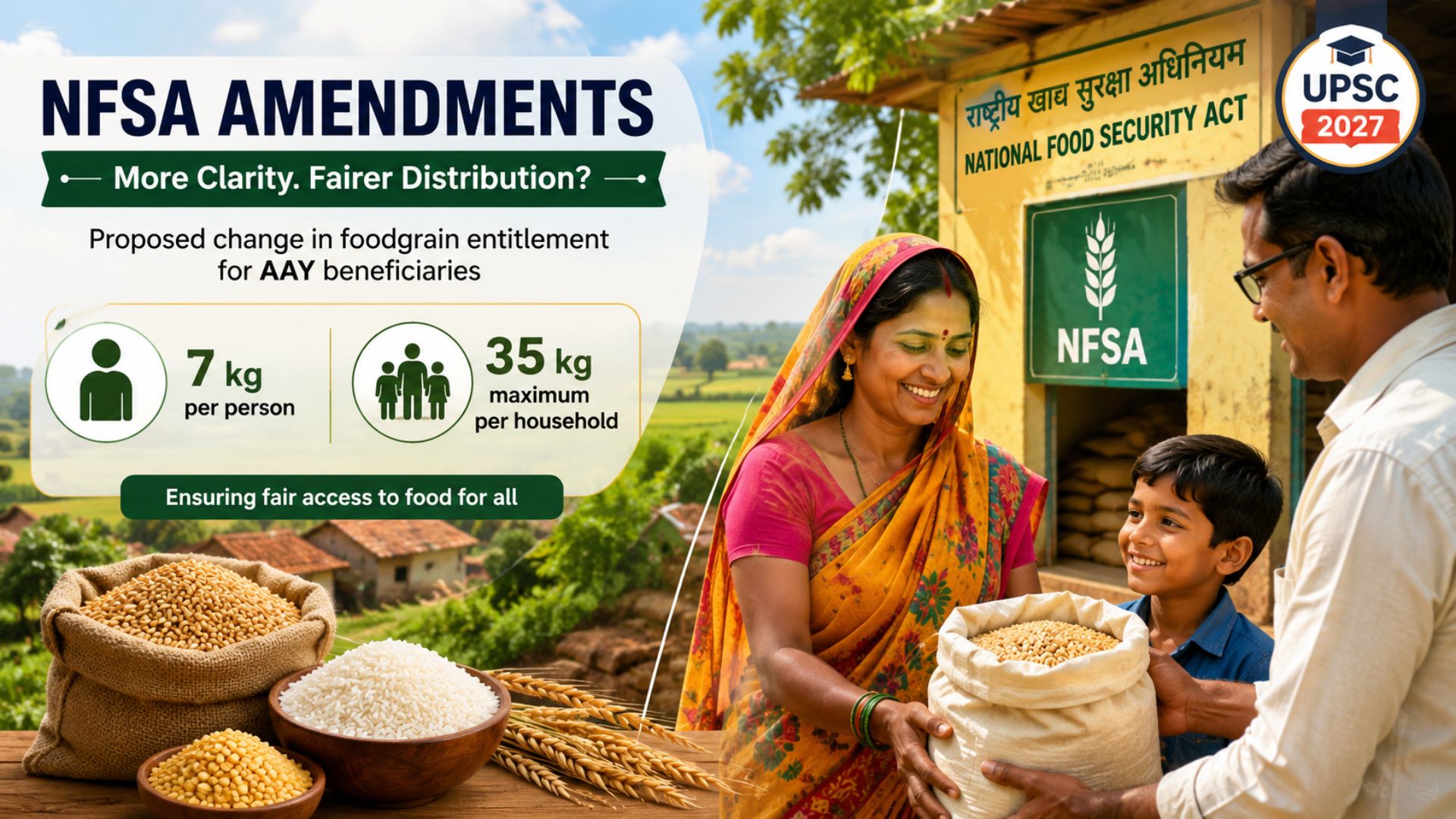
Proposed Amendment to the National Food Security Act: Why is it Debated?

The Union Food and Public Distribution Department has released a draft amendment to the National Food Security Act (NFSA), 2013, inviting public comments until 13 July 2026. The proposal primarily seeks to change the method of foodgrain allocation under the Antyodaya Anna Yojana (AAY), the scheme covering the poorest households.
What is the proposed amendment?
The amendment seeks to replace the existing household-based entitlement with a per-person entitlement for AAY beneficiaries.
| Existing Provision | Proposed Provision |
|---|---|
| Every AAY household receives 35 kg of foodgrains per month, irrespective of family size. | Every AAY beneficiary receives 7 kg per month, subject to a maximum of 35 kg per household. |
| Foodgrains are provided free of cost. | Foodgrains will continue to be provided free of cost. |
Example
Family A: 2 members
Earlier: 35 kg
Now: 14 kg

Family B: 5 members
Earlier: 35 kg
Now: 35 kg

Family C: 7 members
Earlier: 35 kg
Now: 35 kg (maximum limit)
The proposal therefore benefits medium-sized families while reducing allocations for smaller households.
Why has the government proposed this change?
According to the draft notification, the present system creates "significant inequities" within the AAY category.
"Smaller households receive a higher per-capita entitlement, whereas larger households receive a lower per-capita entitlement."
The government argues that the amendment would:
- Remove intra-category inequities
- Ensure a more rational allocation of foodgrains
- Better align entitlements with nutritional requirements
- Make distribution fairer on a per-capita basis
Why are States and activists opposing it?
Certain States and civil society organisations argue that the amendment could produce unintended regional disparities.
| Concern | Explanation |
|---|---|
| Reduced allocation to smaller families | States such as Kerala have relatively smaller household sizes, resulting in lower foodgrain entitlement. |
| Possible North-South divide | Northern States generally have larger families and may receive relatively higher allocations. |
| Outdated beneficiary list | The number of AAY households has not been revised due to the delayed Census, excluding many deserving families. |
| Overall reduction in food support | Critics argue the government is redistributing rather than expanding food security coverage. |
Kerala has indicated that it will urge the Union government to retain the existing 35 kg per household entitlement.
Demands raised by the Right to Food Campaign
Activists argue that the amendment addresses only the distribution formula and not the larger issue of nutritional security.
They have demanded:
- Increase foodgrain entitlement to 14 kg per person
- Update AAY coverage based on the latest population
- Include pulses and edible oil under food security programmes
"The poorest of the poor don't have market access to buy essentials at market rates."
The demand is based on the view that food security should move beyond cereals to ensure balanced nutrition, consistent with recommendations on healthy diets.
Broader policy issues
The debate highlights several larger questions:
- Equity vs adequacy in welfare design
- Household-based vs individual-based targeting
- Importance of updated Census data for welfare programmes
- Need to balance fiscal sustainability with nutritional security
- Regional demographic differences in designing national welfare schemes
What happens next?
The draft amendment is currently in the public consultation stage.
The likely process is:
Draft Amendment
        ↓
Public Comments (till 13 July 2026)
        ↓
Consultation with States & Departments
        ↓
Revised Draft
        ↓
Parliament
The proposal is unlikely to be introduced in the upcoming Monsoon Session of Parliament. Given its political sensitivity and upcoming Assembly elections in States such as Uttar Pradesh, the government is expected to proceed cautiously.
Way Forward
- Update NFSA and AAY beneficiary lists using the latest population data.
- Balance per-capita equity with minimum household food security guarantees.
- Expand food security beyond cereals by gradually including protein-rich foods such as pulses and edible oil.
- Strengthen Centre-State consultations to address regional demographic differences.
- Periodically review entitlements based on nutritional and socio-economic evidence.
Conclusion
The proposed amendment reflects an attempt to make foodgrain allocation more equitable within the AAY category. However, it has also reignited debates on regional equity, outdated beneficiary coverage, and the broader objective of nutritional security. A balanced reform that combines fair distribution, updated beneficiary identification, and diversified nutritional support would better fulfil the constitutional vision of ensuring food security for India's most vulnerable citizens.
Attribution
Original content sources and authors


Syllabus classification
How this article maps to GS papers
Main syllabus
GS2Government PoliciesAlso covers
Quick Q&A
What are the proposed amendments to the National Food Security Act regarding Antyodaya Anna Yojana, and why are they considered significant for India's food security framework?
Why has the proposed shift from household-based to per-capita foodgrain entitlement under the Antyodaya Anna Yojana generated significant policy and political debate across India?
How does the proposed amendment seek to improve equity in foodgrain distribution, and what implementation challenges could limit its effectiveness?
Critically analyze whether the proposed National Food Security Act amendment adequately balances equity, nutritional security, and cooperative federalism in India's welfare architecture.
What policy lessons does the proposed National Food Security Act amendment offer as a case study in designing inclusive and evidence-based social welfare reforms in India?
Practice questions
1 question for mains preparation