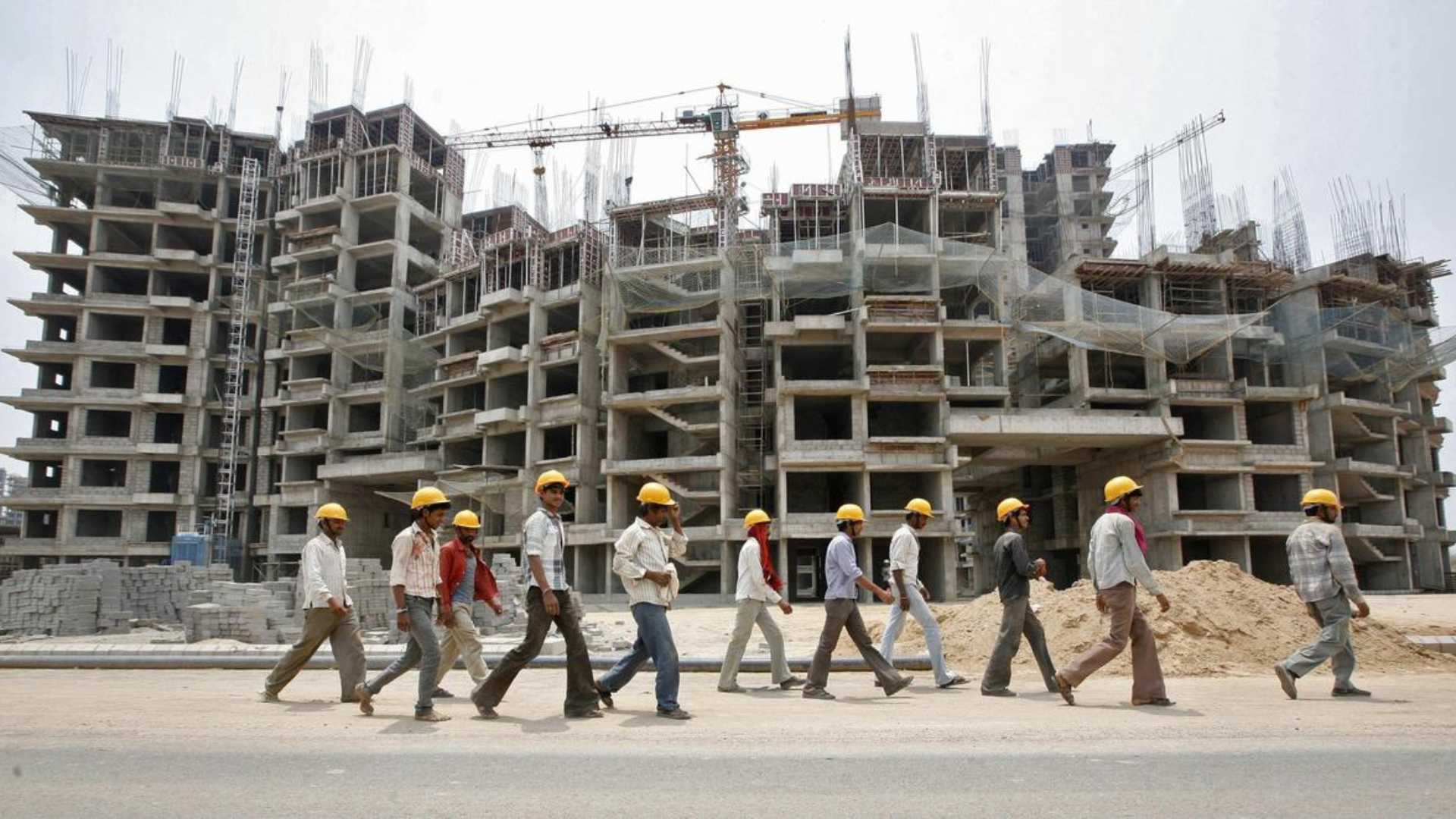
Beyond Poverty Lines: India's Growth, Inequality & the Mobility Trap
Introduction
India's poverty reduction story is real but incomplete. The share of Indians below the World Bank's lower middle income poverty line has fallen from over 50% a decade ago to roughly 30% today — a genuine achievement. Yet beneath this headline lies a more troubling reality: growth has not translated into mobility. With 94.11% of registered informal workers earning under ₹10,000/month, youth unemployment at 45%, and the top 1% capturing 22% of national income, India risks producing not a secure middle class but a vulnerable middle — a class that can neither fall back into poverty nor move meaningfully forward.
"The question is no longer how many people can be lifted out of poverty. It is whether growth is quietly creating a class that can neither fall back nor move forward."
Key Concepts
Poverty Line (Threshold Model) — Binary classification: above or below a subsistence threshold. Measures extreme deprivation but cannot capture conditions just above the line or whether crossing it offers a meaningful pathway forward.
Well-being as a Spectrum (World Bank Policy Paper) — Proposes measuring welfare by distance from a reasonable standard of living rather than binary threshold crossing. Gives greater weight to those furthest behind — captures mobility, not just survival.
Vulnerable Middle — A population segment that has crossed the poverty line but remains in a zone of low, volatile, and insufficient income — unable to convert earnings into durable improvements in education, healthcare, or financial security.
Financialisation of Subsistence — When households use credit not to finance aspiration or investment but to smooth income volatility and sustain basic consumption — debt as a survival mechanism.
India's Growth-Mobility Disconnect
| Indicator | Data |
|---|---|
| Poverty reduction (lower middle income line) | 50%+ → ~30% |
| Informal workers earning <₹10,000/month | 94.11% (e-Shram portal) |
| Formal jobs with social security | <10% of workforce |
| Agriculture's share of employment | ~46% |
| Agriculture's share of GDP | ~18% |
| Average farm household income | ₹10,218/month (all members) |
| Manufacturing jobs lost (2016–21) | ~24 million |
| New labour force entrants annually | ~12 million |
| Youth unemployment | ~45% |
| Graduate unemployment | ~29% |
| Top 1% income share | 22%+ of national income |
| 271 billionaires' wealth | ~25% of net national income |
| Net household financial savings | ~5% of GDP |
| Child wasting rate | 18.7% (highest globally) |
| Child stunting (under 5) | 35.5% |
Structural Fault Lines
1. Labour Market Informality Fewer than 10% of Indian workers hold formal jobs with social security. The informal economy — where 90%+ work — offers limited productivity growth and volatile earnings. Income volatility itself becomes a structural barrier to mobility: families cannot plan, invest, or accumulate when earnings are uncertain.
2. Manufacturing's Failure to Absorb Labour India's structural transformation model requires workers to move from low-productivity agriculture → higher-productivity manufacturing → services. This movement has stalled and partially reversed:
- Manufacturing shed 24 million jobs (2016–21) even as GDP grew
- ~12 million enter the labour force annually — manufacturing cannot absorb them
- Workers are moving back into agriculture — a reversal of structural transformation
3. Productivity-Wage Disconnect Real wages for salaried workers have remained largely stagnant even as overall productivity improved. The link between growth and income is not just weak — it is increasingly fractured. Growth accrues to capital, not labour.
4. Agriculture as Default Absorber With 46% of workforce in agriculture producing only 18% of GDP, the sector functions as an involuntary safety net rather than a productive employer. Average farm household income: ₹75 per person per day — above bare subsistence but far from economic security.
The Measurement Problem
Conventional poverty metrics produce a statistical illusion of progress:
- Poverty headcount falls → policy declared successful
- Conditions just above the poverty line remain invisible to the metric
- Mobility — the ability to move upward over time — is not captured at all
The World Bank's spectrum approach corrects this by asking not "did they cross the line?" but "how far are they from a reasonable living standard and are they moving toward it?"
Applied to India: falling poverty + stalling mobility + rising vulnerability = a development story that looks better on paper than it is in practice.
Inequality's Compounding Effect
The concentration of gains at the top is not separate from the mobility trap — it is structurally connected:
- Capital-intensive growth sectors generate output without employment
- Productivity gains accrue to asset owners, not wage workers
- Top 1% captures 22% of income while 271 billionaires hold wealth = 25% of net national income
- Human development deficits (18.7% child wasting, 35.5% stunting) lock in intergenerational immobility — today's malnourished child is tomorrow's low-productivity worker
Policy Implications
| Challenge | Policy Direction |
|---|---|
| Informal employment dominance | Formalisation incentives; social security expansion |
| Manufacturing job loss | Labour-intensive manufacturing push; PLI scheme redesign |
| Productivity-wage disconnect | Collective bargaining strengthening; minimum wage reforms |
| Agricultural overcrowding | Non-farm rural employment; MGNREGS quality upgrade |
| Measurement failure | Adopt spectrum-based welfare metrics alongside poverty headcount |
| Financialised subsistence | Regulated consumer credit; financial literacy at scale |
Conclusion
India's development narrative is entering a more demanding phase. Reducing extreme poverty, while real, is a lower bar than building an economy of genuine opportunity. The emergence of a vulnerable middle — above subsistence but below security — represents a qualitatively new policy challenge: not lifting people out of poverty but preventing them from being permanently trapped just above it. Restoring the broken link between growth, employment, wages, and mobility is the defining economic governance challenge of the next decade. An economy that generates billionaires and hungry children simultaneously is not failing by conventional metrics — but it is failing by any meaningful standard of human development.
Attribution
Original content sources and authors
Syllabus classification
How this article maps to GS papers
Main syllabus
GS2Government PoliciesQuick Q&A
What are the limitations of poverty-line based measurements in assessing economic well-being in India?
Key limitations include:
- Binary classification: It ignores variations in well-being among those above the threshold, treating them as economically secure even when they are vulnerable.
- No insight into mobility: It does not indicate whether individuals can sustainably improve their living standards.
- Ignores income volatility: Many households just above the poverty line experience unstable incomes, making them prone to slipping back into poverty.
For example, a household earning slightly above the poverty threshold may still struggle with access to healthcare, education, and savings. Thus, poverty reduction does not necessarily imply economic stability.
In the Indian context, while poverty rates have declined significantly, a large segment of the population remains clustered just above the poverty line. This creates a ‘vulnerable middle’—a group that is neither poor nor securely middle class. Hence, relying solely on poverty metrics may lead to an overestimation of developmental success and obscure deeper structural issues such as inequality and lack of upward mobility.
Why is the concept of a 'vulnerable middle' significant in understanding India’s growth story?
This group is significant for several reasons:
- Income instability: Many individuals in this category depend on informal employment with irregular earnings.
- Lack of social protection: With fewer than 10% of workers in formal jobs, most lack access to pensions, insurance, and job security.
- Limited upward mobility: Their income levels are insufficient to invest in quality education, healthcare, or skill development.
For instance, data from the e-Shram portal shows that over 94% of informal workers earn less than ₹10,000 per month, indicating that even those above poverty thresholds remain economically insecure.
The existence of a vulnerable middle challenges the narrative of inclusive growth. It suggests that economic gains are not translating into broad-based prosperity. Instead, growth is creating a segment that is perpetually at risk of falling back into poverty, especially during economic shocks like pandemics or inflation spikes. Addressing this issue is essential for ensuring sustainable and equitable development.
How does the structure of economic growth in India affect employment generation and income mobility?
Key structural issues include:
- Low employment elasticity: Output growth does not translate proportionately into job creation.
- Informalization of workforce: A vast majority of workers remain in low-productivity informal jobs.
- Stagnant wages: Despite productivity gains, real wages for many salaried workers have remained stagnant.
A notable example is the manufacturing sector, which shed approximately 24 million jobs between 2016 and 2021, even as GDP continued to grow. Simultaneously, many workers have shifted back to agriculture, which employs about 46% of the workforce but contributes only around 18% of GDP.
This disconnect weakens the link between growth and mobility. When workers cannot transition into higher-productivity sectors, their ability to improve incomes is constrained. As a result, economic growth becomes less inclusive, and the benefits are concentrated among a smaller segment of the population. To address this, India must focus on labour-intensive manufacturing, skill development, and formal job creation.
Critically analyze the relationship between economic growth, inequality, and poverty reduction in India.
Positive aspects:
- Poverty reduction: The share of population below the poverty line has fallen sharply over the past decade.
- Improved welfare delivery: Schemes like direct benefit transfers and subsidized food have enhanced last-mile connectivity.
Concerns and limitations:
- Rising inequality: The top 1% captures over 22% of national income, while wealth concentration among billionaires has increased.
- Weak income growth: Wage stagnation limits the benefits of productivity improvements.
- Regional and sectoral disparities: Growth is concentrated in select sectors and regions.
For example, while urban technology sectors have flourished, rural areas and traditional industries have lagged behind, widening the inequality gap.
Thus, the relationship is not linear. Growth has reduced extreme poverty but has not ensured equitable distribution of benefits. This creates a paradox where poverty declines coexist with rising inequality. Addressing this requires policy interventions that focus not just on growth, but on inclusive growth, redistribution, and equal opportunity creation.
Examine the issue of labour market informality in India as a case study of structural economic challenges.
Key features of informality include:
- Low and unstable incomes: According to e-Shram data, over 94% of informal workers earn less than ₹10,000 per month.
- Lack of social security: Workers do not have access to benefits such as pensions, healthcare, or unemployment insurance.
- Limited productivity: Informal enterprises often operate with low capital and technology.
A practical example can be seen in the gig economy, where workers such as delivery personnel or drivers lack job security and benefits despite being part of a growing sector.
This informality limits economic mobility and perpetuates vulnerability. Workers are unable to invest in skill development or accumulate savings, trapping them in a cycle of low productivity. Moreover, during economic shocks like COVID-19, informal workers were disproportionately affected.
Addressing informality requires labour law reforms, expansion of social security, and formalization of enterprises. Without tackling this issue, India’s growth will continue to be job-poor and exclusionary.
What are the underlying structural reasons behind the disconnect between economic growth and employment generation in India?
Major underlying reasons include:
- Capital-intensive growth: Sectors driving growth, such as IT and finance, require fewer workers relative to output.
- Slow manufacturing expansion: Manufacturing has not grown fast enough to absorb the large labour force entering the market annually.
- Skill mismatch: The education system often does not align with industry requirements, leading to high unemployment among educated youth.
- Regulatory and infrastructural constraints: Issues such as complex labour laws and inadequate infrastructure hinder industrial expansion.
For instance, youth unemployment is around 45%, and unemployment among graduates is close to 29%, indicating that education alone does not guarantee employment.
Additionally, the reverse migration of workers to agriculture highlights the lack of opportunities in higher-productivity sectors. Agriculture, despite employing nearly half the workforce, generates disproportionately low income.
These structural issues result in jobless or job-poor growth, where GDP increases without corresponding improvements in employment. Addressing this requires a multi-pronged approach, including industrial policy, skill development, and labour-intensive sector promotion.
How can a shift from poverty-based metrics to well-being spectrum approaches improve policy formulation in India?
Advantages of this approach include:
- Captures gradations of well-being: Instead of a binary classification, it assesses how far individuals are from a reasonable standard of living.
- Focus on vulnerability: It identifies those at risk of falling back into poverty, enabling targeted interventions.
- Better policy targeting: Resources can be directed towards improving mobility rather than just reducing poverty.
For example, policies could be designed to support households with unstable incomes through income smoothing mechanisms, insurance schemes, or skill development programs.
This approach also shifts the focus from subsistence to sustainability. It emphasizes whether growth is enabling long-term improvements in living standards, rather than merely lifting people above a threshold.
In the Indian context, adopting such metrics can help address the issue of the vulnerable middle and ensure that economic growth translates into broad-based prosperity and upward mobility. This would mark a transition from quantity-focused to quality-focused development strategies.
Practice questions
2 questions for mains preparation